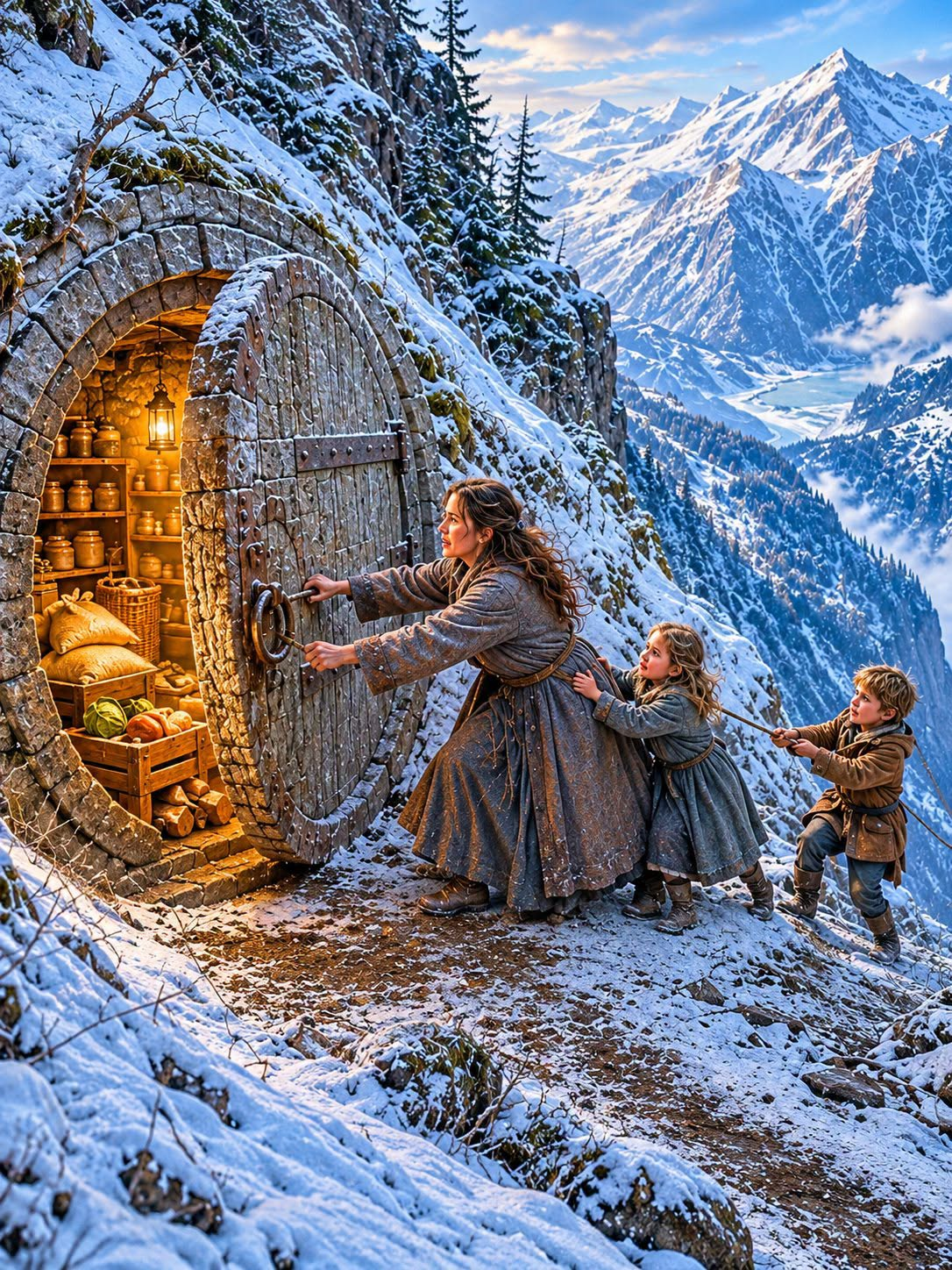
"Mom, why is Dad's name down there?"
Leo's voice trembled.
Elara stared at the small brass plate attached to the turning mechanism beneath the fireplace.
DAVID HALE.
The letters were unmistakable.
She had seen that name on their marriage certificate, on farm invoices, on birthday cards, and finally on a polished wooden coffin.
But she had never expected to find it engraved beneath the floor of a cottage that had supposedly stood abandoned for fifty years.
"Mom?"
Elara swallowed.
"Take your sister away from the fireplace."
"But that's Dad's name."
"I know, sweetheart."
"Did he come here?"
She couldn't answer.
The brass rod continued turning.
Tick.
Tick.
Tick.
A sound so quiet that she might never have noticed it without the storm forcing her to uncover the hearth.
Elara lowered herself onto her knees.
The iron trapdoor stood open only a few inches. Beneath it, a narrow space revealed part of a complicated mechanism: brass gears, iron supports, and a small wheel that rotated with astonishing smoothness.
There was no electricity in the cottage.
No running water.
No working heating system.
Yet something beneath the floor was still operating.
And her dead husband's name was attached to it.
Elara reached toward the plate.
"Don't touch it!"
Leo's sudden shout made her stop.
She turned.
Her son stood near the doorway with Mia pressed against his side.
His face was pale.
"What if it's dangerous?" he whispered.
Elara looked back at the mechanism.
He was right.
She had no idea what powered it or what might happen if she disturbed it.
"You're right," she said. "We need to be careful."
Leo seemed surprised.
Adults rarely admitted when he was right about something important.
Elara pulled her hand away.
Then she examined the trapdoor more closely.
A thick iron frame surrounded it. The hinges were recessed into the stone, protected from moisture and debris. Someone had designed the entrance to remain concealed beneath the massive hearth slab.
This was not an accidental opening.
It was not a forgotten drainage channel.
Someone had built a hidden entrance and deliberately covered it.
The question was why.
And why David's name appeared beneath it.
A violent gust struck the cottage.
The tarpaulin snapped overhead.
Mia whimpered.
"Mommy, I'm cold."
Elara looked toward the dead fireplace.
They needed heat.
Immediately.
Whatever mystery lay beneath the floor could wait until her children were safe.
She pulled the iron ring again.
The trapdoor groaned upward another few inches.
Then it stopped.
Elara noticed a narrow metal arm on the left side.
A support brace.
She pushed it into place.
The trapdoor remained open.
Below it, steep stone steps disappeared into darkness.
A faint current of clean air rose from the opening.
It was noticeably warmer than the air inside the cottage.
Elara held her hand above it.
Not warm enough to be comfortable.
But far warmer than the freezing wind outside.
She frowned.
Underground spaces often maintained steadier temperatures.
Perhaps the chamber could provide temporary shelter.
Perhaps there was even a working fireplace below.
She looked at the children.
"Stay here."
Leo immediately shook his head.
"No."
"Leo—"
"I'm not letting you go down there alone."
Elara recognized that expression.
David had worn it whenever he decided something foolish was worth doing.
"Someone has to stay with Mia."
"Then we all go."
Mia tightened her grip on his jacket.
"I want Mommy."
Elara closed her eyes for a moment.
She had spent the last week trying to protect them from every danger.
The mountain.
The cold.
Hunger.
Uncertainty.
Now she was considering taking them into a hidden chamber beneath an abandoned house.
But the storm was growing worse.
And the cottage was losing heat by the minute.
She made her decision.
"First, we need light."
The candle was one of their last.
Elara had bought a small bundle in town, intending to save them for emergencies.
This qualified.
She placed the candle inside an empty glass jar to shield the flame.
Then she tied a length of rope around a heavy stone near the fireplace.
The other end she secured around her waist.
Leo watched carefully.
"What's that for?"
"So I can find my way back if something happens."
"What kind of something?"
"Hopefully nothing."
She tested the rope.
It held.
Then she knelt beside the opening.
The first step was narrow.
The second was steep.
The third disappeared beneath the edge of the trapdoor.
Elara lowered herself carefully.
Cold stone pressed against her palm.
She moved one step at a time.
The candle illuminated a narrow stairwell built from carefully fitted blocks.
No loose mortar.
No broken stones.
No roots pushing through the walls.
After fifty years of abandonment, the staircase appeared almost untouched.
She descended six steps.
Then eight.
At the tenth, the passage widened.
Elara stopped.
The candlelight revealed a circular chamber.
She stared.
It was unlike anything she had expected.
The walls were built from smooth, pale stone arranged in precise concentric courses.
The ceiling formed a shallow dome.
Narrow ventilation openings disappeared into the masonry.
Along one wall stood wooden shelves holding sealed jars, ceramic containers, and carefully stacked supplies.
The floor was dry.
Completely dry.
Aboveground, the cottage was rotting.
Belowground, this chamber looked as though someone had closed it yesterday.
Elara took another step.
The air smelled faintly of minerals, old wood, and something almost sweet.
She held the candle higher.
A heavy oak table stood in the center.
And upon it lay a large leather-bound journal.
Open.
Waiting.
Elara's heart began pounding.
"Mom!"
Leo's voice echoed from above.
"Are you okay?"
"Yes."
"What do you see?"
She looked around.
How could she explain this?
A hidden room beneath a ruined cottage.
A room protected from the elements.
A room containing more supplies than she had seen since Marcus emptied their pantry.
"Something extraordinary," she whispered.
"What?"
Elara looked toward the stairs.
"Come down carefully. Hold your sister's hand."
Leo descended first.
He kept one hand against the wall and the other around Mia's wrist.
Mia followed slowly, counting each step beneath her breath.
When they reached the chamber, both children stopped.
Leo's mouth fell open.
"Whoa."
Mia stared at the shelves.
"Is this somebody's kitchen?"
Elara almost laughed.
Almost.
"I don't think so."
Leo approached the nearest shelf.
Glass jars stood in neat rows.
Some contained dried beans.
Others held grains.
Several were filled with dark, unidentified substances.
Every container had a handwritten label.
Elara examined one.
The writing was faded but legible.
WINTER STORES — 1948.
She looked at another.
SALT — SEALED.
Another.
DRIED APPLES.
Her stomach tightened.
Food.
Actual food.
Enough, perhaps, to help them survive.
But the dates were decades old.
She knew better than to assume anything stored that long was safe to eat.
The jars would need careful inspection, and some contents would have to be discarded regardless of their appearance.
Still, the shelves offered something she had almost forgotten how to feel.
Possibility.
Leo picked up a small wooden box.
"Mom, look."
"Put that down carefully."
He obeyed.
Inside were neatly arranged metal tools.
Small wrenches.
Brass fittings.
Measuring instruments.
A pair of delicate pliers.
Everything had been wrapped in oiled cloth.
Elara touched the fabric.
It remained flexible.
Whoever had stored these objects had understood preservation.
They had expected the room to remain closed for a long time.
But how long?
And for whom?
Mia wandered toward a woven basket.
Elara caught her hand.
"Stay close, sweetheart."
The little girl pointed.
"Blankets."
Elara turned.
A wooden chest sat beneath the lowest shelf.
Its lid was partially open.
Inside were folded wool blankets wrapped in protective cloth.
Elara lifted one.
It smelled old, but it was dry.
She shook it gently.
No visible insects.
No obvious mold.
She pressed it against her cheek.
Soft.
Thick.
Warm.
Her eyes burned.
For days, she had watched her children shiver beneath thin blankets while wind slipped through the cottage walls.
Now, beneath the very floor where they had been sleeping, someone had hidden an entire chest of wool.
Leo watched her.
"Can we use them?"
Elara nodded.
"After we check and air them out."
"All of them?"
"If they're safe."
He smiled for the first time that day.
It was a small smile.
But it nearly broke her heart.
Elara turned toward the oak table.
The journal lay open beneath a thin layer of dust.
Its cover was dark brown leather.
A brass clasp hung loose along one edge.
The pages were thick and yellowed.
Elegant handwriting filled the visible sheets.
Beside the text were intricate drawings of gears, channels, pipes, and mechanical assemblies.
Elara set the candle down.
She leaned closer.
The first visible heading read:
THE GREAVE — ENVIRONMENTAL REGULATION SYSTEM.
Below it was a date.
October 17, 1949.
She read the opening paragraph.
The writer described a system designed to regulate airflow, moisture, and temperature through a network of underground chambers.
Elara glanced around.
Ventilation shafts.
Dry stone.
Preserved supplies.
The strange warmth.
Suddenly, the chamber began making sense.
This was not simply a cellar.
It was a carefully engineered shelter.
Someone had built it to protect valuable materials from the mountain's brutal climate.
She turned the page.
More diagrams.
A cross-section of the cottage.
A series of hidden channels beneath the foundation.
A mechanical ventilation system connected to a deeper shaft.
Elara traced one drawing with her finger.
It showed a wheel.
A brass rod.
And a small plate.
The mechanism beneath the trapdoor.
She looked toward the staircase.
Then back at the journal.
The next page contained a handwritten note.
Primary regulator must remain operational. Manual interruption may compromise lower chamber stability.
Elara frowned.
Lower chamber?
There was another room?
She turned the page.
A detailed diagram showed the circular chamber in which they stood.
Beneath it was a larger space.
But the drawing ended abruptly.
The lower section had been covered with a separate sheet of paper.
Elara lifted it.
Underneath was a handwritten warning.
DO NOT OPEN THE LOWER ACCESS WITHOUT VERIFYING PRESSURE BALANCE.
She stared.
Pressure balance?
Was there water behind the walls?
An old hydraulic system?
Some kind of ventilation mechanism?
Whatever the explanation, she was not going to experiment with it while her children stood nearby.
She lowered the paper.
Then she noticed the signature at the bottom of the page.
Elias Greave.
Elara whispered the name.
"Elias Greave."
Leo looked up.
"Who's that?"
"I think he built this place."
"Was he rich?"
"I don't know."
"Was he a scientist?"
Elara studied the drawings.
"Maybe an engineer."
Leo looked impressed.
"Like Dad?"
Elara paused.
David had never been formally trained as an engineer.
But he could repair almost anything.
Tractors.
Pumps.
Engines.
Farm machinery.
He loved understanding how things worked.
When Leo was little, David used to take broken clocks apart on the kitchen table and explain every gear.
Elara remembered the two of them laughing over springs and screws.
"Your father would have loved this room," she said.
Leo looked toward the stairs.
"Maybe he did."
Elara's breath caught.
The brass plate.
David's name.
She had almost forgotten.
She turned back to the journal.
There had to be an explanation.
The first pages were technical.
The handwriting described airflow measurements, underground temperatures, and the construction of drainage channels.
Elara understood only portions of it.
But one thing became clear.
Elias Greave had been obsessed with making the mountain habitable.
He had designed the cellar to resist freezing temperatures, moisture, and structural movement.
He had built redundant ventilation passages.
He had created a system that used natural temperature differences to circulate air.
And he had hidden much of the machinery beneath the cottage.
The journal mentioned years of experiments.
Failures.
Repairs.
Improvements.
Then, in a later entry, the tone changed.
December 3, 1950.
The county has again questioned the purpose of the lower works. They see only stone and expense. They do not understand what the ridge can provide.
Elara read the sentence twice.
What the ridge could provide?
She turned another page.
The surface is barren. That is precisely why no one has looked beneath it.
A chill moved through her.
She looked around the chamber.
The smooth walls.
The sealed jars.
The carefully preserved tools.
What had Elias Greave discovered?
Before she could continue, Mia tugged her sleeve.
"Mommy?"
"Yes?"
"Can we stay down here?"
Elara looked at her daughter.
The little girl's cheeks had regained some color.
Her trembling had stopped.
The chamber was not warm, exactly.
But it was sheltered.
And that mattered.
"For a little while," Elara said.
Mia nodded.
Then she sat on one of the folded blankets.
Leo joined her.
Elara returned to the journal.
She needed to understand what they had found.
And she needed to know why David's name was attached to the mechanism.
An hour passed.
The storm continued above them.
Occasionally, a deep vibration traveled through the stone walls.
But the chamber remained stable.
Elara found a small lantern on a shelf.
Its reservoir still contained fuel.
She inspected it carefully before lighting it.
A warm amber glow spread across the room.
The children watched in wonder.
The cellar seemed almost welcoming now.
Elara found a metal kettle, several cups, and a small enclosed heating stove connected to a ventilation pipe.
She did not attempt to use the stove.
Not yet.
She wanted to inspect the chimney and airflow system first.
Instead, she gave the children water from their bottle and the last of the bread they had brought downstairs.
Then she continued reading.
The journal contained entries spanning several years.
Elias Greave described his work with extraordinary precision.
He had apparently built the chamber after losing his wife during a severe winter.
Her death had convinced him that isolation should never mean helplessness.
He wanted to create a shelter capable of sustaining life even when the mountain became impassable.
Elara paused at one passage.
No child should freeze because the nearest road is buried. No mother should have to choose between warmth and bread.
Her throat tightened.
She read the sentence again.
It felt impossibly personal.
As though a man who had died decades before she arrived had somehow understood exactly what her family needed.
She looked at Leo and Mia.
They were sitting close together beneath the blankets.
Mia had fallen asleep against her brother's shoulder.
Leo was examining his father's compass.
Elara felt the familiar ache of grief.
David should have been here.
He should have seen this place.
He should have been the one explaining the gears to Leo.
Instead, his name waited beneath the floor.
She turned another page.
Then another.
The journal eventually reached 1956.
After that, several pages were blank.
The final original entry was brief.
The chamber is complete. The lower works remain secure. I have made arrangements for the property to pass beyond the reach of those who would misuse it.
Elara frowned.
The next line was underlined.
The right person will understand why it must remain hidden.
She sat back.
What did that mean?
Had Elias intended someone to discover the chamber?
If so, who?
And why had nobody opened it for fifty years?
She turned to the back of the journal.
A folded paper slipped from between the pages.
It landed on the table.
Elara unfolded it.
A county map.
Whisperwind Ridge.
The old road.
The cottage.
The circular symbol.
And a handwritten property designation.
G-17.
The same designation the clerk had shown her.
But this map contained something the county copy did not.
A dotted line extended from the cottage toward the eastern slope.
At the end was a small square marked with a letter.
B.
Elara studied it.
A second building?
A buried entrance?
A ventilation outlet?
She looked toward the wall.
The diagram suggested the passage continued beyond the chamber.
Perhaps the lower works extended beneath the ridge.
Perhaps the mysterious circular door outside connected to the same underground system.
She remembered the three knocks.
The metallic ticking.
The movement beneath the trapdoor.
Suddenly, the sounds seemed less supernatural.
They might be mechanical.
But that did not make them less unsettling.
Because someone had kept the system running.
For decades.
"Mom?"
Leo stood beside the table.
Elara looked up.
"Yes?"
"Can I ask something?"
"Of course."
He held out the compass.
"Why did Dad have this?"
Elara frowned.
"Because it belonged to your grandfather."
"I know."
He turned it over.
"But look."
On the back of the brass case, beneath a layer of scratches, was a small engraved symbol.
A circle.
Inside it, a square.
Elara stopped breathing.
"Where did you get that?"
"From Dad's desk. I told you."
"No. I mean the compass."
"Dad said Grandpa gave it to him."
Elara took it carefully.
The symbol was unmistakable.
The same mark carved into the stone arch.
The same mark on the county map.
The same mark beside the cellar diagrams.
She turned the compass over.
The needle swung.
Settled.
Then shifted again.
Leo watched her.
"Is it broken?"
Elara shook her head.
"I don't think so."
She moved it away from the table.
The needle steadied.
She brought it closer to the journal.
It shifted.
Then she moved it toward the wall behind the shelves.
The needle swung sharply.
Elara frowned.
There could be iron or other metal hidden in the masonry.
The compass was reacting to something.
Leo leaned closer.
"What's it doing?"
"I don't know."
He pointed toward the wall.
"Maybe there's metal behind there."
Elara looked at him.
"Maybe."
She examined the compass again.
David had carried it for years.
He had never mentioned the symbol.
Never mentioned Elias Greave.
Never mentioned a hidden cellar on Whisperwind Ridge.
But perhaps he had not known.
Perhaps the engraving was simply an old family mark.
Perhaps the brass plate beneath the hearth had been added by someone else.
Yet the coincidence was becoming difficult to ignore.
She turned the compass over once more.
Along the edge of the case was a tiny inscription.
So small that she had never noticed it before.
She brought it close to the lantern.
The letters were worn.
But readable.
WHEN THE NEEDLE FAILS, FOLLOW THE STONE.
Elara stared.
"What does that mean?" Leo asked.
She shook her head.
"I don't know."
But her mind was racing.
The compass.
The symbol.
The journal.
David's name.
Somehow, they were connected.
She was certain of it.
By evening, the storm had intensified.
The children were growing sleepy.
Elara decided they would remain in the cellar until the wind weakened.
She carried down their remaining blankets and a small bag of supplies.
Then she secured the trapdoor in its open position.
She did not want them trapped underground.
The lantern provided enough light to move safely.
She arranged a sleeping area near the wall, away from the mechanical equipment.
Mia curled beneath a blanket.
Leo lay beside her.
Within minutes, both were asleep.
Elara sat at the oak table.
For the first time in days, her children were not shivering.
They were sheltered.
Dry.
Safe for the moment.
She should have felt relieved.
Instead, she kept staring at the journal.
Something about the brass plate bothered her.
David's name had been engraved on a mechanism that appeared far older than he was.
Had he visited the cottage?
Had he repaired the system?
Had he known about the chamber all along?
If so, why had he never told her?
She thought about the final months of his life.
The hospital visits.
The medications.
The endless paperwork.
David had sometimes seemed troubled by things he refused to discuss.
Once, shortly before his death, she had found him sitting alone at the kitchen table with an old map.
When she asked what he was doing, he folded it away.
"Just thinking about the future," he said.
She had assumed he meant the farm.
Now she wondered.
Another memory surfaced.
David had asked her a strange question one evening.
"If you ever had to start over, what would you need most?"
She had laughed.
"A miracle."
He had smiled sadly.
"No. Something real."
"What kind of something?"
"A place nobody could take away."
At the time, she thought he was frightened of dying.
Perhaps he was.
But perhaps he had been trying to tell her something.
Elara pressed her fingers against her forehead.
She needed facts.
Not memories twisted by grief.
She returned to the journal.
Near the back, several pages appeared newer than the others.
The paper was brighter.
The handwriting different.
She turned to the first.
A date appeared at the top.
April 12, 2018.
Elara froze.
That was only eight years ago.
The entry was brief.
Primary ventilation system inspected. Upper chamber remains stable. External access requires reinforcement.
Below it was a signature.
D. Hale.
Elara's heart slammed against her ribs.
David.
He had been here.
He had entered this chamber.
He had worked on the machinery.
And he had never told her.
She turned the page.
Another entry.
September 6, 2019.
Pressure regulator repaired. Original brass assembly preserved. Lower access remains sealed according to Greave's instructions.
Another signature.
D. Hale.
Elara stared at the words.
She remembered that September.
David had told her he was helping a friend repair an irrigation pump.
He had been gone for two days.
When he returned, his boots were covered in pale dust.
She had teased him about bringing half the mountain home.
He had laughed.
Now she knew where he had been.
Her hands began trembling.
She turned another page.
June 21, 2021.
Boundary records remain inconsistent. Marcus has begun asking questions about the eastern ridge. No disclosure until ownership can be verified.
Elara stopped.
Marcus.
Her brother-in-law.
The man who had evicted her.
The man who had insisted the farm belonged entirely to him.
David had written his name in the journal.
And the entry suggested Marcus had been asking about Whisperwind Ridge years before David died.
Elara read the sentence again.
No disclosure until ownership can be verified.
What ownership?
The cottage?
The lower chambers?
Something hidden beneath the mountain?
She turned the page.
The next entry was dated only six months before David's diagnosis.
February 3, 2023.
The original deed may have survived. If so, the county's current records are incomplete. Elias was right to distrust the transfer. I need to find the missing document before Marcus does.
Elara's pulse quickened.
A missing deed.
An old transfer.
Marcus searching for something.
She thought about the attorney's office.
The trembling hand.
The missing wooden box.
The strange number beneath the legal signature.
Seventy-four.
Had Marcus known about this place?
Had he deliberately concealed something?
And if he had, why had he allowed Lot 74 to remain on the foreclosure list?
Perhaps he had never known its modern designation.
Perhaps David had hidden the connection.
Or perhaps Marcus believed the chamber had already been emptied.
Elara looked around.
The shelves.
The supplies.
The journal.
The carefully maintained mechanism.
Nothing suggested anyone had entered recently.
But David had been here.
And he had left something behind.
She turned another page.
A single sentence had been written across the top.
If Elara ever finds this, she must read the letter before opening the lower chamber.
Her breath caught.
Her name.
Written by her husband.
Not a coincidence.
Not an old family mark.
David had expected her to find this place.
Somehow.
Someday.
Elara looked beneath the sentence.
The rest of the page was blank.
She turned it over.
Nothing.
She searched the following pages.
No letter.
She checked the back cover.
Empty.
Her heart sank.
Where was it?
She examined the journal's binding.
The leather was thick.
The spine reinforced.
A narrow seam ran along the inside cover.
Elara pressed it.
Something shifted.
She slipped a fingernail beneath the edge.
A hidden pocket opened.
Inside was a folded envelope.
Her hands trembled as she removed it.
On the front, in David's unmistakable handwriting, were four words.
For Elara. When necessary.
She stared at the envelope.
For months, she had wished for one more conversation with her husband.
One more chance to ask him what she should do.
One more moment to hear his voice.
Now she held a message he had written for her.
Before he died.
Before Marcus took the farm.
Before she spent her last money on a ruined cottage.
She pressed the envelope against her chest.
"David," she whispered.
Tears blurred her vision.
She waited until she could see clearly.
Then she opened it.
Inside was a single folded sheet.
She recognized the handwriting immediately.
My love,
If you are reading this, then something has happened that I hoped I could prevent.
Elara covered her mouth.
She continued.
I should have told you about the Greave years ago. I wanted to, but there were legal questions I couldn't resolve, and I was afraid that speaking too soon would put you and the children at risk.
I know that sounds impossible. I know you must have questions.
The cottage is only the entrance. The real property lies beneath the ridge.
Elara stopped.
The real property?
She looked around the chamber.
What could possibly be beneath it?
She continued reading.
Elias Greave built more than a shelter. He discovered something during the original excavation. Something that changed the value of the land completely.
The county records were altered after his death. I have spent years trying to understand why.
Marcus knows part of the story. Not all of it. That is what frightens me.
Elara felt cold despite the sheltered room.
David had been afraid of his own brother.
She read on.
If Marcus ever tries to take everything from you, do not fight him over the farmhouse until you understand what is hidden here.
He will expect you to beg. He will expect you to leave town. He will never imagine that you might find the one place he has been searching for.
Elara lowered the letter.
Her mind struggled to absorb the words.
David had known.
Not about his death, perhaps.
Not about the exact circumstances.
But he had feared Marcus might betray them.
And he had prepared for that possibility.
Why hadn't he told her?
Why leave her to discover everything alone?
Anger rose through the grief.
She loved David.
She always would.
But love did not erase the pain of being kept in the dark.
She had spent nights wondering whether she could feed their children.
She had carried them up a mountain believing she had failed them.
And all along, her husband had known about this hidden place.
She wiped her eyes.
Then continued.
There is a second entrance. The circular door outside connects to the storage passage. The lower chamber is sealed separately.
Do not force the lower door.
The old pressure system must be checked first. The mechanism is safe only when the regulator is balanced.
I repaired the upper system, but I never completed the final inspection.
Elara looked toward the brass mechanism.
The ticking.
The turning rod.
The engraved plate.
David had repaired it.
That explained his name.
But it did not explain why he had left the lower chamber sealed.
She read the final paragraph.
The key is not metal.
It is a sequence.
Elias recorded it in the journal, but not where anyone would think to look.
Trust the compass.
And Elara, whatever happens, remember this: the farm was never the most valuable thing our family possessed.
I love you. I love Leo. I love Mia.
Always,
David.
Elara sat motionless.
The letter rested in her hands.
She could almost hear his voice.
She imagined him writing those words alone.
Perhaps in the farmhouse office.
Perhaps at this very table.
Knowing he might never have the chance to explain.
She looked toward her sleeping children.
David had loved them.
That much she had never doubted.
But now she understood that his final months had contained secrets she could barely imagine.
She folded the letter carefully.
Then she picked up the compass.
The needle moved.
Settled.
Shifted again.
When the needle fails, follow the stone.
She looked at the journal.
Elias had hidden a sequence.
David had told her to trust the compass.
There had to be a connection.
She began examining the pages again.
Slowly.
Carefully.
One at a time.
Near midnight, Elara found the first clue.
It was hidden inside a diagram of the ventilation system.
Four small circles appeared beside the main regulator.
Each contained a number.
Three.
One.
Four.
Two.
She studied them.
A sequence.
Perhaps.
But why would Elias hide it in a technical drawing?
She turned to another diagram.
The same four circles appeared.
This time beside a compass rose.
North.
East.
South.
West.
Elara placed David's compass on the page.
The needle swung sharply.
Then stopped.
It pointed toward the eastern wall.
Not north.
East.
She lifted the compass.
The needle returned to its normal position.
She placed it back on the journal.
Again, it turned east.
Something beneath the table or inside the wall was affecting it.
Elara stood.
She carried the compass toward the eastern shelves.
The needle shifted more violently.
She moved closer.
The needle spun.
Then settled toward a section of pale stone behind the lowest shelf.
Elara set down the compass.
She examined the wall.
Most of the stones were perfectly fitted.
But one block had a narrow circular depression at its center.
A small square had been carved inside it.
The familiar symbol.
She pressed the stone.
Nothing.
She tried again.
Still nothing.
Then she noticed four tiny indentations around the square.
One above.
One below.
One on each side.
North.
South.
East.
West.
Her pulse quickened.
She remembered the numbers.
Three.
One.
Four.
Two.
Perhaps they indicated the order in which the stones should be pressed.
She looked around.
Four small stones surrounded the central block.
Each moved slightly beneath her fingertips.
Elara hesitated.
David had warned her not to force the lower chamber.
But this might not be the lower entrance.
It might simply reveal the missing documents.
She returned to the journal.
Studied the diagram again.
Then approached the wall.
She pressed the eastern stone.
A faint click.
The northern stone.
Another click.
The western stone.
A third.
Then the southern stone.
For several seconds, nothing happened.
Elara held her breath.
A soft mechanical sound came from inside the wall.
Something shifted.
A narrow section of stone moved inward.
Then slid sideways.
Behind it was a small compartment.
Elara stared.
Inside rested a rectangular metal box.
Its surface was covered in dust.
A faded paper label had been attached to the lid.
She lifted the lantern.
The handwriting was David's.
PROPERTY RECORDS — DO NOT DESTROY.
Elara's heart began pounding.
She reached inside.
The box was heavier than expected.
She carried it to the table.
A small brass latch secured the lid.
It opened easily.
Inside were several documents wrapped in oilcloth.
A bundle of letters.
An old survey map.
And a thick envelope bearing the county seal.
Elara carefully removed the first document.
The paper was brittle.
The ink had faded.
But the heading remained legible.
ORIGINAL LAND CONVEYANCE — WHISPERWIND RIDGE.
Below it was the name Elias Greave.
Then another name.
One Elara had never seen before.
Thomas Hale.
She frowned.
Hale.
David's family name.
She unfolded the document.
The legal language was dense.
But one paragraph stood out.
It described a transfer of rights from Elias Greave to Thomas Hale and his descendants.
Not merely the cottage.
Not merely five acres.
The document referred to underground structures, mineral access, water systems, and additional acreage beneath the eastern ridge.
Elara read it twice.
Then a third time.
If the document was genuine, David's family might have held rights to property far beyond the ruined cottage.
But legal ownership was complicated.
Old deeds could be superseded.
Rights could be transferred.
Claims could expire.
She knew enough from the farm to understand that a single document did not settle everything.
Still, it explained why David had been searching.
And why Marcus might have been interested.
She opened the next envelope.
Inside was a modern letter from a surveying company.
Dated two years earlier.
Addressed to David Hale.
The first paragraph confirmed that the original property description did not match the county's current records.
The second mentioned a possible historical error involving underground access rights.
The third contained a sentence that made Elara's hands go cold.
Our preliminary assessment suggests the disputed tract may include commercially significant subsurface resources.
Elara stared.
Commercially significant.
She thought about the barren mountainside.
The useless rock.
The land nobody wanted.
Had something valuable been discovered beneath it?
She turned to the final page.
A handwritten note had been added in David's ink.
Marcus must not see this until I know who altered the records.
Elara slowly lowered the paper.
The man who had thrown her children into the cold might have been searching for the same documents she now held.
And David had hidden them here.
Not in the farmhouse.
Not in the barn.
Not anywhere Marcus would think to look.
Beneath an abandoned cottage.
On land the county had sold for four hundred and fifty dollars.
Elara looked toward the sleeping children.
For the first time since David's funeral, she felt something stronger than despair.
Not happiness.
Not relief.
Something harder.
Determination.
She would protect them.
She would learn what these documents meant.
And she would not allow Marcus to take another thing from her family.
She began returning the papers to the box.
Then she noticed one final envelope lying beneath the survey map.
It was newer than the others.
White.
Unsealed.
Her name was written across the front.
But the handwriting was not David's.
Elara frowned.
She opened it.
Inside was a single sheet.
Only one sentence had been typed across the center.
IF YOU HAVE FOUND THE GREAVE, MARCUS IS ALREADY LOOKING FOR YOU.
Elara's breath caught.
She turned the page over.
Nothing.
No signature.
No date.
No explanation.
Then she heard a sound above her.
A heavy scrape.
Followed by footsteps.
Elara froze.
The children were asleep beside the wall.
The storm still battered the mountain.
But the sound came from the cottage.
Someone was walking across the floor.
She extinguished the lantern.
Darkness swallowed the chamber.
The footsteps stopped directly above the trapdoor.
Then a man's voice called softly through the opening.
"Elara?"
She knew that voice.
Marcus.
He had found them.
And then he said something that made her blood run cold.
"Don't touch the journal. I know what David left down there."
A pause.
Then the iron trapdoor began to close.






Comments 0