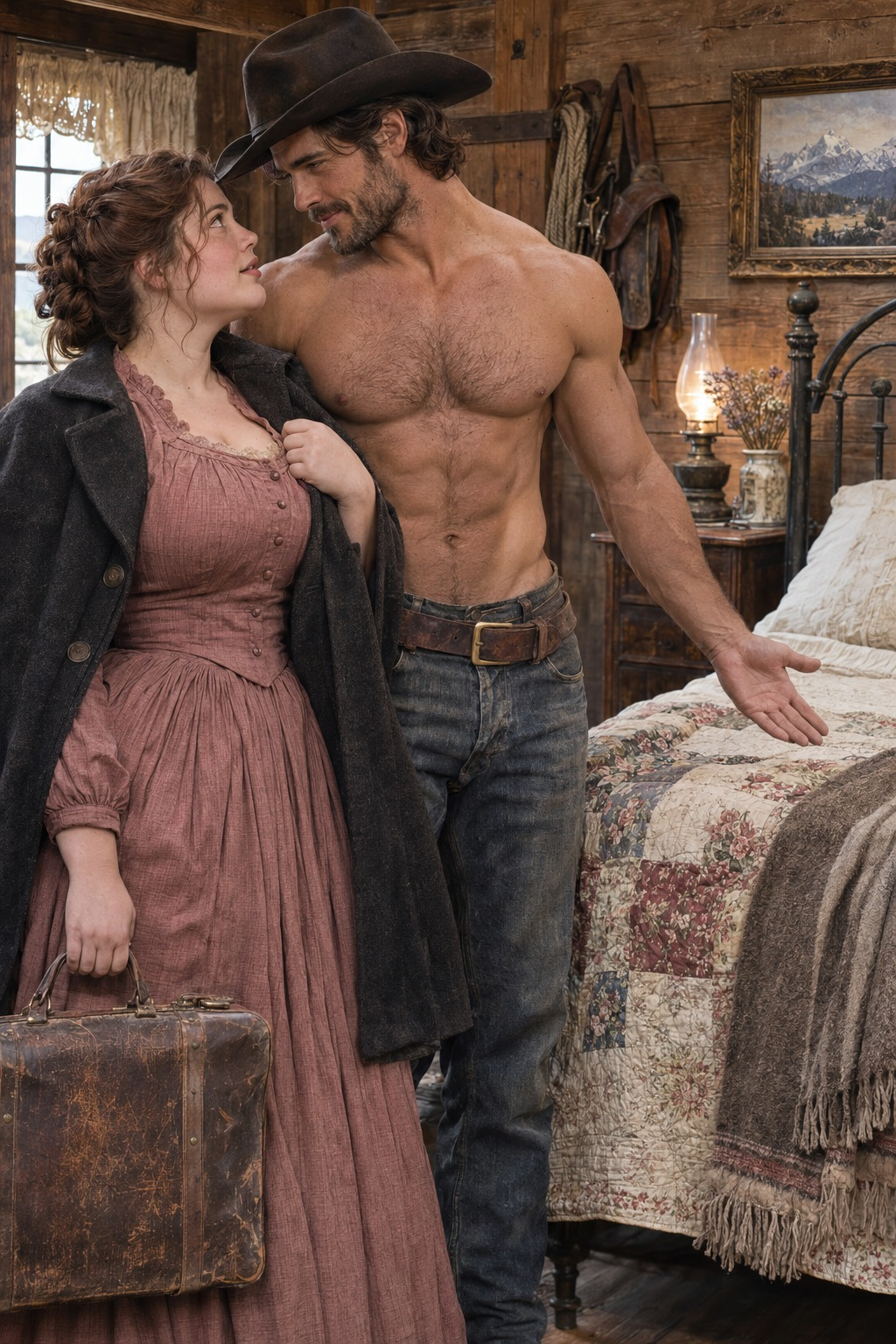
The sheriff hammered an eviction notice onto the boarding house door while I stood outside, clutching my suitcase.
"Please! This was my aunt's home!"
Luke Dawson, the wealthiest rancher in High Mesa, watched from across the street as the sheriff handed me a final notice.
But there was something written beneath the official seal.
My aunt's name.
And a date that made no sense.
I had thirty minutes to leave the only home I had ever known.
My name is Anna Bennett. I was thirty years old, and until that morning, I believed that no matter how difficult life became, I would always have a place to return to.
I had been wrong.
The sheriff stepped away from the door, brushing a little snow from the sleeve of his dark coat.
"Miss Bennett, I'm sorry. The order is final."
I stared at him.
"Final? My aunt owned this boarding house. She left it to me."
"Your aunt had outstanding debts."
"How much?"
He hesitated.
"More than the property is worth."
I looked down at the paper in his hand. The official seal of Pine Crossing was stamped across the top. Beneath it were figures I couldn't understand, several signatures, and a date from almost a year before my aunt had died.
"These debts weren't mentioned in her will."
"The court has reviewed the matter."
"But I never received a notice."
The sheriff lowered his voice.
"Someone should have explained things to you sooner."
Someone.
That was a convenient word for a town full of people who had watched my aunt grow old, accepted her hospitality, eaten at her table, and now seemed perfectly comfortable watching her niece lose everything.
I looked toward the boarding house window.
The curtains were still the same pale blue ones my aunt had sewn herself. The little wooden sign above the porch still read BENNETT BOARDING HOUSE.
I could almost hear her voice telling me to close the front door because the winter wind was getting into the hallway.
She had been gone for only four months.
And now even the house that carried her name was being taken away.
"How long do I have?" I asked.
"Until sundown."
I swallowed.
"Can I at least take the furniture?"
"The property has been included in the seizure."
I stared at him.
"Even my aunt's things?"
He didn't answer.
That was answer enough.
Across the street, two women stood near the general store.
One was Mrs. Harlan, who had stayed at our boarding house for nearly three weeks the previous winter. The other was her friend, a woman whose name I couldn't remember.
They watched me.
Mrs. Harlan leaned toward her companion and whispered something.
The other woman shook her head.
Neither moved.
Neither offered to help.
I wanted to ask them whether they remembered the evenings my aunt had served them hot stew when the roads were blocked by snow. I wanted to remind them that my aunt had never turned away a traveler who couldn't afford a room.
Instead, I bent down and picked up my suitcase.
It was old, with worn leather corners and a brass clasp that sometimes refused to close. I had packed two dresses, a few personal belongings, my aunt's small photograph, and the last money I had managed to save.
Everything else was behind the locked door.
I was not going to cry in front of them.
Not in front of the sheriff.
Not in front of the women across the street.
I lifted my chin and started walking.
The snow had become heavier. It settled on my shoulders and caught in my hair. My boots made small, uneven impressions along the road.
I had no destination.
The nearest town was miles away. I had only a few dollars, no relatives who could take me in, and no idea where I would sleep that night.
I kept walking anyway.
Then I heard a man's voice.
"Miss Bennett?"
I stopped.
A large wooden wagon had pulled up beside the road. The man standing next to it was difficult to overlook.
He was tall, broad-shouldered, and dressed like someone who spent most of his life outdoors. A dark cowboy hat shadowed his eyes. His brown hair curled slightly around his ears, and a neatly trimmed beard framed a strong jaw.
I recognized him immediately.
Luke Dawson.
Everyone in Pine Crossing knew the Dawson ranch.
High Mesa owned more cattle than most of the surrounding ranches combined. Luke employed a dozen men during the winter season, and his land stretched across the hills beyond town.
He was also known for being difficult to approach.
People said he rarely attended social gatherings. He didn't waste words, didn't tolerate dishonesty, and didn't invite strangers into his private affairs.
Yet there he was, looking directly at me.
"Mr. Dawson," I said cautiously.
His eyes moved toward my suitcase.
"You're leaving town?"
"I haven't decided where I'm going."
He glanced toward the boarding house.
"I heard what happened."
I tightened my grip on the suitcase handle.
"Then you know I don't have much to offer."
"I wasn't asking."
He stepped closer.
"I need a cook."
I blinked.
"A cook?"
"My men need feeding. Winter's coming hard, and my nephew Ben deserves something better than burned biscuits."
There was something almost amused in his voice, although his expression remained serious.
I looked at him carefully.
"Are you offering me work?"
"That's what I said."
"I don't need charity, Mr. Dawson."
"Good. I'm offering wages."
His answer came so quickly that I had no immediate response.
He continued.
"Thirty days to start. Room, meals, and fair pay. If it doesn't work out, you'll leave with everything you've earned."
I looked at the wagon.
Then at him.
"Why me?"
Luke adjusted his gloves.
"Your aunt's boarding house had the best meals in Pine Crossing."
I said nothing.
"I remember who cooked them."
For a moment, the noise of the wind seemed to disappear.
My aunt had taught me everything I knew about cooking. She had always insisted that a good meal could make a difficult day easier. When the boarding house was busy, I spent most evenings in the kitchen, preparing food for travelers and ranch hands.
I had never imagined that anyone outside our little circle had remembered.
"How long did you say?" I asked.
"Thirty days."
"And the wages?"
"Fair ones. We can discuss the exact amount before you agree."
I studied his face.
There was no pity in his eyes. No false smile. No suggestion that I should be grateful simply because he had noticed my misfortune.
He was offering a job.
Nothing more.
And after everything that had happened that morning, an honest job was more than I had expected to find.
"All right," I said quietly. "I'll come."
Luke nodded once.
"Get in. It's a long ride."
He lifted my suitcase into the wagon and secured it beside the seat. Then he offered me his hand.
I hesitated for a moment before taking it.
His grip was firm, but careful.
As the wagon began moving, I looked back toward the boarding house.
The sheriff was still standing outside.
Mrs. Harlan had already turned away.
I faced forward.
I had lost my home.
But at least I had somewhere to go.
The journey to High Mesa took nearly two hours.
The road climbed through open pastureland and narrow stretches of pine forest. Snow rested on the fence posts, and distant mountain peaks disappeared beneath low clouds.
Luke drove without much conversation.
I didn't mind.
There was something reassuring about the silence. He didn't ask why I had so little money. He didn't ask whether I had family waiting somewhere. He simply kept his attention on the road.
After a while, I noticed a small leather strap attached to the wagon seat.
A child's toy horse hung from it.
The paint had worn away in several places.
"Is that your nephew's?" I asked.
Luke glanced at it.
"Ben's."
"How old is he?"
"Eight."
"Does he live at the ranch?"
"Yes."
He paused.
"He's been with me for two years."
I looked toward him.
"Does he help around the ranch?"
"Whenever he can. Mostly gets underfoot."
There was a faint warmth in Luke's voice when he mentioned the boy.
I smiled.
"Eight-year-olds are good at that."
Luke gave a quiet breath that might have been a laugh.
Then his expression became distant.
"He doesn't take to people easily."
I turned toward the road again.
"I won't force him to."
"Good."
That was all he said.
By the time we reached High Mesa, the sun was beginning to sink behind the mountains.
The ranch was larger than I had imagined.
A long wooden barn stood beside several fenced pastures. Horses moved slowly through the snow, and a few ranch hands were carrying supplies toward a storage building.
The main house was a two-story wooden structure with a broad porch and several tall windows.
It looked strong, comfortable, and well maintained.
But when Luke led me through the back entrance, I discovered that the kitchen was another matter entirely.
I stopped in the doorway.
Dirty pans filled the sink.
A stack of plates leaned dangerously beside a wooden counter.
Open flour sacks sat near the stove, and vegetables had been left in baskets on the floor.
A pot of something unpleasant-looking rested on the iron stove.
I looked at Luke.
He followed my gaze.
"That's yesterday's supper."
I stared at the pot.
"Yesterday?"
"Possibly the day before."
I tried not to smile.
Luke took off his hat.
"The men have been managing."
"Have they?"
"Not particularly well."
For the first time that day, I almost laughed.
He pointed toward a small staircase.
"Your room is upstairs. There's a bed, a dresser, and a stove. The window looks toward the pasture."
"Thank you."
"Supper's usually at six."
I glanced at the kitchen.
"Then someone had better start preparing it."
Luke looked at the clock.
"It's already past six."
I rolled up my sleeves.
"Then I suppose we'll have to make it work."
He watched me for a moment.
Then he nodded and stepped aside.
I had been at High Mesa for less than five minutes, and already I had a kitchen to rescue.
I found a clean apron hanging behind the pantry door. After tying it around my waist, I began sorting through the supplies.
There were potatoes, onions, carrots, flour, dried beans, and several pieces of beef.
It wasn't much, but it was enough.
I started with the stove.
The iron door creaked as I opened it. I added wood, adjusted the draft, and waited for the fire to catch.
Soon the kitchen began to warm.
I washed the vegetables, cleaned the largest pot, and put together a simple beef stew.
The work was familiar.
For the first time since morning, my hands knew exactly what to do.
I was cutting onions when I heard a small voice behind me.
"Are you the new cook?"
I turned.
A little boy stood in the doorway.
He had brown hair that fell over his forehead and a serious expression that made him look older than eight.
He wore a white shirt with brown suspenders and held a wooden toy horse in one hand.
"Hello," I said. "You must be Ben."
He nodded.
"Uncle Luke said you were coming."
"Then I suppose I am."
He looked around the kitchen.
"Are you staying?"
I paused.
"For thirty days."
Ben considered that answer.
Then he gave me a small smile.
"That's longer than anyone else."
Something in the way he said it made my chest tighten.
Before I could ask what he meant, he turned and disappeared down the hallway.
I stood still for a moment, listening to his footsteps.
Then I returned to the onions.
I had no idea what had happened to the people who had worked at High Mesa before me.
But I was beginning to suspect that the little boy had grown accustomed to goodbyes.
That evening, the ranch hands gathered around the dining table.
They looked surprised when they smelled the stew.
One of them, a weathered man named Thomas, leaned toward his bowl.
"Well, I'll be."
Another took a bite and closed his eyes.
"Mr. Dawson, where'd you find this woman?"
Luke glanced at me.
"She found us."
The men laughed.
I served the remaining bowls and returned to the kitchen.
Ben sat quietly near his uncle.
He ate slowly, occasionally looking toward me as if he were trying to decide whether I would still be there when breakfast came.
I pretended not to notice.
When supper ended, the men thanked me and left.
Luke carried his plate to the kitchen.
"That was good," he said.
"Thank you."
He placed the plate beside the sink.
"You'll find the wages written in the agreement upstairs. I'll bring it to you tomorrow."
"All right."
He hesitated.
"Ben seemed comfortable around you."
I looked toward the doorway where the boy had disappeared.
"He's a sweet child."
Luke's expression changed slightly.
"He's had a difficult time."
I wanted to ask what had happened.
But I knew that some questions needed to wait.
Instead, I nodded.
Luke went upstairs.
I began washing the dishes.
The kitchen was finally beginning to look like a kitchen again. The counters were clean, the vegetables were stored properly, and the remaining food had been covered.
I should have stopped.
I was tired, and my hands were sore.
But there was something comforting about finishing a task properly.
So I swept the floor, wiped down the table, and began scrubbing a stubborn patch beside the stove.
I didn't hear Luke return.
I only noticed him when a warm plate appeared on the table beside me.
I looked up.
He stood there without his hat, his dark hair slightly disheveled.
"You've already earned your dinner, Anna."
I blinked.
"I wasn't expecting anything."
"That doesn't mean you shouldn't eat."
He pulled out a chair.
"Sit down."
I hesitated.
Then I slowly stood.
"Thank you, Mr. Dawson."
"Luke."
I looked at him.
He seemed almost uncomfortable with the formality.
"Everyone here calls me Luke."
"Then Luke," I said softly.
He nodded.
I sat down and reached for the plate.
Before I could take a bite, a small figure appeared behind him.
Ben.
He was holding a folded piece of paper.
"Uncle Luke?"
Luke turned.
"What is it?"
Ben looked at me, then back at his uncle.
His fingers tightened around the paper.
"Should I show her what I wrote?"
The change in Luke was immediate.
His shoulders stiffened.
His eyes dropped to the folded note.
For the first time since I had met him, the rancher looked genuinely afraid.
And Ben was waiting for his answer.






Comments 0