I was pulling five toothbrushes from a chipped ceramic cup when my sister said, "I can take you and the baby, Maria, but the other four will have to stay somewhere else."
My twelve-year-old daughter heard every word.
She slowly lowered the glass she had been holding.
Then the envelope fell out of Dmitri's grandmother's Bible.
My husband's handwriting was on the front.
And suddenly, I had somewhere to take all five of my children.
The foreclosure notice lay on my sister's kitchen table.
I had read it so many times that I could have repeated every sentence without looking.
The bank had completed the sale.
Our farmhouse was no longer ours.
We had until Friday to remove our belongings.
Today was Tuesday.
Four days.
That was all the time I had to figure out how to keep five children together after burying the man who had promised to protect us.
My name was Maria.
I was thirty-eight years old, and until three weeks earlier, I had believed I understood my life.
Dmitri and I had been married for fourteen years.
We had five children, a modest farmhouse, a vegetable garden, and a life that was not particularly comfortable but had always felt safe.
There were mornings when the roof leaked.
There were winters when the heating system struggled.
There were months when Dmitri worked so many hours that I barely saw him before bedtime.
But we had each other.
At least, that was what I had believed.
Then he died.
And everything we had built seemed to disappear with him.
The funeral had been held on a cold Thursday morning.
I remembered standing beside his grave, holding our youngest child against my chest.
Luke had cried until he fell asleep.
Our nine-year-old daughter had refused to leave my side.
The four-year-old had asked when Daddy was coming home.
Julia, our oldest, had not cried at all.
She had simply stared at the coffin.
That frightened me more than anything.
Children should not have to learn how to hide grief.
Neither should mothers.
But I had no choice.
Someone still had to make breakfast.
Someone had to wash clothes, pack lunches, answer questions, and reassure five frightened children that everything would somehow be okay.
I had become that someone.
And now the bank had taken our home.
My sister Eleanor stood beside the kitchen counter.
She was not a cruel woman.
I knew that.
She had two children of her own, a demanding job, and a small house that was already crowded.
When she offered to take me and the baby, I understood that she was trying to help.
But understanding did not make her words hurt less.
"What about Julia?" I asked.
Eleanor looked toward the living room.
"Maria, you know I can't take six people."
"Five children."
"That's still five children."
I looked down at the foreclosure notice.
She continued speaking, but her words became distant.
"Maybe Julia could stay with Mom for a while. Luke and the younger ones could go to your cousin's place. Just until you figure something out."
I stared at the five toothbrushes.
They were standing together in a chipped ceramic cup.
Julia's was navy blue.
Luke's had a little plastic dinosaur attached to the handle.
The younger girl's was purple.
The little boy's was yellow.
And the baby's soft silicone brush was still wrapped in its original packaging.
Five toothbrushes.
Five children.
Five people who had already lost their father.
I could not imagine telling them they were going to lose one another, too.
"No," I said quietly.
Eleanor frowned.
"What?"
"They stay with me."
"Maria, be realistic."
"I am being realistic."
"You don't have a house."
"I know."
"You don't have money."
"I know that, too."
"Then what exactly are you planning to do?"
I had no answer.
That was the truth.
I had absolutely no idea.
But I knew one thing.
I would not divide my children because the world had become inconvenient.
Eleanor sighed.
"I wish you would understand that I'm trying to help."
I nodded.
"I do."
Then I gathered the toothbrushes and placed them inside a small plastic bag.
It was a ridiculous thing to worry about when we had nowhere to sleep.
But I could not leave them behind.
They belonged together.
Just like us.
That evening, I returned to the farmhouse for the last time.
The bank's representative had already changed the locks on the main entrance.
I had permission to collect the remaining personal belongings, but I could not stay overnight.
The rooms looked smaller without our furniture.
The dining room still had a pale rectangle on the wall where our family photographs had hung.
The children's height measurements were still marked on the pantry door.
Julia's name appeared highest.
Luke's was beneath hers.
Then came the younger children.
I stood there for a long time.
I remembered Dmitri holding Luke against the wall while I marked his height with a pencil.
"Look at that," he had said. "He's growing faster than the house."
Luke had laughed.
Dmitri had kissed the top of his head.
I pressed my fingers against the old markings.
For a moment, I could almost hear my husband's voice.
Then the silence returned.
I collected the children's winter clothes, a few blankets, some kitchen supplies, and the small wooden jewelry box Dmitri had given me on our tenth anniversary.
There was very little left to take.
The house had swallowed fourteen years of our lives.
Now all that remained could fit inside a few bags.
Before leaving, I walked into our bedroom.
The bed was gone.
The dresser had been removed.
But Dmitri's grandmother's Bible remained on the small shelf beside the window.
I had almost forgotten it.
It was an old brown leather book with worn edges and a cracked spine.
Dmitri had inherited it from his grandmother.
He rarely spoke about it, but he never allowed anyone to throw it away.
I picked it up and held it against my chest.
Something inside the cover shifted.
I opened the Bible.
A small envelope slipped between the pages and landed on the floor.
My name was written across the front.
Maria.
I recognized the handwriting immediately.
Dmitri's.
My knees nearly gave way.
I sat on the edge of the empty bed frame and turned the envelope over.
There were five words written beneath my name.
"When everything seems to be lost."
I stopped breathing for a moment.
The handwriting was uneven.
The letters leaned slightly to the right.
I had seen those letters thousands of times.
On birthday cards.
On grocery lists.
On notes he used to leave beside my coffee cup.
I had not seen them since he died.
My fingers trembled as I opened the envelope.
Inside was a folded sheet of paper.
There was no long explanation.
No apology.
Only a few lines.
My dearest Maria,
If you are reading this, then things have happened that I desperately hoped you would never have to face.
I need you to take the children to the abandoned farm beyond Cross Ridge.
Find the old cedar.
The one I showed you before we married.
There is shelter inside.
What you need is there.
Do not let anyone separate you from the children.
Trust what I prepared.
I love you.
Dmitri.
I read the letter once.
Then again.
Then a third time.
The abandoned farm beyond Cross Ridge.
The cedar.
I knew exactly what he meant.
Fourteen years earlier, Dmitri had taken me there during one of our first autumn walks.
We had been dating for several months.
He had driven us beyond the old crossroads, along a narrow dirt road, until we reached a clearing surrounded by enormous trees.
One cedar stood above all the others.
Its trunk was so wide that three adults holding hands could barely have reached around it.
A large opening formed a natural hollow near its base.
Dmitri had stepped inside and turned around with a grin.
"Imagine living in here," he had joked.
I laughed.
"You would last two days."
"Three."
"You would complain about the lack of a proper kitchen."
"I would build one."
"You can't even fix your own coffee machine."
He had laughed so hard that he had to lean against the tree.
Then he had taken my hand.
"One day, if the world ever gets too loud, we'll come back here."
I remembered looking into his eyes.
"Why would the world get too loud?"
He shrugged.
"Sometimes life doesn't ask permission before changing."
At the time, I had thought he was being dramatic.
Now I was sitting in an empty farmhouse with a foreclosure notice in my bag.
And my dead husband had given me an address.
I folded the letter carefully.
For the first time in days, my thoughts moved faster than my fear.
If Dmitri had prepared something, perhaps there was a reason.
Perhaps there were supplies.
Perhaps there was enough space for the children to sleep.
Perhaps we could survive until I found another solution.
I looked at the date on the letter.
There was no date.
Only his signature.
That bothered me.
How long had he been preparing this?
Why had he never told me?
And why had he written that I should not let anyone separate me from the children?
I put the letter inside my coat.
Then I took the Bible and carried it to the car.
Before leaving, I turned around and looked at the farmhouse one last time.
I wanted to hate Dmitri for leaving me with so many unanswered questions.
But I couldn't.
Not yet.
I was too busy missing him.
The following morning, I told the children we were going somewhere.
Julia stood beside the kitchen table, listening carefully.
"Where?"
I hesitated.
"Somewhere your father knew."
Luke looked up.
"Is Dad going to be there?"
The question struck harder than I expected.
I knelt in front of him.
"No, sweetheart."
"Then why are we going somewhere he knew?"
I took his small hands.
"Because he left us something."
Julia's expression changed.
"What did he leave?"
"A letter."
"What's in it?"
"I don't know everything yet."
She looked toward the bags packed beside the door.
"Are we going to live with Aunt Eleanor?"
"No."
"Then where?"
I looked at all five of them.
The baby was asleep in his blanket.
The younger children were holding hands.
Luke was waiting for my answer.
Julia was watching my face.
I took a breath.
"There's an old cedar tree beyond Cross Ridge. Your father showed it to me a long time ago."
Luke blinked.
"A tree?"
"Yes."
"Are we going to sleep in a tree?"
I managed a small nod.
"Maybe for a little while."
He looked at Julia.
She didn't laugh.
Neither did I.
The drive took nearly two hours.
The paved road eventually became gravel.
The gravel became a narrow track.
Snow covered the branches, and the trees grew closer together.
I drove slowly.
Every few minutes, Julia looked at the folded letter in my lap.
"Mom?"
"Yes?"
"Did Dad know we were going to lose the house?"
I kept my eyes on the road.
"I don't know."
"But he made a place for us."
I swallowed.
"It seems that way."
"Why didn't he tell us?"
I had asked myself the same question all morning.
"I wish I knew."
Julia looked out the window.
For a while, neither of us spoke.
Then she said something I would remember for the rest of my life.
"I think he wanted you to find it when you needed it."
I looked at her.
She was only twelve.
But grief had made her older in ways I wished it hadn't.
I reached over and gently squeezed her hand.
The road ended near an abandoned wooden fence.
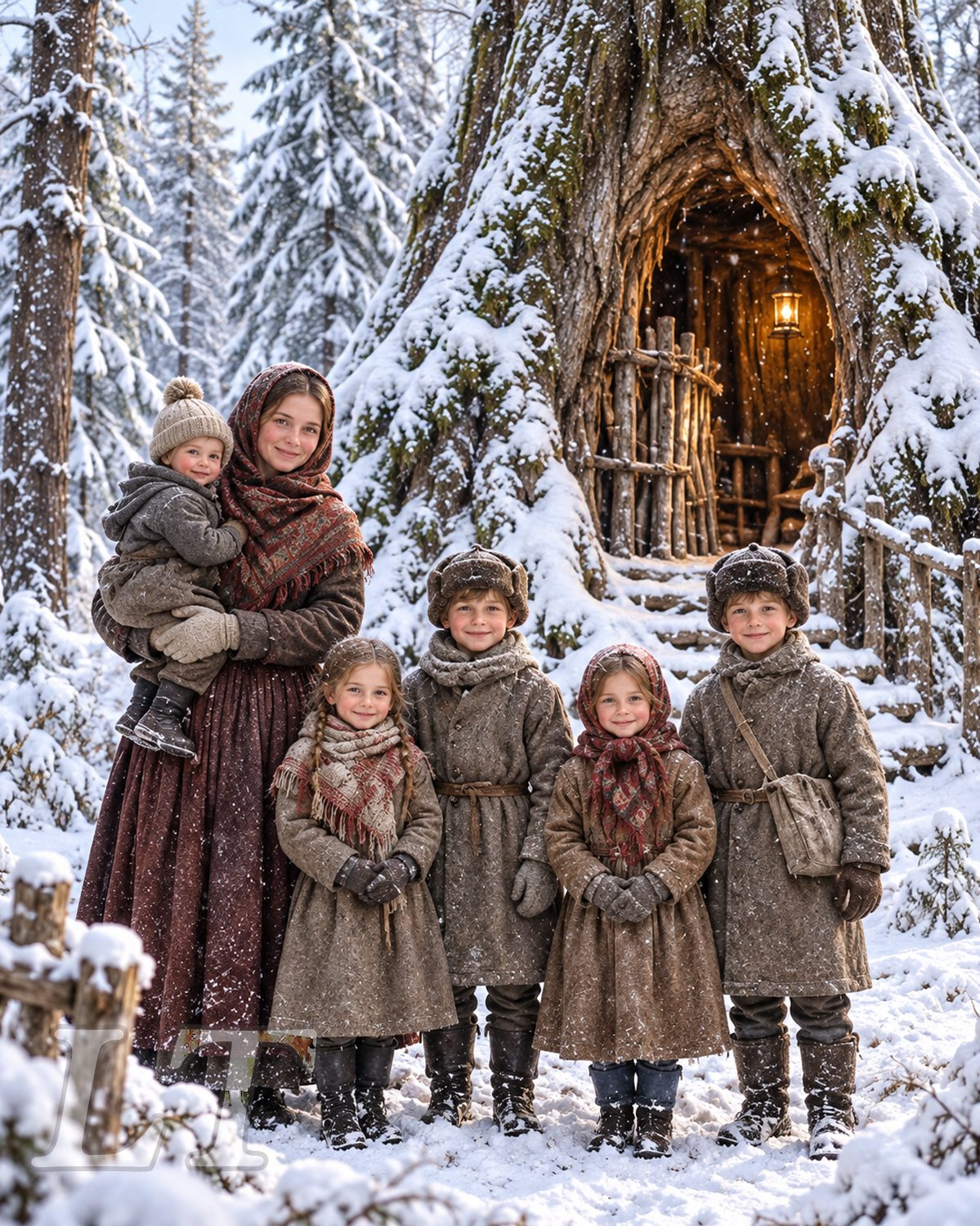
Beyond it stood the enormous cedar.
Even after all those years, I recognized it immediately.
Its trunk rose like a mountain from the snow.
The thick branches were covered in white.
A dark natural opening formed an entrance at the base.
For a moment, I could not move.
I remembered Dmitri standing there fourteen years earlier.
I remembered his laughter.
His warm hands.
The way he had looked at me when he promised that life would never be boring with him.
Now I was standing in front of the same tree with five children and almost nothing else.
Julia stepped out of the car.
She stared at the opening.
Then she turned toward me.
"This is the place?"
I looked at the letter.
Then at the tree.
My voice came out barely above a whisper.
"For now."
Luke climbed out beside her.
"Mom, is there really a house inside?"
"I don't know, sweetheart."
The younger children followed.
Snow gathered on their coats.
I lifted the baby from his car seat and wrapped the blanket more tightly around him.
Then I approached the entrance.
A narrow wooden step had been placed at the base of the opening.
It was not there when Dmitri had first shown me the tree.
I stopped.
Someone had built it.
Recently.
I crouched and brushed away the snow.
Underneath, I noticed a small metal hook attached to the wood.
Hanging from it was an old brass key.
My heart began to pound.
Dmitri had not simply sent us to an abandoned tree.
He had prepared it.
I took the key.
And as I reached toward the darkness inside the cedar, I noticed something else.
There were fresh marks on the wooden frame.
Three small scratches.
The same three scratches Dmitri used to make whenever he finished a piece of carpentry.
I knew them.
I had watched him make them for years.
Someone had been here.
Someone had worked here.
Someone had prepared this place for us.
I turned toward my children.
"Stay close."
Then I stepped inside.
And the first thing I saw was a warm amber light glowing in the darkness.
But the lantern wasn't the only thing Dmitri had left behind.






Comments 0