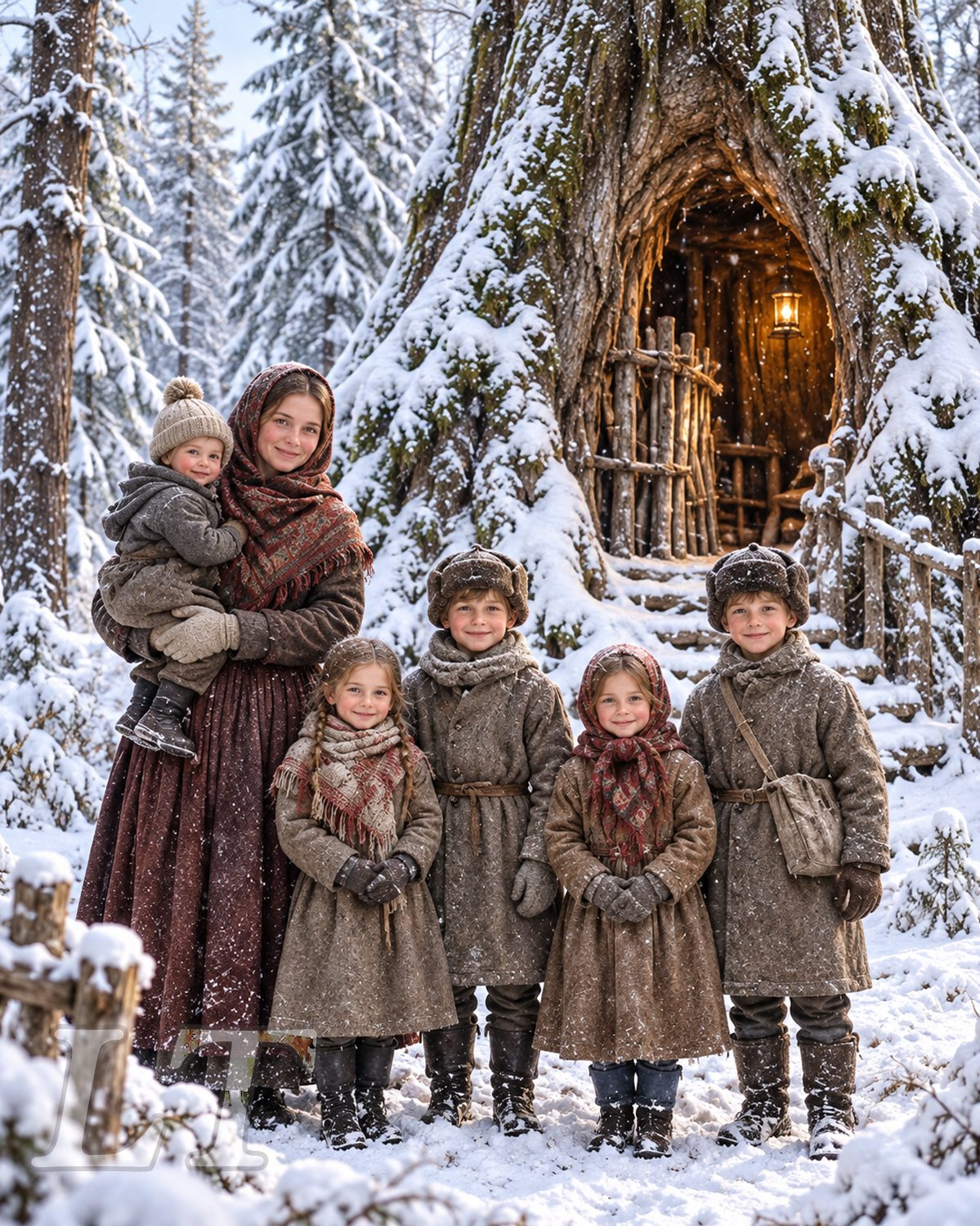
The lantern was already burning.
I stopped just inside the entrance, holding my baby against my chest.
For several seconds, I simply stared.
There was no electricity running through the enormous cedar. No wires. No visible generator. Yet a small battery-powered lantern sat on a wooden shelf, casting a steady amber glow across the hollow interior.
Behind me, Julia stepped carefully through the entrance.
"Mom?"
"Stay close."
She looked over my shoulder.
Then she saw the lantern.
"Someone's been here."
I nodded.
That was becoming increasingly obvious.
The interior of the cedar was much larger than I remembered. Fourteen years earlier, Dmitri and I had stood inside it for perhaps ten minutes. Back then, the floor had been covered with dirt, fallen leaves, and pieces of bark. The walls had been rough and uneven.
Now, wooden boards covered most of the ground.
Someone had cleared away the debris and reinforced several sections of the interior with carefully fitted timber.
There was even a small wooden platform along one side, large enough for several children to sleep on.
I couldn't understand it.
A hollow tree was supposed to be a place where people hid from the rain.
This looked like somewhere a person had spent considerable time preparing.
"Is this our house?" Luke asked.
His voice carried through the enormous trunk.
I turned toward him.
"For now, sweetheart."
He looked at the wooden floor.
"Where's the kitchen?"
Julia almost smiled.
"Luke, it's a tree."
"But Mom said there was shelter."
"There is."
I looked around again.
Near the back wall stood several old feed sacks.
They had been folded carefully and sealed with thick cord.
I approached them while Julia helped the younger children remove their gloves.
The first sack contained blankets.
Not ordinary thin blankets, either.
There were several thick wool blankets, folded into neat rectangles and protected inside a layer of waterproof material.
The second contained more bedding.
The third held what appeared to be winter clothing.
I touched the fabric.
It was clean.
Not new, but clean.
Someone had washed and folded everything.
My throat tightened.
Dmitri had done this.
I was certain of it.
But when?
And how long had he known we might need it?
"Mom, look!"
Julia was standing beside a low wooden shelf.
She had discovered a small collection of items arranged neatly on it.
A metal cup.
A box of matches.
A few candles.
A first-aid kit.
A folded piece of paper.
I walked toward her.
The paper was blank.
I turned it over.
Nothing.
I examined the edges, wondering whether Dmitri might have written something that had faded.
There was no message.
Just an ordinary sheet of paper.
Still, I couldn't shake the feeling that everything inside this tree had been placed exactly where it was meant to be.
"Can we stay here?" Luke asked.
I looked at him.
His cheeks were red from the cold.
His small hands were tucked beneath his arms.
He had been brave during the drive, but I could see how tired he was.
"Yes," I answered.
"For tonight?"
I hesitated.
"For as long as we need."
He seemed satisfied with that.
Children sometimes accepted answers that adults knew were incomplete.
I wished I could do the same.
The first hour passed in a blur of practical decisions.
I placed the baby on the padded blanket while keeping one hand close to him.
Julia helped organize the bedding.
The nine-year-old carefully arranged everyone's shoes near the entrance.
Our four-year-old discovered a small wooden stool and dragged it toward the lantern.
Luke inspected the sleeping platform.
"Can I sleep up here?"
"Not until we know it's safe."
He frowned.
"Why?"
"Because I haven't checked everything yet."
He looked at the ceiling.
"Is there a bear?"
Julia gave him a serious look.
"There better not be."
"Why?"
"Because I'm not sharing my blanket."
Luke giggled.
It was the first time I had heard one of my children laugh since we left the farmhouse.
The sound caught me off guard.
For one brief moment, the hollow cedar did not feel quite so frightening.
I continued inspecting the shelter.
The wooden floor was surprisingly sturdy.
Some boards were older than others, but the newer sections had been cut with care.
I noticed small wooden wedges fitted between the boards and the walls.
There were no obvious gaps large enough for the wind to pass through.
At the back of the hollow, a second section had been partially enclosed with wooden panels.
I approached it cautiously.
The space was narrow, but it seemed to have been designed for storage.
Inside were more feed sacks, a small bundle of rope, and several pieces of neatly stacked firewood.
I looked at the wood.
It was dry.
Completely dry.
That detail unsettled me more than the lantern.
Dmitri had not simply dropped off a few supplies.
He had considered the conditions of this place.
He had thought about moisture.
Cold.
Sleeping arrangements.
The needs of children.
He had planned.
I pressed my hand against the wooden panel.
"How long?" I whispered.
No one answered.
By late afternoon, the children had begun to settle.
The younger ones were sitting together beneath one of the blankets.
Luke had found a small wooden block among the supplies and was turning it over in his hands.
Julia remained near me.
She had been unusually quiet since we arrived.
I knew that look.
She had questions.
She was simply waiting for a moment when the younger children wouldn't hear them.
Eventually, she approached.
"Mom?"
"Yes?"
"Can we talk?"
I nodded.
She glanced at her siblings.
Then she lowered her voice.
"Did Dad know about the bank?"
I stopped folding a blanket.
"What makes you ask that?"
"Because he prepared all this."
I looked toward the supplies.
"I don't know, Julia."
"But someone had to build the floor. Someone had to bring the blankets."
"Yes."
"And the lantern."
"Yes."
She hesitated.
"Maybe Dad knew we were going to lose the house."
The words seemed to hang between us.
I wanted to tell her she was wrong.
I wanted to say that her father would never have allowed us to lose everything if he had known.
But I remembered the foreclosure notice.
The unpaid amounts.
The bank's letters.
The documents I had discovered only after his funeral.
There had been financial problems I knew nothing about.
Dmitri had always handled the household accounts.
I had trusted him.
When he told me everything was fine, I believed him.
Now I wasn't sure what fine had meant.
"Your father loved you," I finally said.
Julia looked down.
"I know."
"He would never have wanted you to feel unsafe."
"I know that, too."
She was silent for a moment.
Then she asked the question I had been avoiding.
"Then why didn't he tell us?"
I reached for her hand.
"I wish I knew."
Julia nodded.
She didn't look convinced.
Neither was I.
As evening approached, the temperature dropped.
The children began moving closer together.
I unfolded another blanket and placed it over the younger two.
The baby had fallen asleep.
I checked his little hands.
They were warm.
That gave me some relief.
The battery lantern continued glowing.
I examined it carefully, looking for a switch or an indicator that might tell me how much power remained.
It appeared to be an ordinary portable lantern.
Beside it sat a small cardboard box containing spare batteries.
I opened the box.
There were four.
I turned one over.
The packaging looked relatively new.
Dmitri had thought about replacements.
A strange ache formed behind my ribs.
I remembered how he used to prepare our farmhouse for winter.
Every autumn, he checked the windows, repaired loose boards, stacked firewood, and made sure the heating system was working.
He never announced what he was doing.
He simply did it.
I had teased him about his endless preparations.
"You act like the snow is going to bury us alive," I once told him.
He had laughed.
"Better to be ready than sorry."
At the time, it had been an ordinary conversation between husband and wife.
Now those words felt different.
I sat on the wooden platform.
My eyes moved around the shelter.
Everything had been prepared with the same quiet attention.
The blankets.
The boards.
The supplies.
The lantern.
It was as though Dmitri had been standing here, imagining each one of us.
I wondered whether he had imagined Luke asking where the kitchen was.
Whether he had thought about Julia trying to be brave.
Whether he had pictured me holding the baby.
The thought nearly broke me.
I turned away before the children noticed.
"Mom, can I have some water?"
Luke's voice brought me back.
I opened one of the storage sacks and found several sealed containers.
There was drinking water.
Enough for the first day, perhaps longer if we rationed it carefully.
I poured a little into the metal cup.
Luke drank eagerly.
"Can I have more?"
"Slowly."
He nodded.
The younger children shared the rest.
Julia watched me distribute the water.
"How much do we have?"
I counted the containers.
"Enough to get started."
"That's not what I asked."
I looked at her.
She was becoming more like her father every day.
Direct.
Observant.
Unwilling to accept an answer that avoided the real question.
"We'll need to find more," I admitted.
She nodded.
"I can help."
"I know you can."
"And we should check the other supplies."
"Tomorrow."
She looked toward the back of the tree.
"There's something behind those boards."
I followed her gaze.
At the far end of the shelter, several wooden panels had been placed against the inner wall.
They looked different from the other boards.
Their edges were darker.
I had noticed them earlier but assumed they were part of the reinforcement.
"What makes you think that?"
Julia pointed.
"That one doesn't touch the floor."
I walked over.
She was right.
A narrow gap ran beneath the lowest panel.
I crouched and examined it.
There was a faint draft coming through.
I placed my fingers against the edge.
The board moved slightly.
Not much.
But enough to tell me it wasn't fixed permanently.
I looked at Julia.
"Don't touch anything until I know what it is."
She nodded.
But I could see the curiosity in her eyes.
I felt it, too.
Dmitri had left something else.
I was almost certain.
We ate a simple dinner that evening.
There was no table.
We sat on the wooden floor with our backs against the curved interior wall.
I divided the food we had brought from the farmhouse.
A little bread.
Some cheese.
Two apples.
A small container of cooked potatoes.
The children ate quietly.
Luke kept looking at the entrance.
"Mom?"
"Yes?"
"Will it snow all night?"
"Probably."
"Will the tree keep the snow out?"
I looked at the enormous trunk.
"I think so."
He considered that.
"Did Dad sleep here?"
The question caught me by surprise.
"I don't know."
"Maybe he did."
I looked toward the lantern.
Perhaps he had.
Perhaps he had sat in this exact place, listening to the wind outside, while imagining his family arriving one day.
Perhaps he had tested the sleeping platform.
Perhaps he had measured the wooden boards.
Perhaps he had spent evenings preparing this shelter while I believed he was working late.
The thought made me feel both grateful and hurt.
I wanted to know why.
I wanted to know everything.
But the letter had offered no explanation.
Only instructions.
Find the cedar.
There is shelter inside.
What you need is there.
I looked at my children.
For tonight, shelter was enough.
After dinner, I made the sleeping arrangements.
The two younger children would sleep together on the lower platform.
Luke would sleep beside Julia.
I would remain near the entrance with the baby.
Julia protested immediately.
"You should sleep on the platform."
"I'm fine here."
"Mom, it's colder near the entrance."
"I'll be all right."
She stared at me.
Then she picked up one of the thickest blankets and placed it beside my bedding.
"At least use this."
I smiled faintly.
"Thank you."
She hesitated.
"You're not going to leave us, are you?"
The question was so quiet that I almost missed it.
I looked at her.
"Never."
She nodded.
Then she climbed onto the platform.
I watched until she lay down.
The lantern cast soft shadows across her face.
She looked younger when she was asleep.
Twelve years old.
Still a child.
I wished I could return her to the farmhouse.
I wished I could put Dmitri back in the kitchen, making coffee and complaining about the weather.
I wished the bank had never sent its letters.
But wishes did not change anything.
So I wrapped the baby in his blanket and sat against the wall.
Outside, the snow continued falling.
Inside, my children slowly drifted to sleep.
I did not sleep.
Every small sound made me look toward the entrance.
The cedar creaked occasionally as the wind moved through its branches.
Snow fell from the upper limbs.
Somewhere in the distance, an animal moved through the forest.
I listened carefully.
Then I heard a different sound.
A soft tapping.
Three knocks.
I sat upright.
The sound came again.
Tap.
Tap.
Tap.
I looked toward the entrance.
Nothing moved.
The lantern continued glowing.
I waited.
After several seconds, I heard it again.
This time it came from somewhere behind the wooden panels at the back of the shelter.
I stood carefully so I wouldn't wake the baby.
I walked toward the sound.
The floorboards creaked beneath my boots.
I stopped beside the panel Julia had noticed earlier.
There was no sound now.
I pressed my hand against the wood.
Cold.
I leaned closer.
For a moment, I heard nothing.
Then something shifted behind it.
A faint scraping sound.
My heart began to beat faster.
I stepped backward.
"Mom?"
Julia was awake.
She sat up on the platform, rubbing her eyes.
"What is it?"
"Nothing. Go back to sleep."
She looked at the wooden panel.
"That doesn't sound like nothing."
I didn't answer.
She climbed down and came toward me.
I held out one hand.
"Stay behind me."
She stopped.
We listened.
The silence stretched.
Then a soft metallic click came from behind the panel.
Julia's eyes widened.
"Mom..."
I reached for the lantern and moved it closer.
The light revealed something I hadn't noticed before.
A small iron latch.
It had been carefully concealed beneath a strip of dark cloth.
I pulled the cloth aside.
The latch looked old, but the metal had been polished recently.
I touched it.
It moved.
My mouth went dry.
There was a hidden compartment behind the wooden panels.
I was certain of it now.
I looked at Julia.
"Wake no one yet."
She nodded.
I lifted the latch.
The panel shifted slightly.
A narrow black gap appeared.
Cold air drifted out.
I placed my fingers against the edge and slowly pulled.
The board moved another inch.
Then I saw something inside.
A small metal container.
It was resting on a shelf in the darkness.
Beside it was a folded piece of paper.
I reached toward the paper.
My fingers brushed its surface.
Then I noticed the handwriting.
The first line was visible beneath the fold.
It contained a name.
Not mine.
Not Julia's.
Not any of the children's.
It was the name of someone Dmitri had once told me never to trust.
I froze.
Julia looked at the paper.
"Mom, who is that?"
I couldn't answer.
Because beneath the name, written in Dmitri's unmistakable handwriting, were six words:
"If she finds this, we're in danger."
And just as I began unfolding the letter, something outside the cedar moved toward the entrance.
A shadow appeared across the lantern light.
Then someone knocked three times.
The same three knocks I had heard from behind the wall.






Comments 0