"The account is in your name."
Julian's words echoed through my mind long after our phone call ended.
I sat on the edge of the motel bed, staring at the bank records scattered across the table.
An account in my name.
Money my father had supposedly left behind.
Money my mother had never mentioned.
And money Marcus Reed seemed desperate to keep hidden.
I immediately called Laura.
She answered quickly.
"Claire?"
"Julian says Mom found a bank statement. Apparently, there's an account in my name."
Laura became quiet.
"Did he send you a copy?"
"Not yet."
"Ask him to send it. Don't contact the bank yourself until we understand the account structure."
A notification appeared on my phone.
Julian had sent a photograph.
I opened it.
The statement showed a financial account established eleven years earlier.
The original deposit was $180,000.
The beneficiary was Claire Bennett.
I read the number again.
One hundred and eighty thousand dollars.
My father had left me more than I had ever imagined.
There was another line beneath the balance.
Account status: Active.
I covered my mouth.
"Laura?"
"I'm here."
"It's active."
"Then we need to establish who has legal authority over it and whether any withdrawals have been made."
I stared at the statement.
"Why did Mom tell us the money was gone?"
"I don't know yet."
I looked at the final section.
The account had been opened three months before my father's death.
The original beneficiary designation carried his signature.
But there was something else.
A note appeared beneath the account details.
No withdrawal permitted without beneficiary authorization or qualifying court order.
I felt tears gather in my eyes.
My father hadn't simply left me money.
He had tried to protect it.
"Laura, I want to know everything."
"We'll find out. But Claire, I need you to remain patient. An account statement is evidence, not yet proof of the amount currently available or the full ownership position."
I nodded.
For the first time, I allowed myself to imagine that my father had managed to protect something for me after all.
The bank appointment was arranged for the following morning.
Laura accompanied me.
Julian arrived separately.
My mother did not come.
She had sent a message saying she was too exhausted to attend.
I suspected she simply didn't want to answer more questions.
A senior account manager named Robert Hayes greeted us in a private office.
He examined my identification and the original documents.
Then he accessed the historical account records.
"Ms. Bennett," he began, "this account was established by your father as part of a separate family financial arrangement."
I leaned forward.
"Was the money intended for me?"
"According to the original beneficiary designation, yes."
"How much remains?"
He examined the screen.
"Before I provide the current balance, I need to verify the account's ownership and authorization history."
Laura presented the relevant documents.
Robert reviewed them carefully.
After several minutes, he turned toward me.
"The account remains active. The current balance is $180,000, excluding any additional interest adjustments that may apply."
I stopped breathing.
Julian stared at him.
"All of it?"
"Yes."
I looked at Laura.
She gave me a small nod.
I turned back to Robert.
"Has anyone withdrawn money?"
He checked the transaction history.
"No withdrawals have been recorded."
I felt tears roll down my cheeks.
Eleven years.
Eleven years of believing that everything my father had worked for had disappeared.
And the money had been sitting there.
Waiting.
Protected.
Robert continued.
"Your father established a restriction requiring the beneficiary's authorization for any distribution. The administrative records show several inquiries about changing the account instructions, but none resulted in a completed transfer."
I looked at the screen.
"Who made those inquiries?"
He examined the records.
"An individual listed as an authorized family contact."
I felt my stomach tighten.
"Evelyn Bennett?"
He nodded.
"Yes."
"Did she have authority to withdraw the funds?"
"No. She could request information and submit administrative inquiries, but she was not the beneficial owner."
Laura leaned forward.
"Did the bank ever receive an instruction from Evelyn Bennett to transfer the account?"
Robert checked.
"Yes. We received a request approximately eleven years ago."
My hands became cold.
"What happened?"
"The request was rejected because the beneficiary authorization was missing."
I looked at Laura.
"Can we have a copy?"
"Subject to the bank's disclosure procedures, we can provide the relevant records to the authorized parties."
Robert printed a summary.
I examined it.
The request had been made three months after my father's death.
The proposed destination was another financial account.
The recipient name was Evelyn Bennett.
But the transfer had never happened.
My mother had tried to move my inheritance.
The bank had refused.
I lowered the paper.
"Does this mean she never had access to the money?"
"Correct. The account remained under the original restrictions."
I breathed out.
For the first time, I felt something close to relief.
My mother had hidden the account.
She had tried to move it.
But she hadn't succeeded.
And my father had made sure of that.
After leaving the bank, Julian and I sat in my car.
Neither of us spoke for several minutes.
Finally, he turned toward me.
"One hundred and eighty thousand dollars."
I nodded.
"Yes."
"That's more than I thought."
I looked through the windshield.
"It was Dad's money."
Julian rubbed his forehead.
"Why did Mom tell us the trust was empty?"
"I think she wanted us to believe there was nothing left."
He looked down.
"She told me the same thing."
I turned toward him.
"Julian, I need you to understand something. That money was never yours to use for your debts."
"I know."
"And it was never mine to use to pay Marcus."
"I know."
He swallowed.
"I really messed things up."
I didn't respond.
He continued.
"I kept thinking I could borrow a little more, win some money back, and fix everything before anyone found out."
I looked at him.
"That's how you got trapped."
He nodded.
"Marcus knew I was desperate."
"That doesn't excuse the documents you signed."
"I know."
He looked at me.
"I want to make this right."
I studied his face.
For years, he had apologized only when he needed something.
This time, he wasn't asking me for money.
He was asking for a chance to take responsibility.
"Then start by dealing with your debts honestly. Don't hide anything. Don't gamble again. And don't use my name."
He nodded.
"I won't."
I looked away.
"I can't promise everything will be the same between us."
"I understand."
"But I don't want you destroying your life either."
His eyes filled.
"Thank you."
I started the car.
We drove separately.
For the first time, I wasn't carrying his financial problems on my shoulders.
Two days later, Laura received the full bank documentation.
The records confirmed that the $180,000 account belonged to me as the designated beneficiary.
The bank also provided the rejected transfer request submitted by my mother.
That document became important in the wider investigation.
It established that Evelyn had attempted to redirect the funds after my father's death without the required beneficiary authorization.
The bank's records also helped clarify the relationship between the family trust and the separate beneficiary account.
They were not the same asset.
The original $60,000 family trust had been managed separately.
Its records showed that substantial funds had been transferred and spent under Evelyn's administration.
The $180,000 account, however, had remained protected.
My mother had never owned it.
And Marcus had never acquired a valid interest in it.
Laura explained that the original ownership instrument transferred from my father's safe-deposit box was connected to a separate investment dispute.
It was not proof that Marcus owned my father's remaining assets.
The document showed that the original investment agreement had never been completed as Marcus claimed.
There was no valid basis for using my personal inheritance to settle Julian's unrelated debt.
The signature on the supposed declaration of final beneficial ownership was also referred for independent examination.
The examiner's preliminary findings identified significant inconsistencies with my known signatures.
The document's date, witness details, and preparation history were also inconsistent.
My mother eventually admitted that she had copied my signature from an old school form.
She claimed she had done so because Marcus told her it was necessary to resolve the family's old financial dispute.
That explanation did not excuse what she had done.
Laura advised me to keep every record and allow the appropriate authorities to review the disputed documents.
I agreed.
I wanted the truth established properly.
Not through revenge.
Not through another family argument.
Through evidence.
Marcus Reed's position began to collapse when the original financial records were examined.
He had claimed that my father's investment agreement gave him continuing rights over the family assets.
But the original documents did not support that claim.
The bank custody receipt showed that he had received the ownership instrument from Evelyn.
It did not establish that he had acquired ownership of the underlying assets.
The disputed guarantor document connected to Julian's loan also became difficult to defend.
My signature had been reproduced without my authorization.
I had never guaranteed Julian's debt.
And I had never agreed to assign my lottery winnings to Marcus.
Julian retained independent legal assistance to review his loan.
He learned that he remained responsible for obligations he had genuinely undertaken, but that the disputed use of my personal information could be challenged.
He also began a repayment plan based on his actual financial situation.
For the first time, he had to face the consequences without expecting me to solve them.
Marcus eventually agreed to withdraw his attempt to connect my inheritance and lottery winnings to Julian's loan.
He also agreed to cooperate with the document review and return the original materials still in his custody.
The remaining questions concerning his historical business dealings were handled through the appropriate legal channels.
I never received a dramatic apology from him.
I didn't expect one.
But I finally had something more valuable than his apology.
I had the documents.
The lottery office reached its final decision several weeks later.
Laura called me on a Thursday morning.
"Claire, I have good news."
I sat down immediately.
"What happened?"
"The lottery office has completed its ownership review."
I held my breath.
"They've confirmed that you are the registered purchaser and rightful claimant of the winning entry, subject to the ordinary verification and payment requirements."
I covered my mouth.
My eyes filled with tears.
"What about Mom's claim?"
"It has been rejected. Her submission did not establish that she funded the purchase or had any ownership interest in the ticket."
I closed my eyes.
For several seconds, I couldn't speak.
Then I whispered:
"Thank you."
Laura smiled through the phone.
"You did the difficult part. You preserved the records and refused to sign away your rights."
After the call ended, I sat quietly.
The winning ticket had originally been worth several million dollars.
Now, after the official review, applicable taxes, and financial planning, I would have enough to change my life completely.
But I wasn't going to spend recklessly.
I hired an independent financial adviser.
I established a secure investment plan.
I set aside money for taxes, long-term savings, housing, and charitable giving.
I also kept the separate $180,000 account my father had left me.
That money was never part of the lottery winnings.
It was something he had worked to protect.
And I intended to honor that purpose.
My mother called three weeks later.
I almost didn't answer.
But something told me I should.
"Claire?"
Her voice sounded smaller than I remembered.
"Yes?"
"I heard the lottery office made its decision."
"They did."
She paused.
"Are you happy now?"
I looked out the window.
"I feel relieved."
She began crying.
"I never wanted things to end like this."
I remained quiet.
"I was frightened after your father died," she continued. "I didn't know how to manage the debts. Marcus kept telling me that everything would collapse if I didn't cooperate."
I listened.
"I thought I was protecting the family."
"Mom, you signed my name."
"I know."
"You tried to claim my lottery ticket."
"I know."
"You hid Dad's account."
Her breathing became uneven.
"I know."
For the first time, she wasn't arguing.
She wasn't blaming me.
She wasn't telling me I was selfish.
She was acknowledging what had happened.
"I'm sorry," she whispered.
I closed my eyes.
Those words were something I had wanted to hear for years.
But an apology couldn't erase eleven years of manipulation.
"Mom, I don't hate you."
She began crying harder.
"But I can't go back to how things were."
"I understand."
"I need boundaries. No more requests for money. No more documents to sign. No more using my name without permission."
"I understand."
"And if we rebuild our relationship, it has to be honest."
She remained silent.
Then she whispered:
"I'll try."
I didn't promise that everything would be fine.
I didn't promise to give her money.
But I agreed to meet her for coffee once we had both had time to think.
It was a beginning.
Nothing more.
And that was enough.
Julian's recovery took longer.
He sold his expensive car.
He moved into a smaller apartment.
He stopped gambling and began attending financial counseling.
He also found steady work.
At first, our conversations were awkward.
We had spent so many years operating according to the same unhealthy family pattern that neither of us knew how to behave differently.
But he kept his promises.
He never asked me to pay his debts.
He never requested access to my accounts.
He began making small repayments toward the money he had borrowed from me.
One afternoon, he came to my new apartment carrying a paper bag.
Inside was a framed photograph of our father.
"I thought you should have this," he said.
I looked at the photograph.
Dad was standing in our old backyard, smiling at the camera.
"Where did you find it?"
"It was in the box."
I smiled faintly.
"Thank you."
Julian sat down.
For a moment, he looked uncomfortable.
Then he spoke.
"I used to think you had everything under control."
I looked at him.
"What do you mean?"
"You always paid the bills. You always knew what to do. Mom always said you were the strong one."
I remained quiet.
"I never thought about what that meant for you."
I looked down.
"I was tired, Julian."
His eyes filled.
"I know."
"No, I don't think you did."
He nodded.
"You're right."
We sat together for a while.
Then he said:
"I'm proud of you."
I looked at him.
He wasn't asking for anything.
He wasn't trying to make me feel guilty.
He was simply telling me something he should have said years earlier.
I reached across the table and squeezed his hand.
"We both have a lot of work to do."
He smiled.
"I know."
Six months later, I moved into a beautiful apartment of my own.
It wasn't the largest property in the city.
It wasn't designed to impress anyone.
But it was mine.
The living room had large windows.
The kitchen had enough space for me to cook comfortably.
There was a small balcony where I could sit with coffee in the morning.
For the first time in years, I didn't have to calculate whether I could afford someone else's emergency.
I also started a small scholarship fund in my father's name.
It supported young people from working families who wanted to continue their education but struggled with tuition and living expenses.
I called it the Daniel Bennett Future Fund.
I wanted his legacy to be about opportunity rather than the financial disputes that had surrounded his final years.
At the opening event, I placed his photograph beside the scholarship announcement.
Julian attended.
My mother came too.
She sat quietly near the back.
After the event, she approached me.
"Your father would have been proud," she said.
I looked at his photograph.
"I hope so."
She hesitated.
Then she reached for my hand.
I allowed her to hold it.
We were not magically healed.
There were still difficult conversations ahead.
But she had begun counseling, and she had stopped asking me for money.
She had also acknowledged in writing that the lottery winnings belonged to me and that the disputed signature documents were unauthorized.
It wasn't everything.
But it was a meaningful step.
One evening, nearly a year after the night my mother had kicked me out, I invited Julian and Evelyn to dinner.
I cooked the meal myself.
Nothing extravagant.
Roasted chicken.
Mashed potatoes.
Green beans.
A simple chocolate cake.
We sat around my dining table.
There were no demands.
No financial arguments.
No threats.
Just three people trying to learn how to be a family without making one person carry everyone else.
Halfway through dinner, my mother looked at me.
"Claire, can I ask you something?"
"Of course."
"Do you ever think about that night?"
I knew exactly which night she meant.
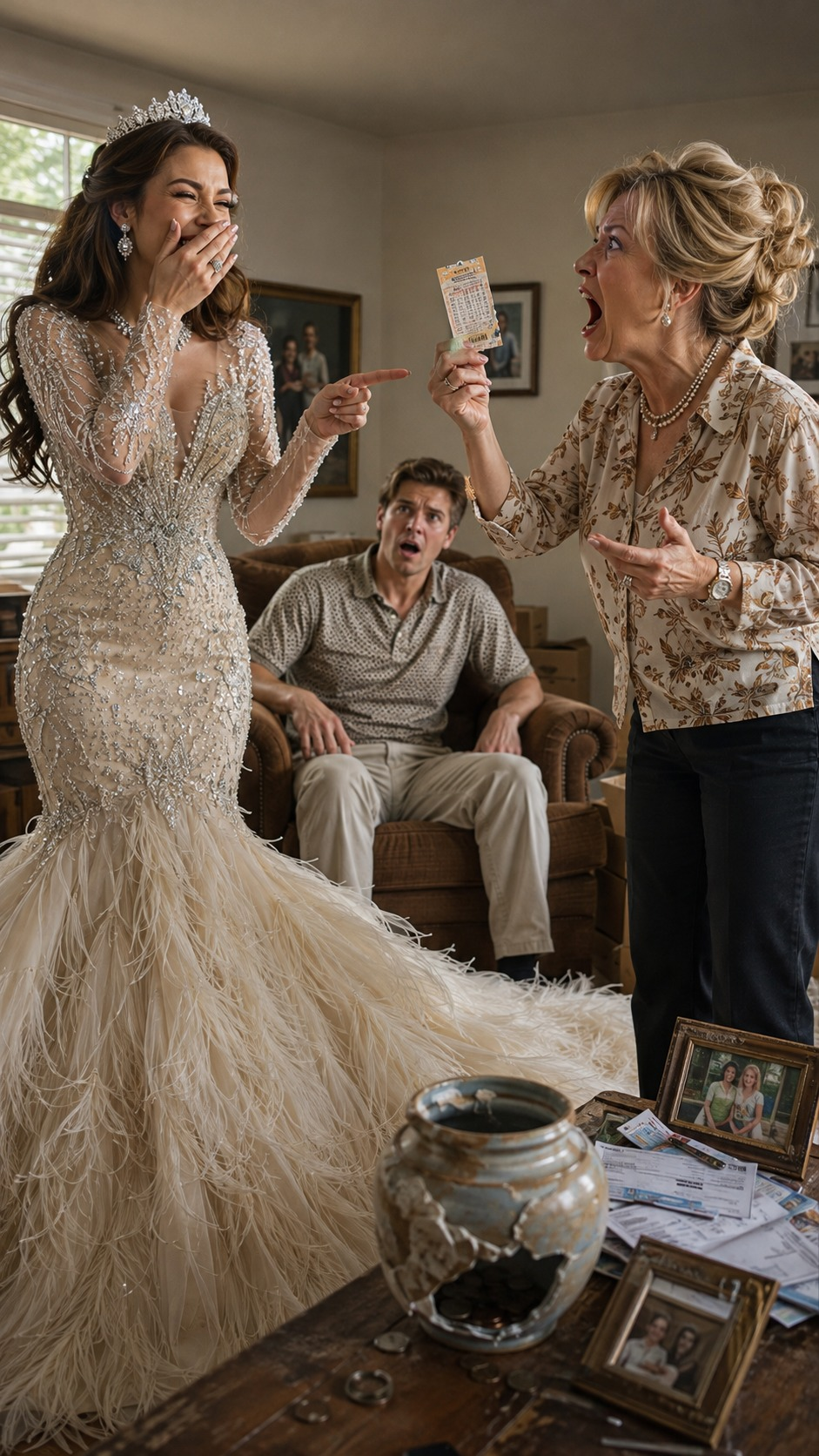
The night she had held the winning ticket in her hand and told me to leave.
I thought for a moment.
"Sometimes."
She lowered her eyes.
"I wish I could take those words back."
I looked at her.
"I can't change what happened."
"I know."
"But I can decide what happens next."
She nodded.
Then Julian raised his glass.
"To Dad."
I smiled.
"To Dad."
My mother lifted her glass too.
We sat together for a moment.
And I imagined my father watching us from somewhere far away.
I remembered his letter.
His warning.
His belief that I would always try to take care of everyone.
But I finally understood what he had wanted me to learn.
Love did not require me to surrender my future.
Family did not give anyone ownership over my life.
And being strong did not mean allowing people to hurt me repeatedly.
I could love my mother without financing her mistakes.
I could support my brother without paying his debts.
And I could honor my father without allowing anyone to use his name against me.
Later that night, after they had left, I stood on my balcony.
The city lights stretched into the distance.
My phone rested on the small table beside me.
There were no angry messages.
No demands.
No threats.
Only a photograph Julian had sent from dinner.
It showed the three of us smiling awkwardly around the table.
I saved it.
Then I looked up at the night sky.
For eleven years, I had believed my responsibility was to keep my family from falling apart.
Now I understood that I had never been responsible for holding together something other people refused to protect.
I had my own home.
My own future.
My father's legacy.
And, finally, peace.
I whispered the words I wished I had told him years ago.
"I made it, Dad."
For the first time, I believed them.






Comments 0