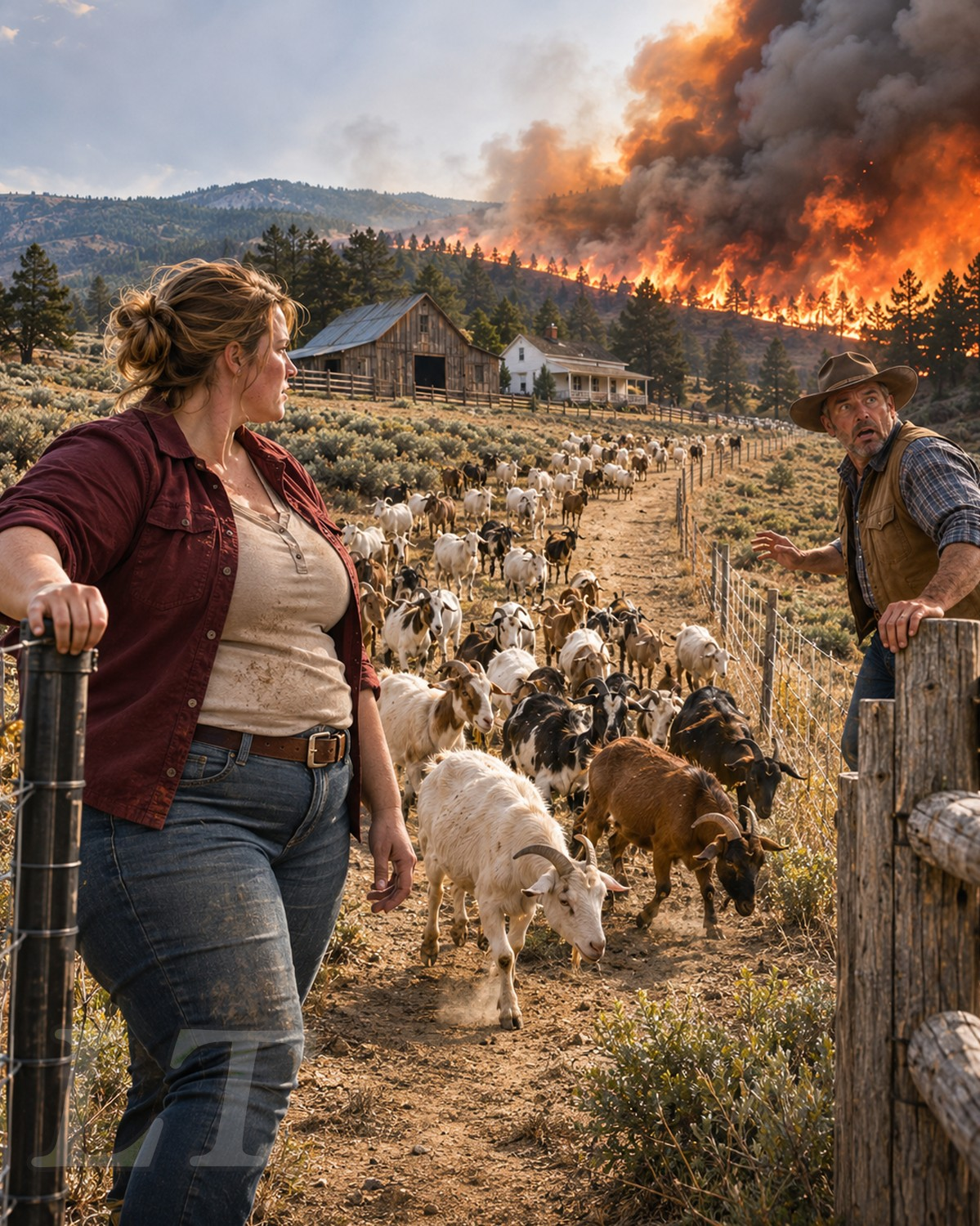
"Get those worthless animals off that hillside!" Preston Blackwood shouted.
He slammed a glossy property photograph against the hood of his expensive pickup truck.
A red circle marked the western slope of Juniper Hollow Ranch.
Inside the circle, someone had written three words.
FUTURE FIRE HAZARD.
Preston thought he had found proof that Tessa Callaway was destroying her land.
He had actually photographed the one thing that might save it.
Four months later, when the worst wildfire in thirty years came roaring over the mountains, that photograph would become the most important piece of paper in Callahan Valley.
But on that April morning, the only thing Preston wanted was an audience.
And Tessa Callaway had given him absolutely no reason to expect one.
She stood on the other side of the fence, holding a pair of fencing pliers, her boots planted in the dusty ground. Her dark auburn hair was braided over one shoulder, and her forest-green work shirt had a fresh tear near the elbow.
Behind her, forty-seven goats were happily dismantling a wall of blackberry bushes.
Preston pointed at them.
"Forty-seven," he said, shaking his head. "I counted them twice because I couldn't believe anybody could be that foolish."
Tessa adjusted the wire she had been tightening.
"Morning, Preston."
"Don't 'morning, Preston' me. I'm trying to save you from making the biggest mistake of your life."
"That's thoughtful."
He frowned.
There was something about her calmness that irritated him more than an argument would have.
Most people in Callahan Valley listened when Preston Blackwood spoke.
Some listened because they respected him.
Others listened because he owned enough land, equipment, and influence to make their lives difficult.
Tessa simply kept working.
Preston leaned against the gate.
"You know what cattle sell for these days?"
"Yes."
"You know what goats sell for?"
"Yes."
"Then explain this."
He swept one arm toward the hillside.
The goats continued eating.
A white female with curved horns pulled a blackberry branch toward herself. A spotted youngster stood on its hind legs to reach a cluster of leaves. Near the back of the herd, an older gray goat with a torn ear shook her head, making a little brass bell ring.
Tessa glanced at them.
"They're doing exactly what I bought them to do."
Preston laughed.
It was a loud, practiced laugh.
The kind that invited everyone within hearing distance to join him.
Unfortunately for Preston, there was nobody else around.
Not yet.
"Miss Callaway, those animals are eating your investment."
"That's the idea."
His smile faded.
"You can't seriously believe that."
Tessa pushed the pliers into her back pocket.
"Preston, did you drive all the way over here to talk about my goats?"
"I drove over here because I hate watching somebody throw away a perfectly good ranch."
"Then you probably shouldn't watch."
For a moment, he simply stared at her.
Then he laughed again.
"Well, I'll be damned."
He climbed into his truck, started the engine, and lowered his window.
"You're going to learn a very expensive lesson, sweetheart."
Tessa rested one hand on the fencepost.
"Maybe."
He drove away with gravel spraying behind his tires.
She watched until the truck disappeared around the bend.
Then she turned toward the goats.
"All right, ladies and gentlemen," she murmured. "Back to work."
The gray goat rang her bell.
Tessa smiled faintly.
She had named that one Mercy.
Not because the animal was particularly gentle.
Mercy had once bitten a livestock dealer hard enough to leave a purple bruise.
Tessa had named her because she had been the first goat to step out of the trailer when the herd arrived.
And because, at the time, Tessa had desperately needed to believe that mercy still existed.
Four weeks earlier, Tessa had signed the papers that made Juniper Hollow Ranch hers.
Two hundred and forty acres.
One deteriorating farmhouse.
One weather-beaten barn.
Three miles of fencing that needed repair.
A well that produced water when it felt cooperative.
And enough neglected vegetation to make a county fire inspector lose sleep.
The real estate agent had called the property "a unique opportunity."
The previous owner had called it "a money pit."
Tessa had called it home.
She was thirty-eight years old when she purchased the ranch.
She had spent almost her entire adult life working for other people.
She had repaired fences in freezing rain.
Driven cattle through summer heat.
Delivered calves at three in the morning.
Slept in the cab of her pickup when a ranch job required her to stay overnight.
And eaten more gas-station dinners than she cared to remember.
She had saved money in envelopes, coffee cans, and eventually a bank account that grew so slowly it sometimes seemed to be moving backward.
For eleven years, she had carried a photograph in the glove compartment of every truck she owned.
It showed a small ranch in Northern California.
Or rather, what remained of one.
A blackened fence.
A collapsed barn.
A hillside covered in ash.
The photograph had curled at the corners.
She never showed it to anyone.
When she first walked the boundaries of Juniper Hollow, she saw things other buyers had overlooked.
The thick blackberry growth along the lower fence.
The dead branches hanging beneath the pines.
The continuous brush stretching from the western ridge toward the farmhouse.
The dry grass tangled beneath the sagebrush.
She could almost see how a fire would move.
Where it would gather strength.
Where the wind would push it.
Where flames might climb from low vegetation into the trees.
The ranch had been neglected for decades.
But it had something she needed.
Space.
And time.
At least, she hoped she had time.
She bought the property on a Friday.
By Monday, she was making calls about goats.
The first livestock dealer laughed when she told him how many she wanted.
"Forty-seven?"
"That's right."
"Why forty-seven?"
"That's what you've got available."
"Most people start with ten or twelve."
"I'm not most people."
He gave her a price that was too high.
She thanked him and hung up.
The second dealer had twenty-six animals, but most were young dairy goats that had never worked heavy brush.
The third dealer had exactly what she needed.
A struggling brush-management operation two counties away was closing.
Forty-seven animals.
Mixed ages.
Mixed breeds.
Some scarred.
Some stubborn.
A few older than most buyers would consider useful.
The seller sounded exhausted.
"Lady, I'll tell you straight. They're not show animals."
"Good."
"Some of them are ugly."
"That's fine."
"One has a torn ear."
"Can they eat brush?"
He paused.
"Eat it? They'll eat the paint off your truck if you park too close."
Tessa drove there the next morning.
She inspected the herd carefully.
Checked their feet.
Examined their teeth.
Watched how they moved.
Asked about vaccinations, parasites, and their previous grazing routines.
The seller became increasingly curious.
"You planning to breed them?"
"No."
"Milk them?"
"No."
"Sell meat?"
"No."
He scratched his head.
"Then what in God's name are you buying them for?"
Tessa looked across the holding pen.
Mercy stood near the fence, chewing on a strand of hay.
"For work."
The seller stared at her.
Then he nodded slowly.
"Well, they know how to do that."
She paid him.
Loaded the goats.
And drove home with the most important investment she had ever made.
By the following morning, the entire valley knew.
Callahan Valley was the kind of place where news traveled faster than the mail.
At Miller's Diner, the breakfast crowd had already turned Tessa's purchase into entertainment.
Grant Worthington was the first to announce it.
"Forty-seven goats," he said, setting down his coffee. "I swear to God. Forty-seven."
A ranch hand named Bobby looked up from his eggs.
"For what?"
"That's the million-dollar question."
Preston Blackwood sat at the center table with three neighboring ranchers.
He leaned back.
"Maybe she's opening a petting zoo."
The men laughed.
"Maybe she thinks goats are cheaper cattle," someone offered.
"Maybe she's starting a circus."
More laughter.
Grant shook his head.
"That woman bought two hundred and forty acres and filled it with goats. You couldn't make this stuff up."
A waitress named Donna refilled Preston's cup.
"Maybe she knows something you boys don't."
Preston grinned.
"Donna, if she knew something, she wouldn't have bought goats."
Donna gave him a look.
"That's funny. My grandfather used goats to clear brush."
"Your grandfather didn't run a cattle operation worth eight figures."
"No," Donna replied. "He just kept his barn standing for fifty years."
A few men chuckled.
Preston didn't.
He took a long drink of coffee.
Then he changed the subject.
But by lunchtime, the jokes had spread.
By evening, someone had posted a photograph of Tessa's livestock trailer online.
The caption read:
CALLAHAN VALLEY'S NEWEST CATTLE BARON.
The comments were merciless.
People who had never met Tessa called her stupid.
People who had never seen her property explained everything she was supposedly doing wrong.
One man suggested she should sell the ranch before the bank took it.
Another asked whether she had mistaken the goats for sheep.
Tessa saw the post while sitting at her kitchen table with a bowl of canned soup.
Her phone buzzed repeatedly.
She read three comments.
Then she turned the phone facedown.
Outside, the goats were settling into their temporary enclosure.
She could hear Mercy's bell through the open window.
Tessa opened a notebook.
On the first page, she had drawn a rough map of Juniper Hollow.
The western slope.
The barn.
The farmhouse.
The driveway.
The access roads.
The lower pasture.
She had divided the property into numbered grazing sections.
Beside each section, she had written the approximate vegetation density, terrain, and number of days she expected the goats to need.
She circled Section Four.
Then she wrote:
Move fencing before sunrise.
The phone buzzed again.
She ignored it.
The work was harder than she had expected.
Not because the goats refused to eat.
They ate enthusiastically.
The problem was everything else.
Portable fencing had to be moved constantly.
Water had to be carried or piped to new locations.
The goats needed shelter, mineral supplements, and regular checks.
Predators were a concern.
So were poisonous plants, damaged fencing, and the steep ground near the western ridge.
Tessa worked alone most days.
She rose before daylight.
Fed and checked the herd.
Repaired whatever had broken overnight.
Then began moving fencing.
By midmorning, her hands usually hurt.
By afternoon, her back did.
By evening, she was often too tired to cook.
But the land was changing.
Slowly.
Almost invisibly at first.
The blackberry thickets became thinner.
The dense brush beneath the trees opened.
Dry grass disappeared from the edges of the driveway.
Low branches became easier to reach and remove.
Where the goats had worked, Tessa followed with hand tools, cutting remaining woody stems and hauling away dead material.
She did not simply turn animals loose and hope for the best.
She measured.
Observed.
Adjusted.
And repeated.
Every evening, she photographed the day's work from the same marked locations.
The photographs went into a folder on her laptop.
She named it Juniper Hollow Fuel Reduction.
Nobody in the valley knew about the folder.
Nobody asked.
They were too busy laughing.
The first time Grant Worthington visited, he brought advice.
The second time, he brought criticism.
The third time, he brought a friend.
They stood beside the county road, staring at the pale strips across Tessa's hillside.
"Look at that," Grant said. "She's turning the place into a desert."
His friend whistled.
"That's ugly."
"Ugly doesn't begin to cover it."
The goats were working along a narrow section near the western fence.
Tessa stood nearby, adjusting a water trough.
Grant called to her.
"Hey, Callaway! You planning to grow anything on that dirt?"
"Not much this summer."
"That's obvious."
His friend laughed.
Grant raised his voice.
"You know, there are actual agricultural classes for people who don't understand land management."
Tessa straightened.
"Thanks, Grant."
"I'm serious."
"So am I."
He frowned.
"You're going to ruin your topsoil."
"I'm monitoring the ground cover."
"Looks like you're monitoring a disaster."
Tessa looked at the hillside.
The goats had reduced much of the dense brush, but the ground was not completely bare.
Short grasses remained in patches.
Roots still held the soil.
She had deliberately avoided pushing the animals too long in areas vulnerable to erosion.
But explaining that to Grant would have required him to stop talking.
And he showed no signs of doing so.
"Well," he announced, "don't say nobody warned you."
He climbed back into his truck.
His friend followed.
As they drove away, Tessa heard them laughing.
She waited until the truck disappeared.
Then she returned to her work.
The nickname came two weeks later.
The Callaway Desert.
Grant invented it over breakfast.
Preston made sure everyone heard it.
By the weekend, somebody had painted a small wooden sign.
CALLAWAY DESERT — 2 MILES.
They placed it beside the county road.
Tessa found it on her way to the feed store.
She stopped her truck.
Got out.
Read the sign.
For a long moment, she stood perfectly still.
Then she walked around it.
The lettering was crooked.
The paint was fresh.
Someone had taken enough time to make the arrow point directly toward her property.
She could have pulled it out.
Could have thrown it into the ditch.
Could have driven into town and demanded to know who had done it.
Instead, she returned to her truck.
She had fencing supplies to buy.
At the feed store, the cashier avoided her eyes.
Tessa paid for her order.
As she turned to leave, she heard a man near the counter whisper:
"That's her."
Another voice answered:
"The goat lady?"
A snicker.
Then another.
Tessa kept walking.
But when she reached her truck, she sat behind the wheel without starting the engine.
Her hands rested on the steering wheel.
She stared through the windshield.
For a few seconds, the humiliation hurt more than she wanted to admit.
She had worked for years to buy that ranch.
She had given up vacations.
Relationships.
Comfort.
Opportunities.
She had lived in cheap rentals and driven trucks that broke down every other month.
And now strangers were laughing at the one thing she had sacrificed so much to build.
She closed her eyes.
For a moment, she was eleven years younger.
Standing beside another fence.
Watching smoke rise over another hillside.
Hearing animals cry from somewhere she couldn't reach.
Her eyes opened.
She started the truck.
And drove home.
On the first Monday in May, a stranger stopped beside her western fence.
He drove an old silver pickup with faded paint and a cracked dashboard.
His name was Cole Barrett.
He was sixty-one years old.
Retired.
Quiet.
And unlike most men in Callahan Valley, he had spent more time studying wildfire behavior than cattle prices.
For twenty-six years, Cole had worked as a wildland firefighter.
He had fought fires in California, Oregon, Idaho, Montana, and Colorado.
He had seen entire neighborhoods vanish.
Watched flames cross highways.
Seen burning embers travel far ahead of the main fire.
And stood beside men who never came home.
Retirement had not made him forget any of it.
That morning, he was driving toward town when he noticed the strange pale strips across Juniper Hollow's hillside.
At first, he thought somebody had been clearing land for a road.
Then he looked more closely.
The strips followed the contours.
One crossed the slope above the barn.
Another interrupted the thick brush connecting the western hillside to the house.
A wider section opened around the driveway.
Cole slowed his truck.
He studied the layout.
Then he pulled over.
For several minutes, he said nothing.
He simply looked.
Finally, he climbed out and walked toward the fence.
Tessa was carrying a steel post driver.
"Morning," Cole called.
She stopped.
"Morning."
"Mind if I ask you something?"
"Depends."
He smiled.
"Fair enough."
He pointed toward the western slope.
"Who designed that?"
Tessa followed his gaze.
"The fencing?"
"The cleared sections."
"I did."
Cole looked back at the hillside.
"All of it?"
"Yes."
"Why?"
Tessa shifted the post driver against her hip.
"Brush management."
He studied her.
Then the land.
Then her again.
"That's a pretty particular way to manage brush."
She said nothing.
Cole stepped closer to the fence.
"That upper strip. Why does it widen above the barn?"
Tessa hesitated.
"Because the slope changes."
"And the prevailing wind?"
"Usually comes from the west in late summer."
Cole's expression changed.
He pointed toward the driveway.
"Why clear both sides?"
"Access."
"For what?"
"Vehicles."
"What kind of vehicles?"
Tessa met his eyes.
"Whatever needs to get through."
For a moment, neither spoke.
Then Cole looked toward the goats.
Forty-seven animals were browsing through dense brush, completely unconcerned by the conversation.
Mercy's brass bell rang softly.
Cole turned back to Tessa.
"Miss Callaway, do you know what ladder fuel is?"
"Yes."
"Do you know what happens when a surface fire reaches enough of it?"
"Yes."
"Do you know what a fuel break is?"
"Yes."
Cole slowly removed his cap.
"Then I have one more question."
Tessa waited.
He looked toward the distant western mountains.
"Are you expecting a wildfire?"
The question struck her harder than she expected.
For weeks, people had asked why she bought goats.
Why she cleared brush.
Why she refused cattle.
Why she was ruining her land.
Nobody had asked whether she was afraid of fire.
Nobody had looked closely enough to understand what she was building.
Until now.
Tessa lowered the post driver.
"I'm preparing for one."
Cole stared at her.
The wind moved through the pines.
Somewhere behind them, Mercy's bell rang again.
Finally, he spoke.
"How long have you been planning this?"
Tessa looked toward the western ridge.
"Eleven years."
Cole's eyes narrowed.
"Eleven years?"
She nodded.
He opened his mouth to ask another question.
But his phone suddenly vibrated.
He glanced at the screen.
The caller was a former colleague from the state forestry service.
Cole answered.
"Barrett."
He listened.
His expression changed.
"What do you mean, already?"
Tessa watched him.
Cole turned away from the fence.
"How dry?"
A pause.
"That's worse than last year."
Another pause.
Then he looked toward the western mountains.
His face had gone pale.
"Send me the report."
He ended the call.
For several seconds, he said nothing.
Tessa tightened her grip on the post driver.
"What is it?"
Cole stared at his phone.
Then at her hillside.
Then back toward the distant forest.
"That was an old friend of mine," he said quietly. "He's been reviewing the early-season fire conditions."
Tessa waited.
Cole swallowed.
"He said there's something in the latest measurements that nobody in this valley is going to want to hear."
He turned the phone toward her.
A new message had arrived.
Attached was a preliminary fire-danger report.
Across the top of the first page, in bold red letters, were three words.
EXTREME FIRE POTENTIAL.
And beneath them was a map.
A map with one section of the western mountains circled in red.
Cole enlarged the image.
His finger stopped moving.
Because the projected high-risk corridor pointed directly toward—
Juniper Hollow Ranch.






Comments 0