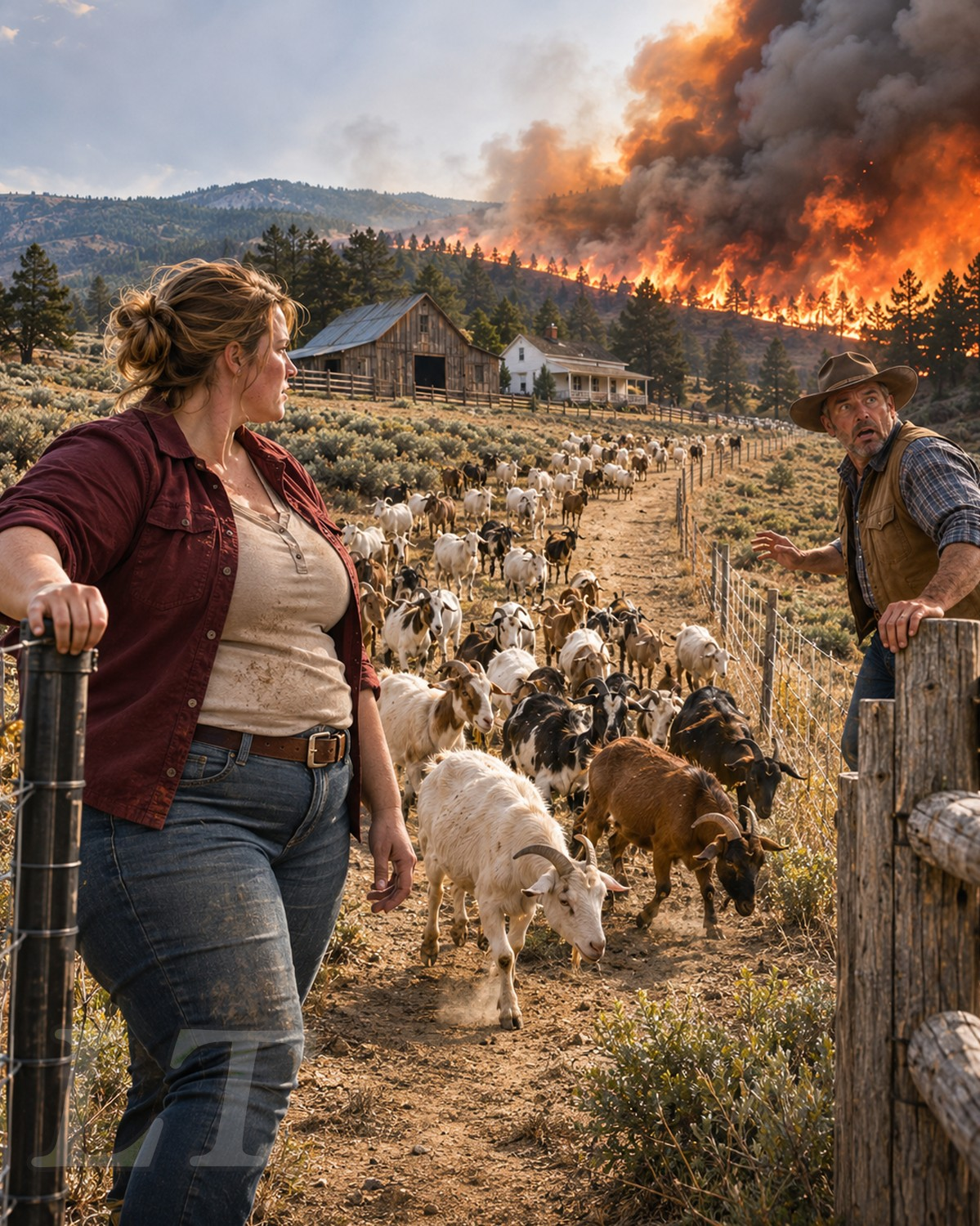
"That red line runs straight through my property," Tessa Callaway said.
Cole Barrett didn't answer immediately.
He stood beside the western fence of Juniper Hollow Ranch, holding his phone between them. On the screen was a preliminary wildfire risk map, its colors ranging from pale yellow to a deep, angry red.
The darkest section covered the western mountains.
And a narrow finger of that red stretched directly toward Tessa's land.
"Tell me something," Cole said. "When you bought this place, did you know what the fire history looked like?"
Tessa nodded.
"I checked the county records."
"How far back?"
"Forty years."
Cole lowered the phone.
Most ranchers he knew couldn't tell him when the last major wildfire had crossed their own property. They knew cattle prices, rainfall totals, and how much hay they had stored. But ask them about historical fire patterns, and they would shrug.
This woman had researched four decades of fire history before purchasing a ranch everyone considered worthless.
"You're not doing this because you think a fire might come someday," he said.
Tessa looked toward the goats.
"No."
"You're doing it because you think one is coming soon."
She didn't deny it.
A gust of wind moved across the hillside. Mercy, the old gray goat with the torn ear, lifted her head and shook her brass bell.
Cole studied the cleared strips again.
He had seen professionally designed fuel breaks that were less carefully positioned.
"You understand these won't make your ranch fireproof?"
"I know."
"Wind-driven embers can travel over cleared ground. Buildings can ignite even when the surrounding grass doesn't."
"I know that too."
"And forty-seven goats aren't going to stop a crown fire."
Tessa finally looked at him.
"I'm not asking them to stop one."
"Then what are you asking?"
She pointed toward the western slope.
"To take away enough fuel that the fire doesn't have the same strength when it reaches the buildings."
Cole felt something tighten in his chest.
It wasn't fear.
Not exactly.
It was the uncomfortable recognition of someone who understood the problem.
He looked at the woman standing before him.
Her shirt was stained with dust. Her hands were rough. A fresh scratch ran along her wrist where a blackberry thorn had caught her.
She looked exhausted.
And she had been working almost entirely alone.
"How much have you cleared?" he asked.
"About thirty-eight acres of heavy brush so far. Some sections are only partially treated."
"How much do you plan to finish?"
"Everything I can before September."
Cole looked toward the mountains.
"That's a lot of work."
"I've noticed."
He almost smiled.
Then he remembered the report.
"Miss Callaway, I think you and I need to have a longer conversation."
They sat on the farmhouse porch twenty minutes later.
Tessa brought out two glasses of iced water.
Cole spread several printed maps across an old wooden table.
He had called a friend and asked him to email the latest available information. Tessa had printed the documents using a small machine in her kitchen.
The first map showed vegetation density.
The second showed historical fire perimeters.
The third displayed projected seasonal fire danger.
Cole placed his finger on the western mountains.
"Here's what worries me."
Tessa leaned forward.
"The western slopes have been accumulating fuel for years. We've had dry seasons, insect damage in some areas, and a lot of dead material beneath the trees."
She nodded.
"And now we've got a forecast suggesting prolonged heat and below-normal rainfall."
"How reliable?"
"Seasonal forecasts aren't guarantees. But the current fuel conditions are real."
He traced a line toward Callahan Valley.
"If a large fire starts west of here during a strong wind event, it could move through this corridor."
His finger stopped near Juniper Hollow.
Tessa stared at the map.
"That's the same route as the fire thirty years ago."
Cole looked up.
"You found that one?"
"County archives. Newspaper photographs. Old incident reports."
He studied her for a moment.
"Most people don't go that deep."
"Most people haven't watched a ranch burn."
The words came out before she could stop them.
Cole didn't ask.
Not yet.
Instead, he pointed toward her barn.
"Your buildings need more than grazing. Keep the roof and gutters clear. Move firewood and anything combustible away from the house. Screen the vents if they aren't already protected."
"I have a list."
"Of course you do."
She reached beneath the table and produced a notebook.
Cole opened it.
There were pages of handwritten measurements.
Fence locations.
Water sources.
Access routes.
Emergency contacts.
Equipment needs.
At the back, a detailed evacuation checklist.
He read silently.
Then he turned another page.
A heading caught his attention.
Animals That Cannot Be Evacuated.
Below it were several possible shelter arrangements.
Cole's expression changed.
"You're planning for the possibility that you might have to leave them."
Tessa looked toward the pasture.
"I have to."
"Forty-seven goats are a lot to move on short notice."
"I know."
"And if an evacuation order comes late—"
"I know, Cole."
Her voice was sharper than before.
She immediately looked down.
"I'm sorry."
He closed the notebook.
"No need."
For a while, they listened to the wind.
Then Cole said, "You've thought about losing them."
Tessa swallowed.
"Every day."
Three miles east, Grant Worthington was having a very different conversation.
He stood inside the office of Blackwood Cattle Holdings, staring at a large aerial photograph mounted on the wall.
Preston Blackwood sat behind a polished desk.
The office was decorated with framed cattle awards, photographs of prize bulls, and an enormous portrait of Preston's grandfather.
Grant pointed toward the photograph.
"Look at that western hillside."
Preston leaned back.
"Callaway's place?"
"What's left of it."
The aerial image had been taken by a local surveying company earlier that spring.
Tessa's cleared strips were plainly visible.
They looked pale and irregular against the surrounding dark vegetation.
Grant shook his head.
"She's ruining that land."
Preston studied the photograph.
"Maybe."
"Maybe? Preston, she's got goats stripping everything down."
"I've seen it."
"Then why aren't you saying something?"
Preston gave him a cold smile.
"I already did."
"And?"
"She told me to mind my business."
Grant laughed.
"That sounds like her."
Preston didn't laugh.
He was studying the western boundary.
A long section of Tessa's property bordered land belonging to Blackwood Cattle Holdings.
Beyond that boundary, a natural drainage corridor ran toward a narrow service road.
Preston had wanted access to that corridor for years.
It would shorten the route between two sections of his operation and provide room for future improvements.
The previous owner of Juniper Hollow had refused to sell.
Preston had expected the next owner to be more cooperative.
Then Tessa Callaway arrived.
A woman with no wealthy family backing her.
No major cattle operation.
No local political connections.
And, as far as Preston could determine, very little money.
He had assumed buying the land from her would be easy.
But the goats complicated things.
Not because he believed they were valuable.
Because Tessa was behaving like someone who had a plan.
Preston disliked plans he didn't understand.
"What's eighty acres worth over there?" he asked.
Grant considered.
"Depends on improvements. The western section is rough, but there's useful access."
"What would you offer?"
"For her land?"
"Yes."
Grant named a figure.
Preston smiled.
"I was thinking less."
"How much less?"
Preston told him.
Grant raised his eyebrows.
"She'd have to be desperate."
"Give her another few months."
Preston tapped the photograph.
"She's spending money every day and earning almost nothing. Eventually, reality catches up with everybody."
Grant nodded.
"And when it does?"
Preston leaned back in his chair.
"I'll be there to help."
By the middle of May, the jokes had become a routine part of Tessa's life.
At the gas station, men asked whether she was selling goat cheese.
At the hardware store, someone suggested she buy miniature cowboy hats for the herd.
A stranger left a plastic toy goat on the hood of her pickup.
Someone else photographed her carrying portable fencing and posted the image online with the caption:
THE QUEEN OF THE CALLAWAY DESERT.
Tessa stopped reading the comments.
But avoiding them didn't make them disappear.
One afternoon, she walked into Miller's Diner to pick up a sandwich.
The conversations at the counter became noticeably quieter.
Preston sat in his usual booth.
Grant was beside him.
Three other ranchers occupied the opposite seats.
Preston looked up.
"Well, if it isn't the goat queen herself."
Tessa approached the counter.
"Afternoon, Donna."
Donna gave her a sympathetic smile.
"Your sandwich is almost ready, honey."
Preston raised his voice.
"Tell me something, Miss Callaway. How's the goat empire coming?"
"Busy."
"Making any money yet?"
"Not selling anything."
The table erupted in laughter.
Preston spread his hands.
"See, gentlemen? That's what I've been telling you. The woman has a business that doesn't sell anything."
Tessa waited for her sandwich.
Grant leaned forward.
"Maybe she can charge admission. People could drive through and look at all that dirt."
More laughter.
Donna placed the paper bag on the counter.
"That'll be eight fifty."
Tessa paid.
As she turned, Preston spoke again.
"Seriously, Tessa. There's no shame in admitting you made a mistake."
She stopped.
The diner quieted.
Preston smiled.
"If you need advice, all you have to do is ask."
Tessa looked directly at him.
"Do you want some advice, Preston?"
His smile widened.
"From you?"
"Yes."
He chuckled.
"All right. Let's hear it."
She held his gaze.
"Clear the dead brush around your grandfather's juniper windbreak."
The smile disappeared.
A rancher at the table glanced toward Preston.
"What?"
Tessa continued calmly.
"The trees are too close together, and there's a lot of dry material underneath. If you get a fast-moving fire, that windbreak could carry flames toward your hay barn."
Preston stared.
Then he laughed.
But this time the sound was forced.
"You're giving me fire advice?"
"I'm telling you what I saw from the road."
"I've managed that property longer than you've been alive."
"I understand."
"Then maybe you should worry about your goats."
Tessa nodded.
"I do."
She turned toward the door.
Behind her, Preston called out.
"Don't forget who you're talking to!"
She stopped with her hand on the handle.
Then she looked back.
"I haven't."
She walked outside.
For several seconds, nobody at Preston's table spoke.
Then Grant gave a nervous laugh.
"She's got some nerve."
Preston stared at the door.
His face had darkened.
"She has no idea who she's dealing with."
Donna, who had heard every word, quietly removed the empty coffee cups.
She had worked at Miller's for seventeen years.
She knew that tone.
And she didn't like it.
That evening, Tessa found Cole waiting beside her barn.
He was examining a section of recently cleared ground.
"You're making progress," he said.
"Not fast enough."
"You're doing more than most people."
"Most people aren't trying."
Cole looked at her.
"That's what I wanted to talk about."
She set down a bucket.
"What?"
"The landowners meeting next Thursday. I think you should come."
Tessa shook her head.
"No."
"Let me finish."
"I know what you're going to say."
"Then you know it's important."
She walked toward the water trough.
Cole followed.
"I could explain the fuel reduction. Show them the maps. Talk about the fire conditions."
"They won't listen."
"Some might."
"Preston won't."
"Preston isn't everybody."
Tessa turned.
"He's everybody who matters in that room."
Cole frowned.
"That's not true."
"Maybe not officially."
She rested her hands on the trough.
"But he's the biggest landowner. He helps finance half the community events. People work for him. They rent equipment from him. They borrow money through people he knows."
Cole said nothing.
"Do you think Grant is going to stand up in front of Preston and say the crazy goat woman might be right?"
"He might if I explain the science."
Tessa gave him a tired look.
"Cole, they've already decided what they think of me."
"Then let them think it."
"That's what I've been doing."
He looked toward the goats.
Mercy was standing on a small rise, watching them.
"There's a difference between ignoring people and letting them walk into danger."
Tessa looked away.
The words landed harder than he intended.
Cole noticed.
"I'm not asking you to save the whole valley."
"Good."
"I'm asking you to let me try."
For a long moment, she said nothing.
Then she nodded.
"You can talk to them."
Cole smiled.
"Thank you."
"But don't make me the center of it."
He hesitated.
"Why?"
"Because the moment you say my name, they'll stop hearing yours."
The meeting took place in the community hall the following Thursday.
Thirty-two landowners attended.
Preston sat in the front row.
Grant sat beside him.
Cole had been given fifteen minutes to speak.
He brought maps, photographs, and a short presentation explaining how accumulated vegetation could influence wildfire intensity.
At first, the audience listened.
Cole described dry grasses and brush.
He explained how low branches could help flames reach tree crowns.
He discussed the importance of defensible space around buildings.
Then he showed an aerial photograph of Juniper Hollow.
A murmur moved through the room.
Grant leaned toward Preston.
"Here we go."
Cole pointed at the image.
"This is an example of targeted vegetation reduction using managed grazing."
Someone laughed.
Cole continued.
"Notice how the treated strips interrupt the continuous brush. That can reduce surface fuel and potentially give firefighters better conditions to work with."
Preston raised his hand.
Cole nodded.
"Yes?"
"Are you telling us those goats can stop a wildfire?"
"No."
"Because that's what it sounds like."
"Then you're misunderstanding me."
A few people shifted uncomfortably.
Cole kept his voice level.
"Fuel reduction doesn't eliminate fire risk. It can reduce intensity under certain conditions. Wind, slope, weather, and embers still matter."
Preston leaned back.
"So the goats might help, or they might not."
"Correct."
"That's a pretty expensive gamble."
Cole looked at him.
"So is leaving heavy brush against your buildings."
The room became quiet.
Grant cleared his throat.
"Some of us have been managing ranches for generations."
Cole nodded.
"And some of those ranches have accumulated dangerous fuel for generations."
A few people laughed.
Preston didn't.
Cole moved to the next slide.
But the room had changed.
People were no longer discussing wildfire preparedness.
They were choosing sides.
Afterward, Preston approached Cole near the exit.
"You embarrassed me in there."
Cole folded his maps.
"I explained fire behavior."
"You used my property as an example."
"I didn't name your property."
"You didn't have to."
Cole looked at him steadily.
"Preston, if you've got heavy vegetation near your buildings, deal with it. That's all I'm saying."
Preston stepped closer.
"You think that woman knows more about ranching than I do?"
"I think she knows what she's trying to accomplish."
"And you think I don't?"
Cole paused.
"I think you're taking this personally."
Preston's jaw tightened.
"You're damn right I am."
Three days later, Preston drove to Juniper Hollow.
This time, he didn't come to laugh.
He arrived in a polished black pickup shortly after ten in the morning.
Tessa was repairing a section of fence near the western pasture.
She saw the truck coming and immediately knew something was different.
Preston wasn't smiling.
He climbed out carrying a leather folder.
"Miss Callaway."
"Preston."
"I have a business proposition."
Tessa set down her tools.
"What kind?"
"I want to buy eighty acres along your western boundary."
She looked at him.
"No."
He blinked.
"You haven't heard my offer."
"I heard what you want."
"That's not how negotiations work."
"I'm not negotiating."
Preston opened the folder anyway.
Inside was a printed purchase proposal.
He held it toward her.
"Take a look."
Tessa didn't reach for it.
"That land isn't for sale."
"Everything has a price."
"Not everything."
He exhaled sharply.
"You're being unreasonable."
"Then we're finished."
She bent to retrieve her pliers.
Preston's voice hardened.
"I know what you paid for this place."
Tessa straightened.
He continued.
"I know what the repairs are costing you. I know you've got a mortgage. I know those animals aren't generating meaningful income."
She watched him without speaking.
"I can take a lot of pressure off your shoulders."
"By buying the western slope."
"Exactly."
"The part of the ranch I've spent the most time clearing."
He smiled.
"That work doesn't add much value to me."
"It adds value to me."
"Then you're confusing sentiment with economics."
Tessa looked toward the hillside.
The cleared sections formed pale lines through the brush.
She had spent weeks working on them.
Every fencepost represented hours of labor.
Every treated acre represented a little less fuel between the mountains and her home.
Preston followed her gaze.
"Let's be realistic. You're thirty-eight years old. You're running a failing operation alone. You've got a barn that's practically falling down and a house that needs a new roof."
Tessa's face remained still.
"You don't have the resources to turn this into a successful cattle ranch."
"I'm not building a cattle ranch."
"Then what are you building?"
She met his eyes.
"Something you don't understand."
The words struck him like a slap.
His expression hardened.
"Careful."
"About what?"
"Your attitude."
Tessa folded her arms.
"Preston, you came onto my property and offered to buy land I don't want to sell. I said no. That's the end of it."
He took one step closer.
"You know, people around here have been pretty patient with your little experiment."
"My little experiment?"
"Those goats. The ugly clearings. The way you're making the valley look."
Tessa stared at him.
Then she asked a question he hadn't expected.
"Why do you care so much?"
Preston opened his mouth.
She continued.
"My land doesn't affect your cattle. My goats aren't on your property. I'm not asking you for money. I'm not asking you for help."
He said nothing.
"So why does it bother you?"
His eyes narrowed.
"Because bad decisions affect neighbors."
"Then clear your windbreak."
His face flushed.
"I told you to stay out of my business."
"And I've told you to stay out of mine."
For a moment, they stood facing each other.
The only sound came from the goats working through brush farther up the slope.
Then Preston slowly closed his folder.
"Pride can be expensive, Miss Callaway."
Tessa nodded.
"So can being wrong."
He stared at her.
Then he turned and walked back to his truck.
Before climbing inside, he looked over his shoulder.
"You're going to regret turning me down."
Tessa didn't answer.
The truck pulled away.
She watched until it disappeared.
Only then did she realize her hands were shaking.
Cole arrived that afternoon.
He found Tessa sitting on the barn steps with a bottle of water.
"Rough day?"
She gave him a tired smile.
"Something like that."
He sat beside her.
For a while, they watched the goats.
Then she told him about Preston's offer.
Cole listened carefully.
"Eighty acres?"
"The western hillside."
"That's the most important part of your treatment area."
"I know."
"Did he say why he wanted it?"
"Access, probably. Maybe future development."
Cole frowned.
"Did he threaten you?"
"Not directly."
"What did he say?"
Tessa repeated Preston's final words.
Cole looked toward the driveway.
"That doesn't sound like a man who accepts no very well."
"He'll get used to it."
"Maybe."
Tessa glanced at him.
"You think he'll cause trouble?"
Cole considered his answer.
"I think people who are used to getting their way sometimes mistake refusal for an insult."
She looked down at her hands.
"I can't afford a fight with him."
"Then don't fight."
"He might not give me a choice."
Cole nodded slowly.
"Keep records. Every offer. Every conversation. Every time he comes onto the property."
Tessa looked at him.
"You sound like you expect something."
"I've seen men make foolish decisions when their pride gets hurt."
She sighed.
"All I wanted was a ranch."
Cole looked toward the western mountains.
"Sometimes owning something means having to defend it."
That night, Tessa sat at her kitchen table with her notebook open.
She had calculated how much fencing she still needed.
How many sections remained untreated.
How much money she could spend before the next mortgage payment.
The numbers were not encouraging.
She had enough savings to continue for several months.
But only if nothing major broke.
The well pump was already making an unfamiliar noise.
The barn roof needed repairs.
Her truck had begun leaking oil.
And the portable fencing equipment was wearing faster than expected.
She rubbed her forehead.
For the first time since buying Juniper Hollow, she allowed herself to wonder whether Preston was right about one thing.
Maybe she had taken on more than she could manage.
Then she looked at the photograph beside her notebook.
The old photograph from Northern California.
The blackened fence.
The collapsed barn.
The ash-covered hillside.
Eleven years had passed.
She could still remember the smell.
The heat.
The helplessness.
The sound of animals trapped behind a fence she couldn't reach.
Tessa picked up the photograph.
Her thumb moved across its curled edge.
"I won't wait this time," she whispered.
Outside, Mercy's bell rang faintly.
Tessa placed the photograph back in the notebook.
Then she opened her laptop and began revising the grazing schedule.
She moved the western slope ahead of the lower pasture.
Extended the treatment area around the barn.
Added another cleared corridor beside the driveway.
It would mean longer days.
More work.
Less sleep.
But the western ridge worried her.
And the fire report worried her more.
She worked until nearly midnight.
Then she heard a vehicle.
Tessa froze.
Headlights swept across the kitchen window.
A truck had stopped near the front gate.
She looked at the clock.
11:47 p.m.
Nobody visited Juniper Hollow at that hour.
She turned off the kitchen light.
The headlights remained motionless.
Tessa moved carefully toward the window.
A dark pickup sat beyond the gate.
Its engine was running.
She couldn't see the driver.
Then the truck slowly reversed.
Its tires crunched against the gravel.
It turned around and disappeared down the county road.
Tessa stood at the window long after the lights were gone.
The following morning, she found tire tracks near the western entrance.
Someone had stopped beside the fence.
The ground was disturbed where a person had stepped out.
Tessa followed the footprints a short distance.
They ended near one of her newly installed boundary markers.
She crouched.
The marker had been moved.
Not far.
Only a few feet.
But enough to make her certain someone had touched it.
She took photographs.
Measured the distance.
Recorded the time.
Then she called Cole.
He arrived an hour later.
Together, they examined the tracks.
"Could've been somebody turning around," Cole said.
"At midnight?"
He didn't answer.
Tessa showed him the moved marker.
Cole studied it.
"Have you checked the other boundary posts?"
"Not yet."
They walked along the fence.
Most of the markers were untouched.
But near the upper western slope, they found another disturbed patch of soil.
A small wooden stake lay on the ground.
Cole picked it up.
A strip of orange survey tape was tied around the top.
"That's not yours?" he asked.
Tessa shook her head.
"No."
Cole turned the stake in his hand.
"Somebody's been marking something."
She looked toward the neighboring Blackwood property.
A cold feeling settled in her stomach.
"Preston?"
Cole didn't answer.
He examined the orange tape.
Then he looked toward the distant service road.
"Let's not assume anything yet."
Tessa nodded.
But she knew what she had seen.
And she knew what Preston had said.
You're going to regret turning me down.
By late afternoon, Tessa had photographed every boundary marker along the western fence.
She uploaded the images to her laptop.
Then she placed Preston's purchase proposal, which he had left in her mailbox that morning, inside a folder.
The price was even lower than she had expected.
A handwritten note was attached.
Think carefully. This offer won't stay available forever.
No signature.
But she recognized the stationery.
Tessa read the note twice.
Then she placed it beside the photographs.
She was tired of being laughed at.
Tired of being underestimated.
And now, for the first time, she was beginning to feel watched.
At six thirty, she called the county land records office.
A clerk confirmed that the western boundary had not changed.
No transfer had been filed.
No easement had been granted.
No survey request had been submitted under Tessa's name.
She thanked the clerk.
Then she asked one final question.
"Has anyone requested records for my western parcel recently?"
The clerk hesitated.
"I can tell you what public requests have been logged."
Tessa waited.
There was a pause while the woman checked her computer.
Then she said, "Yes, actually. Someone requested the historical boundary documents and access records last week."
Tessa tightened her grip on the phone.
"Who?"
Another pause.
The clerk gave her the name.
Tessa went completely still.
It wasn't Preston Blackwood.
It wasn't Grant Worthington.
It was a company she had never heard of.
West Ridge Development Partners.
She wrote the name down.
Then she ended the call.
For several minutes, she stared at the paper.
Finally, she opened her laptop and searched the company name.
The first result was a business registration.
The second was an old planning document.
The third was a recently filed application involving land access in Callahan County.
Tessa clicked it.
A map appeared.
She enlarged the image.
The proposed access corridor crossed the western boundary of Juniper Hollow.
Exactly where Preston wanted to buy eighty acres.
Her stomach tightened.
She scrolled to the bottom of the document.
There was a section labeled:
Authorized Representative.
Tessa leaned closer.
The name had been partially obscured by a scanning error.
She downloaded the original file.
Opened it.
Magnified the signature.
And recognized the handwriting.
Then her phone rang.
Unknown number.
She answered.
"Hello?"
A man's voice spoke quietly.
"Miss Callaway?"
"Yes."
"You don't know me. But I know what Blackwood is planning."
Tessa stood.
"Who is this?"
The man ignored the question.
"Listen carefully. Don't sign anything. Don't let anyone onto your western property."
Her pulse quickened.
"Why?"
A long silence followed.
Then the man said something that made her blood turn cold.
"Because the eighty acres aren't what he really wants."
Tessa gripped the phone.
"What does he want?"
The man took a shaky breath.
"There's something buried in the old county records. Something about Juniper Hollow that your seller never told you."
Tessa looked toward the darkening western hillside.
"What something?"
The voice dropped to a whisper.
"Check the original deed. Not the copy you received at closing. The original."
A noise sounded on the caller's end.
A door opening.
The man suddenly stopped speaking.
Then Tessa heard another voice.
A voice she recognized.
"Who are you talking to?"
The line went dead.






Comments 0