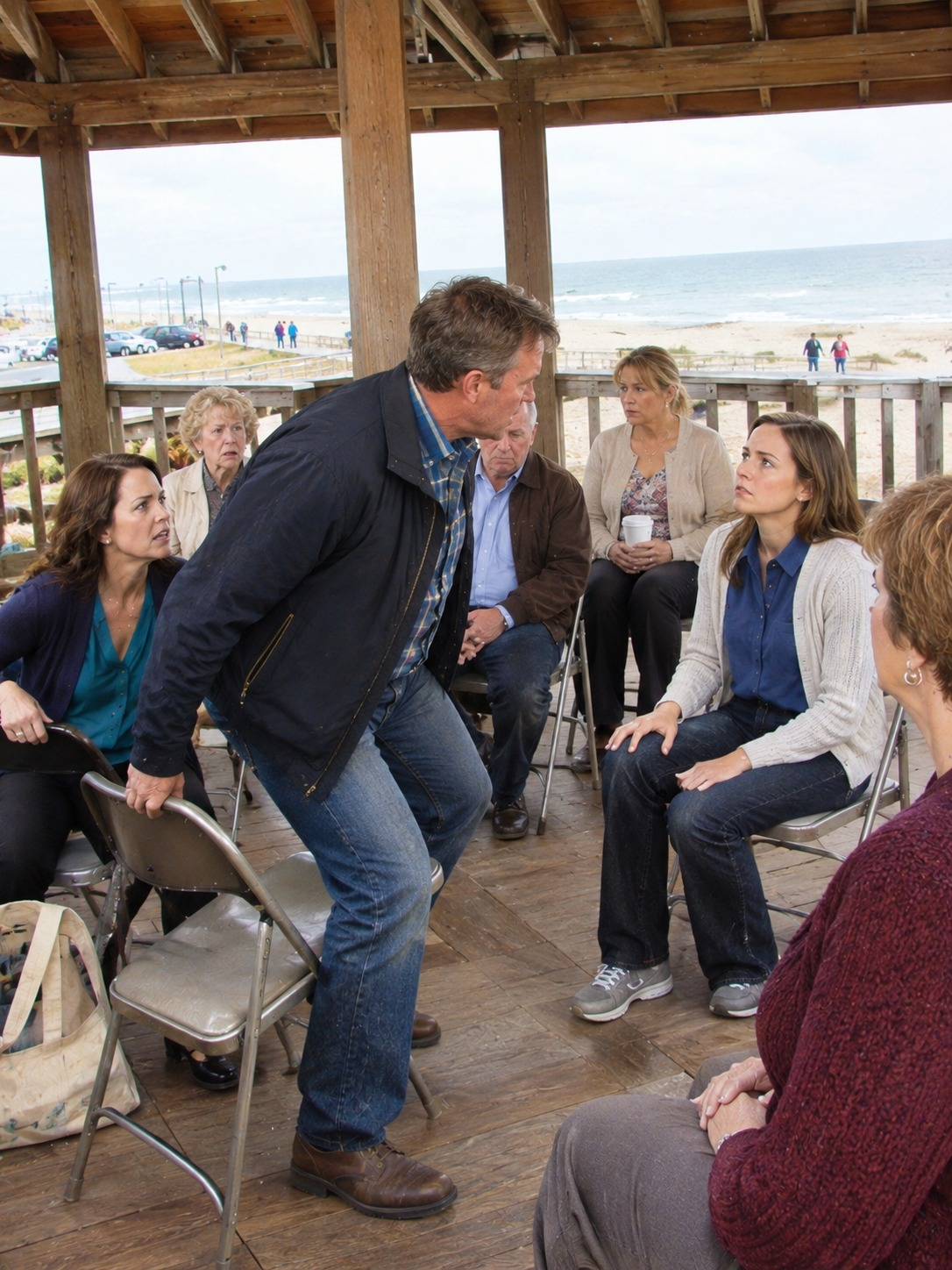
Martin's voice trembled through Rebecca's phone.
"Colin submitted the final document himself."
Nobody moved.
Rebecca leaned closer to the speaker.
"Are you certain?"
"Yes. I prepared the draft, but Colin made the final changes. He uploaded the withdrawal authorization using his own email account."
Hannah stood beside the kitchen table.
"Did he use my signature?"
Martin hesitated.
"The signature was already on the document when he sent it to me for review."
Melissa covered her mouth.
Rebecca asked another question.
"Who instructed you to include Hannah's signature?"
Martin exhaled.
"Colin."
Hannah closed her eyes.
"Did you know I hadn't authorized it?"
"I knew there was no direct confirmation from you."
"Then why didn't you stop him?"
Martin didn't answer immediately.
Finally, he said:
"I should have."
Rebecca ended the call after requesting that Martin provide a complete written statement and preserve every original file.
For several seconds, the room remained silent.
Then Hannah looked at her mother.
"Mom, did you know Dad was going to use my signature to withdraw my application?"
Melissa shook her head through tears.
"No. I swear I didn't."
"But you copied it."
"Yes."
"Without asking me."
Melissa lowered her eyes.
"Yes."
Hannah turned toward the window.
I wanted to comfort her, but I understood that she needed something more important than reassurance.
She needed the truth.
And she needed time to decide what to do with it.
Rebecca finally spoke.
"We now have a clearer picture. Melissa copied Hannah's signature onto what she believed was a replacement household document. Colin subsequently used that signature in later versions, including the withdrawal authorization. Martin prepared drafts and failed to verify the authorization. The school refused to process the request without Hannah's direct confirmation."
She looked at Hannah.
"These actions need to be evaluated through the appropriate legal process. But you have not lost your educational opportunity."
Hannah nodded.
Then she whispered:
"I just want my life back."
I took her hand.
"You can have it."
Three weeks later, the truth was no longer confined to photographs and family arguments.
Rebecca had helped Hannah obtain the school's original correspondence records.
The admissions office confirmed that Colin's withdrawal request had never been authorized by Hannah and that the school had correctly rejected it.
An independent document examiner reviewed the disputed signatures and the available original files.
The examiner found inconsistencies between Hannah's known signatures and the signatures appearing on the later agreements.
The examiner also identified evidence that the documents had been modified after the original household schedule was prepared.
The findings did not establish every detail of who had physically created each signature.
However, combined with Martin's written statement, Colin's emails, and the preserved electronic correspondence, they raised serious questions about the documents' authenticity.
Rebecca advised Hannah to pursue the matter formally rather than negotiate privately with her father.
Hannah agreed.
She also made one decision that surprised everyone.
She refused to demand money from Colin.
She wanted the disputed debt withdrawn, the false educational authorization acknowledged, and her personal records returned.
She wanted him to stop contacting her school and claiming she had agreed to obligations she had never accepted.
Nothing more.
Nothing less.
Colin initially refused.
He sent long messages explaining that he had acted for the family's benefit.
He insisted that the household agreement had been misunderstood.
He accused Melissa of betraying him and me of encouraging Hannah to abandon her responsibilities.
But the evidence was no longer something he could dismiss by raising his voice.
His own emails showed that he had tracked Hannah's educational plans.
His messages showed that he had attempted to pressure her into returning home.
Martin's statement established that Colin had requested documents concerning Hannah's withdrawal without obtaining her direct authorization.
Eventually, through Rebecca, Colin agreed to withdraw his $48,600 demand and stop presenting the family spreadsheets as an enforceable debt.
The disputed documents were preserved for the appropriate review.
Hannah's nursing school enrollment remained active.
And for the first time in years, nobody could tell her that she needed permission to pursue her future.
Melissa's part in the situation was more difficult to repair.
She came to my villa several times.
Sometimes she brought groceries.
Sometimes she simply sat with Hannah in the garden.
The first few visits were uncomfortable.
Hannah was polite, but distant.
Melissa never demanded forgiveness.
One afternoon, she arrived carrying an old photograph album.
"I found these in the closet," she said.
Hannah opened it.
There were pictures from her childhood.
Her first day of school.
Her high school graduation.
Her eighteenth birthday.
And a photograph of her standing between her younger brothers, holding both of their hands.
Hannah smiled sadly.
"I remember this."
Melissa sat beside her.
"You were always taking care of them."
"I loved them."
"I know."
Melissa looked at the photograph.
Then she said:
"I made a terrible mistake when I let your father convince me that keeping the family together meant keeping you at home."
Hannah didn't respond.
Melissa continued.
"I should have asked what you wanted. I should have protected your right to make your own decisions."
Hannah closed the album.
"Mom, I don't want to spend the rest of my life being angry with you."
Melissa's eyes filled.
"But I also can't pretend nothing happened."
"I understand."
"I need you to understand that trusting you again will take time."
Melissa nodded.
"I'll wait."
Hannah reached for her hand.
It wasn't complete forgiveness.
But it was a beginning.
And for that afternoon, it was enough.
Colin's relationship with the family changed considerably.
Paige stopped speaking to him for several months.
Beth told him she would no longer participate in family gatherings organized to pressure Hannah.
My father admitted that he had signed documents without reading them and apologized directly to his granddaughter.
He also agreed to provide Rebecca with every record he had retained.
My mother struggled most with the realization that avoiding conflict had allowed the situation to continue.
She eventually visited Hannah alone.
She didn't bring excuses.
She brought a handwritten letter.
In it, she apologized for repeatedly telling Hannah to be patient while expecting her to sacrifice her education.
She admitted that she had treated Hannah's help as something the family was entitled to rather than something Hannah had freely given.
Hannah read the letter privately.
A few days later, she called her grandmother.
They spoke for nearly forty minutes.
It wasn't a perfect reconciliation.
But they began rebuilding their relationship without pretending the past hadn't happened.
Colin took longer.
He sent Hannah several messages.
Some were angry.
Others were apologetic.
He said he had been overwhelmed by work, finances, and the responsibility of raising two young children.
He admitted that he had depended too heavily on Hannah.
But he struggled to accept that those circumstances did not give him the right to control her future.
Hannah eventually agreed to one meeting.
We arranged it through Rebecca's office, with clear boundaries.
Colin arrived looking tired.
He sat across from his daughter.
For several seconds, neither spoke.
Then he said:
"I never thought you would leave like this."
Hannah looked at him.
"I didn't leave because I stopped loving you."
He lowered his eyes.
"I know."
"I left because I couldn't keep putting my life on hold."
Colin rubbed his hands together.
"The boys miss you."
"I miss them too."
"They keep asking when you're coming home."
Hannah's expression softened.
"Tell them I'll visit when we arrange it. I want to be their sister again."
Colin nodded.
Then he looked at her.
"I'm sorry."
Hannah remained quiet.
He continued.
"I thought if I made you understand how much the family needed you, you would stay."
"You made me believe I had no choice."
"I know."
She took a breath.
"I love my brothers. But I am not responsible for raising them."
Colin nodded again.
This time, he didn't argue.
Hannah stood.
"I hope we can have a relationship someday that doesn't depend on what I can do for everyone else."
Colin looked up.
"I hope so too."
She left without promising anything she wasn't ready to give.
And that was the first honest conversation they had shared in years.
By the time summer arrived, Hannah had moved into her own room near campus.
It was small.
The furniture was inexpensive.
The kitchen barely had enough space for two people.
But everything inside belonged to her.
She arranged her textbooks beside the window.
She placed her nursing school acceptance letter in a simple frame.
And she hung the photograph of her brothers beside her desk.
She still visited them.
Sometimes they spent Saturday afternoons at my villa.
They swam, played board games, and argued over which movie to watch.
Hannah enjoyed being with them without having to manage every part of their lives.
Melissa began arranging childcare independently.
Colin reduced his travel schedule and took more responsibility for the boys.
It wasn't always easy.
There were difficult conversations and occasional disagreements.
But the responsibility no longer automatically fell on Hannah.
One Saturday, the twins arrived carrying a handmade card.
They had drawn a large red heart and written their names underneath.
Inside, in uneven handwriting, were the words:
WE ARE PROUD OF YOU, HANNAH.
She hugged them both.
Then one of them asked:
"Are you going to be a doctor?"
Hannah laughed.
"No. I'm going to be a nurse."
"Will you help people?"
"Yes."
"Like you help us?"
She looked at them.
"Exactly like that."
The boys hugged her again.
I watched from the kitchen doorway.
For once, she wasn't missing her own opportunities to take care of them.
She was simply their big sister.
And they were happy to have her.
The following September, Hannah began the clinical portion of her nursing program.
I drove her to campus on the first morning.
She wore navy-blue scrubs, white sneakers, and a small silver necklace her grandmother had given her.
Her dark hair was tied neatly behind her head.
She carried a backpack filled with notebooks, pens, and the supplies she had purchased herself.
Before getting out of the car, she turned toward me.
"Are you coming to the orientation ceremony?"
"Wouldn't miss it."
She smiled.
Then she looked through the windshield at the students entering the building.
For a moment, she didn't move.
I touched her shoulder.
"What's wrong?"
She shook her head.
"Nothing."
Then she laughed softly.
"I just can't believe I'm finally here."
I smiled.
"You worked for this."
She nodded.
"I really did."
She stepped out of the car.
Before walking toward the entrance, she turned back.
"Thank you for letting me stay with you."
I looked at her.
"You never needed to earn a place in my home."
Her eyes filled.
Then she walked toward the building.
I watched until she disappeared inside.
And I knew that the young woman entering that classroom was not the frightened girl who had arrived at my villa carrying an old blue duffel bag.
She was someone who had finally been allowed to choose her own direction.
That evening, I hosted a small dinner at the villa.
Not fifteen relatives.
Not an event planned without permission.
Just the people Hannah wanted there.
Melissa came.
Beth and Paige came.
My parents came.
The twins brought a cake decorated with blue icing.
Colin was invited too, but Hannah had decided she wasn't ready to have him at the same table.
Everyone respected her decision.
Before dinner, my mother raised a glass.
"To Hannah."
She smiled.
"To the person who worked so hard to get where she is."
Beth added:
"And to the nurse we know she'll become."
Everyone raised their glasses.
Hannah looked around the table.
Then she stood.
"I want to say something."
The room became quiet.
"I spent a long time believing that loving my family meant always saying yes. I thought being a good daughter meant putting everyone else first."
She looked at Melissa.
Then at my father.
"Now I understand that I can love my family and still have my own life."
Nobody interrupted.
"I don't want to lose the people I love. But I don't want to lose myself either."
She smiled.
"So here's to new beginnings."
We raised our glasses.
For the first time, the family gathering felt like something Hannah had freely chosen.
Later that night, after everyone had left, Hannah and I stood on the terrace.
The ocean was dark.
Lights from the neighboring houses reflected across the water.
She held two cups of tea.
"Do you remember the first message Mom sent you?" she asked.
I laughed.
"The one about filling the refrigerator?"
She nodded.
"Fifteen relatives. Friday morning. No permission required."
I smiled.
"It feels like another lifetime."
Hannah looked toward the house.
"I used to think that if I disappointed Dad, I would lose everyone."
"You didn't."
"No. But I had to learn that keeping everyone happy wasn't the same as being loved."
I nodded.
She took a sip of tea.
Then she looked at me.
"Do you regret telling them no?"
I thought about the messages, the bedroom chart, the accusations, the documents, and the months of conflict.
I thought about the girl who had arrived at my door asking for ten days of peace.
And I thought about the woman standing beside me now.
"No," I said. "Not for a second."
Hannah smiled.
Then she leaned against my shoulder.
The villa was quiet.
The refrigerator was full, but nobody had ordered me to fill it.
The guest rooms were empty, but nobody had assigned them without asking.
And the house that my mother had once called our beach house was finally being used for exactly what I had intended.
A place where people could feel safe.
A place where family meant love rather than obligation.
Most importantly, a place where Hannah had learned that she could say no without surrendering her future.
She had her nursing program.
She had her brothers.
She had a chance to rebuild her relationship with her parents on healthier terms.
And she had a home she could always return to without having to prove she deserved it.
I looked at the ocean and smiled.
For the first time, nobody was asking Hannah to give up anything.
She was finally free to build the life she had chosen.






Comments 0