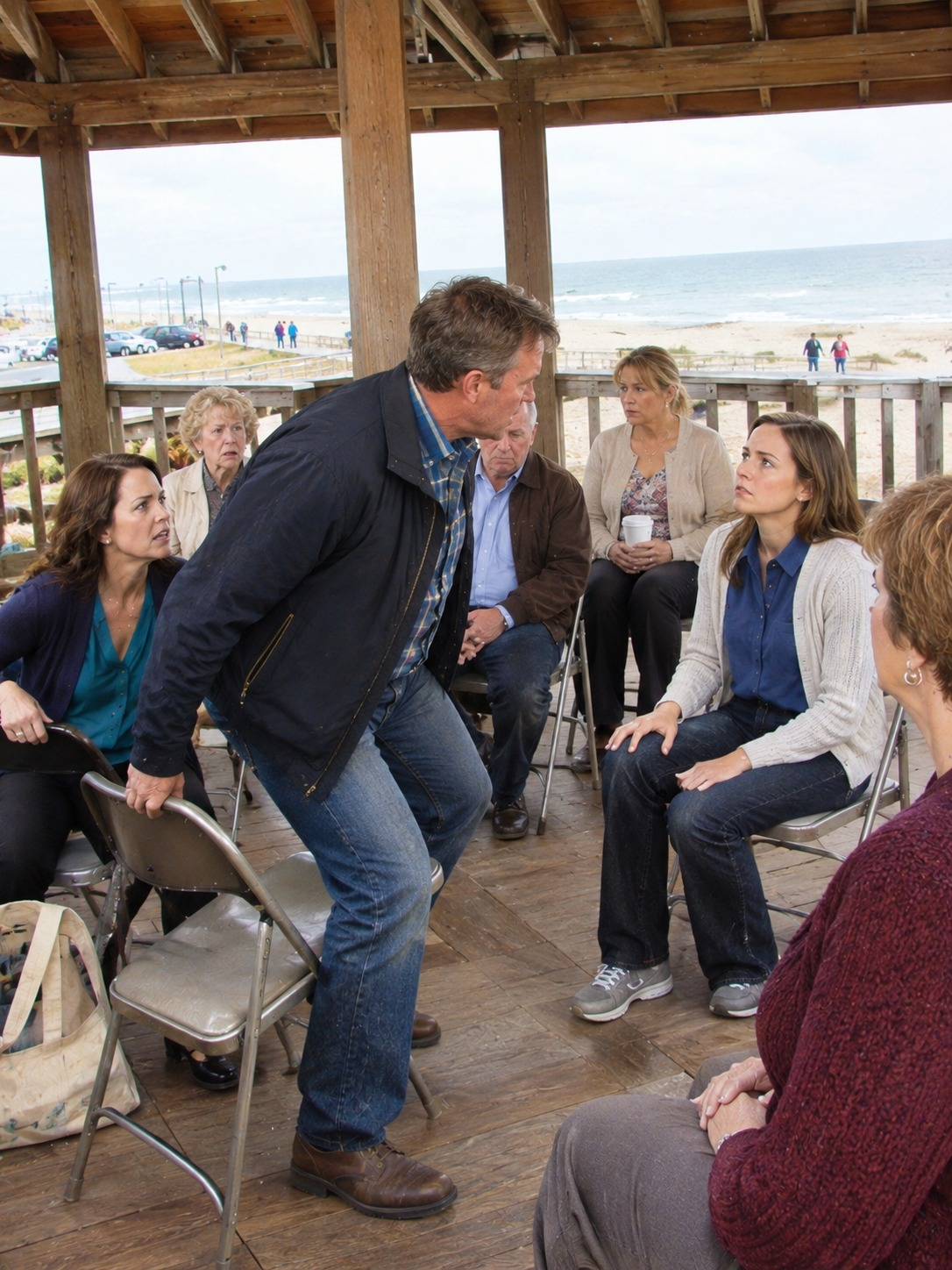
Hannah grabbed my wrist as my brother slammed his phone onto the wooden table.
"Please don't let him take me back!"
Colin stood over her, pointing at a message displayed on his screen.
But there were four words on the screen that made my blood run cold.
FIFTEEN RELATIVES. FRIDAY. YOUR VILLA.
My brother had already invited them.
And nobody had asked me.
I was standing beside the kitchen counter when I received my mother's message at 12:08 Wednesday morning.
"Fill the fridge before Friday. Fifteen relatives are staying at your beach villa."
I read it once.
Then again.
For several seconds, I simply stared at the screen.
There was no greeting. No explanation. Not even a question about whether I would be available.
It was written like an instruction from someone who believed I was responsible for carrying out whatever she decided.
I was forty-eight years old. I owned a beachfront property in Sea Bright, New Jersey, had a mortgage, paid the insurance, handled maintenance, and managed the rental calendar.
Yet my mother still communicated with me as though I were a teenager who had forgotten to complete a household chore.
I placed my coffee mug on the counter and typed a response.
"Why?"
Her answer arrived almost immediately.
"Because everyone needs somewhere to stay. Your father and I thought it would be wonderful to have the family together."
I looked at the message.
Everyone.
That word apparently included fifteen people.
I had not agreed to host a gathering. I had not offered the property. I had not even been told that anyone was considering visiting.
I typed another message.
"You haven't asked me."
Three dots appeared.
Disappeared.
Then appeared again.
Finally, my mother replied.
"Don't start making this difficult, Natalie. Your cousins have already arranged their schedules."
I leaned against the counter.
There it was.
The familiar accusation.
If I disagreed with her, I was difficult.
If I established a boundary, I was selfish.
If I refused to accommodate everyone, I was somehow responsible for ruining the family's happiness.
I had spent years trying to avoid those accusations.
For years, I had accepted invitations I didn't want, paid expenses I hadn't agreed to cover, and allowed relatives to treat my belongings as though they were community property.
But the villa was different.
I had bought it six years earlier.
The purchase had required nearly everything I had saved.
I sold my previous home, used the equity to make a substantial down payment, and accepted a mortgage that still required careful budgeting.
There had been no family inheritance.
No financial gift from my parents.
No secret contribution from Colin.
Every improvement had come from my own income.
The property was mine.
Not ours.
Mine.
I looked at my mother's message again.
Then another notification appeared.
My father had entered the conversation.
"Your mother has worked hard to organize this. Don't embarrass her."
I exhaled slowly.
My father had always been particularly skilled at making other people's boundaries sound like personal insults.
He rarely raised his voice.
He didn't need to.
One disappointed sentence from him could make me feel twelve years old again.
Before I could answer, Colin joined the conversation.
My older brother sent a laughing emoji.
Then he wrote:
"We'll be there whether you like it or not."
I stared at those words.
For a moment, I almost laughed.
Not because the message was funny.
Because it was so unbelievably arrogant.
Colin had spent most of his adult life assuming that other people would eventually accommodate him.
He was good at making demands sound like decisions.
He could turn a suggestion into an obligation simply by repeating it confidently enough.
And our parents had spent decades reinforcing that behavior.
When Colin needed money, they called it family support.
When he needed childcare, they called it helping his children.
When he needed someone to organize a holiday, they called it keeping the family together.
Whenever I objected, I was reminded that I had no children, fewer responsibilities, and therefore more freedom.
Apparently, owning a beach villa meant I had unlimited time, unlimited groceries, and unlimited spare bedrooms.
I opened the group chat.
My mother had already begun discussing sleeping arrangements.
Paige, my cousin, offered to bring breakfast muffins.
Uncle Robert asked whether the barbecue grill was available.
Someone else wanted to know if the downstairs bathroom had been renovated.
Then my mother posted a photograph of the villa.
It was an old picture taken during a summer visit.
She had added a caption.
"Our family beach house is ready for another wonderful weekend!"
I looked at the photograph for several seconds.
My house.
My furniture.
My deck.
My ocean view.
And beneath the picture, people were already discussing who would sleep where.
I typed one word.
"No."
I sent it.
The conversation stopped for approximately seven seconds.
Then my mother responded.
"Natalie is stressed. She always gives in eventually."
I read that sentence twice.
She wasn't saying I would reconsider.
She wasn't even pretending to respect my decision.
She was telling everyone that my refusal didn't matter.
My answer was simply an inconvenience they expected to outlast.
I locked my phone and walked toward the guest bedroom.
Hannah was sitting on the edge of the bed, surrounded by nursing school documents.
She had arrived eleven days earlier with an old blue duffel bag, two suitcases, and a folder containing every document she needed for her clinical program.
At twenty-four, she had finally been accepted into a nursing program after years of working evenings and weekends.
She had spent six years helping raise her younger twin brothers.
She collected them from school, prepared meals, supervised homework, and stayed home whenever one of them became sick.
Her mother, Melissa, worked late shifts at a hotel.
Her father, Colin, traveled frequently for work.
Somehow, the responsibility had gradually become Hannah's.
It had never been formally discussed.
Nobody had asked whether she wanted that arrangement.
It had simply become expected.
When the nursing program accepted her, Hannah thought her family would be proud.
Instead, Colin told her to postpone enrollment.
He said the boys were too young.
He said Melissa needed help.
He said family responsibilities came first.
And when Hannah explained that she had already spent years postponing her own plans, he accused her of abandoning everyone.
She had called me that evening.
Her voice had been unusually quiet.
"Aunt Natalie, could I stay with you for a few days?"
I hadn't asked her to explain immediately.
I simply said yes.
She arrived the following afternoon.
I offered her the guest bedroom and told her she could stay until she was ready to move into the affordable room she had already rented near campus.
Ten days.
That was all she needed.
A little quiet.
A little space.
And the chance to prepare for the future she had worked so hard to earn.
I had not realized how much her arrival would upset Colin.
Now, standing in the guest bedroom doorway, I looked at her.
"Your father has invited fifteen people here for Friday."
Her hands stopped moving.
"What?"
I showed her the message.
She read it slowly.
Then she looked up.
"Because of me?"
"I don't know yet."
She lowered her eyes.
I recognized the expression immediately.
It was the same expression she wore whenever someone made her feel responsible for another person's disappointment.
"Hannah, look at me."
She did.
"You haven't done anything wrong."
Her lips pressed together.
I sat beside her.
"You're allowed to go to school. You're allowed to move out. You're allowed to build a life that doesn't revolve around taking care of everyone else."
She nodded, but I could tell she wasn't convinced.
Her phone vibrated.
A message from Colin appeared.
She glanced at it.
Then another arrived.
I didn't ask her to show me.
Instead, I returned to the kitchen and began preparing lunch.
A few minutes later, she joined me.
She placed her phone on the counter.
"He's telling everyone you're keeping me here."
I stopped cutting vegetables.
"What exactly did he say?"
"That I left without thinking. That you encouraged me to abandon my brothers. That the family needs to bring me home before I make a permanent mistake."
I put down the knife.
"You're twenty-four."
"I know."
"You chose this program."
"I know."
"You rented your own room."
"I know, Aunt Natalie."
Her voice cracked slightly.
I reached across the counter and covered her hand.
"Then why are you letting him make you feel guilty?"
She looked away.
"Because he always does this."
For a moment, neither of us spoke.
Outside, the ocean was visible beyond the distant rooftops.
Hannah picked up her phone again.
"I don't want them coming here."
"Neither do I."
"But Grandma will say we're embarrassing her."
I gave a small nod.
"She already has."
Hannah looked at me.
I wasn't smiling.
I wasn't angry anymore, either.
Something had changed.
I had spent years believing that avoiding conflict was the same as protecting my peace.
Now I understood that sometimes silence simply gave other people more room to make decisions for you.
That afternoon, I called my mother.
She answered on the second ring.
"Finally. I was wondering when you'd start being reasonable."
"Mom, nobody is staying at my property on Friday."
A long sigh came through the phone.
"Natalie, please. People have already made plans."
"Then they need to change them."
"Your brother is coordinating everything."
"That's his problem."
She lowered her voice.
"Don't make this about ownership."
I looked toward the large window overlooking the garden.
"It is my property, Mom."
"We're family."
"That doesn't give you permission to invite fifteen people into my home."
She became quiet.
Then she said something that made me sit up straighter.
"Colin says Hannah needs all of us right now. We can't let her make this mistake."
I glanced toward the hallway.
Hannah was standing there.
She had heard everything.
I kept my voice steady.
"Hannah is an adult. She doesn't need to be rescued."
My mother interrupted.
"You don't understand what's happening."
"Then explain it."
She hesitated.
For the first time during the entire conversation, she seemed unable to find an immediate answer.
Then she said:
"Your brother will handle this when he gets there."
The call ended.
I stood holding my phone.
Hannah slowly walked into the kitchen.
"What did she say?"
I looked at her.
"Your father and grandmother aren't planning a normal family weekend."
Her face changed.
Before either of us could say anything else, my phone vibrated again.
A new message had appeared in the family group chat.
It was a photograph of a color-coded bedroom assignment chart.
And beside the master suite, where my name should have been, someone had written:
AVAILABLE — NATALIE CAN SLEEP DOWNSTAIRS.






Comments 0