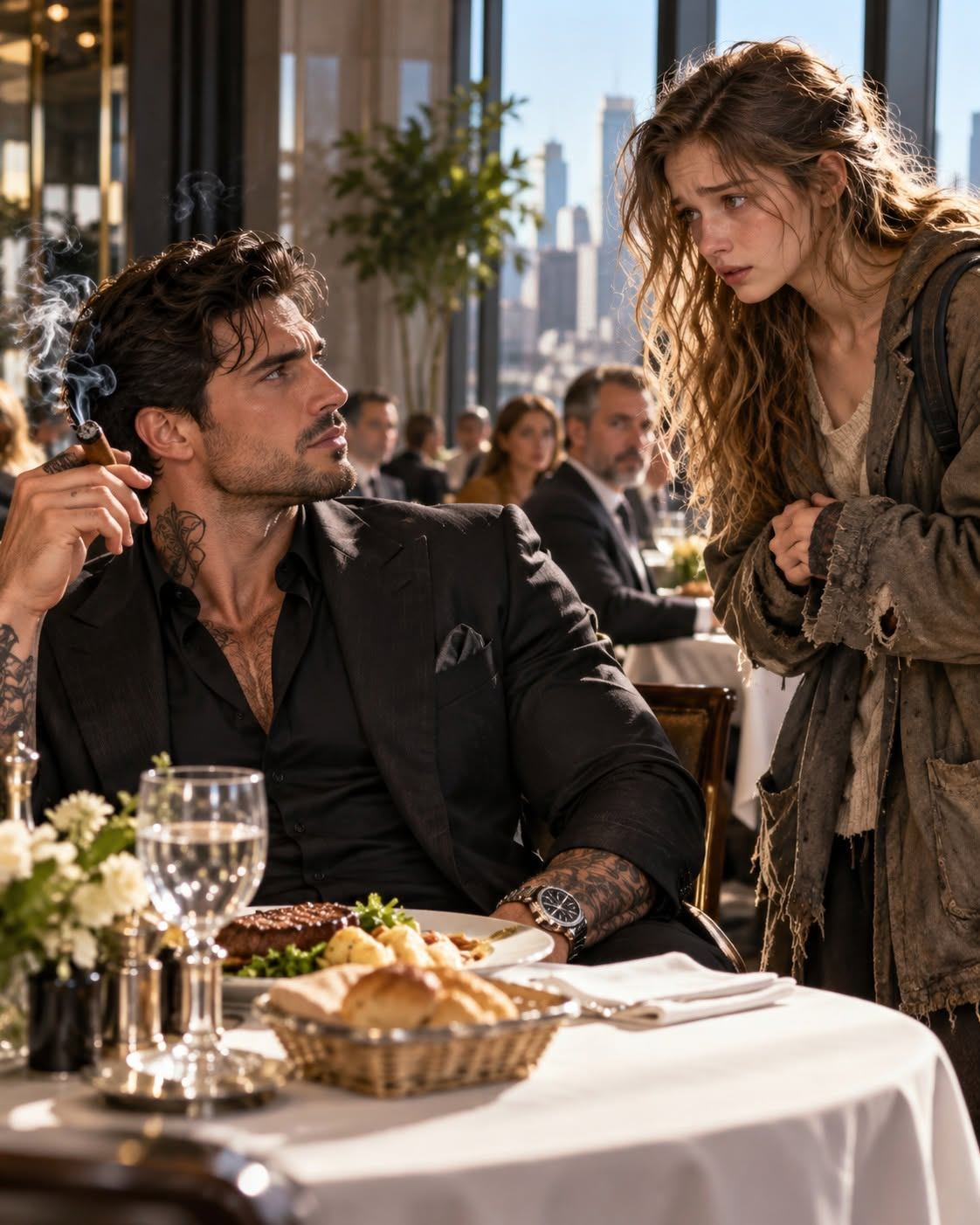
"Sir, please. I only wanted the bread!"
The young woman's voice trembled as the waiter reached for her arm.
I looked down at the folded paper sticking out of her torn coat pocket.
Four faded words were written across it.
St. Catherine's Children's Home.
I knew that name.
And suddenly, the hungry stranger standing beside my table was no longer a stranger.
At 9:47 P.M. on a Thursday in January, I was sitting in one of Chicago's most expensive restaurants, staring at a dinner I no longer wanted.
My name is Vincent Whitmore.
I'm forty-one years old.
For twenty years, I had built a criminal empire that stretched through shipping companies, luxury hotels, private clubs, and businesses whose owners preferred never to mention my name.
People called me powerful.
Others called me dangerous.
Some simply lowered their voices whenever I entered a room.
I had grown accustomed to all of it.
Fear was predictable. Respect could be purchased. Loyalty could be negotiated.
But kindness?
Kindness was a currency I had stopped believing in a long time ago.
That night, I had just finished a meeting with three executives who had spent two hours explaining why a shipping contract worth eighteen million dollars had fallen apart.
I had listened without raising my voice.
Then I had told them to leave.
Now I was alone, sitting near the enormous windows overlooking downtown Chicago.
A half-eaten steak rested on my plate.
Beside it sat a silver basket filled with warm bread.
I had barely touched either.
My phone vibrated.
A message from my security chief, Marcus Hale.
Everything clear downstairs. Car ready whenever you are.
I turned the phone facedown.
I wasn't ready to leave.
Not because I enjoyed the restaurant.
Because I hated going home.
My penthouse occupied the top two floors of a building overlooking Lake Michigan. It had six bedrooms, a private theater, a library, and more square footage than most families would ever need.
Yet every night, I walked through those rooms alone.
I had money.
I had influence.
I had men who would answer my calls at three in the morning.
What I didn't have was anyone who would notice if I stopped calling.
I reached for my water glass.
That was when I heard her.
"Excuse me, sir."
Her voice was so quiet I almost missed it.
I turned.
A young woman stood beside my table.
She couldn't have been older than twenty-seven.
Her long dark-blonde hair had been gathered into a messy knot, though half of it had escaped and fallen around her face.
Her blue eyes were tired.
Not the kind of tired that came from a long day at work.
The kind that came from too many nights spent wondering where you would sleep.
She wore a thin gray-brown coat with a torn sleeve. Her boots were worn at the toes, and a faded black backpack hung from one shoulder.
Her hands were red from the cold.
She looked at me briefly.
Then her eyes dropped to the bread.
"Are you going to finish that?"
I stared at her.
"Finish what?"
She swallowed.
"The bread, sir."
For a moment, I thought I had misunderstood.
People approached me constantly.
Some wanted business opportunities.
Some wanted favors.
Others wanted money or protection.
This woman wanted the bread I hadn't eaten.
"You're asking for my leftovers?"
Her cheeks turned pink.
"I'm sorry. I know it's strange."
She glanced toward the restaurant entrance.
"I haven't eaten since Tuesday."
Something tightened inside my chest.
It was Thursday night.
"Since Tuesday?"
She nodded.
"I tried the shelter this afternoon, but they didn't have enough meals for everyone. I thought maybe..."
Her voice faded.
She looked embarrassed.
As though hunger were something she needed to apologize for.
Before I could answer, a waiter hurried toward us.
"Miss Carter!"
The young woman flinched.
"I told you already," he continued. "You cannot approach customers."
"I'm sorry," she whispered. "I was just asking—"
"You need to leave."
He reached toward her elbow.
"Don't."
My voice wasn't loud.
It didn't need to be.
The waiter stopped.
He looked at me.
Then at the watch on my wrist.
Then at the tattoos visible beneath my shirt collar.
Recognition crossed his face.
"Mr. Whitmore."
I placed my glass on the table.
"What's your name?"
"Andrew, sir."
"Andrew, did she threaten anyone?"
"No, sir."
"Did she steal anything?"
"No."
"Then why are you treating her like a criminal?"
His face reddened.
"Restaurant policy, Mr. Whitmore. We have to consider the comfort of our guests."
I looked around.
Several people had stopped eating.
A woman at a nearby table was watching with open curiosity.
Two businessmen quickly looked away when I caught their eyes.
I turned back to Andrew.
"Bring another chair."
He blinked.
"Sir?"
"And another place setting."
"Of course."
He disappeared so quickly that I almost smiled.
The young woman remained standing.
"Please," she said. "You don't have to do that."
"What's your name?"
"Emma."
"Emma what?"
"Emma Carter."
"I'm Vincent."
She looked surprised.
Not because of my name.
Because I had offered it.
"Thank you, Vincent."
I couldn't remember the last time a stranger had spoken my first name without hesitation.
"Sit down, Emma."
She glanced at the chair Andrew was carrying toward us.
"I don't belong here."
I studied her for a moment.
"Who told you that?"
She looked confused.
"Nobody had to."
I pulled the bread basket closer to the empty place setting.
"Sit down."
She hesitated.
Then she sat.
Andrew returned with a plate and silverware.
"Would you like a menu, Mr. Whitmore?"
"No."
I looked at Emma.
"Do you have any allergies?"
She shook her head.
"Good. Bring hot soup, roasted chicken, vegetables, fresh bread, and whatever dessert the kitchen recommends."
Emma's eyes widened.
"Sir, that's too much."
"Vincent."
"What?"
"My name is Vincent."
She lowered her eyes.
"Vincent, I can't pay for all that."
"I didn't ask you to."
"But—"
"Emma."
She looked up.
"You're hungry. Eat."
For several seconds, she didn't move.
Then she picked up a piece of bread.
She broke it carefully in half.
And began eating.
I pretended to study my phone.
But I noticed everything.
The way she took small bites at first.
The way her shoulders gradually relaxed.
The way she glanced around the restaurant, almost expecting someone to tell her she'd made a mistake.
When the soup arrived, she wrapped both hands around the bowl.
The steam rose toward her face.
She closed her eyes for a moment.
That simple gesture did something to me.
I had watched men celebrate million-dollar deals without showing half as much gratitude as this woman showed toward a bowl of soup.
"Slow down," I said gently. "There's plenty."
She nodded.
"I'm sorry."
"You apologize a lot."
She gave a small, embarrassed smile.
"Bad habit."
"Who taught you that?"
Her smile disappeared.
"Life, I guess."
I leaned back.
For the first time that evening, I was interested in something other than business.
"How old are you?"
"Twenty-seven."
"Where are you staying?"
She hesitated.
"Sometimes shelters."
"And tonight?"
She looked at the soup.
"I haven't figured that out yet."
I waited.
Finally, she added, "There's a laundromat on West Madison. The dryer vent blows warm air into the alley. Sometimes I sleep near it."
I stared at her.
Outside the windows, Chicago was freezing.
The temperature had fallen well below zero.
"How long have you been living like that?"
"Eight months."
Eight months.
I thought about my penthouse.
The empty bedrooms.
The guest bathroom with heated floors.
The refrigerator filled with food I rarely ate.
And this young woman sleeping behind a laundromat.
"What happened?"
Emma put down her spoon.
"Everything happened."
I said nothing.
She looked toward the windows.
"A year ago, I had a little apartment. Nothing fancy. One bedroom. The heater made a terrible noise, and the kitchen window wouldn't close all the way."
A faint smile touched her lips.
"But it was mine."
"What did you do?"
"I worked at a bookstore during the day and took classes at night."
"Classes for what?"
"Teaching."
Her expression changed.
For the first time, I saw something brighter than exhaustion in her eyes.
"I wanted to teach third grade."
"Why third grade?"
"Because they're old enough to ask interesting questions and young enough to believe the answers might be wonderful."
I smiled.
She noticed.
"What?"
"Nothing."
"You're laughing at me."
"I'm not."
"You think it's silly."
"Actually, I think it's the first sensible thing I've heard all day."
She laughed.
It was quiet and unexpected.
And somehow, it made the restaurant feel less empty.
"What happened to school?" I asked.
Her smile faded.
"The bookstore closed. I fell behind on tuition. I found another job, but they cut my hours. Then I got sick for a few weeks."
"What kind of sick?"
"Nothing serious. Just a bad respiratory infection."
She shrugged.
"But missing work meant missing rent. My landlord gave me notices. I tried payment plans. I tried everything."
"And then?"
"Then I had nowhere to go."
She said it without drama.
That made it worse.
I had known men who lost fortunes through arrogance, gambling, or greed.
Emma had lost everything because she'd gotten sick and missed a few paychecks.
"Do you have family?"
She shook her head.
"Not really."
"Not really?"
"I grew up in foster care."
I waited.
She took another sip of soup.
"Mostly group homes. Different places. Different people."
"Where?"
"Wisconsin."
Something shifted in my mind.
I couldn't explain why.
"Where in Wisconsin?"
"Outside Milwaukee."
I felt my fingers tighten around my glass.
Emma continued eating, unaware.
"There was this one place where I stayed longer than anywhere else."
I kept my voice even.
"What place?"
She glanced at me.
"St. Catherine's Children's Home."
The room seemed to grow quieter.
I didn't move.
I didn't breathe.
For twenty years, I had avoided hearing those words.
St. Catherine's.
A brick building outside Milwaukee.
A place connected to the worst betrayal of my life.
A place where a man named Richard Vale had hidden something that belonged to me.
A place my father had warned me never to investigate.
I looked at Emma.
She was still holding her spoon.
Still wearing that exhausted expression.
Still completely unaware that she'd just opened a door I had spent two decades keeping closed.
"Vincent?"
I blinked.
"Yes?"
"Did I say something wrong?"
"No."
But my voice sounded different.
Even to me.
Emma noticed.
"You look upset."
"I'm fine."
She lowered her spoon.
"I shouldn't have talked so much."
"That's not it."
"Then what?"
I studied her face.
Her blue eyes.
Her cheekbones.
The small crease between her eyebrows when she worried.
Something about her looked familiar.
Not familiar in the way you recognize someone you've met before.
Familiar in the way an old photograph can suddenly come alive.
"How old were you when you arrived at St. Catherine's?"
She frowned.
"I'm not sure. Maybe six or seven."
"Do you remember who brought you there?"
Her expression changed.
"Why?"
"Just curious."
She looked down.
"I don't remember much from before that."
"Nothing?"
"Little things."
"Like what?"
She hesitated.
"A woman singing."
I felt a chill.
"What woman?"
"I don't know."
She rubbed her thumb against the edge of the soup bowl.
"I remember her voice. Sometimes I dream about it."
"What did she sing?"
Emma looked uncomfortable.
"It's silly."
"Tell me."
She took a breath.
"Something about stars."
I stared at her.
"Stars?"
She nodded.
"She used to say that even when the sky was dark, the stars were still there."
My heart began beating harder.
I knew those words.
I had heard them before.
Twenty years ago.
From someone I had believed was dead.
I reached for my phone.
Emma watched me.
"Vincent?"
I opened an encrypted folder I hadn't touched in years.
Inside were photographs.
Documents.
Names.
Memories I had buried beneath business deals and violence and two decades of regret.
I scrolled past an old warehouse.
A newspaper clipping.
A photograph of my father.
Then I found it.
A faded picture taken outside St. Catherine's Children's Home.
Three adults stood near the entrance.
One was Richard Vale.
The second was a woman whose face had been partly hidden by the photographer's finger.
And the third—
I stopped.
The third person was holding a little girl.
The child had dark-blonde hair.
Blue eyes.
And a small silver pendant shaped like a star.
I looked up at Emma.
"Do you have anything from your childhood?"
She hesitated.
"What do you mean?"
"Anything you kept. A photograph. A toy. Jewelry."
Her expression became guarded.
"Why?"
"Emma, please."
She studied me.
Then slowly reached inside her coat.
From beneath her sweater, she pulled out a thin chain.
A small silver star hung from it.
The same pendant.
My throat went dry.
"Where did you get that?"
She looked down at the necklace.
"I've always had it."
"Who gave it to you?"
"I don't know."
I leaned forward.
"May I see it?"
She hesitated.
Then carefully removed the chain and placed it in my palm.
The pendant was scratched.
One point of the star was slightly bent.
I turned it over.
There were letters engraved on the back.
Two initials.
E. W.
My hands went cold.
I knew those initials.
I had seen them on letters.
On birthday cards.
On a photograph I'd kept locked away for twenty years.
Eleanor Whitmore.
My younger sister.
The sister who had disappeared when she was nineteen.
The sister my father claimed had died in a car accident.
The sister whose body I had never been allowed to see.
I looked at Emma.
Twenty-seven years old.
Raised outside Milwaukee.
A silver star pendant.
A woman singing about stars.
It was impossible.
And yet—
"Vincent?"
Her voice pulled me back.
"Why are you looking at me like that?"
I closed my hand around the pendant.
I wanted to ask a hundred questions.
Instead, I forced myself to breathe.
"Emma, do you remember anything else about the woman who sang to you?"
She looked frightened now.
"Not much."
"Try."
She swallowed.
"Sometimes she called me her little star."
My chest tightened.
Eleanor used to call everyone she loved that.
Our mother had called her the same thing.
"Anything else?"
Emma stared at me.
Then her expression changed.
"Actually..."
She paused.
"What?"
"There's something I've never told anyone."
I leaned forward.
She looked at the pendant in my hand.
"When I was little, I used to have this dream."
"What dream?"
"A woman was holding me in a car. She was crying. There were headlights behind us."
I stopped breathing.
Emma continued.
"She kept telling me not to be afraid."
Her voice trembled.
"And she said that if anything happened, I needed to remember a name."
"What name?"
Emma looked directly into my eyes.
"Whitmore."
The word struck me harder than any threat I'd received in twenty years.
I sat motionless.
Emma watched me with growing alarm.
"Vincent?"
Before I could answer, my phone vibrated.
Marcus.
I ignored it.
It vibrated again.
Then a third time.
I glanced at the screen.
Urgent. Call me.
I opened the message.
A photograph appeared.
It showed the restaurant entrance.
Two men in dark coats were standing outside.
Beneath the photograph, Marcus had written:
Boss, we have a problem. Someone followed the girl here.
I stared at the screen.
Another message arrived.
One of them just showed security a photograph of Emma Carter.
I slowly looked toward the restaurant doors.
Through the glass, I saw one of the men speaking to the maître d'.
Then he raised his phone.
On the screen was a photograph of Emma.
And beneath it were three words.
BRING HER BACK.
I stood.
Emma flinched.
"Vincent? What's happening?"
I moved between her and the entrance.
The man outside looked up.
Our eyes met.
And then he smiled.
Not because he'd found Emma.
Because he'd recognized me.
My phone vibrated one last time.
A new message appeared from an unknown number.
You were supposed to leave the girl alone, Vincent.
I stared at the screen.
Then another message arrived.
Ask her what happened to your sister.
At that exact moment, Emma reached for the silver pendant.
Her fingers brushed mine.
And she whispered something I would never forget.
"Vincent... why does that man outside look exactly like the person in my nightmares?"






Comments 0