The basement door opened.
Every person in the room turned.
A woman stood at the top of the stairs.
She was older than the photographs Thomas had seen. Her dark hair was streaked with gray, and her face carried the marks of years spent away from the family she had once called home.
But her eyes were unmistakable.
Elizabeth dropped the document.
"Mom?"
The woman descended one step.
"Elizabeth."
The young woman covered her mouth.
For several seconds, neither moved.
Then Elizabeth rushed toward the staircase.
Catherine Bell opened her arms, and her daughter fell against her.
They held each other tightly.
Thomas watched in disbelief.
Catherine was alive.
The woman everyone had believed dead for twenty-seven years was standing in the courthouse basement.
Margaret approached slowly.
"Catherine?"
Catherine looked toward her.
"Hello, Margaret."
Margaret began crying.
She reached for her sister-in-law, and the two women embraced.
Thomas remained beside the table.
He looked at Samuel.
Then at the photograph.
Then at Catherine.
"How many people in this family have been declared dead without actually dying?"
Samuel gave a tired smile.
"More than I would have preferred."
Thomas approached Catherine.
"Where have you been?"
Catherine released Elizabeth's hands.
"Trying to keep you all alive."
Thomas shook his head.
"That's not an explanation."
"No," she replied. "But it's the truth."
She looked toward Silas.
"Especially where he is concerned."
Silas stood beside the table.
His confidence had disappeared.
"Catherine, you should not be here."
She turned toward him.
"Neither should you."
The sheriff moved closer.
"Mrs. Bell, I need to ask you some questions."
Catherine nodded.
"I expected that."
She reached into her handbag and removed a small identification card, followed by several legal documents.
"My name is Catherine Bell. I am the surviving daughter of William Bell, and I am here to correct a fraudulent property transfer filed under my name."
Elizabeth examined the documents.
"Mom, why did you sign the transfer order?"
Catherine looked at her daughter.
"I didn't."
She took the court order from the table.
Then she examined the signature.
"This is a forgery."
Samuel approached.
"You're certain?"
Catherine nodded.
"Absolutely."
She pointed toward the bottom of the page.
"Look at the date. The judge's office used an old registration stamp. That particular stamp was retired more than ten years ago."
Thomas looked at the document.
"So someone created a false order using your name."
Catherine nodded.
"Silas needed my branch of the family to approve the transfer. Since he believed I was dead, he thought he could manufacture my consent."
Silas laughed bitterly.
"You cannot prove that."
Catherine looked at him.
"Actually, I can."
She opened her handbag again.
Inside was a thick envelope containing certified documents, bank statements, and copies of correspondence.
"I kept records of every contact Jonathan Rook's people made with me."
Thomas frowned.
"You knew about Jonathan?"
"From the beginning."
Catherine explained that she had discovered the fraudulent transfers while helping her father organize the family's legal records.
She had confronted Jonathan Rook.
He had offered her money to remain silent.
She refused.
Then the threats began.
Her husband was followed.
Her home was searched.
Eventually, she was forced to leave Wyoming with her infant daughter.
She had spent years moving between different towns, changing addresses, and using her mother's maiden name.
When she learned that Silas had imprisoned Margaret, she began gathering evidence.
She had contacted Samuel.
She had also arranged for copies of the original witness statements to be sent to investigators.
"I wanted to come back sooner," Catherine said. "But I couldn't risk leading them to Elizabeth."
Elizabeth held her mother's hand.
"You could have told me."
Catherine looked at her.
"I know."
"You let me believe I had no family."
"I thought distance was the only way to keep you safe."
Elizabeth's eyes filled.
"I needed my mother."
Catherine lowered her head.
"I know, sweetheart. And I'm sorry."
The words were simple.
But they carried twenty-seven years of regret.
Elizabeth embraced her again.
Thomas looked away.
He knew that some wounds could not be repaired in a single conversation.
But at least this time, the family had a chance to begin.
Silas suddenly moved toward the staircase.
The sheriff stepped in front of him.
"Stay where you are."
Silas looked at the deputies.
"You cannot arrest me."
The sheriff picked up the witness register.
"Actually, I can."
Silas shook his head.
"On what grounds?"
The sheriff looked at the documents.
"Fraud, unlawful confinement, forged property transfers, conspiracy, and obstruction of justice."
Silas laughed.
"You think those papers are enough?"
Samuel stepped forward.
"They are only the beginning."
He pointed toward the leather folder.
"I have signed testimony from the original witnesses. I have medical records from St. Agnes. I have copies of the fraudulent death certificate and the original inheritance agreement."
Catherine placed her documents beside his.
"And I have financial records linking Silas to every major transfer."
Robert approached.
"And I have the bank accounts."
Silas looked at him with open hatred.
"Traitor."
Robert nodded.
"Yes. I was."
He looked toward Thomas.
"But I'm done helping you."
The sheriff turned toward the deputies.
"Take him into custody."
The two men approached Silas.
For a moment, he looked as though he might resist.
Then he noticed the weapons.
His shoulders dropped.
The man who had controlled the Bell family for decades finally had nowhere left to hide.
As the deputies placed handcuffs around his wrists, Silas looked at Thomas.
"You think this makes you a winner?"
Thomas stood still.
"No."
Silas frowned.
Thomas continued.
"It makes you accountable."
Silas was led toward the stairs.
At the doorway, he turned once more.
"You'll never recover what you lost."
Thomas looked toward Margaret.
Then Clara.
Then Elizabeth.
"Perhaps not," he replied. "But I know what I still have."
Silas disappeared.
The basement door closed.
For several seconds, nobody spoke.
Then Samuel sat down.
He looked exhausted.
"Well," he said quietly, "I believe that's enough excitement for one morning."
For the first time in years, Margaret laughed.
It was a small sound.
Almost unfamiliar.
But Thomas recognized it immediately.
It was the laugh he had missed.
The laugh he had believed he would never hear again.
The following weeks were difficult.
The investigation revealed that Silas had been involved in fraudulent property transfers across several counties.
Elias Mercer was arrested after investigators discovered records connecting him to the forged signatures.
Dr. Edward Holloway was charged with falsifying medical documents and participating in Margaret's unlawful confinement.
Judge Nathaniel Cross resigned before the investigation was complete. His financial records were later examined, and he was charged with corruption and conspiracy.
Sheriff Daniel Hargrove cooperated with investigators.
He admitted that he had knowingly ignored evidence and accepted payments from companies connected to Silas.
His cooperation did not erase his responsibility.
He lost his position and faced legal consequences.
Robert also faced charges.
He admitted his involvement in the fraudulent transfers and gave a complete account of the operation.
His testimony helped investigators recover financial records that would otherwise have remained hidden.
Thomas did not immediately forgive him.
Neither did Clara.
But Robert continued cooperating, even when doing so meant admitting things that made him look worse.
He stopped making excuses.
He stopped asking for sympathy.
He simply told the truth.
For Thomas, that was the first meaningful change he had seen in his brother.
Samuel's testimony became central to the investigation.
The witness register was authenticated.
The original inheritance agreement was recovered from beneath Daisy's grave with the help of a specialist team.
Inside the sealed compartment were the original deed, William Bell's final instructions, and the missing pages that established the rights of all three family branches.
The documents proved that the northern ridge had never been intended for private ownership.
It was a protected family trust.
The twelve families who had lost their properties were finally identified.
Some had died.
Others had grown old believing that the land would never be returned.
But their children and grandchildren were still there.
The legal process took months.
It required hearings, testimony, and careful examination of every transfer.
Catherine, Margaret, Samuel, and Elizabeth attended the proceedings.
Thomas attended every hearing he could.
Clara accompanied him whenever the children could be left with Anna.
At the final hearing, the court recognized the original trust.
The fraudulent transfers were declared invalid.
The families who had lost their land received legal recognition of their claims, and a restoration process began.
The northern ridge was placed under a protected community trust.
The Bell family would remain its guardian, but no individual could sell or mortgage the property for personal gain.
Clara was formally recognized as the next family guardian.
Elizabeth and Catherine received their rightful place in the family agreement.
And Eliza, as the youngest descendant, would one day have a voice in the trust's future.
When the judge announced the decision, Thomas closed his eyes.
He thought of his father.
His mother.
Margaret.
The families who had been cheated.
And the little girl who had once stood outside three different doors, asking strangers for help.
For the first time, the truth had survived.
Spring arrived slowly in Wyoming.
The snow melted from the pasture.
The creek began flowing again.
The horses returned to the lower fields.
And the ranch house became noisy.
Not with arguments.
Not with accusations.
But with children.
Eliza ran through the yard every morning.
Toby had learned to walk.
He followed his sister everywhere, sometimes falling into the grass and laughing when she helped him stand.
Margaret spent hours in the kitchen.
She made the apple pie Clara remembered from childhood.
She repaired old quilts.
She planted flowers beside the blue door.
Catherine moved into the small house near the barn.
She wanted to remain close to Elizabeth while allowing her daughter to build an independent life.
Samuel visited every Sunday.
He brought old books for Eliza and taught her how to identify the different marks on the original land surveys.
He also taught her something more important.
He explained that a document was only as honest as the people who were willing to stand behind it.
Elizabeth became involved in restoring the community records.
She worked with local historians and the descendants of the twelve affected families.
The old courthouse basement was reopened.
The room where Samuel had been imprisoned became part of a public historical archive.
A small plaque was placed near its entrance.
It carried the names of the families who had fought to recover their land.
And beneath those names was a sentence from William Bell's original agreement.
LAND IS NOT A PRIZE TO BE STOLEN. IT IS A PROMISE TO BE KEPT.
Thomas visited the plaque often.
Each time, he remembered how close his family had come to losing everything.
One afternoon, Robert returned to the ranch.
He stood outside the blue door holding a small wooden box.
Thomas opened it.
For several seconds, the brothers looked at each other without speaking.
Robert placed the box on the porch.
"I found this in Father's old belongings."
Thomas opened it.
Inside was a photograph of the two brothers as boys.
They stood beside the first barn.
Thomas had one arm around Robert's shoulders.
Both were smiling.
Robert looked at the photograph.
"I used to think I could get everything I wanted without losing anything."
Thomas said nothing.
"I was wrong."
Robert lowered his eyes.
"I'm not asking you to forgive me."
"Good."
Robert nodded.
"I just wanted you to have this."
Thomas looked at his younger brother.
He saw the man who had betrayed him.
But he also remembered the boy who had once followed him across the pasture.
"I don't know if we'll ever be brothers the way we were."
Robert swallowed.
"I understand."
"But if you want to become someone I can trust, you'll have to start by telling the truth even when it costs you."
Robert nodded.
"I will."
Thomas extended his hand.
Robert looked at it.
Then he accepted.
It was not forgiveness.
Not yet.
But it was a beginning.
On the first warm Saturday of May, Thomas organized a gathering at the ranch.
The descendants of the twelve families came.
Some arrived from neighboring towns.
Others traveled from Colorado, Montana, and farther away.
They brought photographs, old letters, and stories passed down through generations.
There were tears.
There were embraces.
And there were people who finally learned where their grandparents had lived before losing everything.
Thomas stood near the old barn.
He watched Clara speaking with Catherine.
Margaret was helping Eliza arrange flowers on a wooden table.
Toby was attempting to chase a chicken.
Anna laughed as she tried to keep him from falling.
Elizabeth stood beside Samuel, holding the original inheritance agreement.
The family was no longer divided by secrets.
There were still painful memories.
There were still apologies that needed time.
But nobody was hiding anymore.
When the gathering began, Thomas stepped forward.
He did not prepare a speech.
He simply looked at the people standing in front of him.
"My father believed this land belonged to our family," he began.
"He was right, but not in the way I once understood."
He looked toward the northern ridge.
"We were never meant to own it for ourselves. We were meant to protect it until the people who had been cheated could come home."
He paused.
"For years, I believed that losing my daughter meant losing my family. I believed that my wife was gone. I believed my brother was dead. I believed the past could never be repaired."
He looked toward Clara.
"But I was wrong about more than I can explain."
Clara smiled gently.
Thomas continued.
"This ranch has survived because people refused to forget the truth. Today, it belongs to a promise bigger than any one family."
He stepped aside.
Samuel raised his glass.
"To the families who came home."
Everyone lifted their glasses.
"To the families who came home."
That evening, after the guests had left, Thomas found Eliza sitting on the porch.
She was holding the red ribbon.
The same ribbon that had brought her mother back to the ranch.
"Grandpa?"
Thomas sat beside her.
"Yes, sweetheart?"
"Can I ask you something?"
"Anything."
"Why did Grandma keep this ribbon for so long?"
Thomas looked at it.
"Because it reminded her that family is worth finding."
Eliza considered that.
"Even when people are far away?"
"Especially then."
She looked toward the pasture.
"Do you think Daisy knew we would find the papers?"
Thomas laughed softly.
"I don't think Daisy knew anything about legal documents."
Eliza giggled.
Then she leaned against his arm.
"Are we going to stay here forever?"
Thomas looked toward the house.
Through the open windows, he could hear Margaret speaking with Catherine.
Clara was reading to Toby.
Anna was washing dishes.
Elizabeth was arranging the family photographs.
The rooms were full.
The house was warm.
And for the first time in decades, nobody was waiting for someone to disappear.
"As long as you want to, sweetheart."
Eliza rested her head against his shoulder.
A little later, Clara came outside.
She stood beside them.
"Papa?"
Thomas looked up.
"Yes?"
She sat on his other side.
For a moment, neither spoke.
Then Clara reached for his hand.
"Thank you for opening the door."
Thomas looked at her.
"I should have opened it twenty years ago."
She shook her head.
"We can't change that."
"No."
"But we can decide what happens next."
Thomas squeezed her hand.
"Yes, we can."
Margaret appeared in the doorway.
"Everyone coming inside? The pie is getting cold."
Eliza jumped up.
"Apple pie!"
She ran toward the kitchen.
Clara laughed.
Thomas stood and offered his hand to Margaret.
She accepted.
For a moment, they remained together on the porch.
The blue door stood open behind them.
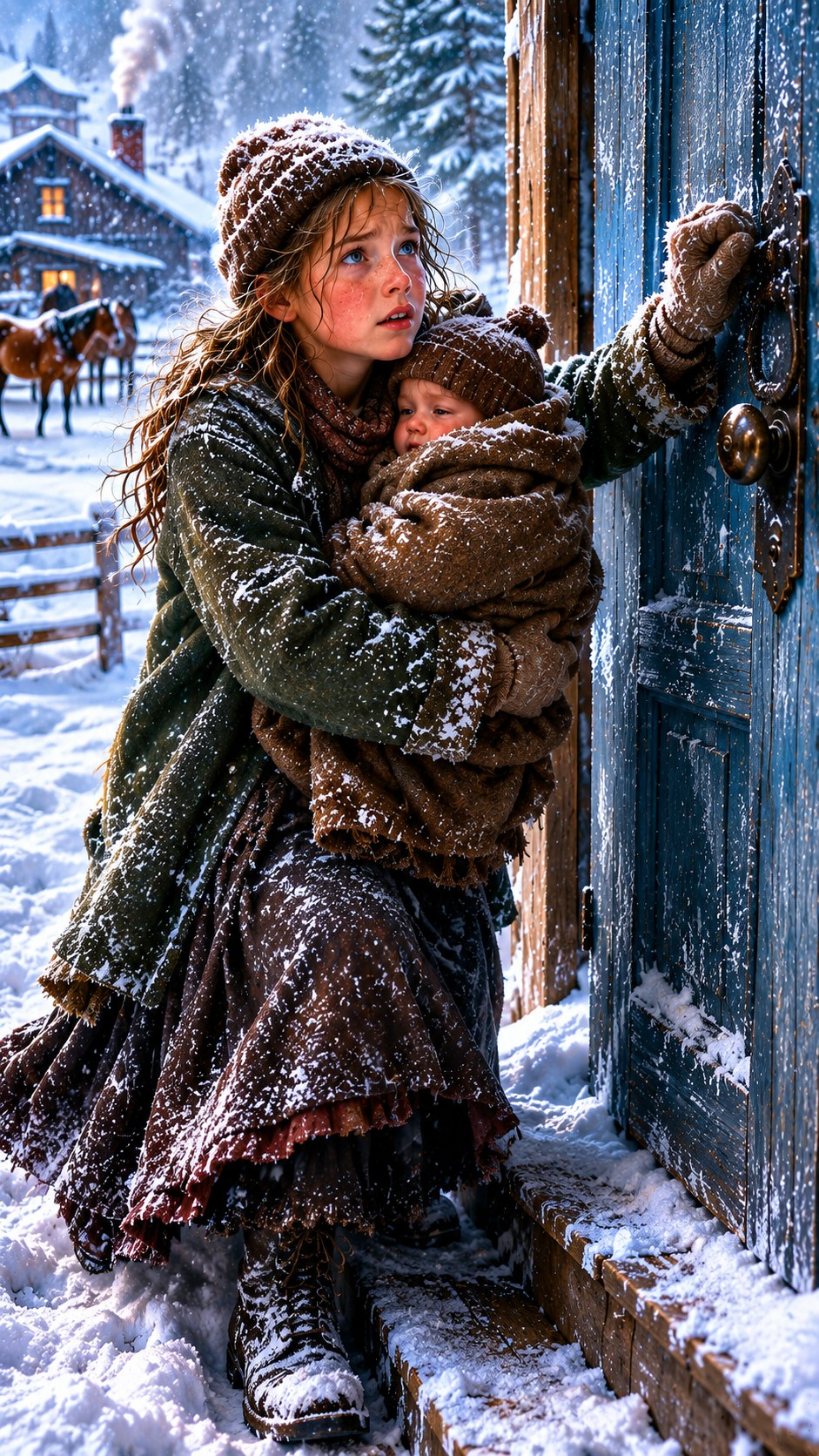
The same door that had once welcomed a frightened little girl carrying her baby brother through a terrible storm.
Now it stood open for everyone.
Thomas looked toward the northern ridge.
The land was still there.
The old barn was still standing.
The creek continued its journey through the valley.
But the most important thing had changed.
The Bell family no longer had to protect its secrets.
They could finally protect one another.
And when Thomas stepped inside, he knew that the home he had spent so many years trying to recover was no longer hidden beneath the floor, buried beneath the pasture, or written inside an old deed.
It was sitting around the kitchen table.
Together.
Safe.
And finally home.






Comments 0