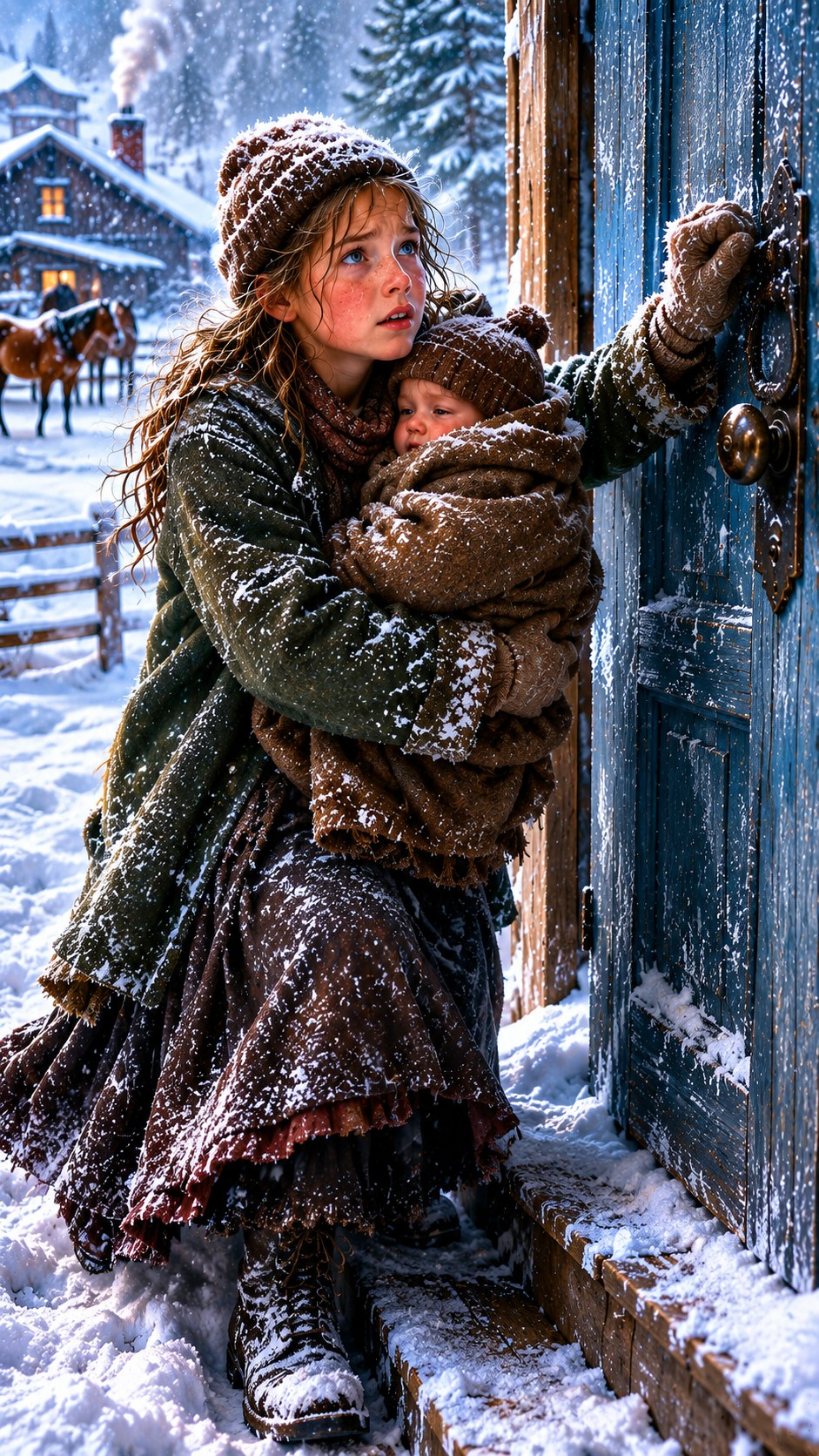
Thomas Bell stood in the doorway, unable to move.
The brass key lay on the floor behind him.
For twenty years, he had imagined what it would feel like to open that door again. Sometimes he thought he would cry. Other times, he believed he would feel nothing at all. He had even considered burning the entire room and everything inside it, just to stop the memories from following him through the house.
But he had never opened it.
Not once.
Until a little girl named Eliza Hart arrived at his ranch carrying a baby wrapped in an old brown coat.
The first thing Thomas saw was a small wooden rocking horse.
It stood beside a narrow bed, its painted white mane covered in dust. One of its wooden legs had been repaired with a piece of darker timber. A faded blue ribbon remained tied around its neck.
Beside the rocking horse stood a tiny pair of leather shoes.
They were so small that Thomas could have held both of them in one hand.
His throat tightened.
He remembered buying those shoes.
He remembered the little girl who had worn them.
And he remembered the last time he had heard her laughter.
"Clara..."
The name escaped his mouth like a confession.
Behind him, Eliza struggled to keep her eyes open.
"Sir?"
Thomas did not turn.
He stepped into the room.
The floorboards creaked beneath his boots. Dust floated through a narrow beam of amber light coming from the hallway. Everything looked exactly as it had on the morning he had locked the door.
The small bed.
The white curtains.
The wooden horse.
A collection of picture books arranged neatly on a shelf.
And on the wall, above the bed, hung a framed drawing.
A little girl had drawn a house with a crooked chimney, a brown horse, and two people standing beside a blue door.
At the bottom, in uneven handwriting, were four words.
MY HOME WITH PAPA.
Thomas reached for the frame.
His fingers brushed the dusty glass.
He had kept every drawing.
Every birthday ribbon.
Every broken toy.
Every little thing Clara had ever touched.
He had told himself that keeping the room unchanged was a way of honoring her memory.
But the truth was harder.
He had never accepted that his daughter was gone.
He had simply run out of places to look.
"Sir?"
Eliza's voice sounded weaker this time.
Thomas turned.
The girl was sitting on the wooden bench, her face pale beneath the redness caused by the cold. Toby lay against her chest, wrapped in the thick blanket Thomas had brought.
Her eyes were fixed on the open room.
"Is that your daughter's room?"
Thomas looked at her.
For several seconds, he could not answer.
"Yes."
"Was she little?"
He swallowed.
"She was six when I last saw her."
Eliza lowered her eyes.
"That's younger than me."
Thomas nodded.
"Much younger."
He walked back into the hallway and picked up the brass key.
Then he noticed that the girl was trying to sit straighter.
"Don't move," he said gently. "You need to rest."
"But Toby..."
"I'm going to take care of him."
Eliza immediately tightened her arms around the baby.
Thomas stopped.
He understood.
This child had spent three days fighting the weather, hunger, and exhaustion. She had knocked on doors and been turned away. She had carried her brother when her own body was begging her to stop.
Trust was not something she could be expected to give to a stranger simply because he had offered a warm room.
He crouched several feet away.
"Listen to me, Eliza. I'm not going to separate you. I'll bring some warm milk and something soft for both of you to eat."
She studied his face.
"Promise?"
"I gave you my word."
She nodded faintly.
Thomas stood and walked toward the kitchen.
He had not gone far when he heard her speak again.
"Sir?"
He turned.
"Yes?"
"Did your little girl have brown hair?"
Thomas looked toward the room.
"Dark brown. Almost black."
Eliza touched the tangled auburn strands falling across her cheek.
"My mama had dark hair."
His hand tightened around the empty cup.
"What did you say?"
"My mama. She had dark hair, too."
Thomas stared at her.
"What's your mother's full name?"
"Clara Hart."
He already knew.
But hearing it again from the little girl's mouth made the name feel painfully real.
"Did she ever tell you about this place?"
Eliza shook her head.
"She didn't talk much about when she was little."
"Did she tell you about a man named Thomas?"
The girl hesitated.
Then she shook her head again.
"No."
Thomas looked down.
A strange feeling moved through his chest.
He had spent twenty years wondering whether Clara hated him.
Whether she had forgotten him.
Whether she had built another life somewhere and deliberately erased the ranch from her memory.
Now her daughter was sitting in his hallway.
And she did not even know his name.
He walked into the kitchen.
The old iron stove was still warm. He placed a kettle over the fire and reached for a small saucepan.
There was milk in the pantry, potatoes in a wooden basket, and a little leftover chicken broth.
He warmed the milk first.
Then he prepared a bowl of broth.
He moved quickly, but his hands were unsteady.
He had not cooked for children in a very long time.
In fact, he had not cooked for anyone since Margaret died.
The ranch had become a place of routines.
Feed the horses.
Repair the fences.
Check the barn.
Cut wood.
Eat.
Sleep.
Repeat.
It had been easier to live with work than with memories.
He poured the milk into a small cup and placed the broth beside it.
Then he remembered something.
Children needed warmth.
Not just food.
He went to the cupboard above the kitchen table and took down an old wooden box.
Inside were several knitted blankets.
One was cream-colored, with tiny blue flowers along its edges.
He recognized it immediately.
Margaret had made it for Clara before her first winter.
Thomas held it for a moment.
Then he carried everything back to the hallway.
Eliza was still awake.
Barely.
Her eyes followed him as he approached.
"I brought something warm."
He placed the cup within her reach.
She looked at the broth.
Then at the milk.
"Can Toby have some?"
"We'll make sure he's warm first. Babies need special care when they've been out in the cold this long."
Thomas had seen enough winters to know the danger.
He would not pretend a warm room could immediately undo three days of exposure.
He hurried to fetch a clean cloth and warmed water.
He tested the temperature carefully before returning.
"May I?"
Eliza looked down at Toby.
Then she slowly nodded.
Thomas gently adjusted the blanket around the baby.
Toby's face was pale.
His lips were dry.
But when Thomas touched his tiny hand, the child moved one finger.
Thomas froze.
"Eliza."
The girl immediately leaned forward.
"What?"
"He moved."
Her eyes widened.
"Toby?"
She touched his cheek.
"Toby, sweetheart?"
The baby's mouth opened slightly.
A weak sound escaped him.
It was barely a cry.
But it was enough.
Eliza began to tremble.
She pressed her forehead against his bonnet.
"You're here," she whispered. "You're still here."
Thomas looked away.
He had seen men die.
He had buried friends.
He had watched winter take livestock and destroy entire harvests.
But there was something unbearable about watching a child rejoice because her baby brother had made a tiny sound.
He placed another blanket around Eliza's shoulders.
"You're both staying here tonight."
She looked up.
"Both of us?"
"Both of you."
"Even if we don't have money?"
Thomas's face hardened.
"Who told you that you needed money to be given shelter?"
"The man at the second house."
Thomas said nothing.
Eliza lowered her eyes.
"He said he couldn't take in strangers."
The rancher looked toward the blue door.
He imagined an eleven-year-old girl standing outside in the snow while a grown man closed a door in her face.
His jaw tightened.
"You're not strangers to me anymore."
Eliza did not understand what he meant.
Neither did Thomas.
Not completely.
He returned to the kitchen to fetch another blanket.
When he came back, he found Eliza staring at the little wooden rocking horse.
She had turned her head toward the open room.
"Can I ask something?"
"Of course."
"Did your daughter like horses?"
Thomas almost smiled.
"She loved them."
"Did she have a favorite?"
"A brown mare named Daisy."
Eliza looked toward the window.
"There were horses outside."
"Yes."
"Are they yours?"
"Every one of them."
"Do you let children ride them?"
Thomas paused.
"I used to."
She looked at him.
"Why don't you anymore?"
He had no answer that an eleven-year-old should have to hear.
So he simply said, "Maybe I will again."
Eliza nodded.
Her eyes began closing.
Thomas noticed that her fingers were still curled around the edge of Toby's blanket.
He brought a pillow and carefully placed it behind her head.
"Sleep, child."
"What if I wake up and you're gone?"
"I'm staying."
"Promise?"
He looked at the exhausted girl.
"I promise."
Her eyelids finally closed.
Thomas remained beside the bench until her breathing became steady.
Then he turned toward the kitchen.
He needed to think.
He needed to understand how Clara's daughter had ended up at his door.
And most importantly, he needed to know why the child carried that particular ribbon.
He returned to the locked room.
This time, he entered fully.
The little bed stood beneath the window.
He approached the old writing desk.
There were scratches along its surface, made by Clara when she had been learning to write. Margaret had once scolded her for carving her initials into the wood.
Thomas had laughed.
He had told his wife that a little girl should be allowed to leave her mark on the world.
He ran his fingers over the letters.
C.B.
Clara Bell.
His daughter had been born Clara Bell.
She had become Clara Hart only after leaving the ranch.
Thomas opened the desk drawer.
Inside lay a small collection of letters, a broken hair ribbon, a wooden button, and a folded piece of paper.
He picked up the paper.
It was a drawing.
On one side, Clara had drawn three people.
A tall man.
A woman with long dark hair.
And a little girl holding both their hands.
On the back was a sentence written in Margaret's careful handwriting.
WHEN CLARA COMES HOME, WE WILL NEVER LET HER FEEL ALONE AGAIN.
Thomas sat down.
He remembered Margaret writing those words.
He remembered how she had cried after Clara disappeared.
He remembered promising his wife that he would find their daughter.
And he remembered breaking that promise.
Not because he had stopped searching.
But because someone had convinced him that there was nothing left to find.
His eyes moved toward the bottom drawer.
It was locked.
He searched the desk for the small silver key.
He found it beneath an old stack of papers.
The lock clicked.
Inside lay a bundle of letters tied with faded blue string.
Thomas lifted them carefully.
The first envelope bore Margaret's handwriting.
The second had no name.
The third was addressed to him.
He stared at it.
He recognized the writing immediately.
Clara.
His hands began trembling.
He had never seen this envelope before.
The paper was yellowed, and the edges had become brittle.
The date was written in the upper corner.
Twenty years earlier.
Thomas slowly opened it.
Inside was a single page.
The first sentence made his stomach turn.
Papa, if you are reading this, it means someone has finally told you what really happened.
Thomas read the line again.
Then again.
He moved closer to the lamp.
The letter continued.
I didn't leave because I stopped loving you. I left because I was told you no longer wanted me here.
Thomas stopped breathing.
He read the next sentence.
Margaret knows the truth, but she is afraid of what will happen if you discover who helped me disappear.
The letter slipped slightly in his hands.
Margaret?
His wife had known?
He looked toward the old bed.
For twenty years, he had believed that Clara had chosen to leave him.
He had blamed himself for being too strict, too stubborn, too consumed by the ranch.
But now he was beginning to understand that someone had deliberately separated them.
He continued reading.
I tried to come home once. I stood outside the blue door, but a man told me that you had ordered him never to let me inside again.
Thomas felt sick.
He had never given such an order.
Never.
The final lines were written in a different hand.
The ink was darker.
Papa, if anything happens to me, please find my children. The little one has your family's eyes. I have kept the red ribbon because Mama told me it would help you recognize us.
Thomas lowered the letter.
Children.
Not child.
His eyes moved toward the hallway.
Eliza had said her mother's name was Clara Hart.
Toby was eighteen months old.
And there was something else.
The letter had been written years before Toby was born.
Clara had known that one day she might have children.
But why had she never come back?
Why had she waited so long?
And who had convinced her that her own father wanted nothing to do with her?
Thomas folded the letter carefully.
Then he heard a faint sound from the hallway.
A small movement.
He turned.
Eliza was standing in the doorway.
She looked unsteady, holding the cream blanket around her shoulders.
"Sir?"
Thomas quickly placed the letter on the desk.
"You should be resting."
"I heard you talking."
"I wasn't talking to anyone."
She looked at the paper.
"Is that from my mama?"
Thomas did not answer immediately.
Then he nodded.
"Yes."
Eliza took one step into the room.
"Did she write about us?"
Thomas looked at her.
For the first time since she had arrived, he saw something other than exhaustion in her eyes.
Hope.
A small, fragile hope.
He did not want to destroy it with a promise he could not yet explain.
"She wrote that she wanted her children to be found."
Eliza's lips parted.
"She wanted us to come here?"
Thomas looked down at the letter.
"I believe she did."
The girl stared at him.
Then she asked a question that made the room feel even smaller.
"Did Mama ever have a home before we lived in our cabin?"
Thomas nodded.
"Yes."
"Was it this one?"
He looked toward the little bed.
"Yes, sweetheart. This was her home."
Eliza stepped closer to the desk.
She studied the drawings, the toys, and the tiny shoes.
Then she noticed the initials carved into the wood.
C.B.
She touched them with one finger.
"Mama used to draw those letters."
Thomas looked up sharply.
"What?"
"On pieces of paper. She always wrote C and B together."
He could barely speak.
"Did she tell you what they meant?"
Eliza shook her head.
"She said it was a name she didn't use anymore."
Thomas closed his eyes.
His daughter had spent her entire life carrying a name she had been taught to hide.
He looked at the child standing in front of him.
Then he looked at the ribbon on the desk.
A terrible thought began forming.
Perhaps Clara had not simply been kept away from the ranch.
Perhaps someone had been making sure she could never return.
A sharp knock sounded at the blue entrance door.
Thomas turned.
Eliza flinched.
The knock came again.
Three hard strikes.
Then a man's voice called from outside.
"Thomas Bell! Open up!"
Thomas recognized the voice.
His expression changed.
He had not heard that man in nearly twenty years.
And he knew exactly why he had come.






Comments 0