The first morning I woke up without being afraid of the sound of a key in the lock, I stayed in bed for several minutes and listened to the apartment.
The refrigerator hummed in the kitchen.
A car passed somewhere below the windows.
From the bedroom next door came the familiar rustle of Noah turning over beneath his blankets.
Nothing extraordinary happened.
And that was precisely what made the morning feel extraordinary.
For twelve years, I had measured my days by Daniel's moods. I had learned to recognize danger in the smallest sounds: the sharp placement of a glass on the table, the silence after a question, the particular way he closed a cabinet when something displeased him.
I had believed that if I became patient enough, careful enough, and understanding enough, I could prevent the next argument.
I had been wrong.
The responsibility for Daniel's behavior had never belonged to me.
I was beginning to understand that truth, although understanding it did not erase the years I had spent living differently.
I rose, wrapped myself in a soft robe, and walked into the kitchen.
The glass coffee table was gone.
We had arranged for the broken furniture to be removed, and the navy-blue rug had been professionally cleaned. The living room looked almost the same as it had before that terrible evening, but I had chosen not to replace the table immediately.
I wanted the room to feel like ours again, not like a photograph of a life that had never existed.
Noah appeared in the doorway, his copper-red hair sticking up on one side.
"Mom?"
I turned.
"Good morning, sweetheart."
He glanced toward the empty space where the table had stood.
"Are you still thinking about that night?"
I considered lying.
I could have told him that everything was fine, that the past was behind us, that he no longer needed to worry.
Instead, I pulled out a chair.
"Sometimes," I admitted. "But I don't think about it the way I did before."
"How do you think about it now?"
I sat beside him.
"I think about how frightened we were. I think about what we learned. And I think about what we need to do to make sure we feel safe."
Noah looked down at his hands.
"Do you still get scared when someone raises their voice?"
"Sometimes."
He seemed relieved by my honesty.
"Me too."
I reached across the table and squeezed his fingers.
"Being scared doesn't mean we're weak. And being brave doesn't mean we have to face everything alone."
He nodded.
Then, after a moment, he asked the question I had been expecting.
"Are we going to live here forever?"
I looked around the kitchen.
The apartment had been beautiful when we moved in. It had floor-to-ceiling windows, elegant furniture, and a view that made the city look peaceful even on its busiest days.
But a beautiful home was not necessarily a safe one.
"I don't know if we'll stay here forever," I told him. "We can decide together what feels right."
"Could we get a house with a little garden?"
The question caught me off guard.
"A garden?"
"With flowers. And maybe a place where I can build things."
I smiled.
"That sounds lovely."
He leaned against me.
For a moment, I simply held him.
Then the doorbell rang.
My body reacted before my mind did. My shoulders tightened, and my heart began to race.
Noah noticed.
"It's okay, Mom."
I took a slow breath.
He was right.
The bell was only a sound. It did not have to become a warning.
I checked the security display.
Margaret stood outside with a folder in her hand.
When I opened the door, she greeted me warmly.
"I hope I'm not interrupting breakfast."
"Not at all."
She glanced at Noah.
"I brought the final documents."
We sat at the kitchen table while she explained the remaining paperwork. The legal proceedings had been completed, the trust records corrected, and the assets that could be recovered had been returned through the appropriate process.
The authorities had also completed their review of the records connected to my father's estate. The inconsistencies had been documented, and the relevant parties had been required to answer questions about the transfers and the altered paperwork.
Not every historical question had a definitive answer.
We never learned exactly what had happened during every hour of my mother's disappearance. Some memories had died with the people who could have explained them.
But we established what mattered most.
Thomas Whitaker had been my biological father.
He had tried to contact me.
My mother had not simply forgotten him, and he had not simply abandoned me.
Other people had interfered with their attempts to reach each other, and the resulting lies had shaped my life long before I understood what was happening.
The financial records were corrected, and the estate dispute was resolved through the legal process.
I finally possessed the documents that proved where I came from.
Margaret handed me a final envelope.
"This contains the certified copies of your records. Keep them somewhere safe."
I placed it beside the wooden box of photographs.
"Thank you."
She looked at me for a moment.
"Your mother wanted you to know the truth. I think she would be relieved that you have it now."
I swallowed against the ache in my throat.
"I wish she could have told me herself."
"So do I."
After Margaret left, Noah and I made pancakes.
He insisted on measuring the flour himself, even though he spilled some across the counter. I pretended not to notice until he began laughing at the mess.
The sound filled the kitchen.
I hadn't realized how much I had missed hearing him laugh without looking toward the hallway first.
That afternoon, we took the photographs out of the wooden box.
I showed him the picture of Thomas holding me as a baby. I told him what Arthur had explained about his grandfather, the trust, and the letters.
Noah listened carefully.
"Do you think Grandpa would have liked Dad?" he asked.
It was a difficult question.
"I don't know," I said. "They might have disagreed about many things. But I know your grandfather wanted to know me, and I wish he had been given that chance."
Noah studied the photograph.
"Maybe he would have taught me to ride a bike."
I smiled sadly.
"Maybe."
We placed the picture beside one of my mother.
For years, I had thought of my family history as a story with missing pages. Now the pages had been returned to me, even if some of the writing was faded and incomplete.
I didn't have to invent answers for the parts we could not recover.
I could remember my mother with love while acknowledging that she had been frightened.
I could recognize Evelyn's fear without excusing her silence.
And I could accept that Daniel had made choices for which he was responsible.
That distinction mattered.
Forgiveness, I discovered, was not a requirement for healing.
Neither was forgetting.
Sometimes healing began with the simple decision to stop allowing another person's actions to define the rest of your life.
Several weeks later, Daniel requested a meeting.
I agreed to speak with him only after discussing the arrangements with my attorney. The meeting took place in a neutral setting, with clear boundaries and no expectation that I would reconsider our marriage.
He arrived looking different from the man who had stood over me beside the shattered table.
He wore a plain blue shirt and dark trousers. His hair was neatly trimmed, but the confident expression that had once seemed permanent was gone.
He sat opposite me.
For a moment, neither of us spoke.
Then he said, "I know I don't deserve another chance."
I waited.
"I'm sorry for what I did to you. I'm sorry Noah had to see it. I'm sorry I lied about your father and allowed you to live with questions I could have answered."
His voice faltered.
"I told myself I was protecting the family. The truth is, I was protecting myself."
I listened without interrupting.
He acknowledged the financial concealment, his decision to hide the letter, and the way he had used anger to silence me. He had begun working with a qualified professional to address his behavior and had agreed to follow the arrangements established for contact with Noah.
I did not promise to forgive him.
I did not promise to return.
When he finished, I folded my hands on the table.
"I'm glad you're finally taking responsibility," I said. "But our marriage cannot continue as it was."
He nodded, his eyes lowered.
"I understand."
"I need you to understand something else. Noah is not responsible for keeping us connected. He doesn't owe you forgiveness, and he doesn't have to make you feel better about what happened."
"I understand."
"If you want to become a better father, you must do that because he deserves a safe, dependable parent—not because you expect him to forget."
Daniel swallowed.
"I know."
We discussed the practical arrangements for Noah's well-being and the steps that would follow. The conversation was difficult, but it remained calm.
For the first time, I left a meeting with Daniel without feeling that I had to replay every sentence to determine whether I had made him angry.
I felt sad.
I felt exhausted.
But I also felt free to make my own decisions.
Months passed.
Noah and I eventually moved into a comfortable house with a small garden, just as he had requested. It was not as grand as the apartment, but it had sunlight in the kitchen, a quiet bedroom for Noah, and enough space for a little workbench in the garage.
We planted flowers along the fence.
Noah chose yellow ones because he said they looked happy even on cloudy days.
I placed my mother's photographs on a shelf in the living room. Thomas's picture stood beside them, not as a replacement for the man I had grown up believing was my father, but as part of the truth I had finally recovered.
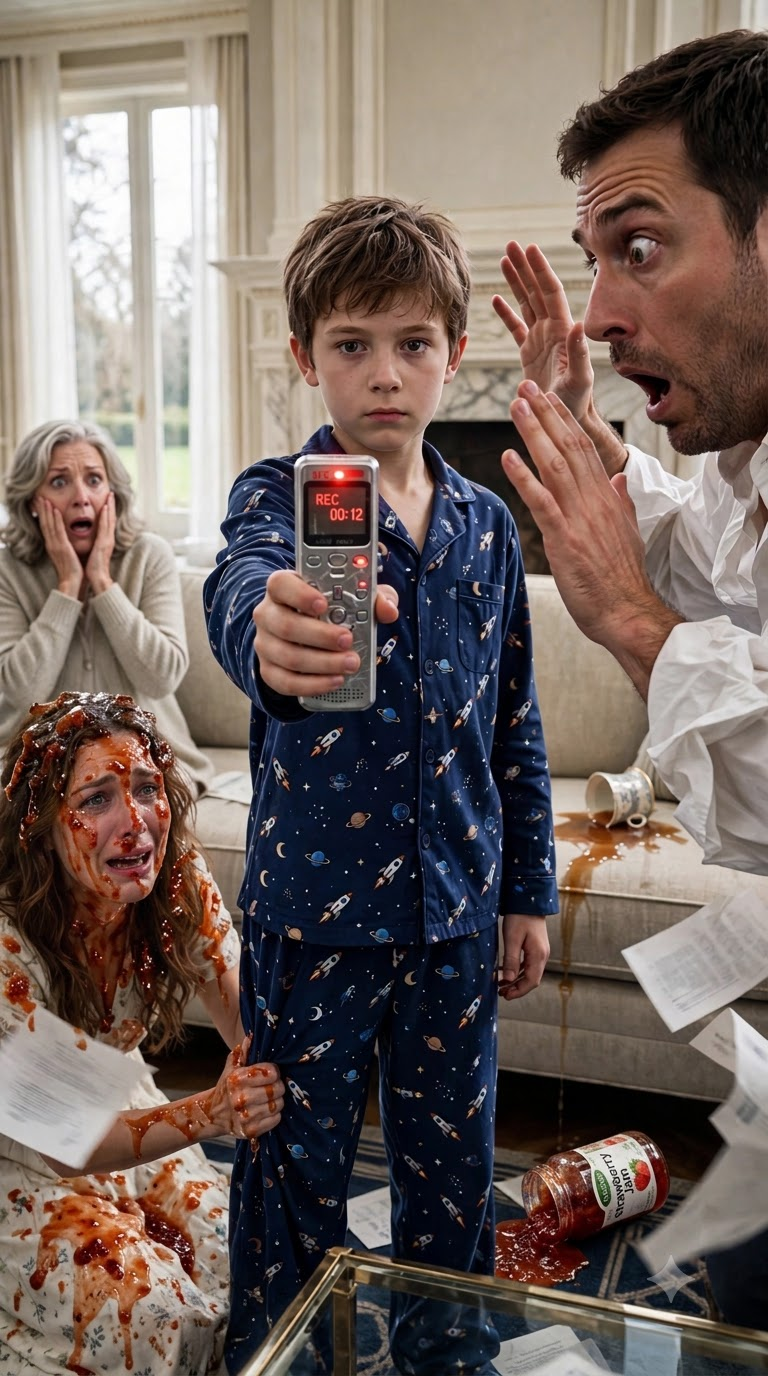
The silver recorder remained in a drawer.
I didn't throw it away.
It had helped expose what happened, but I didn't want it to become the symbol of Noah's childhood.
He deserved to remember more than fear.
He deserved to remember the pancakes, the garden, the evenings we spent reading together, and the ordinary mornings when nothing terrible happened.
He deserved to be ten years old.
One Saturday, nearly a year after the night everything changed, Noah and I sat at the kitchen table assembling a small wooden model house.
He carefully fitted two pieces together.
"Mom?"
"Yes?"
"Do you think I did the right thing with the recorder?"
I set down my screwdriver.
"You were trying to protect me. I understand why you did it."
"But I was scared."
"Of course you were."
He looked at the little wooden house.
"I thought Dad would be angry forever."
I reached for his hand.
"You were never responsible for managing his anger. You were a child, and you deserved to feel safe."
He nodded slowly.
Then he asked, "Would you have been okay if I hadn't recorded anything?"
I considered the question carefully.
"We might have needed another way to prove what happened. But what your father did was wrong whether or not anyone recorded it. You didn't have to earn the right for me to be safe."
Noah's eyes filled.
I moved beside him and wrapped my arms around his shoulders.
For a long time, neither of us spoke.
Then he leaned back and wiped his face.
"Can we finish the house?"
I smiled.
"Absolutely."
We worked until the little wooden structure stood complete on the table.
It had crooked windows, a tiny front door, and a roof Noah insisted on painting yellow.
When he finished, he stepped back to admire it.
"It's not perfect," he said.
"No," I agreed. "But it's ours."
He grinned.
Then he carried it to his bedroom and placed it beside his books.
That evening, we ate dinner in the garden.
The air was cool, and the lights along the fence glowed softly as the sun disappeared. Noah told me about a school project and a friend who wanted to build a model airplane with him.
I listened.
I asked questions.
I laughed when his story became ridiculous.
And for the first time in years, I did not spend the evening wondering whether my happiness might provoke someone else's anger.
After dinner, Noah helped me clear the table.
Then he stopped beside the back door and looked at me.
"Mom?"
"Yes, sweetheart?"
"Are we safe now?"
I walked over to him and knelt so that we were eye to eye.
"We are building a safe life," I told him. "And if something ever feels wrong, we will talk about it. We will ask for help. We won't hide the truth just to make someone else comfortable."
He considered that for a moment.
Then he wrapped his arms around my neck.
I held him close.
The night Daniel shoved me into that glass table, I believed our family had shattered beyond repair.
In one sense, it had.
The family I thought I had—the marriage built on trust, the mother-in-law who claimed to care for me, the husband who promised to protect me—could not be restored because it had never been what I believed.
But something better had grown from the wreckage.
Noah no longer believed he had to protect me by himself.
I no longer believed that keeping a family together required me to endure whatever happened inside it.
And the truth about my father no longer belonged to people who had decided I was too fragile to hear it.
We had lost years.
We could not recover the conversations my mother and father had never been allowed to finish. We could not undo the fear Noah had carried into his bedroom or erase the memory of the shattered table.
But we could choose what happened next.
I could give my son a home where questions were welcome, where apologies were followed by changed behavior, and where love never demanded silence.
I could remember my parents without allowing the lies surrounding them to determine my future.
And I could forgive myself for taking so long to understand that peace built on fear was never peace at all.
That night, after Noah had gone to bed, I stood in the doorway of his room.
He was asleep beneath his blanket, one hand resting beside the little wooden house on his bedside table.
I watched his chest rise and fall in the quiet rhythm of sleep.
Then I turned off the lamp and gently closed the door.
For once, I did not pause outside it to listen for danger.
I walked back into my own room, opened the window, and let the cool evening air move through the curtains.
The past was still part of my story.
But it no longer controlled the ending.
I had my son.
I had the truth.
And I had a home where neither of us needed to be afraid.






Comments 0