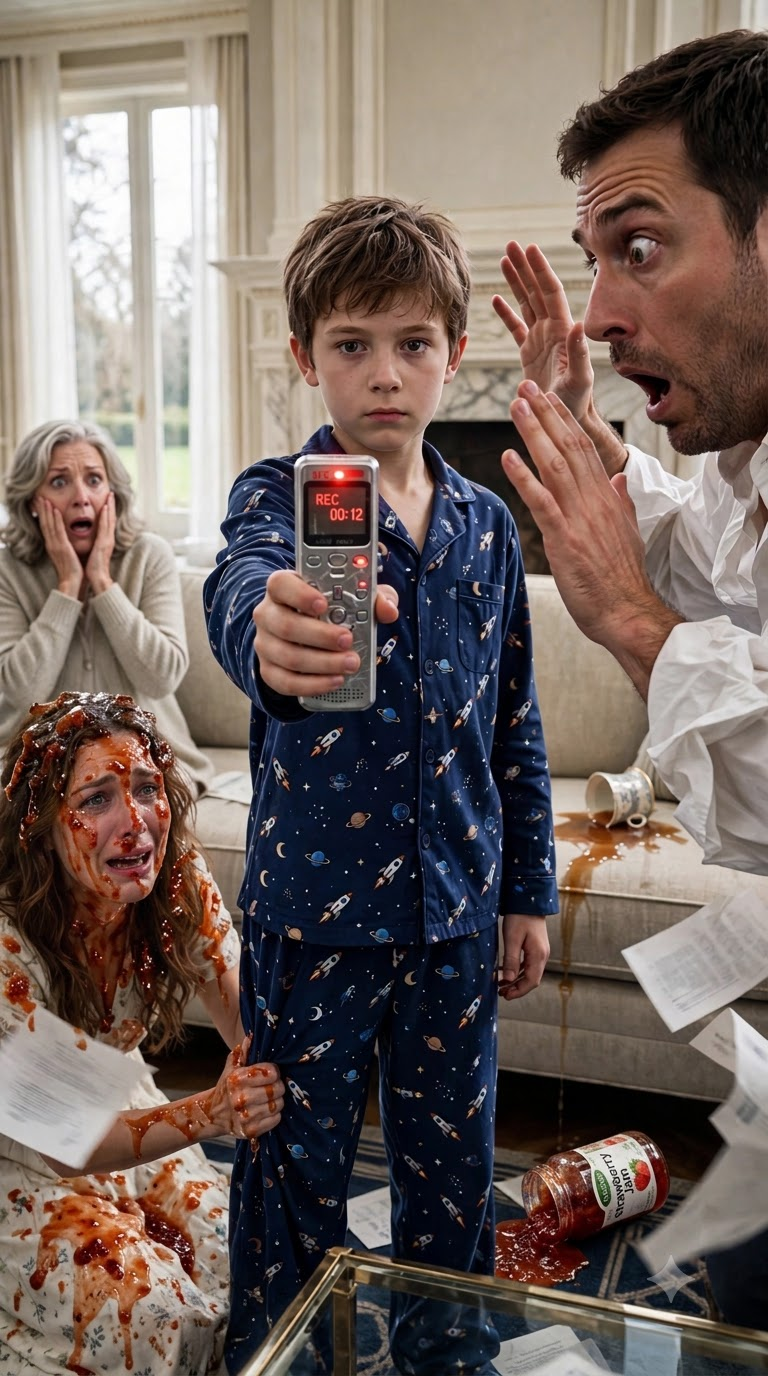
My ten-year-old son stepped between my bleeding body and his father, whispering, "Don't touch my mom again."
Daniel stopped reaching for me.
His mother tightened her fingers around her porcelain teacup.
On the floor beside my son's bare feet lay a scratched silver voice recorder.
Three small words glowed on its display.
REC — 00:12.
My husband had no idea what those twelve seconds would cost him.
For one suspended moment, nobody moved.
I lay on the navy-blue rug with one hand pressed against my forehead. My other palm rested against the floor, but I could not bring myself to push up. Tiny pieces of glass glittered around my sleeves, catching the warm light from the lamps. A thin line of blood had traveled from my hairline toward my eyebrow.
The pain came in waves.
First my shoulder.
Then my hip.
Then the back of my head, where I had struck the floor after Daniel shoved me into the glass coffee table.
But the worst pain was watching my son stand in front of me.
Noah was ten years old. He still slept with a stuffed bear when storms rattled the windows. He still left half-finished drawings on the kitchen counter and forgot where he had put his school shoes. That morning, he had asked whether we could make pancakes together on Saturday.
Now he was facing a grown man who had just thrown his mother across a living room.
And he was doing it alone.
"Noah," I whispered.
My throat felt raw.
"Baby, please come here."
He didn't turn around.
His little shoulders rose and fell beneath his oversized teal pajamas. I could see the tension in his hands, the way his fingers curled and released beside his thighs. He was frightened. I knew my child well enough to recognize every small sign.
Yet he stayed where he was.
Daniel looked down at him with an expression of disbelief that slowly hardened into anger.
"Move."
Noah swallowed.
"No."
The word was barely audible, but it changed the room.
Daniel's eyebrows lifted. For twelve years, I had watched him make people retreat without needing to touch them. A lowered voice, a narrowed gaze, a single step toward someone who disagreed with him—those were usually enough.
He had trained our household to respond to his moods before he even spoke.
I apologized before I understood what I had done wrong. I learned to recognize the sound of his keys in the lock. I could tell whether dinner would end peacefully by the way he set down his phone.
And his mother, Evelyn, had watched the entire transformation with quiet satisfaction.
She called it marriage.
She called it maturity.
She called it a woman's responsibility to preserve her family.
Tonight, she sat on our cream-colored sofa wearing a burgundy cashmere cardigan, her silver hair perfectly arranged, her pearl earrings catching the light. Her teacup rested on its saucer as if nothing unusual had happened.
A few minutes earlier, she had been smiling.
Not laughing. Evelyn was too sophisticated for that.
She had simply watched Daniel shove me backward with a small, knowing curve to her lips, as though an argument she had been making for years had finally been settled.
Now she was staring at Noah's hand.
At the recorder.
"What is that?" Daniel demanded.
Noah held the device against his chest.
"A recorder."
"I can see that. Why do you have it?"
"For school."
Daniel's mouth tightened.
"Hand it over."
"No."
My heart hammered against my ribs.
"Noah," I whispered again, trying to make my voice stronger. "You don't have to do this."
He finally glanced back at me.
His eyes were gray, just like mine. There were freckles across his nose, and a small crease between his eyebrows that appeared whenever he was trying to solve a difficult problem.
I had seen that expression over mathematics homework, broken toys, and puzzles spread across his bedroom floor.
I had never seen it while he was protecting me.
"It's okay, Mom," he said.
It wasn't okay.
We both knew it.
But the way he said those words nearly broke me more thoroughly than the fall had.
Daniel took one step forward.
Noah moved half a step backward, positioning himself more firmly between his father and me. His heel came dangerously close to a cluster of glass fragments, and I instinctively reached toward him.
"Careful," I whispered.
Daniel followed my movement with his eyes.
"Look at what you've done," he said to me. "You've made him think he can disrespect his father."
I stared at him.
He had shoved me into a table. He had watched me fall. He had not once asked whether I could breathe, whether my head hurt, or whether I needed help.
And somehow, in his mind, I was still responsible for what happened next.
Evelyn finally placed her teacup on the coffee table beside her.
"Daniel, don't make a scene in front of the boy."
Her voice was smooth, almost gentle.
It was the same voice she had used when she told me, during my first year of marriage, that a good wife knew which battles were worth fighting.
She had been standing in my kitchen then, arranging flowers I had bought for my own birthday.
"Men have difficult days," she had told me. "A woman who constantly challenges her husband makes those days worse."
I had believed, for a while, that she was trying to help me understand her son.
Eventually, I realized she was teaching me how to disappear inside my own home.
Now she looked at Noah and offered him a thin smile.
"Sweetheart, give Daddy the little machine. This is an adult disagreement."
Noah stared at her.
"You saw him push Mom."
Evelyn's smile faded slightly.
"Your mother lost her balance."
"No, she didn't."
The words landed with a force none of us had expected.
Daniel's face darkened.
"Enough."
Noah flinched at the sound, and I saw the child inside him—the little boy who knew exactly what that tone meant.
For a moment, I thought he might run to me.
Instead, he reached into his pocket and brought the recorder forward.
Daniel's eyes followed it.
"Give it to me," he repeated.
Noah's thumb hovered above the buttons.
"I recorded it."
Daniel stared at him.
"What did you say?"
"Tonight."
"Recorded what?"
"Everything."
A tiny muscle jumped in Daniel's cheek.
Then he laughed.
It was a short, humorless sound.
"You think that little toy proves something?"
Noah didn't answer.
Daniel extended his hand.
"Now."
I watched my son's fingers tighten around the silver casing. His knuckles turned pale. The recorder looked impossibly small in his hand, a cheap plastic device with scratches across its back and a cracked corner near the battery cover.
I remembered buying it at an electronics store several weeks earlier.
Noah had needed a recording device for a school project about family stories. He wanted to interview me about my childhood and ask Daniel about his first job. He had been excited about the project, carefully writing questions in a notebook.
I had thought nothing of it when he started carrying the recorder around the apartment.
I had not known that he was using it for something else.
Or perhaps I had known, somewhere deep inside, that my son was paying attention to things I had spent years pretending not to see.
"Noah," Daniel said, lowering his voice. "You don't understand what you're doing."
"Yes, I do."
"No. You don't."
Daniel stepped closer.
Noah's shoulders stiffened.
"You're a child," Daniel continued. "You don't get involved in matters between your parents. You don't record people without permission. And you certainly don't stand there accusing your father of things you don't understand."
Noah looked down at the recorder.
Then he lifted his eyes again.
"I understand that you hurt Mom."
Silence.
I heard the faint hum of the refrigerator from the kitchen. Somewhere beyond the windows, a car horn sounded and faded into the distance.
Daniel's expression changed in a way I had never seen before.
He was still angry, but something had slipped beneath the anger. Something uncertain.
He looked toward Evelyn.
It was a small movement, barely noticeable.
She noticed it anyway.
For years, the two of them had communicated through glances and unfinished sentences. Evelyn could silence Daniel with a look when guests were present, and Daniel could make her abandon an argument simply by setting down his glass.
They were different people, but they shared one essential belief.
They believed the family belonged to them.
They believed the truth was whatever they agreed to tell everyone else.
And they believed I would always be too frightened to contradict them.
"Give me the recorder," Daniel said.
Noah shook his head.
"Please don't make me ask again."
My son drew a careful breath.
Then he said the sentence that made Evelyn's teacup strike its saucer.
"I recorded the other times, too."
The cup rattled sharply against the porcelain.
Daniel turned toward his mother.
She had gone pale.
For the first time that evening, she looked genuinely frightened.
"What other times?" Daniel demanded.
Noah's eyes remained fixed on him.
"The nights you shouted at Mom. The time you threw her phone. The time you told her nobody would believe her if she ever tried to leave."
My blood seemed to turn cold.
I remembered every incident.
The broken phone had been replaced the following morning. Daniel had told me he was sorry, then explained that I had pushed him too far.
The night he threatened to make sure I never saw Noah again, he had apologized with flowers.
Each time, Evelyn had offered the same advice.
Don't exaggerate.
Don't provoke him.
Don't destroy your son's family over a bad evening.
I had kept silent because I believed silence was the price of protecting Noah.
I had never considered that he might be collecting the evidence I was too frightened to preserve.
Daniel's expression shifted again.
He looked at Noah as if he were seeing a stranger wearing his son's face.
"How long have you been doing this?"
Noah said nothing.
"Answer me."
"I don't have to."
Daniel's hand dropped to his side.
For a moment, I thought he might grab the recorder anyway. My body tensed, ready to pull Noah toward me even though I could barely move.
But Daniel stopped himself.
He had noticed the same thing I had.
Noah wasn't simply holding a recording device.
He was holding something Daniel could not control merely by shouting at it.
"What have you done with those recordings?" Daniel asked.
Noah's thumb moved over the recorder's buttons.
"Nothing."
"Don't lie to me."
"I'm not."
"Then why are you acting like this?"
Noah's eyes flicked briefly toward me.
"Because Mom is hurt."
Daniel opened his mouth, but no words came out.
I had spent twelve years waiting for him to recognize the consequences of his actions. I had imagined apologies, explanations, even moments of genuine remorse.
I had never imagined that the first person to make him speechless would be his own ten-year-old son.
Evelyn stood.
The movement was so abrupt that her teacup rattled again.
"Daniel, take the boy upstairs. He is upset, and his mother needs medical attention. We can discuss this after everyone has calmed down."
It sounded reasonable.
That was how Evelyn made dangerous things sound harmless.
She wrapped control in the language of concern. She called intimidation discipline and called silence peace.
But Noah shook his head.
"I'm staying with Mom."
Evelyn's lips pressed together.
"You're being very disrespectful."
"No."
"Excuse me?"
"I'm staying with her."
His voice trembled on the last word.
He was scared. I could see it now, unmistakably. His knees were tense, his shoulders rigid, his breathing too shallow.
Yet he stayed.
Daniel glanced at the recorder again.
Then he tried a different approach.
His expression softened. His voice became quieter.
"Noah, buddy. Listen to me. I know tonight was frightening. Your mother and I had an argument, and things got out of hand. That doesn't mean you need to make it worse."
He crouched slightly, trying to bring his face closer to his son's level.
"Give me the recorder. We'll forget this happened."
Noah studied him.
"You said that last time."
Daniel froze.
"What?"
"You said we'd forget it happened."
My eyes filled with tears, but I refused to let them fall. I wanted to reach for Noah, to tell him he didn't have to carry our family's secrets anymore.
I wanted to apologize for every time he had heard a slammed door and pretended not to notice.
Every time he had watched me smile at breakfast after crying in the bathroom.
Every time I had told him that his father was simply tired.
Daniel slowly straightened.
His softer expression disappeared.
"Give it to me."
"No."
"NOW."
The shout struck the walls.
Noah recoiled, but his fingers stayed wrapped around the recorder.
Daniel lunged forward—not striking him, but reaching for the device.
Noah stepped sideways.
Daniel's hand closed on empty air.
"Stop!" I cried.
Pain flared through my shoulder as I tried to push myself upright.
The room tilted.
I caught myself with one palm, gasping as a sharp fragment pressed against the fabric near my wrist. I pulled away before it could cut me.
Noah immediately glanced toward me.
That brief distraction was enough for Daniel to reach toward the recorder again.
But Noah pulled it close to his chest.
"Don't touch me."
Daniel stopped.
The words seemed to surprise him more than the refusal itself.
Evelyn hurried around the sofa.
"Daniel, please. Think about what this looks like."
He turned toward her.
"What it's going to look like?"
She hesitated.
For the first time, I understood that she wasn't worried about our son.
She wasn't worried about my injuries, either.
She was worried about appearances.
About neighbors hearing the commotion. About someone discovering that the respectable family she had spent decades presenting to the world was built on fear.
Daniel understood it, too.
He looked toward the windows, then at the front door, then back at Noah.
His gaze had become calculating.
"What exactly is on that device?" he asked.
Noah looked down at it.
"I told you."
"Play it."
My heart lurched.
Noah's thumb hovered above the button.
Daniel's face tightened.
"Go ahead. Play it. Let's hear what you think you've captured."
It was a trap. I knew it from the way he stood, from the false confidence returning to his voice.
He wanted to make Noah doubt himself. He wanted to turn the moment into another argument in which the loudest person decided what was real.
But Noah had already made up his mind.
He looked at me once.
I wanted to tell him to stop. I wanted to tell him to put the recorder away and let me take him somewhere safe.
Instead, I gave him the smallest nod I could manage.
He turned back toward his father.
Then his thumb pressed PLAY.
A burst of static crackled through the tiny speaker.
Daniel's expression hardened.
Evelyn stood perfectly still.
Noah held the recorder between them.
And then a man's voice emerged from the speaker—Daniel's voice, unmistakable and cold, recorded on a night when he had believed no one was listening.
"If you ever tell anyone what happened in this house," the recording said, "I'll make sure you lose the only person you have left."
My stomach tightened.
I knew those words.
I remembered the room, the broken phone, the way Daniel had stood between me and the door.
But before I could draw another breath, the recording continued.
A second voice entered the conversation.
A woman's voice.
Evelyn's.
"Then make sure the boy never finds out what you did before he was born."
Noah's thumb froze above the recorder.
Daniel's face went completely white.
And Evelyn whispered, "Turn that off."






Comments 0