The telegram lay open on the medical bed.
DANIEL WILL BE RELEASED WHEN THE THIRD HEIR IS BROUGHT TO THE COOKHOUSE.
I read it twice.
Then I looked at Amos.
"You're not going anywhere."
He shook his head.
"I didn't say I was."
"Good. Because you've already broken one leg. I'm not letting you break the other."
Despite the pain, he managed a faint smile.
But the smile disappeared when he saw the expression on my face.
"Bessie, there's something you need to understand about that cookhouse."
I held the brass key.
"Then tell me."
He looked toward Margaret.
She had entered quietly and was standing beside the door.
For a moment, neither spoke.
Then she approached the bed.
"Elizabeth built that hiding place," she said. "Before the mining company took over Bitter Creek, the cookhouse had a storage cellar beneath the kitchen."
I nodded.
"I know."
Margaret continued.
"Your mother used it to hide the original records. She believed the company would never search beneath a building used every day by the miners."
I looked at Amos.
"And you knew?"
He nodded.
"I helped her move the documents."
"Then why did you tell me the deed was in the cabin?"
"Because there were two copies. The one in the cabin contained the land agreement. The original inheritance declaration remained beneath the cookhouse."
I examined the brass key.
"What's inside?"
Amos took a breath.
"Everything."
The original birth records.
The final inheritance declaration.
The signed testimony of Samuel Whitcomb.
And the evidence connecting Elias Whitcomb to Elizabeth's murder.
I stood.
"Then that's where we're going."
Margaret looked concerned.
"Not without a plan."
I turned toward her.
"Whitcomb has Daniel. He wants all three heirs in one place. We know where the documents are. We know what he wants."
Joseph entered the room.
"I've already sent a message to Nathaniel Price."
I looked at him.
"Can he help?"
"He can bring the sheriff and the county judge."
"How long?"
"By tomorrow morning."
I glanced at the telegram.
"Then we have until tomorrow morning."
Anna stepped beside me.
"You're not going alone."
I looked at my sister.
For the first time, I felt something I had never experienced growing up.
I wasn't facing the world by myself.
I had a sister.
A brother.
An aunt.
And a man lying in a medical bed who, despite all his mistakes, still held my hand when I needed him.
I nodded.
"All right. We go together."
We reached Bitter Creek shortly after midnight.
The mining camp looked almost deserted.
Several buildings had been abandoned, and the saloon windows were dark.
The cookhouse remained standing.
Its wooden walls were weathered, but the roof was intact.
I stopped outside.
I remembered the years I had spent there.
The enormous flour sacks.
The iron stove.
The long tables.
The sixty miners who had eaten my food while making jokes about my weight.
I remembered the wedding morning.
The laughter.
The insults.
The way Amos had stood beside me without joining in.
For years, I had believed that Bitter Creek was the place where my life had become smaller.
Now I understood that it was also the place where my family's story had been buried.
Silas approached.
His arm was wrapped in a bandage.
He had insisted on coming despite his injuries.
"Are you ready?"
I looked at the cookhouse.
"No."
He nodded.
"Neither am I."
Joseph examined the windows.
"Someone's inside."
Anna raised her rifle.
I looked at the building.
A faint light appeared beneath the kitchen door.
Then a shadow crossed the window.
Daniel.
I recognized his silhouette.
My brother was alive.
I moved toward the entrance.
Silas caught my arm.
"Wait."
I turned.
He pointed toward the ground.
There were fresh footprints.
Several sets.
And beside them lay a cigarette.
The men were close.
We had to be careful.
Joseph approached the rear wall.
He found a narrow opening beneath the storage shelves.
"Here."
We entered quietly.
The smell of old flour and cold ashes filled the room.
I knew every corner.
Every shelf.
Every cupboard.
The large iron stove still stood against the wall.
I walked toward it.
Amos had once told me that Elizabeth had hidden the documents beneath the kitchen.
I examined the floorboards.
One was different.
Its surface was smoother.
Someone had removed it before.
I knelt and inserted the brass key into a small opening.
It turned.
A quiet click followed.
Then the floorboard lifted.
Beneath it was a narrow iron handle.
Joseph helped me pull.
A wooden trapdoor opened.
Cold air rose from the darkness below.
I looked at Anna.
She nodded.
We climbed down.
The cellar was larger than I expected.
A narrow passage extended beneath the kitchen.
Shelves lined both walls.
Several wooden crates remained stacked in the corners.
At the far end stood a metal cabinet.
I approached it.
The brass key fit the lock.
Inside were three leather folders.
The first contained the original land agreement.
The second contained the inheritance declaration.
The third contained a collection of letters.
I opened the first folder.
My mother's signature appeared on the first page.
Beside it were the signatures of the original landowners.
I checked the second folder.
Three names.
Bessie Miller.
Anna Miller.
Daniel Miller.
Each name had a corresponding birth record.
And beneath them was a statement signed by Elizabeth.
I leave my children the land not because it is valuable, but because it is the only home our family was ever allowed to call its own.
I felt tears gather in my eyes.
Anna stood beside me.
She read the sentence.
Then she touched the paper.
"She wanted us together."
I nodded.
"Yes."
Joseph opened the third folder.
He found a sealed envelope.
The words on the front were unmistakable.
For my children, when they are finally together.
I opened it.
Inside was a letter.
My mother's final letter.
I began reading.
My dearest children,
If you are reading this together, then the people who tried to separate you have finally failed.
I stopped.
Anna placed her hand on my shoulder.
I continued.
I have spent too many years being afraid. I have watched good people lose their homes because powerful men believed that money gave them the right to take everything.
I cannot promise that the world will always be kind to you.
But I want you to remember something.
You were never born to serve another person's pride.
You were born to live freely.
My hands trembled.
Bessie, you were always the strong one. Even when you were little, you stood between your sister and anything that frightened her.
I looked at Anna.
She was crying.
Anna, you were the curious one. You always wanted to know why things happened. Never lose that courage.
I turned the page.
And my son, Daniel, if you are reading this, I hope you have found your way back to your sisters.
I never stopped loving you.
I couldn't continue.
Anna took the letter.
She read the final paragraph aloud.
The land belongs to all three of you. But your greatest inheritance is not the valley, the buildings, or the money. It is the right to decide what kind of people you will become.
Do not let hatred turn you into the men who hurt us.
Love one another.
Your mother, Elizabeth.
For several moments, nobody spoke.
Then a voice came from the stairs.
"That's a beautiful letter."
I turned.
Elias Whitcomb stood above us.
Behind him were two armed men.
And between them was Daniel.
His hands were tied.
"Put the documents down," Whitcomb ordered.
I held the letter against my chest.
"No."
He smiled.
"I was hoping you'd say that."
Daniel looked at me.
His face was bruised.
There was blood near his temple.
But he was standing.
Alive.
"Bessie," he said quietly.
"Are you hurt?"
He shook his head.
"Not badly."
Whitcomb stepped down.
"Such a touching family reunion."
Joseph raised his rifle.
One of Whitcomb's men immediately pointed his weapon at him.
Silas moved beside the stairs.
Anna held the birth register.
I stood between the metal cabinet and Whitcomb.
"You wanted the documents," I said.
He nodded.
"Yes."
"Then take them."
Whitcomb looked surprised.
I placed the inheritance declaration on the table.
"But first, I want Daniel released."
He laughed.
"You think you're negotiating?"
"Yes."
He looked at me.
Then at Daniel.
"Your brother is a troublesome young man."
Daniel spat blood onto the floor.
"Better than being a murderer."
Whitcomb's smile disappeared.
I continued.
"Let him go. Then we can discuss the documents."
Whitcomb stepped closer.
"You have no idea what you're doing."
I looked directly into his eyes.
"I know exactly what I'm doing."
He pointed toward the cabinet.
"Those records will ruin families."
"No. They'll expose what happened to them."
He raised his voice.
"Your mother was a fool."
I felt anger rise.
But I remembered her letter.
Do not let hatred turn you into the men who hurt us.
I took a breath.
"My mother was brave."
Whitcomb reached for the inheritance declaration.
I moved it away.
"You will never own this land again."
His expression became vicious.
He grabbed my wrist.
Anna shouted.
Joseph raised his rifle.
Silas moved forward.
Then Daniel struck the man holding him.
His head slammed against the wooden railing.
The second guard turned.
Silas knocked the weapon from his hand.
Everything happened quickly.
Whitcomb released my wrist.
I stepped backward.
Daniel freed one hand and seized the man's coat.
The guard fell against the shelves.
Joseph reached the stairs.
Then the front door of the cookhouse burst open.
"County sheriff!"
Several men entered.
Nathaniel Price stood behind them.
And beside him was the county judge.
Whitcomb turned.
For the first time, he had nowhere to go.
The arrest took less than ten minutes.
The sheriff collected the weapons.
The guards were restrained.
Whitcomb was taken outside.
He tried to protest.
He claimed the documents were stolen property.
He claimed the land belonged to the company.
He claimed we had fabricated the evidence.
But Nathaniel Price had brought the original legal records.
Joseph had brought the witness testimony.
And Daniel had brought his father's signed confession.
There was nowhere left for Whitcomb to hide.
As the sheriff led him away, Whitcomb turned toward me.
"You'll regret this."
I looked at him.
"No."
He stopped.
I continued.
"I've regretted enough."
Then he was gone.
I stood in the doorway.
The cold night air touched my face.
Behind me, Anna was embracing Daniel.
Joseph had tears in his eyes.
Silas leaned against the wall, exhausted.
And for the first time in many years, the truth was no longer something we had to whisper.
It was written.
Signed.
And finally in the hands of people who could act on it.
The following weeks changed everything.
The county investigation uncovered a network of falsified mining reports, illegal land transfers, and payments made to officials.
Several former miners came forward.
Some had lost brothers.
Others had lost fathers.
They testified about the night the northern shaft was sealed.
Daniel testified too.
He described what he had seen as a child.
He explained how his father had been pressured into helping the company.
And he presented the original statement signed by Samuel Whitcomb.
The evidence was overwhelming.
Elias Whitcomb was charged with conspiracy, fraud, bribery, and involvement in the unlawful deaths of the trapped miners.
The men who had helped him were also prosecuted.
The northern valley was placed under temporary legal protection.
Then, after months of hearings, the judge restored the inheritance to the Bennett-Miller heirs.
The land belonged to three siblings.
Bessie.
Anna.
Daniel.
But we made a decision.
We would not sell the valley.
We would not turn the land into another mining operation.
Instead, we established a trust.
The original cabin would remain standing.
The cookhouse would become a community kitchen.
The abandoned miners' buildings would be repaired and offered to families who had lost their homes.
And part of the land would be preserved as a memorial to the men who never came out of the mine.
For the first time, Bitter Creek would belong to the people who lived there.
Not the people who controlled them.
Amos spent several months recovering.
His leg healed slowly.
The doctor warned that he might never walk without a cane.
Amos accepted the news quietly.
I helped him with his exercises.
At first, he hated needing assistance.
He hated asking for water.
He hated being unable to carry firewood.
But I reminded him that I had spent years lifting sacks of flour.
He wasn't going to win an argument about stubbornness.
One morning, he managed to stand beside the bed.
He held the cane.
His face was pale with effort.
I stood in front of him.
"Ready?"
He nodded.
He took one step.
Then another.
When he reached me, he stopped.
His eyes were shining.
"I did it."
I smiled.
"Yes, you did."
He looked at me.
"Thank you."
I adjusted his collar.
"Don't thank me yet. You still have to learn how to split wood again."
He laughed.
It was the first time I had heard him laugh without pain.
Then his expression became serious.
"Bessie."
I looked up.
"I owe you an apology."
I waited.
"I should have told you about Rose. About Clara. About the land. About everything."
He took a breath.
"I wanted a wife, but I also wanted someone to make my life easier. I didn't realize how unfair that was to you."
I looked at him.
"Why did you choose me?"
He smiled faintly.
"Because you were the strongest person I'd ever met."
I shook my head.
"That's not enough."
He nodded.
"I know."
He took my hands.
"I chose you because I loved the way you worked. The way you answered people who tried to humiliate you. The way you never asked anyone to feel sorry for you."
He paused.
"And because I wanted to grow old beside you."
I looked at him.
For a long time, I said nothing.
Then I leaned forward and kissed his forehead.
"We start again."
He closed his eyes.
"Together?"
"Together."
Clara and Rose visited us the following spring.
Rose was six years old and had a serious expression that reminded me of Amos.
She stood outside the cabin holding a drawing.
When Amos opened the door, she stared at his cane.
"Does it hurt?"
He shook his head.
"Not anymore."
She looked at his leg.
"Can you still hunt?"
"Not very well."
She considered this.
"Then I'll help."
Amos laughed.
I knelt beside her.
"What are you drawing?"
She handed me the paper.
It showed a small cabin surrounded by mountains.
There were four people standing outside.
Amos.
Clara.
Rose.
And me.
I looked at her.
"Who's this?"
She pointed to my figure.
"That's you."
I smiled.
"Why did you draw me?"
She shrugged.
"Because you're part of the family."
I felt my eyes fill.
I hugged her.
"Yes, sweetheart. I am."
Clara stood nearby.
She looked at Amos.
Then at me.
There was no bitterness between us anymore.
We had both loved the same man at different times.
But we had also learned that love did not require anyone to disappear.
Clara would always be Rose's mother.
And I would never try to replace her.
Instead, we became friends.
Not immediately.
Not easily.
But honestly.
And that was enough.
One year after the night we found the final inheritance document, the people of Bitter Creek gathered outside the old cookhouse.
The building had been repaired.
The roof was new.
The windows were clean.
Inside stood long wooden tables, a large iron stove, and shelves filled with food.
It was no longer a place where miners came to insult the woman preparing their meals.
It was a place where families could eat without worrying about the cost.
I stood near the doorway wearing a simple green wool dress.
Amos stood beside me with his cane.
Anna was helping Margaret arrange the tables.
Daniel was outside with Joseph, repairing the fence.
Silas had returned to surveying the valley.
He had refused any payment for his work.
Instead, he asked to help restore the old mining trails.
Nathaniel Price had become the legal representative of the family trust.
The county had officially recognized the three heirs.
And the memorial for the miners had been completed.
Sixty-seven names were engraved into a large stone.
Some families came from distant settlements to see them.
Others placed flowers beneath the names.
I watched an elderly woman touch the name of her husband.
She had waited more than twenty years for someone to acknowledge what had happened.
Now she finally had the truth.
I understood why my mother had fought so hard.
She hadn't wanted wealth.
She had wanted justice.
And she had wanted her children to live without fear.
Later that evening, Amos and I returned to the cabin.
The snow had melted.
The mountains were green again.
I opened the door and stepped inside.
Everything looked familiar.
The wooden table.
The stove.
The shelves.
The bed near the wall.
But the cabin felt different.
It no longer held secrets.
There were no hidden documents beneath the floor.
No men waiting outside.
No letters we were afraid to read.
Amos placed his cane beside the door.
Then he came toward me.
"Bessie?"
I turned.
"Yes?"
He held out a small wooden box.
I looked at it.
"What's this?"
"Something I should have given you a long time ago."
I opened it.
Inside was a simple gold ring.
Not expensive.
Not decorated with stones.
Just a smooth band.
I looked up.
Amos took my hands.
"I know we already married."
I smiled faintly.
"I remember."
"But the first time, I asked you to become my wife because I thought I needed someone to survive the mountains."
He paused.
"This time, I'm asking because I want to share whatever life we have left."
My eyes filled.
He continued.
"You don't owe me an answer. You don't owe me forgiveness. I only want you to know that I choose you without conditions."
I looked at the ring.
Then at him.
"You know something?"
"What?"
"When you first asked me to marry you, I thought you were offering me a place to survive."
He nodded.
"And now?"
I slipped the ring onto my finger.
"Now I think we're building a place to live."
He kissed my forehead.
Outside, the wind moved gently through the trees.
For once, it carried no warning.
That summer, the three siblings visited Elizabeth's grave.
The grave was in a small cemetery overlooking the valley.
Margaret came with us.
So did Clara, Rose, Amos, and Joseph.
I placed a bouquet of wildflowers beside the stone.
Anna stood on my left.
Daniel stood on my right.
For a long time, none of us spoke.
Then Daniel knelt.
He placed a small photograph beneath the flowers.
It showed the three of us as babies.
Two girls.
One boy.
Together in a wooden cradle.
"I wish we had known each other sooner," he whispered.
Anna touched his shoulder.
"Me too."
I looked at the inscription.
Elizabeth Bennett.
Beloved mother.
I remembered her letter.
Her warning.
Her courage.
And her final wish.
I placed my hand on the stone.
"We found each other, Mama."
The words came quietly.
"But we didn't let what happened to you make us bitter."
Margaret began crying.
Amos stood beside me.
He slipped his hand into mine.
And for the first time, I felt that the story my mother had started was finally complete.
Years later, people in Bitter Creek would still talk about the three Bennett children.
They would remember the stolen land.
The sealed mine.
The missing records.
And the woman who had been presumed dead for seventeen years.
But they would also remember something else.
They would remember the cookhouse.
The place where no miner was turned away because he had no money.
The place where children could eat warm bread after school.
The place where widows received help without having to ask.
And they would remember Bessie Carter.
The woman the miners once mocked for being too big, too heavy, and too much.
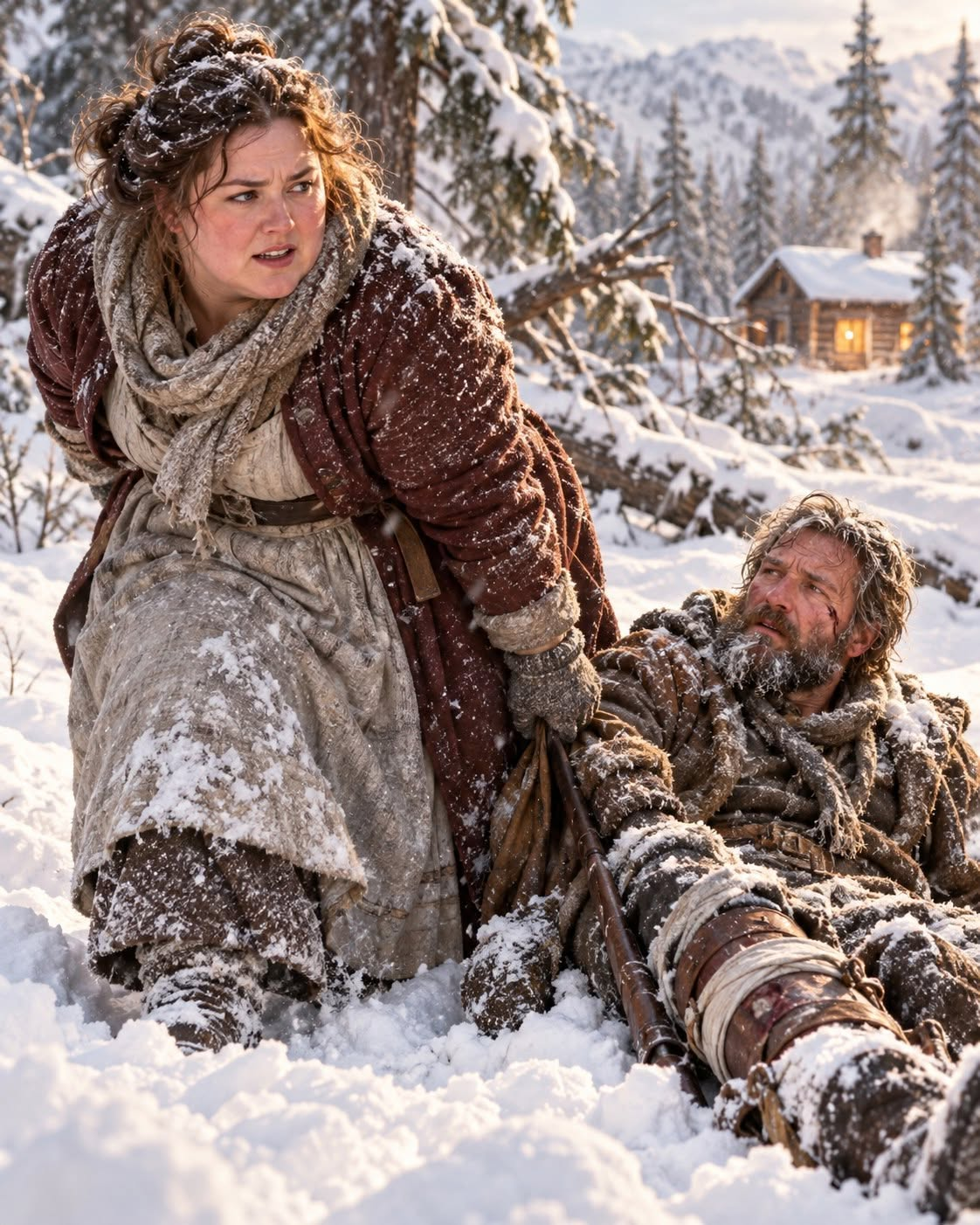
The woman who had dragged her injured husband through a blizzard.
The woman who had refused to surrender her family's truth.
She never became smaller to make other people comfortable.
She never apologized for taking up space.
And she never again allowed anyone to decide what she was worth.
One evening, Amos and I sat outside our cabin watching the sun disappear behind the mountains.
He reached for my hand.
"Do you ever wish we'd met somewhere else?"
I considered the question.
"Sometimes."
He smiled.
"Where?"
I looked toward the valley.
"Somewhere without a broken leg, a missing inheritance, and three dozen men trying to kill us."
He laughed.
I leaned against his shoulder.
"But then we might not have found everyone."
He kissed the top of my head.
The mountains stood quietly around us.
Our home was warm.
Our family was together.
And for the first time in generations, nobody was hiding from the truth.
I had once believed that being chosen by someone meant being given a place in their life.
Now I understood something better.
I had never needed anyone's permission to belong.
I had simply needed the courage to claim the life that was already mine.






Comments 0