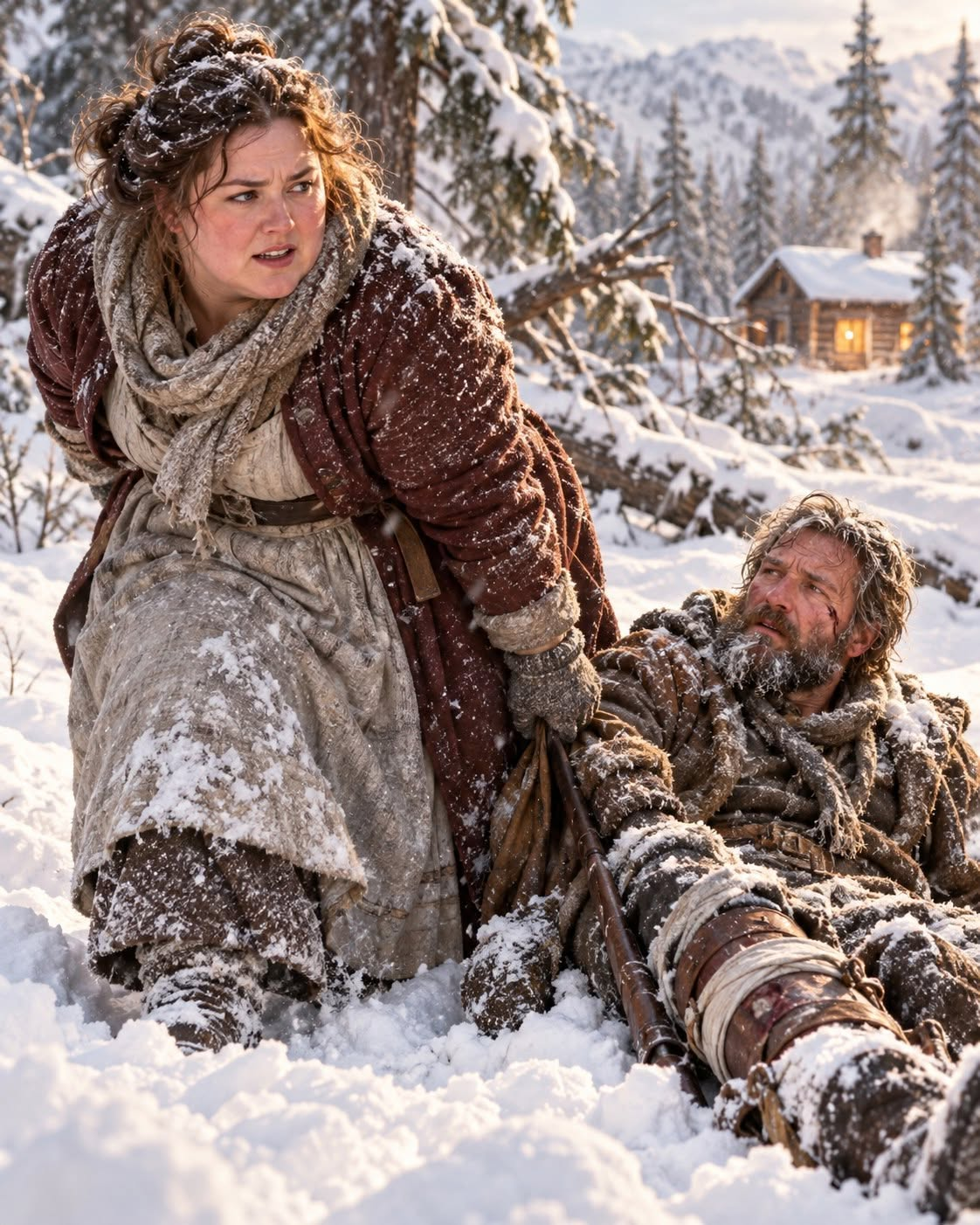
"Silas."
Amos had barely managed to whisper the name.
I turned toward the darkness.
The lantern was moving.
Slowly.
Its yellow light appeared and disappeared behind the snow-covered pine trees, growing brighter each time the wind shifted.
I tightened my grip on Amos's coat.
"Who is Silas?"
Amos didn't answer immediately.
His breathing had become shallow. His eyes remained fixed on the approaching light.
"He's trouble."
I looked toward the trees again.
"Is he one of the miners?"
Amos swallowed.
"Used to be."
That was all he said.
I wanted to ask more, but another gust of wind struck us. Snow swept across the ground, nearly covering the tracks we had made.
The lantern stopped.
Someone was standing beyond the trees.
I could just make out the outline of a man.
He wasn't moving.
Then a voice came through the storm.
"Amos Carter?"
I recognized the voice.
My stomach tightened.
I had heard it before.
At Bitter Creek.
The man stepped forward, raising his lantern.
A broad figure emerged from the darkness, wearing a long black coat and a fur hat pulled low over his forehead.
His beard was dark, his cheeks red from the cold, and a thick leather belt crossed his waist.
Silas Rourke.
The former foreman of Bitter Creek mining camp.
The same man who had once told me that a woman my size should be grateful anyone was willing to feed her.
I hadn't seen him since my wedding.
He looked down at Amos.
Then at me.
A slow smile spread across his face.
"Well, I'll be damned."
I didn't answer.
Silas lowered his lantern.
"Looks like the mountain finally caught up with you, Carter."
Amos tried to move.
Pain stopped him immediately.
Silas noticed.
His smile widened.
"What happened to your leg?"
"Tree fell."
"That's unfortunate."
He sounded anything but sorry.
I shifted slightly, placing myself between Silas and Amos.
"Can you help us?"
Silas looked at me as though he had only just noticed I was there.
"Bessie Miller."
"Bessie Carter now."
He laughed.
"Still correcting people, I see."
I didn't respond.
He examined my clothes, my muddy boots, and the snow packed around my knees.
Then he looked at Amos again.
"Didn't know you had fallen so far."
Amos's jaw tightened.
"Keep walking, Silas."
"Can't do that."
"Then mind your business."
Silas lifted his lantern.
"Funny thing about business. Sometimes it follows you."
I felt Amos's fingers tighten around my sleeve.
It was a small movement.
But I noticed it.
"Do you know him?" I asked.
Amos looked at me.
"Yes."
"How?"
"Long story."
Silas laughed again.
"That's one way to put it."
I didn't like the way he looked at my husband.
I liked even less the way he seemed to enjoy seeing him helpless.
"Can you get us to the cabin?" I asked.
Silas stared at me for several seconds.
Then he shook his head.
"Not with him looking like that."
"He's alive."
"For now."
I stepped closer.
"Then help me."
Silas looked down at my hands.
They were trembling from the cold.
He noticed the rifle splint, the blood, and the improvised knots holding Amos's leg in place.
For the first time, his expression changed.
Not sympathy.
Surprise.
"You did that?"
"Yes."
"With his rifle?"
"Yes."
He looked at Amos.
Then back at me.
"How long have you been dragging him?"
"Long enough."
Silas lowered the lantern.
"You're going to kill yourself."
I had heard that sentence twice already.
Amos had said it.
Now Silas was saying it.
I was beginning to dislike how many people thought they knew what I could survive.
"Then give me a hand."
Silas didn't move.
Instead, he looked toward the ridge.
"There's something you need to understand, Bessie."
I waited.
"This isn't the kind of night you want to be wandering around looking for trouble."
I looked at the snow-covered forest.
Then at my injured husband.
"Trouble already found us."
For a moment, Silas said nothing.
Then he stepped closer.
He reached for Amos's coat.
But Amos suddenly caught his wrist.
"Don't touch her."
Silas looked down at the hand gripping him.
Then he smiled.
"There he is."
Amos released him.
His eyes never left Silas.
I realized something then.
Whatever had happened between these two men, it had not ended peacefully.
And whatever Silas wanted, it had brought him into the mountains on the same night my husband nearly died.
I first met Silas Rourke during my second month at Bitter Creek.
He was the camp foreman.
He had a habit of standing in the cook tent with his hands behind his back, watching everyone work as though the entire camp belonged to him.
He wasn't the strongest man there.
He wasn't the smartest.
But he knew how to make people afraid of losing their jobs.
And he enjoyed using that ability.
I had learned quickly that the safest way to deal with Silas was to finish my work and avoid giving him a reason to speak to me.
That wasn't always possible.
One morning, a shipment of flour arrived late.
The men were hungry, and the kitchen was already short on supplies.
I had spent most of the night stretching what little food remained.
When Silas walked in, he found me dividing the last of the bread into smaller portions.
He looked at the plates.
Then at me.
"What's this?"
"Breakfast."
"Looks like a child's serving."
"It's all we have until the next shipment."
He picked up a piece of bread.
Turned it over.
Then dropped it onto the table.
"Maybe if you weren't eating so much yourself, we'd have enough."
Several miners laughed.
I kept my eyes on the cutting board.
"I haven't eaten yet."
Silas leaned forward.
"Don't get smart."
I continued slicing the bread.
He watched me for a moment.
Then he took two pieces from the tray and walked out.
I didn't say anything.
But I remembered.
I remembered every insult.
Every time someone laughed.
Every time a man asked for more food and then complained about the woman who had prepared it.
I remembered because I had learned that some people counted on you forgetting how badly they treated you.
They wanted you to believe it was normal.
I never did.
Amos had been different from the beginning.
He didn't visit the cook tent often.
When he did, he usually stood near the entrance and waited until I noticed him.
He never whistled.
Never shouted.
Never called me sweetheart or darling as though he had the right.
He simply asked for what he needed.
One afternoon, he came in carrying a bundle of rabbit pelts.
I was lifting a sack of flour onto the table when he entered.
The sack slipped slightly.
I caught it against my hip.
A miner sitting nearby laughed.
"Careful, Bessie. Don't hurt yourself."
Amos put down the pelts.
Then he walked over.
"Need help?"
I looked at him.
"No."
He nodded.
"All right."
He didn't insist.
He didn't make a show of helping me.
He simply returned to his business.
That was the first thing I noticed about him.
He didn't treat me like I was helpless.
Later that afternoon, I found him sitting outside the tent, repairing a leather strap.
I carried him a cup of coffee.
He looked up.
"Didn't ask for this."
"I know."
He accepted it.
"Thank you."
I sat on an overturned crate nearby.
For several minutes, neither of us spoke.
Then he looked at the cook tent.
"Those men always talk like that?"
"Mostly."
"Why do you stay?"
I watched the smoke rising from the kitchen chimney.
"Because work doesn't disappear just because people are cruel."
He nodded slowly.
"Fair enough."
That was the whole conversation.
But the following day, he returned.
And the day after that.
He began bringing me small things from the mountain.
A handful of wild berries.
A piece of dried meat.
Once, a small wooden spoon he had carved himself.
I still have that spoon.
It hangs beside the stove in our cabin.
I never told him how much it meant to me.
The marriage proposal came three weeks later.
I had not expected it.
I had barely allowed myself to think of Amos as anything more than a decent man.
Decent men were rare enough.
I wasn't foolish enough to imagine that one might want to marry me.
When he placed the gold nuggets on the table, I thought he had made a mistake.
He hadn't.
He explained that he owned a cabin beyond the northern pass.
He had enough supplies to survive winter.
He could hunt.
He could trap.
He could maintain the roof and the stove.
But he didn't want to spend another winter alone.
"I need someone who understands work," he told me.
I looked at the gold.
Then at him.
"Why me?"
He seemed confused by the question.
"Because I've watched you."
I frowned.
"Watched me do what?"
"Work."
He leaned against the table.
"You get up before the men. You feed them. You clean up after them. You keep the kitchen running even when they make it difficult."
He paused.
"And you don't quit."
I looked down.
Nobody had ever described me that way.
Not even my own family.
They had always described me as difficult to accommodate.
Too expensive to feed.
Too big for a small room.
Too much trouble.
Amos had described what I did.
Not what I looked like.
"You're sure?" I asked.
"Yes."
"You don't know what it's like living with me."
"Then we'll learn."
I studied his face.
He wasn't smiling.
He wasn't flirting.
He was making a serious offer.
I thought about the camp.
I thought about the men.
I thought about waking up every morning knowing that someone would find a new reason to make me feel ashamed of taking up space.
Then I thought about the cabin.
A place where I could work without being laughed at.
A place where I could cook without listening to insults.
A place where a man looked at me and saw strength.
"I'll need time," I told him.
Amos nodded.
"Take it."
He left the gold on the table.
And walked away.
The next morning, Silas found out.
I was carrying a bucket of water when he stopped me near the supply shed.
"Is it true?"
I continued walking.
"What's true?"
"You're marrying the trapper."
I stopped.
"Yes."
Silas laughed.
"That old mountain fool?"
I tightened my grip on the bucket.
"His name is Amos."
"Does he know what he's getting?"
I looked at him.
"What do you mean?"
Silas leaned against the doorframe.
"Three days up the pass. One room. One bed. One winter. He'll have enough trouble keeping himself alive without feeding another mouth."
I said nothing.
He grinned.
"How much did he pay you?"
My face grew hot.
"That's none of your business."
"So he did pay."
I walked past him.
Silas called after me.
"Careful, Bessie! If he changes his mind, the kitchen is still hiring!"
The men near the stable laughed.
I didn't turn around.
But I heard every word.
Our wedding took place the following morning.
The magistrate had been drinking.
The miners had gathered outside the small meeting room.
Someone had brought a bottle of whiskey.
Someone else had decided the occasion needed entertainment.
When I entered, several men began laughing.
I wore a simple dress that had been washed so many times the fabric had lost most of its color.
It wasn't elegant.
It wasn't expensive.
But it was clean.
And it was mine.
Amos stood near the magistrate.
He wore a dark coat and a white shirt.
His hair was combed back, and his beard had been trimmed.
He looked uncomfortable.
But when he saw me, he smiled slightly.
Not a broad smile.
Just enough to make me feel that I had made the right decision.
Then the jokes started.
"Careful, Amos!"
"Better reinforce that bed!"
"If she rolls over, you'll disappear!"
The laughter filled the room.
I stared straight ahead.
I had heard worse.
I knew how to survive humiliation.
But then I noticed Amos turning toward the men.
His expression had changed.
"That's enough."
The room became quieter.
One miner chuckled.
"Come on, Carter. We're only having fun."
Amos stepped closer.
"Then find something funny."
Nobody answered.
The magistrate cleared his throat and continued the ceremony.
I remember the exact moment Amos took my hand.
His fingers were rough.
Warm.
Steady.
And for the first time in years, I didn't feel as though I needed to make myself smaller.
After the wedding, he led me outside.
The miners were still watching.
He didn't say anything to them.
He simply opened the wagon door and helped me climb in.
Then he climbed beside me.
We left Bitter Creek before noon.
I never looked back.
The cabin was smaller than I expected.
One room.
One bed.
One stove.
A narrow table.
Two wooden chairs.
Shelves filled with canned food, flour, dried beans, salt, and jars of preserved vegetables.
There were tools hanging beside the door.
A rifle rack near the window.
And a small wooden chest beneath the bed.
Amos showed me everything.
He explained how the stove worked.
Where he kept the spare blankets.
Which floorboards creaked.
How to close the shutters when the wind became too strong.
Then he stood near the door.
"Well?"
I looked around.
"It's home."
He nodded.
"Good."
That first night, we shared the bed.
Not because either of us expected anything.
But because the temperature dropped so sharply that sleeping separately would have been foolish.
Amos lay on his side.
I lay on mine.
There was a small space between us.
After a while, he spoke.
"You comfortable?"
"Yes."
"Good."
Silence.
Then I heard him shift.
"Bessie?"
"Yes?"
"If you ever want something different, tell me."
I turned my head.
"What do you mean?"
He looked uncomfortable.
"This marriage. I don't want you thinking you owe me anything."
I stared at him.
For several seconds, I couldn't find the right words.
Then I turned back toward the ceiling.
"I don't want to owe you anything either."
"Fair enough."
That was how our marriage began.
Not with grand promises.
Not with declarations.
Just two people sharing a cold room and trying to build something neither had ever had before.
Back in the forest, Silas was still standing over us.
His lantern illuminated the snow around Amos's body.
I returned my attention to the present.
"Can you help us or not?"
Silas looked at me.
Then he examined Amos again.
"Where's the cabin?"
"North ridge."
"How far?"
"Less than a mile."
He shook his head.
"Not in this weather."
I felt anger rising in my chest.
"Then tell me what we should do."
He looked toward the ridge.
"There's an old hunting shelter about half a mile east. We could get him there."
Amos immediately shook his head.
"No."
Silas looked down.
"Still giving orders?"
"Don't take her there."
I stared at my husband.
"Why?"
He didn't answer.
Silas gave a short laugh.
"Because he's got secrets."
Amos's face tightened.
"Shut your mouth."
I moved closer to him.
"What secrets?"
Neither man answered.
The wind swept between the trees.
Silas adjusted his lantern.
Then he looked at me with an expression I couldn't understand.
"You really don't know, do you?"
"Know what?"
He glanced at Amos.
Then back at me.
"Your husband didn't come up here alone the first time."
My stomach tightened.
"What are you talking about?"
Silas took one step closer.
Amos suddenly grabbed my wrist.
"Bessie, listen to me."
I turned.
His eyes were wide now.
Not from pain.
From fear.
"Don't believe anything he tells you."
Silas smiled.
Then he reached inside his coat.
He pulled out a small folded piece of paper.
It was yellowed with age.
The edges were stained.
He held it up beside the lantern.
I could barely make out the handwriting.
But I recognized one thing immediately.
My husband's name.
Amos Carter.
And beneath it was a date.
The date of our wedding.
Silas unfolded the paper.
His eyes met mine.
"There's something your husband never told you about the day he asked you to marry him."
Amos tried to sit up.
"Bessie, don't let him—"
Silas began reading.
And the first words out of his mouth were my name.






Comments 0