I stared at the photograph Gretchen had sent me.
For several seconds, I couldn't understand what I was looking at.
It showed a printed email, apparently forwarded from Peter's business account. Beneath it was a name.
David Bennett.
Peter's older brother.
I looked toward my husband.
"Why is your brother involved in this?"
Peter's expression changed immediately.
He pulled out the chair beside me.
"Claire, let me explain."
I placed the phone on the table.
"That's what everyone has been telling me for weeks. This time, I want the entire truth."
Peter looked at the photograph.
Then he closed his eyes.
"I didn't think my mother would involve David."
"Why was he involved in the first place?"
Peter took a long breath.
David lived in Indianapolis and worked in commercial property management. He had helped Peter with several business matters over the years, although I had never been particularly close to him.
According to Peter, he had originally approached David for advice about our finances.
He had explained the hospital expenses, his consulting business, and the possibility of borrowing against our home.
David had warned him that taking out another loan without a clear repayment plan would be dangerous.
Peter hadn't liked hearing that.
Instead, he had continued searching for another solution.
Then Gretchen became involved.
She had contacted David privately and explained that Peter was considering sending Austin to Joanie's house temporarily.
David had apparently asked whether I knew about the arrangement.
Gretchen told him that I had agreed.
David accepted her explanation.
But when Peter later asked him to review the property documents, David noticed that my signature looked different from the signature on the original ownership records.
He questioned Peter.
Peter told him that the document was only a draft.
David wasn't convinced.
He warned Gretchen that she should not witness something she hadn't personally seen.
Yet she had already signed the declaration.
I listened without interrupting.
"So David knew?"
Peter nodded.
"He knew something wasn't right."
"Did he know Austin was being sent away?"
"He knew about the arrangement."
"And did he know you had told our son I agreed?"
Peter looked down.
"I don't know."
I picked up my phone.
"Then we're going to find out."
I called Gretchen.
She answered almost immediately.
"Claire?"
"I saw the photograph."
There was a pause.
"I thought you should know."
"Did David ask you to sign the declaration?"
"No. Peter did."
"Then why did you write that you saw me sign?"
Gretchen began crying.
"Peter told me that if the company questioned the application, I should confirm that you had approved it."
I closed my eyes.
"Did you understand what you were doing?"
"At the time, I convinced myself it was only paperwork."
"Paperwork involving my home."
"I know."
"Did David tell you not to do it?"
She hesitated.
"Yes."
I looked at Peter.
He was staring at the table.
"What did David say?"
"He told me that if Claire hadn't signed, I couldn't claim she had."
For a moment, I couldn't speak.
Even someone outside our immediate household had recognized the problem.
But the two people closest to me had continued anyway.
Gretchen spoke again.
"Claire, I am so sorry."
I believed that she was sorry.
But I also knew that an apology couldn't erase what had happened.
"I need you to understand something," I said. "You don't get to decide that my husband needs protecting more than my children need honesty."
"I understand."
"And Austin must never be put in that position again."
"Never."
I ended the call.
Then I looked at Peter.
"Your brother was right."
Peter nodded.
"I know."
"Why didn't you listen?"
He rubbed his forehead.
"Because I was ashamed."
I waited.
He continued.
"I had convinced myself that I could solve everything if I just had enough money and enough control. When David questioned me, I felt like he was telling me I couldn't provide for my family."
I looked at him.
"And when Austin offered you his birthday money, did you feel proud of him?"
Peter's eyes filled.
"No."
"Did you feel concerned?"
He nodded.
"Then why didn't you stop everything?"
He looked down.
"Because I had already gone too far."
I leaned back.
That was perhaps the first honest explanation he had given me.
He had made one bad decision.
Then another.
Then another.
Each one required another lie to protect the previous one.
And eventually, our nine-year-old son had become part of a plan he had never understood.
I stood carefully.
"Peter, we're going to finish this properly."
He looked up.
"What do you mean?"
"Tomorrow, we're contacting the company together. We're withdrawing the application. We're reviewing the finances with an independent professional. And we're going to make sure every document involving my name is corrected."
He nodded.
"Okay."
"You're also going to speak with David."
"I will."
"And Gretchen."
He looked toward the phone.
"Yes."
I took a breath.
"I don't know what happens to our marriage after this. But I know what happens to Austin."
Peter nodded.
"He stays home."
"Yes."
"And he never has to wonder whether he's wanted."
Peter lowered his head.
"I promise."
This time, I didn't accept the promise as proof.
I would need to see it in his actions.
The following Monday, Peter and I met with an independent financial adviser.
We brought every statement, every application, and every document related to the proposed financing.
The adviser reviewed the accounts carefully.
She explained that the proposed home-equity arrangement was not necessary to address our immediate expenses.
There were other options.
We could restructure some payments, reduce certain discretionary costs, and negotiate a manageable payment schedule for the hospital bills.
More importantly, she explained that any financing involving jointly owned property required proper authorization from both owners.
I confirmed in writing that I had not authorized the disputed application.
Peter withdrew it.
Hamilton Property Solutions confirmed that no loan had been issued and no lien had been placed on the house.
The company also documented the disputed signatures and closed the application without proceeding.
Peter agreed to provide any additional information required to correct the records.
We then reviewed our household accounts.
The consulting transfers were real, but Peter had been using the money inconsistently.
Some payments had gone toward business expenses.
Others had covered personal purchases.
A few had simply remained in the separate account without being included in our household budget.
Nothing about the review was pleasant.
But for the first time in months, I knew exactly where our money was going.
We created a realistic monthly budget.
We arranged a payment plan for the remaining medical expenses.
We postponed unnecessary renovations.
And we agreed that no major financial decision would be made without a conversation and approval from both of us.
It wasn't a magical solution.
We still had bills.
We still had sleepless nights.
And we still had a marriage that needed serious repair.
But we no longer had to pretend that Austin was the problem.
He never had been.
The next important conversation happened at the kitchen table.
Peter asked Austin whether he would be willing to talk with him.
Austin agreed, but only after I promised to stay nearby.
Peter sat opposite him.
I sat beside our son.
There was no paperwork.
No travel list.
No money on the table.
Just the three of us.
Peter looked at Austin.
"Buddy, I owe you a proper apology."
Austin held his toy car.
"Okay."
Peter took a breath.
"I told you that your mother agreed to send you to Aunt Joanie's. That wasn't true."
Austin looked down.
"I know."
Peter nodded.
"I also told you that things would be easier if you stayed somewhere else. I made you feel like you were causing problems for the family."
Austin didn't answer.
Peter continued.
"That was wrong. The bills and the responsibilities in this house belong to the adults. You should never have been asked to solve them."
Austin looked up.
"But you said three kids cost too much."
Peter's eyes filled.
"I was worried about money, and I said something that hurt you. Having three children means we have three children to care for. It doesn't mean one of them matters less."
Austin played with the wheels of his toy car.
"Did you want me to go?"
Peter swallowed.
"I thought it would make things easier. But I didn't think enough about how it would make you feel."
"Did you want Grandma to have my room?"
Peter glanced at me.
Then he looked back at Austin.
"I allowed that idea to become part of a plan. I should never have done that without talking to your mother. Your room belongs to you."
Austin nodded.
Then he asked:
"Are you mad because I told Mom?"
Peter shook his head.
"No, buddy."
"Really?"
"Really. You did the right thing by telling her."
Austin looked toward me.
I gently squeezed his hand.
Peter leaned forward.
"I want you to know something else. You don't have to be perfect to live here. You don't have to be quiet all the time. You don't have to help with the babies to earn anything."
Austin looked at him.
"Even if I forget to clean my room?"
Peter smiled sadly.
"Even then."
"Even if I don't want to share my toys?"
"Even then."
"Even if I ask for new shoes?"
Peter nodded.
"Especially then."
Austin was quiet for a moment.
Then he asked:
"Can we go buy them?"
Peter looked at me.
I nodded.
He turned back toward his son.
"Yes. This afternoon, if you want."
Austin smiled.
It wasn't a huge smile.
It was small and cautious.
But it was real.
The following weekend, Gretchen came to visit.
She had returned to Joanie's house after leaving our home.
She arrived carrying a paper bag.
Inside were homemade chocolate chip pancakes, a small box of strawberries, and a new baseball cap for Austin.
He ran toward her when he saw her.
"Grandma!"
She hugged him.
"Hello, sweetheart."
He looked inside the bag.
"Are those pancakes?"
"Just the way you like them."
He smiled.
I watched from the kitchen doorway.
Gretchen looked toward me.
"Claire, may I speak with you?"
I nodded.
We stepped into the living room while Peter helped Austin set the table.
Gretchen looked nervous.
"I've been thinking about everything."
I waited.
"I spoke with David. He told me I needed to take responsibility for what I did."
She lowered her eyes.
"He was right."
I folded my hands.
Gretchen continued.
"I spent so much time trying to protect Peter from feeling overwhelmed that I stopped considering what was happening to everyone else."
I listened.
"I also convinced myself that because I had raised him and helped him, I had the right to make decisions for his household."
She looked at me.
"I didn't."
I nodded slowly.
"No, you didn't."
She began crying.
"I know you may never trust me the way you did before."
I didn't pretend otherwise.
"Trust will take time."
"I understand."
She wiped her cheeks.
"I want to help with the babies, but only when you want me to. And I will never discuss Austin's living arrangements again without you."
I considered her words.
Then I said:
"You can be their grandmother. You can love them. You can help us when we ask. But you need to respect that Peter and I are their parents."
She nodded.
"I will."
I looked toward the kitchen.
Austin was laughing at something Peter had said.
Gretchen followed my gaze.
"I hurt him."
"Yes."
"I know."
She took a breath.
"May I apologize to him again?"
"Yes. But don't expect him to make you feel better about it."
She nodded.
"I won't."
That afternoon, Gretchen apologized directly to Austin.
She didn't explain her reasons.
She didn't blame money.
She didn't ask him to forgive her.
She simply told him that what she had said was wrong.
Austin listened.
Then he asked whether she could teach him how to make pancakes.
Gretchen smiled.
"Of course."
They spent the next hour in the kitchen.
The pancakes weren't perfectly round.
One was too dark around the edges.
Austin insisted that the misshapen ones tasted better.
For the first time in weeks, the kitchen sounded like a family kitchen again.
The following month wasn't perfect.
I still had difficult days.
My recovery took longer than expected, and there were nights when the twins seemed to wake each other every hour.
Peter and I began counseling.
Our first sessions were uncomfortable.
He had to confront the way he used control to manage anxiety.
I had to confront how much I had relied on the assumption that my husband would always tell me the truth.
We didn't solve everything immediately.
But we began communicating.
Peter also arranged to reduce some of his consulting commitments so he could spend more time at home.
He started taking responsibility for the household budget.
He attended the twins' pediatric appointments.
He helped with nighttime feedings.
And most importantly, he began spending time with Austin without expecting the boy to act like an extra adult.
He played baseball with him in the backyard.
He helped him with homework.
He took him to the park.
Sometimes Austin still asked whether a purchase was too expensive.
Whenever he did, Peter answered honestly without making him feel guilty.
One Saturday, Peter brought home a small savings box.
It was wooden, with a blue lid.
He placed it on Austin's desk.
"What's this?" Austin asked.
"Something I thought you might like."
Austin opened it.
Inside was a small note.
It read:
For your dreams, not your responsibilities.
Austin looked at his father.
"What does that mean?"
Peter smiled.
"It means your money belongs to you. You can save it for something you want."
Austin nodded.
Then he carried the box downstairs.
He placed it on the kitchen table.
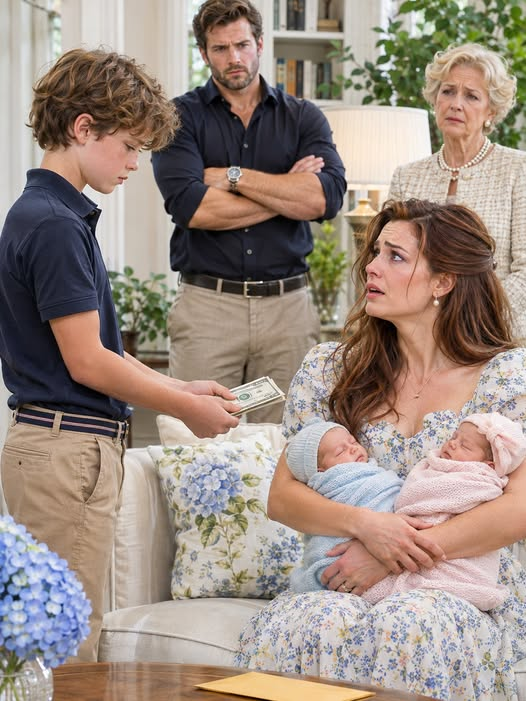
The same table where he had once offered us $146 to let him stay.
I looked at it.
Then at my son.
"Do you want to put your birthday money in there?"
He smiled.
"Yes."
He opened the box and carefully placed the bills inside.
This time, he wasn't paying for anything.
He was simply saving.
Three months after that terrible afternoon, we went shopping for new shoes.
Austin chose blue sneakers with white soles.
He walked around the store several times, testing them.
"These feel good."
I smiled.
"Then they're the ones."
Peter stood beside us.
He looked at our son.
"Do you like them, buddy?"
Austin nodded.
"They're not too expensive."
Peter crouched.
"That's not what we're deciding."
Austin looked at him.
"We're deciding whether they fit and whether you like them."
Austin smiled.
"Then I really like them."
We bought the shoes.
On the way home, Austin sat in the back seat holding the shopping bag.
After a few minutes, he spoke.
"Mom?"
"Yes, sweetheart?"
"Can I still visit Aunt Joanie next month?"
I turned around.
"Of course."
"Can Dad come too?"
Peter glanced at him through the rearview mirror.
"I'd love to."
Austin smiled.
"Then maybe we can all have pancakes."
Peter laughed.
"That's a good idea."
Austin looked out the window.
Then he said something that made me smile.
"I don't need to move there. I just want to visit."
I reached back and touched his knee.
"That's exactly right."
By the time summer arrived, the twins were sleeping for longer stretches.
I had returned to work part-time, and we had established a routine that worked for everyone.
Austin had adjusted beautifully to being an older brother.
He loved making funny faces for Mason.
He sometimes sang to Hailey when she became restless.
But we never expected him to become their caretaker.
He was allowed to play.
He was allowed to make mistakes.
He was allowed to be nine.
One Sunday afternoon, we celebrated Austin's tenth birthday.
The house was filled with family.
Joanie came from Columbus.
Gretchen brought her famous chocolate chip pancakes.
David arrived with a baseball glove.
Peter organized a small backyard game.
The twins sat in their baby seats while everyone gathered around the birthday cake.
Austin stood beside the table.
There were ten candles.
I watched him close his eyes.
He made a wish.
Then he blew them out.
Everyone clapped.
Peter handed him a small wrapped box.
Austin opened it.
Inside was a framed photograph.
It showed the five of us together in the kitchen, taken only a few weeks after the twins were born.
I was holding Hailey.
Mason was sleeping in his bassinet.
Austin stood between Peter and me.
All of us were smiling.
Austin looked at the photograph.
"Can I put this in my room?"
"Of course," Peter said.
Austin hugged him.
Then he came toward me.
"Mom?"
"Yes, sweetheart?"
"Can we keep the old picture too?"
I knew exactly which one he meant.
The photograph he had once packed into his cardboard box because he thought he was leaving.
I smiled.
"Yes. We can keep both."
He nodded.
Then he ran outside to play with his cousins.
Gretchen came to stand beside me.
She looked toward the backyard.
"He seems happy."
"He is."
She remained quiet for a moment.
Then she said:
"I'm grateful you let me come back into his life."
I looked at her.
"He never stopped being your grandson."
She nodded.
"I know."
"But being family means taking care of each other. It also means respecting each other."
"I understand."
I smiled faintly.
"Then let's keep doing better."
She smiled.
We watched Austin running across the grass.
Peter was playing baseball with him.
Every time Austin hit the ball, he shouted with excitement.
The twins slept peacefully inside.
For a moment, I thought about the afternoon when my son had placed $146 on the kitchen table.
I remembered his careful little fingers.
His too-small shoes.
His folded list.
His promise to make himself easier to take care of.
I remembered how he had asked whether he could stay for one more month.
And I remembered the sentence that had changed everything.
Dad said you already agreed, Mom.
I looked toward Peter.
He caught my eye.
He walked over and stood beside me.
"Happy birthday to our boy," he said.
I nodded.
"He's a wonderful kid."
Peter looked toward Austin.
"He really is."
Then he reached for my hand.
I allowed him to take it.
We were not pretending that nothing had happened.
Trust had taken time to rebuild.
It would continue to require honesty, patience, and effort.
But our family was no longer making decisions through secrets.
The financial problems had been addressed.
The disputed application had been withdrawn.
The house remained ours.
Austin stayed in his school, kept his bedroom, and continued growing up surrounded by people who loved him.
Gretchen learned that helping a family didn't mean controlling it.
Peter learned that being a good father wasn't about making difficult decisions alone.
And I learned that protecting my children sometimes meant asking difficult questions, even when the answers hurt.
That evening, after everyone had left, I found Austin sitting at the kitchen table.
His blue savings box was in front of him.
He was counting his birthday money.
I walked over.
"How much do you have now?"
He smiled.
"More than before."
"That's wonderful."
He carefully put the bills away.
Then he looked up.
"Mom?"
"Yes?"
"Do you remember when I gave you my $146?"
I nodded.
"I remember."
He looked thoughtful.
"I was really scared."
I sat beside him.
"I know, sweetheart."
"I thought you were going to say yes."
I reached for his hand.
"I'm sorry you ever had to feel that way."
He leaned against my shoulder.
Then he said:
"I'm glad I told you."
I kissed the top of his head.
"So am I."
He looked toward the living room, where Peter was putting away the birthday decorations.
Then he smiled.
"Mom?"
"Yes?"
"Can we make pancakes tomorrow?"
I laughed softly.
"Of course."
"Chocolate chip?"
"Definitely."
He climbed down from his chair and hugged me.
Then he ran toward his father.
"Hey, Dad! Mom said we're making pancakes tomorrow!"
Peter smiled.
"Then I guess I'll be in charge of breakfast."
Austin laughed.
I watched them together.
The kitchen table was clean.
The savings box sat safely in Austin's bedroom.
The twins were sleeping.
And nobody was counting how much it cost to keep a child at home.
Because Austin had never been an expense to remove.
He had always been our son.
And he had always belonged.






Comments 0