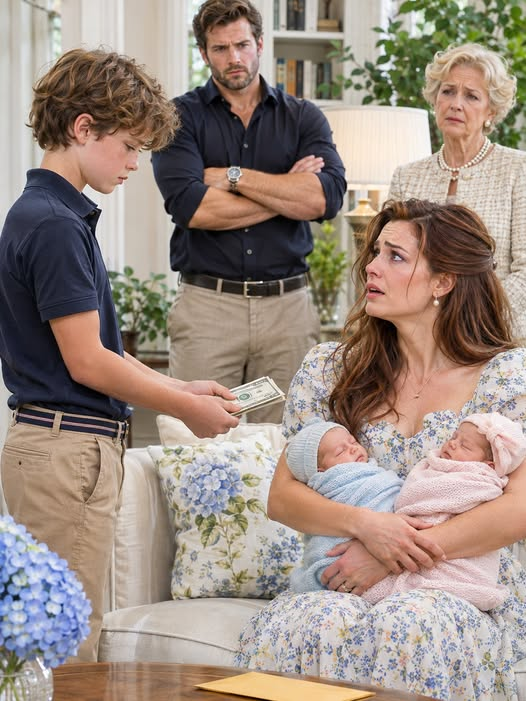
I waited until Austin had gone upstairs before I looked at the photograph again.
The cardboard box sat on his bedroom floor.
His favorite baseball cap was visible inside.
Beside it were two books, a small stuffed dog, and a framed photograph of the five of us taken before the twins were born.
I recognized the photograph.
It had been on his bedside table for almost three years.
Austin was holding my hand in it.
Peter stood behind us with one arm around my shoulders.
We were smiling.
I wondered when my son had decided that the photograph belonged in a moving box.
I slowly folded the paper and placed it beside the $146.
My hands were shaking.
Not because I was uncertain about what to do.
Because I was beginning to understand how much had happened while I had been recovering.
That evening, Peter returned to the kitchen after finishing his work call.
He found me sitting at the table with the photograph, the travel list, and Austin's money arranged in front of me.
"You're still thinking about this?"
I looked up.
"Yes."
He pulled out a chair.
"Claire, I understand that you're upset."
"Do you?"
"I do."
"Then tell me why our son has been packing his belongings."
Peter leaned back.
He looked tired.
"I didn't want him to feel rejected."
I stared at him.
"Then why did you tell him I had agreed to send him away?"
He rubbed his forehead.
"I thought it would be easier if he understood that the arrangement was temporary."
"For whom?"
He didn't answer.
I continued.
"Did you tell him that his mother needed him to leave?"
"No."
"Did you tell him I was overwhelmed by having three children?"
Peter looked down.
"I said things were getting difficult."
"Did you tell him he could help by going to Joanie's?"
He remained silent.
I felt my stomach tighten.
"Peter."
He finally looked at me.
"Yes."
I closed my eyes.
He continued quickly.
"I didn't mean it the way you're interpreting it."
"How else should a nine-year-old interpret it?"
Peter leaned forward.
"I was trying to protect him from feeling like a burden."
I looked at the money.
"By making him believe he had to pay his way?"
He didn't answer.
I thought about Austin's shoes.
The way he had insisted they still fit.
The way he had offered to buy diapers.
Suddenly, I remembered something from the previous Thursday.
I had been sitting on the couch when Austin came into the living room.
He had stood in front of me for several minutes before speaking.
"Mom, can I have something?"
"Of course, honey. What do you need?"
He had looked down at his feet.
"Nothing."
I had smiled.
"Are you sure?"
He had nodded and walked away.
At the time, I hadn't thought much about it.
Now I understood.
He had needed new shoes.
He had been afraid to ask.
"Peter, did Austin tell you his shoes were hurting?"
He frowned.
"What?"
"His shoes. They're too small."
Peter looked toward the hallway.
"I don't know."
"Have you looked at his feet recently?"
"Claire, I have a lot going on."
"So does he."
Peter sighed.
"I'll buy him shoes."
"That's not the point."
"Then what is the point?"
I looked directly at him.
"The point is that our child has been learning to ask for less because he thinks his existence costs too much."
Peter became quiet.
For several seconds, I could hear only the refrigerator humming.
Then he said something I wasn't expecting.
"My mother thought this would help."
I looked at him.
"Your mother?"
"She was the one who suggested Joanie."
"That doesn't explain your part in it."
He stood.
"I didn't think you'd react this way."
I stared at him.
"How did you expect me to react?"
He walked toward the counter.
"I thought you'd understand the financial pressure."
There it was again.
Money.
Hospital bills.
Mortgage payments.
Childcare.
His explanations always returned to the same subject.
But none of them explained why my son had been told his mother wanted him gone.
I opened the drawer and took out the twins' hospital paperwork.
Several bills were still waiting to be paid.
I knew how much the delivery had cost.
I knew how much money we had spent.
I had been there.
I had watched Peter organize the insurance documents.
I had listened to the discussions about our savings.
We were under pressure.
But we weren't in a situation where a nine-year-old needed to finance his own childhood.
"Did you actually calculate how much money Austin costs us?" I asked.
Peter looked confused.
"What?"
"You keep saying three children are too expensive. Did you calculate it?"
"Claire, that's not what this is about."
"Then what is it about?"
He didn't answer.
I put the papers down.
"I want to know what exactly you and your mother told him."
Peter shook his head.
"You're making this into something bigger than it needs to be."
"No. I'm finally seeing how big it already is."
He walked out of the kitchen.
I remained seated.
A few minutes later, I heard footsteps on the stairs.
Austin appeared in the doorway wearing his pajamas.
He held something behind his back.
"Mom?"
"Hi, sweetheart."
He walked toward me.
Then he placed a small pair of gray socks on the table.
"They're my favorite."
I smiled.
"They're nice."
"Can I take them to Joanie's if I go?"
My smile disappeared.
"Why are you asking me that?"
He shrugged.
"Grandma said I should take things I like."
I reached for his hand.
"Austin, you're not going to Joanie's because nobody has decided that you should."
He looked down.
"But Dad said Saturday."
"I know."
"Is Saturday still happening?"
"No."
He seemed relieved.
Then he asked:
"Can I still visit Aunt Joanie someday?"
"Of course."
His face brightened.
"Can she still make pancakes?"
I laughed softly.
"Absolutely."
He smiled.
For a moment, he looked like my little boy again.
Then he glanced toward the kitchen counter.
"Mom, can I ask you something?"
"Anything."
"If the hospital bills are really big, can I help with them when I'm older?"
I felt tears gathering in my eyes.
I pulled him gently toward me.
"No, sweetheart. That's an adult responsibility."
"But I could get a job."
"One day, when you're grown up, you can decide what you want to do with your money."
He nodded.
I kissed his forehead.
"Right now, your job is to be nine."
He leaned against me.
For several seconds, neither of us spoke.
Then he whispered:
"Grandma said you might not believe me because you're tired."
I looked down at him.
"What else did Grandma say?"
He hesitated.
Then he reached into his pajama pocket.
He pulled out a folded receipt.
I unfolded it.
It was from a children's clothing store.
Two pairs of pajamas.
One winter coat.
A pair of socks.
The receipt was dated three days earlier.
At the bottom was a handwritten note:
Keep the total low. He won't need much.
I stared at the handwriting.
I recognized it immediately.
It belonged to Gretchen.
But something else on the receipt caught my attention.
The purchase hadn't been made with my mother-in-law's card.
It had been paid for using Peter's.
And on the back, my husband had written four words.
Don't tell Claire yet.
I looked toward the stairs.
Then I heard Peter's voice behind me.
"Why are you going through those papers?"
I turned.
He was standing in the doorway.
And this time, I wasn't going to let him walk away without answering me.






Comments 0