The name was Janine.
My name.
I stared at the document lying on Harold Brennan's conference table.
Janine Elizabeth Whitmore.
Robert had written my name beneath a paragraph about protecting his children.
For a moment, I couldn't hear anything except the beating of my own heart.
Nathan Cole stood across from me, holding the shoulder of a frightened little boy.
Tyson sat motionless beside the window.
Eleanor covered her mouth.
And Harold leaned over the document, studying every line.
I looked at Nathan.
"What does this mean?"
He took a breath.
"It means Robert trusted you."
I shook my head.
"That isn't what I'm asking."
My voice trembled.
"Who are you?"
Nathan looked down at the photograph.
Then back at me.
"My mother was named Caroline Cole."
I waited.
"She worked with Robert many years ago. He helped her when she was in trouble."
I looked at the photograph again.
Robert stood beside a young woman holding a baby.
Nathan had told me that baby was him.
And that Robert had been protecting a second family.
My chest tightened.
"Are you telling me my husband had another child?"
Nathan hesitated.
Then shook his head.
"No, Mrs. Whitmore."
I stared at him.
"Then what are you telling me?"
He looked ashamed.
"I let you believe something that wasn't true."
The room went silent.
Nathan continued.
"Robert wasn't my father."
I closed my eyes.
For the first time that morning, I felt something loosen inside my chest.
But the relief lasted only a moment.
"Then why did you say he was protecting a second family?"
Nathan swallowed.
"Because that's how my mother described it. Robert helped us for years. He treated us like family."
I looked at the boy.
He had Robert's gray-blue eyes.
Or perhaps I had wanted to see them.
Grief can make a person search for someone they've lost in every unfamiliar face.
Nathan continued.
"My mother was raising me alone. Robert helped her find work, arranged legal assistance, and made sure we had somewhere safe to live."
I looked at Harold.
He was examining the document.
"Janine," he said gently, "this appears to be an old testamentary draft or copy. We need to verify its history before treating it as an operative will."
I nodded.
Then I looked back at Nathan.
"Why did Robert want me to protect his children?"
Nathan pointed to the paragraph.
"Read the whole sentence."
I leaned forward.
The document referred to Robert's wishes for the children and families he had helped through a small charitable fund.
It named me as the person he hoped would oversee those arrangements if they were ever completed.
Not a secret wife.
Not another biological child.
A promise to help people who needed it.
I sat down.
My knees had become weak.
"Robert never told me about this."
Nathan lowered his eyes.
"My mother said he didn't want you burdened while he was sick."
I almost laughed.
There it was again.
Robert had tried so hard to protect me that he had left me with mysteries.
I looked at his photograph.
"Oh, Robert," I whispered. "You should have trusted me with the whole truth."
Harold turned to Nathan.
"Before we discuss anything further, I need you to explain how you came into possession of these papers."
Nathan nodded.
"My mother died six years ago. She left a box of documents. I didn't look through everything until recently."
"Why recently?"
"Because I was contacted about purchasing this house."
I stared at him.
"By Tyson?"
"Through Daniel Mercer initially."
Tyson lowered his head.
Nathan continued.
"The transaction seemed unusual. The price was far below what I understood the property to be worth, and I was told the owner was elderly and unable to manage the sale."
I felt cold.
"Unable?"
"Yes."
He looked at me.
"When I asked for proof that you had agreed, I received the authorization and the medical report."
I remembered the night Nathan came to my door.
The envelope.
The petition.
The look on his face when he realized I wasn't the helpless woman Tyson had described.
Nathan continued.
"I recognized Robert's name. My mother had kept correspondence from him. That's why I began comparing the documents."
Harold nodded.
"And the will?"
"It was in her box. I brought it because I thought it might explain why Robert was so determined to protect the house."
I looked at the document.
"Did he leave you money?"
Nathan shook his head.
"Not through that paper. My mother received help during her lifetime. She kept the documents because they mattered to her."
I studied him.
"Then why didn't you tell me all of this when you came to my house?"
He looked ashamed.
"Because I wasn't sure what was true. And because I was afraid you would think I was involved."
I sighed.
"Nathan, everyone in this story seems to have been afraid of telling me the truth."
He lowered his eyes.
"You're right."
I looked at the little boy.
He couldn't have been more than nine.
"What's your name, sweetheart?"
He whispered, "Oliver."
I smiled gently.
"Hello, Oliver."
He looked at me.
"Hello."
"Why are you here?"
Nathan put a hand on his son's shoulder.
"I brought him because I had promised to take him to school after stopping here. When I learned what happened to Tyson, I came directly to the office instead. I should have arranged somewhere else for Oliver to wait."
I nodded.
Oliver looked frightened by the adults and their serious faces.
I reached into my purse and found a peppermint.
"Would you like one?"
He glanced at his father.
Nathan nodded.
Oliver took it.
"Thank you."
I smiled.
"You're welcome."
For a moment, I thought of Marcus and Michael.
Then my stomach tightened.
I turned toward Tyson.
"Where is Michael?"
Tyson looked up.
His face was pale.
"Mom—"
"Don't tell me to calm down. Don't tell me I'm confused. Tell me where my grandson is."
He swallowed.
"Tatum arranged for Michael to stay with Nathan."
I stared at him.
"What?"
Nathan stepped forward.
"That's not quite what happened."
I turned.
He took a breath.
"Tatum contacted me yesterday. She said Michael had become upset about the family situation and wanted to speak with me."
I frowned.
"Why would Michael want to speak with you?"
"Because he'd overheard his parents discussing the house. He thought I was buying it and that you would have to leave."
My heart ached.
Poor Michael.
He was only twelve.
He loved his bedroom.
His grandmother.
His family.
And now he had been frightened by a scheme he couldn't understand.
Nathan continued.
"I told Tatum I would speak with him only with her present and in a public place. We met briefly at the hotel lobby. Michael asked me whether I was taking your home."
I covered my mouth.
"What did you say?"
"I told him I wasn't buying anything without the owner's clear permission."
Tears filled my eyes.
Nathan continued.
"Tatum left the conversation abruptly after receiving a call. Michael stayed with her cousin at the hotel. I didn't take him anywhere."
I looked at Tyson.
"Then why did Tatum say Michael wasn't with her?"
He lowered his eyes.
"Because she was panicking."
I stared at him.
"About what?"
He swallowed.
"Victor."
I closed my eyes.
Of course.
Victor Hale.
The man who seemed to be standing behind every terrible decision.
Harold leaned forward.
"Tyson, before we continue, we need to confirm the children's whereabouts."
Tyson nodded.
He called Tatum again.
This time, she answered.
Harold asked that she confirm where Marcus and Michael were and allow Tyson to speak with them.
A few minutes later, Michael's voice came through the phone.
"Dad?"
I began crying.
Tyson swallowed.
"Hey, buddy."
"Is Grandma okay?"
I covered my mouth.
Tyson looked at me.
"She's right here."
I leaned toward the phone.
"Michael?"
"Grandma!"
His voice broke.
"Are you going to lose your house?"
I closed my eyes.
"No, sweetheart."
"Mom said things are complicated."
"They are. But the grown-ups are working through them."
He was quiet.
Then whispered, "I don't want you to go away."
I began crying harder.
"Oh, Michael. I'm not going away."
"Promise?"
I took a breath.
"I promise I'll always love you and make time for you."
He sniffled.
"Okay."
Marcus came onto the call next.
He asked whether I was all right.
I told him I was.
Then I asked them both to listen to the adults caring for them and not to worry about the legal problems.
When the call ended, I sat back.
For the first time in days, I could breathe.
My grandsons were safe.
That mattered more than every document on Harold's table.
The weeks that followed were not easy.
I wish I could tell you that the truth came out in one dramatic afternoon.
That everyone confessed.
That Victor was arrested before dinner.
That Tyson and Tatum apologized and immediately became better people.
But life rarely works that way.
The truth arrived slowly.
Through documents.
Interviews.
Financial records.
Bank statements.
Electronic files.
And people finally admitting what they had done.
The first major discovery concerned Victor Hale.
Andrew Price provided the original lending agreement and related records.
They supported what Robert had said on the recording.
Tyson had borrowed money for a failed business.
Robert had refused to pledge our home.
The original agreement did not authorize Victor to take the house.
The document Victor pushed beneath my bathroom door had been altered.
A forensic document examiner later identified significant differences between the disputed signature and known examples of Robert's handwriting.
The electronic records also pointed to a recently assembled version of the document.
Robert had not signed it three days after his death.
He couldn't have.
And now there was evidence that someone had tried to make it appear otherwise.
Victor's threats and the disputed paperwork became part of a criminal investigation.
Margaret's involvement was investigated too.
The recording did not prove she had caused Robert's medical emergency.
The hospital records showed that he had been gravely ill and had experienced serious breathing difficulties.
His doctors had documented the progression of his cancer.
There was no credible evidence that Margaret or Victor had caused his death.
I cried when Harold explained that.
Not because I wanted anyone punished.
But because I had been terrified that my husband's final moments had been stolen from him.
They hadn't.
Robert died from the illness we had fought together.
The confrontation in the hospital had been cruel and stressful.
But it was not the cause of his death.
I could finally remember his last days without imagining a crime behind every shadow.
Margaret eventually gave a formal statement.
She admitted that she had owed Victor money.
She admitted passing information about Robert's documents to him.
And she acknowledged participating in the recent effort to obtain my house through a transaction I had never authorized.
She claimed she had believed Tyson would persuade me to agree before anything was completed.
That explanation didn't excuse what she had done.
But it helped explain how the scheme had developed.
Victor wanted repayment.
Tyson wanted his debts erased.
Tatum wanted financial security.
Margaret wanted relief from her own obligations.
And somehow, all four had convinced themselves that my house was the answer.
My home.
The place where Robert and I had raised our son.
The place where we had celebrated Christmas mornings and birthdays.
The place where I had cared for my husband when he was dying.
They had looked at it and seen money.
Not memories.
Not dignity.
Not a woman who still had years of life she intended to enjoy.
Money.
I remember sitting across from Harold when he explained the proposed sale.
"Janine," he said, "the transaction has been terminated."
I stared at him.
"Completely?"
"Yes. The proposed buyer is no longer proceeding, and the transaction file has been closed."
I covered my mouth.
"And the house?"
He smiled.
"The recorded title remains yours."
I began crying.
Harold handed me a tissue.
Then he said, "We've also addressed the unauthorized financing inquiry and documented the disputed authorization."
I nodded.
"What about the guardianship petition?"
Rebecca answered.
"No guardian was ever appointed. The draft and supporting report raised serious concerns, but they did not give Tatum legal authority over you."
I closed my eyes.
For days, I had feared that someone might arrive with a paper declaring me incapable of making my own decisions.
Now I understood how much of that fear had been deliberately created.
The medical report was investigated.
The doctor whose name appeared on it denied having examined me.
The document's origin became part of the broader inquiry.
And the guardianship effort went no further.
I was still Janine Whitmore.
Eighty years old.
A little slower on the stairs.
Occasionally forgetful about where I left my glasses.
But perfectly capable of deciding how to live my own life.
The second major discovery concerned Robert's estate papers.
Harold traced the law office named in Robert's old correspondence.
The attorney who had prepared the draft trust had retired years earlier.
His archived files were eventually located.
They confirmed that Robert had explored creating a charitable fund and additional protections for me.
But the trust draft had never been completed.
The document Nathan brought was not a later, controlling will.
It was part of that unfinished planning.
Robert's valid estate arrangements had already been administered after his death.
There was no secret second family entitled to my house.
No hidden heir.
No mysterious transfer waiting to be enforced.
Nathan's mother, Caroline, had been a woman Robert helped through difficult circumstances.
Robert had once told me he believed people should help others when they could.
I hadn't known how seriously he took that belief.
Caroline had been one of several people he quietly assisted.
Nathan showed me letters his mother had kept.
In one, Robert wrote that he hoped Nathan would grow into a kind and responsible man.
I smiled when I read it.
"That sounds like him."
Nathan looked at me.
"My mother always said Robert was the reason she got a second chance."
I looked down at the letter.
"Then I'm glad he helped her."
Nathan hesitated.
"Mrs. Whitmore, I'm sorry I frightened you."
I looked at him.
"You did."
He nodded.
"I know."
"But you also brought me information I needed."
His eyes filled with tears.
"Thank you."
I smiled.
"Just promise me one thing."
"What?"
"Next time you need to tell an eighty-year-old woman something important, don't arrive at her house after midnight."
He laughed.
For the first time since we met, I laughed too.
Tyson's situation was more complicated.
He had participated in the attempted sale.
He had concealed the debt.
He had allowed false claims about my mental condition to circulate.
And he had pressured me repeatedly.
The authorities reviewed his conduct along with the others'.
Harold made sure I understood that loving my son did not require me to interfere with the investigation.
I didn't.
Tyson obtained his own attorney.
He cooperated with requests for records.
He also began working with a financial counselor to understand the full extent of his debts.
For the first time in his adult life, he stopped asking me to solve them.
One afternoon, several weeks after the recording was recovered, he came to Harold's office.
He looked tired.
Older.
His right arm was no longer in a sling.
He sat across from me.
For a long time, neither of us spoke.
Then he said, "Mom, I don't expect you to forgive me."
I looked at him.
"Good."
He blinked.
I continued.
"Because forgiveness isn't something you can demand."
He nodded.
"I know."
I studied his face.
He had Robert's nose.
My dark eyebrows.
And the same nervous habit of rubbing his hands together when he was frightened.
"I love you, Tyson."
His eyes filled with tears.
"I love you too."
"But I don't trust you."
He looked down.
"I understand."
I took a breath.
"You tried to sell my home."
He nodded.
"You let people call me incapable."
He began crying.
"You allowed your wife to seek control over my affairs."
His voice broke.
"I know."
I leaned forward.
"Do you understand what that did to me?"
He covered his face.
For a moment, he couldn't speak.
Then he whispered, "I made you feel like you didn't matter."
I felt tears rise.
"Yes."
He lowered his hands.
"And you mattered more than anyone."
I shook my head.
"Then you should have treated me that way."
He nodded.
"You're right."
I sat quietly.
Then I told him what Robert had said on the recording.
Do not let her kindness become your excuse.
Tyson closed his eyes.
"I've heard those words a hundred times in my head."
I looked at him.
"Then it's time you started living by them."
Tatum and Tyson moved out of my house.
Not because I changed the locks while they were away.
Not because I shut off the electricity.
Not because I threw their belongings onto the lawn.
Harold and Rebecca helped us follow the proper legal process.
Written notices were provided.
Occupancy arrangements were addressed.
And eventually, Tyson and Tatum agreed to leave by a specified date.
They rented a smaller place across town.
It wasn't luxurious.
There was no enormous kitchen.
No formal dining room.
No backyard swimming pool.
But it was theirs to manage.
For the first time in years, they were responsible for their own housing expenses.
Tatum didn't accept the change gracefully.
At first, she complained.
Then she blamed Harold.
Then Eleanor.
Then me.
She said I was breaking up the family.
I listened once.
Then I told her something I wished I had said years earlier.
"Tatum, a family isn't held together by one person surrendering everything."
She stared at me.
I continued.
"If you want a relationship with me, it has to begin with respect."
She didn't answer.
I didn't chase her.
That was new for me.
I had spent so many years trying to make everyone comfortable that I had forgotten I was allowed to be comfortable too.
Tyson and Tatum had difficult conversations about their marriage, their debts, and the choices they had made.
I didn't attend those conversations.
I didn't pay their bills.
I didn't tell them how to fix everything.
Those were their responsibilities.
And for once, I let them carry them.
The day they moved out, I stood on the front porch.
A moving truck was parked in the driveway.
Boxes lined the hallway.
Marcus carried a small suitcase.
Michael held his favorite basketball.
They looked worried.
I knelt as much as my knees would allow.
"Come here, boys."
They hurried into my arms.
I held them tightly.
Marcus whispered, "Grandma, are we still allowed to visit?"
My heart broke.
"Of course."
Michael looked up.
"Even if Mom and Dad don't live here?"
I smiled through my tears.
"Especially then."
He frowned.
"Why?"
"Because visiting Grandma should be something you do because you want to. Not because anyone needs a place to stay."
Marcus smiled.
Michael hugged me again.
"Can we still make pancakes?"
I laughed.
"Absolutely."
"With chocolate chips?"
"Extra chocolate chips."
He grinned.
For a moment, everything felt simple again.
Then Tyson came outside.
He looked at the house.
Then at me.
"Mom."
I nodded.
"Tyson."
He swallowed.
"Thank you for letting us stay all those years."
I looked at him.
"I wish you'd understood what it meant."
He lowered his eyes.
"I do now."
I hoped he did.
But I no longer needed to decide that day whether I believed him.
Time would show me.
Actions would show me.
Not promises.
He hugged me.
I hugged him back.
Then I stepped away.
The moving truck pulled out.
Tyson's car followed.
And for the first time in five years, my house belonged to me in every ordinary, daily sense.
Not just on paper.
In practice.
In peace.
In silence.
I stood on the porch and watched them turn the corner.
Then I went inside.
The first thing I did was open every curtain.
Sunlight poured into the rooms.
I walked upstairs.
Past the hallway table.
Past the family photographs.
Past the rooms that had been occupied for years.
I opened the bedroom door Tyson and Tatum had used.
The room was empty.
No suitcases.
No laundry.
No television playing.
No shoes scattered across the floor.
Just a large, beautiful room with sunlight falling across the hardwood.
Robert and I had slept there for decades.
I stood in the doorway.
Then I walked to the window.
The backyard looked exactly as I remembered.
The old oak tree.
The rose bushes.
The stone path Robert built.
I pressed my hand against the window frame.
"Well, Robert," I whispered, "I'm coming back."
That afternoon, Eleanor helped me move my belongings into the bedroom.
She carried pillows.
I carried photographs.
We changed the sheets.
Opened the windows.
And placed Robert's picture on the bedside table.
Then Eleanor stood in the doorway.
"Janine, this room looks like you again."
I smiled.
"It feels like me."
She looked at the bed.
"Are you going to keep that old quilt?"
I laughed.
"Of course."
"Robert hated that quilt."
"He said it was too warm."
Eleanor smiled.
"And you kept it anyway."
I looked at the blue-and-white fabric.
"He always pulled it over his feet when he thought I wasn't looking."
We laughed.
Then we cried a little.
And for the first time, the tears didn't feel like fear.
They felt like love.
Eleanor and I had a long conversation about Margaret.
It wasn't easy.
Margaret's actions had damaged both of us.
Eleanor had lost trust in her sister.
I had lost trust in someone Robert had once relied upon.
But Eleanor had provided her communications, cooperated with the investigation, and told the truth even when it hurt.
One afternoon, she came over carrying a lemon cake.
She placed it on the kitchen counter.
Then looked at me.
"Janine, I know I made mistakes."
I nodded.
"You did."
She swallowed.
"I should have told you sooner."
"Yes."
She looked down.
"I was afraid of losing my sister."
I took a breath.
"And I was afraid of losing my son."
She looked up.
For a moment, we simply stared at each other.
Then I said, "Fear makes people do foolish things."
Eleanor nodded.
"But it doesn't excuse them."
"No," I said. "It doesn't."
She wiped her eyes.
I reached for her hand.
"I still want you in my life."
She began crying.
"Oh, Janine."
"But no more secrets."
She nodded.
"Never again."
I smiled.
"Good. Now cut that cake."
She laughed.
And just like that, we began finding our way back to each other.
Harold helped me update my estate plan.
This time, everything was done carefully.
With independent advice.
Clear instructions.
And no pressure from anyone.
I made provisions for Marcus and Michael through a properly structured trust.
Their parents would not control those funds.
The money would be available for education and other needs under the terms we established.
I also included a charitable gift in Robert's memory.
Not because I felt obligated to complete every idea he had left unfinished.
But because I wanted to honor the kindness he had shown Caroline and others.
Nathan helped me identify a local organization that assisted families facing housing insecurity.
I made a donation.
Then another.
And eventually, I began volunteering there twice a month.
I didn't tell everyone about it.
I didn't need applause.
I simply liked knowing that something good could come from all the trouble.
Harold also helped me organize my financial records.
I reviewed my accounts.
Changed passwords.
Updated authorized contacts.
And made sure I understood every document I signed.
No more handing papers to Tyson because he said he would take care of them.
No more paying bills I hadn't reviewed.
No more pretending that asking questions meant I didn't trust my family.
I had learned that asking questions was how I protected myself.
And I was finally willing to do it.
Three months after my birthday, Eleanor arrived at my house with a brochure.
She placed it on the kitchen table.
I looked at the cover.
Bright red leaves.
Golden trees.
A white church beside a quiet road.
Maine.
I stared at it.
"Eleanor?"
She smiled.
"Remember what you said about wanting to see the autumn leaves?"
I laughed.
"Robert always promised we'd go."
"Well, Robert isn't here to drive."
I smiled sadly.
"No."
Eleanor leaned forward.
"But I am."
I looked at her.
"You're serious?"
"Completely."
I picked up the brochure.
For years, I had dreamed of seeing New England in October.
Robert and I talked about it every autumn.
But something always came up.
Work.
Family.
Illness.
Then he died.
And somehow, I decided that dream had died with him.
I looked at Eleanor.
"Let's go."
Her eyes widened.
"Really?"
"Really."
She laughed.
Then reached across the table.
"Janine Whitmore, you're finally becoming adventurous."
I smiled.
"No, Eleanor."
I looked at the photograph of the red trees.
"I'm finally remembering that I always was."
We went in October.
The leaves were even more beautiful than the pictures.
Red.
Orange.
Gold.
Entire hillsides glowing beneath a clear blue sky.
We stayed in a small inn.
Ate blueberry pancakes.
Walked along the harbor.
And took far too many photographs.
One afternoon, we stopped beside a lake.
The water was perfectly still.
Trees reflected across its surface.
I stood on the shore.
The air smelled of pine.
A cool breeze moved through my hair.
Eleanor walked ahead to take a picture.
I stayed behind.
For a moment, I closed my eyes.
I imagined Robert standing beside me.
His hand in mine.
His brown jacket.
His familiar smile.
I could almost hear him.
Beautiful, isn't it, Janine?
I opened my eyes.
"Yes," I whispered.
"It is."
I missed him.
I would always miss him.
But for the first time in years, missing him didn't mean I had to stop living.
I took a photograph of the lake.
Then I sent it to Marcus and Michael.
Grandma finally made it to Maine.
Michael replied with a row of colorful hearts.
Marcus wrote:
Looks amazing, Grandma. Love you.
I smiled.
Then I put my phone away.
Eleanor called from the path.
"Janine! Come on!"
I laughed.
"I'm coming!"
And I went.
By the following spring, life had settled into something I hadn't expected.
Peace.
Real peace.
Tyson had found steady work.
He was still dealing with the consequences of his financial decisions, and the legal matters connected to the property scheme had not simply vanished.
But he was taking responsibility for them.
He stopped asking me for money.
He began visiting by arrangement.
Sometimes we had coffee.
Sometimes we talked about the boys.
Sometimes the conversations were uncomfortable.
But they were honest.
Tatum remained distant for a while.
Eventually, she began making an effort.
She called before visiting.
She asked instead of demanding.
And when she brought the boys over, she thanked me.
Those were small changes.
But small changes were all I was willing to trust at first.
I didn't need a perfect family.
I needed a family that understood boundaries.
Marcus and Michael came over every other Saturday.
We made pancakes.
Played cards.
Worked in the garden.
And sometimes sat on the porch talking about school.
I loved those afternoons.
Not because I was needed to cook or clean.
But because my grandsons wanted to be with me.
That was the difference.
One Saturday, Michael asked me a question while we were planting flowers.
"Grandma?"
"Yes, sweetheart?"
"Are you happy?"
I stopped digging.
I looked at him.
He was kneeling beside the flower bed, holding a small purple plant.
His hair fell into his eyes.
He looked so much like Tyson had at that age.
I smiled.
"Yes, Michael."
He studied me.
"Really?"
I nodded.
"Really."
He thought about that.
Then asked, "Even though you live alone?"
I looked toward the house.
The windows were open.
Music played softly inside.
The dining room table was set for lunch.
Eleanor was coming over later.
My calendar held plans for the following week.
A gardening club.
A volunteer shift.
A lunch with Harold and his wife.
And another trip I was already dreaming about.
I looked back at Michael.
"Sweetheart, living alone isn't the same as being lonely."
He considered that.
Then nodded.
"Okay."
I smiled.
"Now hand me that flower."
He did.
We planted it beside the roses.
Then he ran inside to wash his hands.
I stayed in the garden.
For a moment, I looked at the house.
My house.
Robert's house.
The place where we had built a life together.
It was still standing.
And so was I.
On my eighty-first birthday, I prepared dinner for eight.
Not because anyone demanded it.
Not because I was trying to earn their affection.
But because I wanted to.
I made roast chicken.
Mashed potatoes.
Green beans.
And Robert's favorite lemon cake.
Eleanor arrived early with flowers.
Harold and his wife came next.
Then Tyson and Tatum.
Marcus and Michael hurried through the front door carrying a gift bag.
"Happy birthday, Grandma!"
I laughed.
"Thank you, boys."
They hugged me.
Tyson handed me a card.
I opened it.
Inside, he had written:
Mom, thank you for giving me the chance to become someone you can trust again. I know I have a long way to go. I love you.
I read it twice.
Then looked at him.
He seemed nervous.
I smiled gently.
"Thank you, Tyson."
His eyes filled with tears.
I hugged him.
Not because everything was forgotten.
Not because the past no longer mattered.
But because love could exist alongside accountability.
And because I wanted to believe people could change when they chose to do the work.
Tatum helped set the table.
She asked where I wanted the plates.
I told her.
She listened.
It was such a small thing.
But I noticed.
We sat down together.
Eight chairs.
Eight people.
A full table.
And this time, nobody was missing because they had decided my birthday didn't matter.
After dinner, Marcus brought out the cake.
Michael carried the candles.
Eleanor insisted on singing loudly.
Harold sang terribly.
Tyson laughed.
And Tatum took photographs.
I looked around the table.
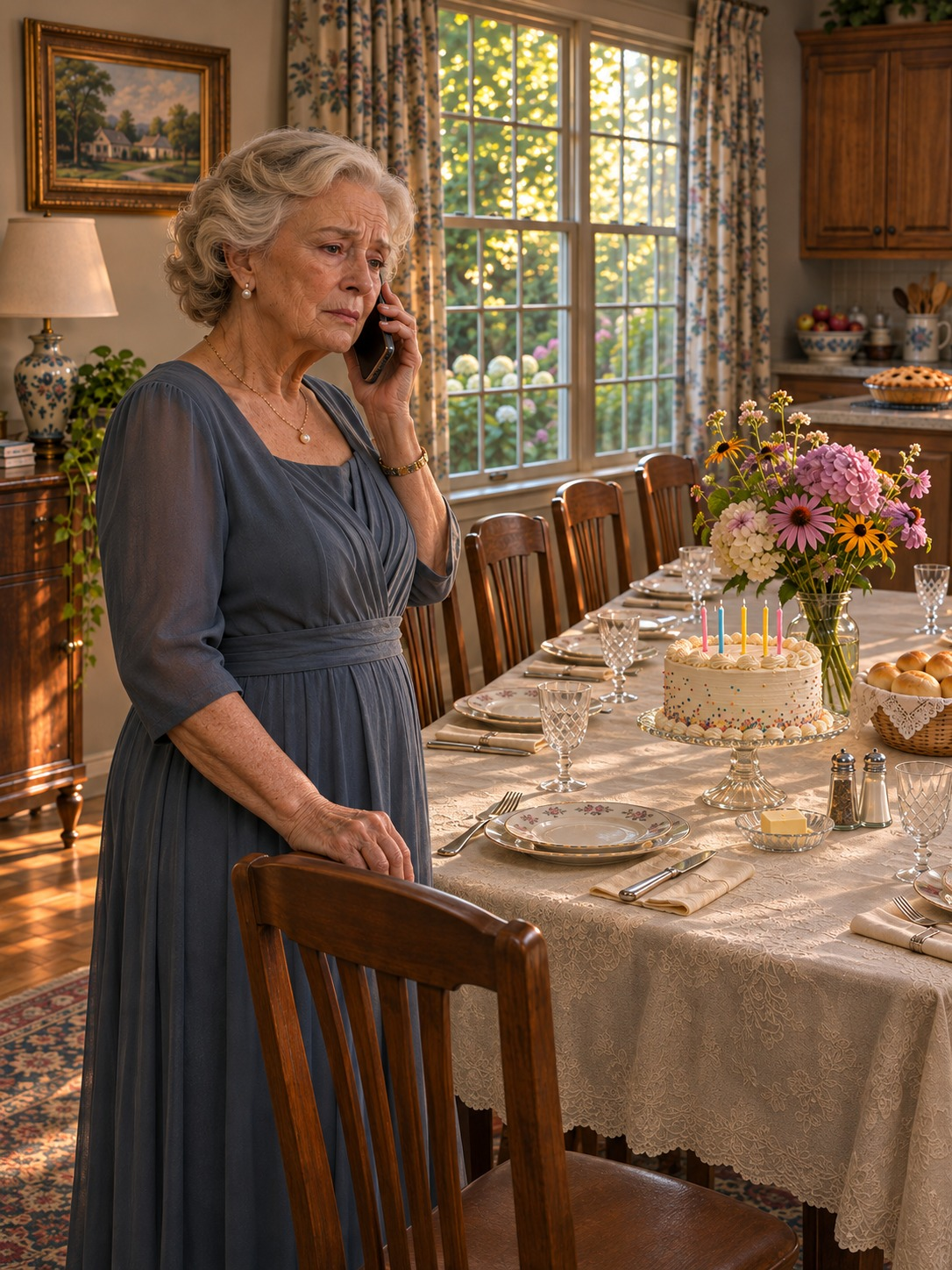
For a moment, I remembered my eightieth birthday.
The empty chairs.
The cold dinner.
The message telling me to clean the upstairs bathroom.
The terrible feeling that I had become invisible in my own family.
I remembered the bank statements.
The forged documents.
The midnight visitors.
The threats.
The recording.
Robert's voice.
And the day I finally stood up for myself.
Then Michael leaned forward.
"Grandma, make a wish!"
I smiled.
I looked at the candles.
Eighty-one.
Another year.
Another chance.
I closed my eyes.
And made a wish.
Not for money.
Not for a bigger house.
Not for everyone to love me perfectly.
I wished for the courage to keep living the life I had reclaimed.
Then I blew out the candles.
Everyone cheered.
I laughed.
And for the first time in a very long while, I didn't feel like a guest at my own table.
I felt like the woman who belonged there.
Later that evening, after everyone had gone home, I walked through the quiet house.
The dishes were washed.
The candles were out.
The flowers stood in a vase on the dining table.
I turned off the kitchen light.
Then stopped beside Robert's photograph.
He was smiling.
The same smile I had loved for nearly fifty years.
I picked up the frame.
"Well, darling," I whispered, "you would have liked tonight."
I imagined him laughing at Harold's terrible singing.
Complaining that the cake had too much frosting.
Sneaking another slice when he thought I wasn't looking.
I smiled.
Then I thought about the letter he had left me.
Kindness should never require you to surrender your dignity.
I had carried those words through the hardest year of my life.
They had helped me understand something I should have known long ago.
Being a mother didn't mean I had to sacrifice everything.
Being a grandmother didn't mean I had to accept disrespect.
And being eighty-one didn't mean my life was almost over.
I still had mornings to enjoy.
Places to visit.
Books to read.
Flowers to plant.
People to love.
And dreams I hadn't even imagined yet.
I placed Robert's photograph back on the table.
Then I walked upstairs.
Into my bedroom.
The room I had shared with him.
The room I had finally reclaimed.
I opened the window.
A warm breeze moved through the curtains.
Outside, the oak tree rustled softly.
The house was quiet.
But it wasn't empty.
It was filled with memories.
With possibilities.
With the life I had chosen.
I climbed into bed and pulled the old blue-and-white quilt over my feet.
Then I laughed.
Because Robert had been right.
It was too warm.
I pushed it aside.
Turned off the lamp.
And smiled into the darkness.
A year earlier, my family had told me to clean the house on my birthday.
A week later, they had returned to find strangers involved in a sale they thought they could control, and a mother who was no longer willing to be controlled.
The sale had failed.
The strangers were gone.
The people who tried to take my home had faced the consequences.
And I had finally stopped asking permission to live my own life.
My name is Janine Whitmore.
I am eighty-one years old.
I am a widow.
A mother.
A grandmother.
A friend.
And the owner of a beautiful old house filled with nearly fifty years of memories.
But more importantly, I am still the owner of my own future.
And that, at my age, is the greatest birthday gift I could ever receive.






Comments 0