I sat in my son's leather recliner with the bank statement trembling between my fingers.
The numbers were identical.
Four digits.
Nothing more.
Yet those four digits seemed to turn the room upside down.
For years, I had believed that money was the simplest way to help someone you loved.
If Tyson called because the boys needed school supplies, I helped.
If the car broke down, I helped.
If Tatum said the grocery bill had become impossible, I helped.
I never asked for receipts.
I never demanded explanations.
I told myself that family was built on trust.
But that evening, with my birthday dinner growing cold in the kitchen, I began to wonder whether trust had become an excuse for never looking closely.
I carried the tablet to my desk.
My desk was a small oak secretary Robert had bought at an estate sale when we were first married.
It had a fold-down writing surface, three narrow drawers, and a stubborn brass lock that sometimes required a little wiggle.
Robert used to call it my command center.
"Every family needs a general," he would say.
"And ours wears an apron."
I smiled faintly at the memory.
Then I opened the bottom drawer.
Inside were ten years of financial records.
Not every statement, of course.
I had switched to electronic banking for most things.
But I still printed important documents.
Old habits.
Robert had believed in keeping records.
"If somebody asks where the money went," he used to say, "you ought to be able to tell them."
I wished he were there.
I wished I could sit across from him and ask whether I was being foolish.
Instead, I took out a notebook.
On the first page, I wrote the date.
Then I wrote three words.
Money given Tyson.
I began with the most recent year.
In January, I had transferred $1,200 because Tyson said the heating system needed repairs.
In February, $800 for the boys' school expenses.
In March, $1,500 because Tatum's car supposedly needed a new transmission.
In April, $600 for groceries.
In May, $2,000 because Tyson said he had fallen behind on several bills.
I paused.
May.
I remembered that conversation.
Tyson had come into the kitchen while I was making soup.
He looked exhausted.
"Mom, I hate asking," he had said.
That was how he usually began.
I hate asking.
He would lower his eyes.
Rub his forehead.
Tell me he felt ashamed.
Then he would explain the emergency.
And I would reach for my checkbook before he finished.
I had thought I was protecting his dignity.
Now I wondered whether I had simply made asking easier.
I turned another page.
June.
July.
August.
September.
By the time I finished adding the amounts, I had given Tyson and Tatum more than $11,000 that year alone.
And that didn't include groceries, utility bills, property taxes, insurance, or the household repairs I had paid for directly.
I sat back.
The number frightened me.
Not because I couldn't afford every dollar.
Robert had left me comfortable.
We had saved carefully.
We owned the house outright.
I received Social Security and income from investments.
I wasn't wealthy in the way people on television were wealthy.
But I had enough.
Enough to live peacefully.
Enough to travel occasionally.
Enough to help my grandchildren.
At least, I should have had enough.
Yet I had spent years worrying about money.
I had stopped going on trips with Eleanor.
I had delayed replacing my aging car.
I had canceled a gardening club membership because the annual fee seemed unnecessary.
And all the while, Tyson and Tatum had been enjoying things I told myself were beyond my budget.
I looked at the tablet.
The vacation photograph remained open.
Tatum stood beside the pool wearing a designer handbag I recognized.
She had brought it home several months earlier.
When I admired it, she told me it had been a gift.
"Tyson surprised me," she said.
I remembered smiling.
"How thoughtful."
That same week, Tyson had asked me for $1,800 to cover an unexpected household expense.
I opened my notebook again.
The dates matched.
I felt sick.
Still, I forced myself to be careful.
A coincidence was not proof.
And a matching account number in an email notification did not necessarily explain how the payment had been made.
Perhaps Tyson had used an authorized account.
Perhaps the agency had stored an old payment method.
Perhaps there was an explanation I hadn't considered.
I needed facts.
Not assumptions.
That was something Robert had taught me.
When our marriage was young, we once had a terrible argument over a bill he had supposedly forgotten to pay.
I accused him of being careless.
He insisted he had paid it.
We barely spoke for an evening.
The next morning, he found the canceled check.
The bank had made an error.
Afterward, he told me something I never forgot.
"Janine, feelings tell you when something is wrong. Facts tell you what to do about it."
I repeated those words aloud.
Then I called the number on the back of my bank card.
The automated system asked me to enter information.
I followed the instructions.
Eventually, I reached a representative named Melissa.
"How can I help you today, Mrs. Whitmore?"
I explained that I wanted to review several transactions.
She asked the usual security questions.
Then she began reading the recent activity.
Most of it was familiar.
Groceries.
Pharmacy.
Utilities.
A payment to the lawn service.
Then she mentioned a transaction I didn't recognize.
A travel-related charge.
I sat straighter.
"Could you repeat that?"
She did.
The amount was substantial.
Not the full cost of a luxury vacation, perhaps, but more than I had ever spent on a single trip for myself.
I asked when it had been processed.
She gave me the date.
September 18.
My mouth went dry.
"Can you tell me who authorized it?"
Melissa explained that she could review the available transaction details but could not determine who had physically initiated the payment from the information on her screen.
She asked whether I recognized the merchant.
I looked at the tablet.
The travel agency's name matched.
"No," I said slowly. "I don't remember authorizing that purchase."
Her tone changed.
She became more careful.
She explained the process for reporting a potentially unauthorized transaction.
She advised me to review my account access, change passwords, and consider placing additional security restrictions.
I listened.
I wrote everything down.
Then I asked whether anyone else was listed as an authorized user.
There was a pause while she checked.
"Mrs. Whitmore, I can confirm that the account is held in your name. I don't see another joint owner listed."
I closed my eyes.
"Thank you."
After the call, I sat motionless.
I wanted to believe there had been a misunderstanding.
I wanted Tyson to call and explain everything.
I wanted to hear him say, "Mom, there's been a mistake."
But my phone remained silent.
The only sound came from the refrigerator humming in the kitchen.
I looked toward the hallway.
Upstairs, behind the master bedroom door, Tyson and Tatum kept their belongings.
Their clothes.
Their electronics.
Their expensive luggage.
The bedroom that had once belonged to Robert and me.
I remembered the day they moved in.
Tyson had arrived with a rented truck.
Tatum carried Michael, who had fallen asleep in the car.
Marcus ran ahead, shouting that Grandma's house was enormous.
They had been struggling financially.
At least, that was what they told me.
Their lease had ended.
Tyson said his business income had become unpredictable.
Tatum said they needed a few months to save for a new place.
"Just until Christmas," Tyson promised.
That had been five years ago.
At first, I was delighted.
I loved having the boys around.
I loved hearing footsteps on the stairs.
I loved making pancakes on Saturday mornings.
After Robert died, the house had felt too large.
Too quiet.
Having family there seemed like a blessing.
Then small changes began.
Tatum complained that the guest bathroom was too cramped.
Tyson said the boys needed separate sleeping spaces.
They asked whether I would consider moving into the smaller bedroom downstairs.
"Only temporarily," Tatum said.
"You don't need all that space anyway."
I had agreed.
Then Tatum replaced my bedroom curtains.
She moved Robert's old reading chair into storage.
She complained about the floral wallpaper I had chosen twenty years earlier.
Eventually, the room stopped looking like mine.
I told myself that was fine.
Young families needed room to grow.
But sitting at my desk that evening, I finally asked myself a question I had avoided.
When had I stopped being the owner of my own home?
I looked down at my notebook.
The figures stared back at me.
I turned to a fresh page.
This time, I wrote:
Household expenses paid by Janine.
I listed the property taxes.
Insurance.
Utilities.
Repairs.
Landscaping.
Appliance replacements.
I remembered the new refrigerator Tyson had insisted we needed.
The dishwasher Tatum chose.
The patio furniture they purchased after telling me the backyard needed updating.
Every major expense had somehow ended up being mine.
And when I questioned a purchase, Tyson always had an answer.
"Mom, it's an investment in the house."
Or:
"You're going to leave the place to us someday anyway."
That sentence had once sounded practical.
Now it sounded like a warning.
I opened the top drawer and removed the folder containing my estate documents.
Robert and I had made wills years earlier.
After he died, I updated mine.
Tyson was my only child.
Naturally, I had planned to leave him the house.
I had never imagined doing anything else.
But a will was not a deed.
And an expectation was not ownership.
I knew that much.
Still, I wanted to be certain.
I found the most recent property tax statement.
My name appeared at the top.
Janine Whitmore.
I found the homeowners insurance policy.
Again, my name.
Then I located a copy of the deed.
I studied it beneath the desk lamp.
I was the sole owner.
The realization should have comforted me.
Instead, it made me angry.
Not the loud kind of anger that sends people slamming doors.
A quieter kind.
The kind that settles deep in your chest and makes everything suddenly clear.
For five years, Tyson and Tatum had behaved as though they were doing me a favor by living in my house.
They complained about my habits.
Criticized my cooking.
Told me when the boys needed rides.
Asked me to stay out of the living room when they had guests.
And I had accepted it because I thought being useful was the same as being loved.
I looked at the photograph of Robert on my desk.
He was standing beside our old fishing boat, wearing a ridiculous sunhat.
I touched the frame.
"What would you do?" I whispered.
Of course, the photograph didn't answer.
But I remembered something he had once said about Tyson.
Our son had been sixteen and had borrowed Robert's truck without permission.
He returned it with a dented bumper and a story about someone hitting him in a parking lot.
Robert discovered the truth two days later.
Tyson had backed into a concrete post.
I wanted to forgive him immediately.
Robert disagreed.
"Love him enough to make him responsible," he told me.
At the time, I thought he was being too strict.
Now I wondered whether I had spent the years since Robert's death trying to compensate for his absence by never saying no.
I put the photograph down.
Then I checked the time.
It was nearly nine.
My eightieth birthday was almost over.
I hadn't received a single phone call from Tyson.
Not even a message.
I stood and went into the kitchen.
The birthday cake was still on the table.
The candles lay beside it.
I picked up one of the extra dinner plates.
Then I stopped.
I didn't want to clean up after them.
Not tonight.
For once, I wanted to leave something unfinished.
I switched off the dining room lights.
The room fell into shadow.
Then I went to my bedroom.
My small bedroom.
The one beside the laundry room.
I changed out of my new dress and hung it carefully in the closet.
I sat on the edge of the bed.
For the first time in years, I didn't feel like a mother waiting for her son to come home.
I felt like a woman who had misplaced her own life.
And I wanted it back.
I picked up my phone.
I scrolled through my contacts until I found a name I hadn't called in several months.
Harold Brennan.
Attorney at Law.
Harold had handled Robert's estate.
He had helped us purchase our first home.
He had advised me when I updated my will.
He was careful, patient, and sometimes painfully direct.
I trusted him.
It was too late to call that night.
So I placed the phone on my nightstand.
I lay down.
I didn't sleep much.
At five-thirty the next morning, I made coffee.
At six, I sat at the kitchen table with my notebook.
At six-thirty, I dialed Harold's number.
He answered on the fourth ring.
"Janine?"
His voice sounded surprised.
"Good morning, Harold."
"Good heavens. Is everything all right?"
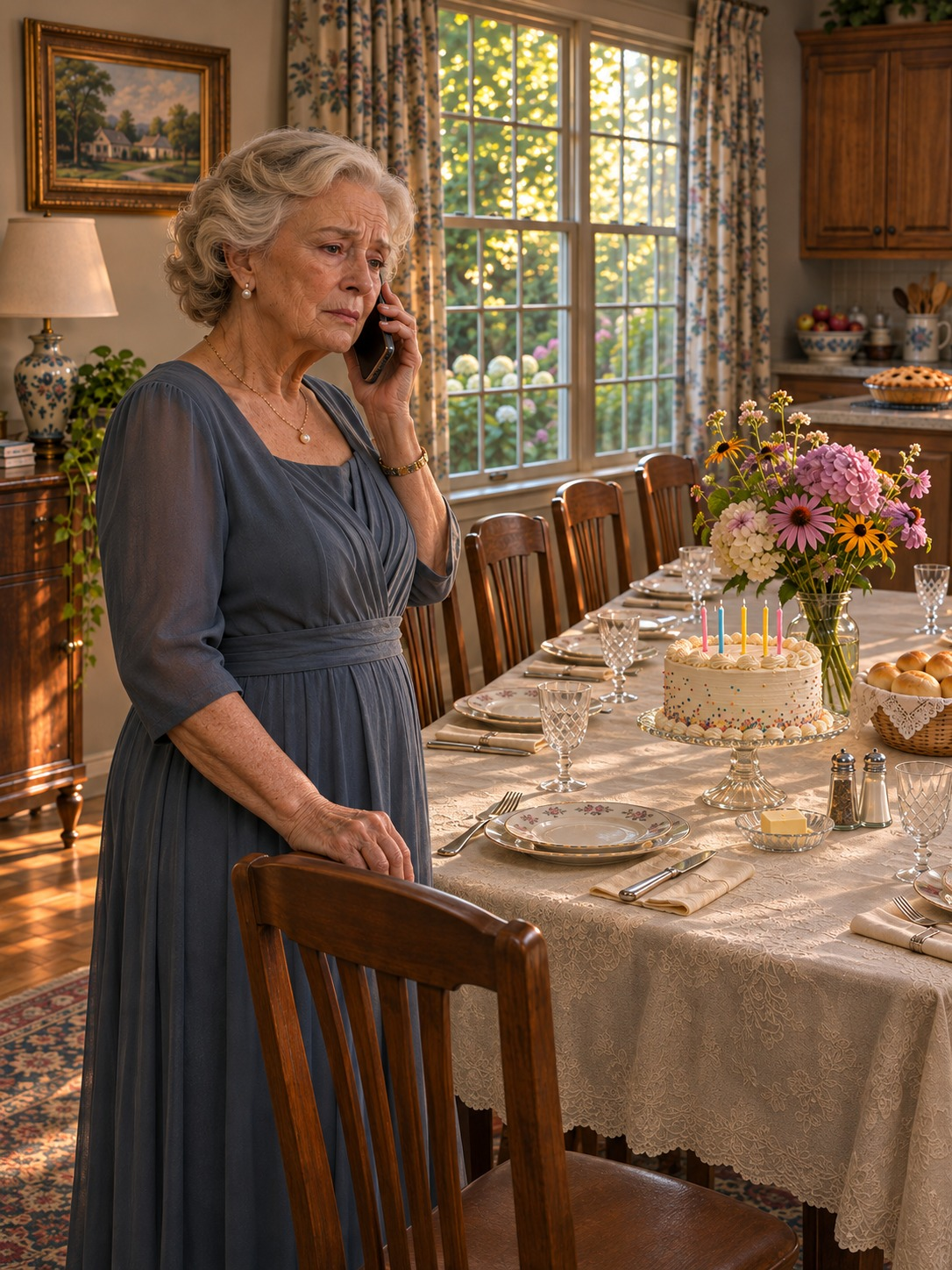
I looked toward the dining room.
The birthday table was still set.
Eight empty chairs.
Eight unused napkins.
The cake in the center.
I took a breath.
"Harold, I need to ask you something."
"Of course."
"The house is in my name alone, correct?"
There was a brief silence.
Then he said, "As far as the documents I have on file, yes. Why?"
I looked at the staircase.
"Because I think it's time I made some changes."
His tone became serious.
"What kind of changes?"
I hesitated.
Then I told him about the birthday.
The vacation.
The bank transaction.
The years of financial help.
He listened without interrupting.
When I finished, he was quiet for several seconds.
Then he said, "Janine, I want you to come into my office this morning."
"Is something wrong?"
"I don't know yet."
His answer frightened me more than reassurance would have.
"Bring your deed, your financial records, and anything you found relating to that travel payment."
I glanced at the tablet on the table.
"All right."
"And Janine?"
"Yes?"
"Until we review everything, don't confront Tyson or Tatum. Don't promise them anything. And don't sign anything they put in front of you."
My heart began beating faster.
"Harold, why would they ask me to sign something?"
He paused.
Then he said, "Because there's another document in your old estate file that I want to check."
I gripped the phone.
"What document?"
I heard papers moving on his desk.
Then a drawer opening.
He was silent long enough that I thought the call had dropped.
"Harold?"
"I'm here."
"What did you find?"
His voice was no longer merely concerned.
It was sharp.
"Janine, before you come in, I need you to answer one question."
"All right."
"Did Tyson ever ask you to sign papers concerning the house after Robert died?"
I stared at the kitchen wall.
A memory surfaced.
Tyson sitting beside me at the dining table.
A stack of documents.
Tatum standing behind his chair.
Something about making things easier for the future.
I had almost forgotten.
"Yes," I whispered.
Harold took a breath.
"Then we need to talk immediately, because one of those papers may not have been what he told you it was."






Comments 0