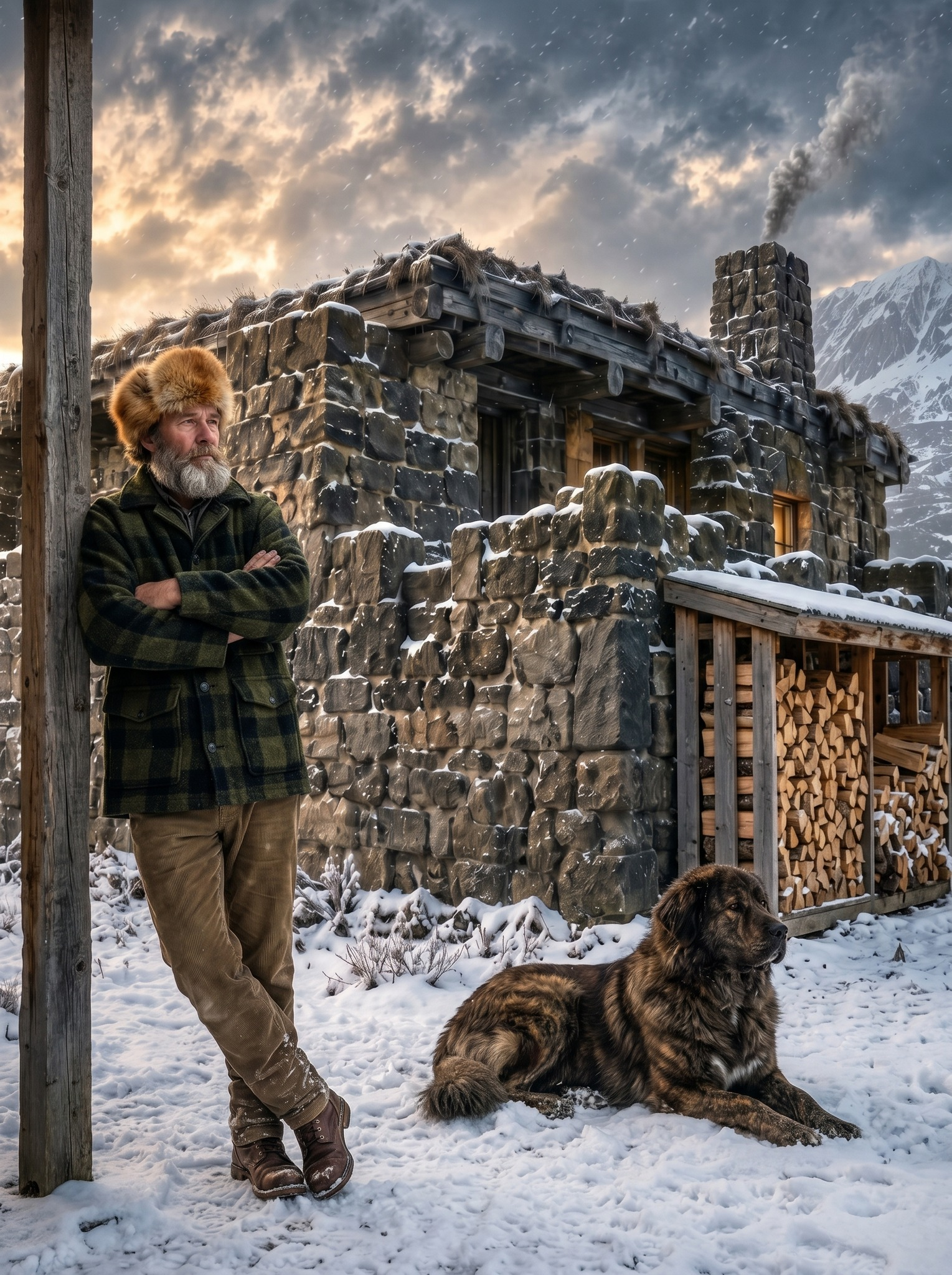
Gideon Voss knew that voice.
For twenty years, he had tried to forget it.
He stood motionless beside the fort's heavy wooden door, his hand resting on the latch.
Outside, the wind screamed across Elcorn Basin.
Inside, the last fire was dying.
Ruth watched her husband's face.
"Gideon?"
He did not answer.
The voice came again.
"Open the door. We haven't much time."
Gideon swallowed.
Then he lifted the latch.
The door swung inward.
A tall man stood in the snow, wrapped in a black wool coat. His beard had turned almost entirely white, and a deep scar ran from his left temple to his jaw.
Behind him stood Calvin Rusk.
The cattle buyer's hands were bound.
His face was bruised.
He looked half-frozen.
Gideon stared at the older man.
"Martin Vale."
The stranger removed his hat.
"Hello, Gideon."
Ruth looked between them.
"Who is he?"
Gideon's voice was barely audible.
"The man who taught me to lay stone."
Martin Vale had been Gideon's master when Gideon was a young apprentice in Pennsylvania.
He was a brilliant mason.
He understood foundations, arches, chimneys, and the peculiar ways stone behaved under pressure.
But he was also a cruel man.
He had taught Gideon that strength mattered more than kindness.
That a building was worth whatever it cost to complete.
That a man who hesitated was a man who failed.
Gideon had left his employment after a retaining wall collapsed at a quarry, killing two workers.
Vale had blamed the men.
Gideon had blamed the defective foundation.
They had never spoken again.
Now Vale stood at the entrance of the fort Gideon had spent months rebuilding.
"How did you find me?" Gideon asked.
Vale looked past him.
"I've been following the trouble in Elcorn Basin."
"Why?"
"Because I helped design the original drainage system."
Gideon felt a chill.
"You?"
Vale nodded.
"I worked under the army's civilian engineering contractor in 1861. I was younger then. So was Isaac Bell."
From the bench beside the stove, Isaac lifted his head.
"Martin?"
Vale stepped inside.
The old mason stared at him.
Then his expression changed.
"You came back."
Vale removed his gloves.
"I should have come back years ago."
Gideon looked toward Calvin Rusk.
"Why is he with you?"
Vale's face hardened.
"Because he escaped custody during the storm."
Calvin lowered his eyes.
Vale continued.
"I found him trying to reach the northern road. He was nearly frozen. He told me he knew a sheltered route through the old military passage."
"Then why are his hands tied?"
"Because he tried to run when he realized I was bringing him here."
Calvin looked up.
"You're making a mistake."
Vale ignored him.
Gideon stepped aside.
"Get inside before you freeze."
Ruth closed the door behind them.
The wind continued howling outside.
Calvin Rusk collapsed onto a bench.
Samuel brought him a blanket.
Nobody spoke to him.
Gideon looked toward Vale.
"You said you helped design the drainage."
"I did."
"Then you know what lies beneath the northern courtyard."
Vale nodded.
"The old inspection chamber."
"And the second foundation?"
"Part of the original military road."
Gideon frowned.
"Why was it buried?"
Vale looked toward Isaac.
"Because the army abandoned the lower crossing after the flood of 1863. They filled the entrance and reinforced the road above it."
Isaac nodded slowly.
"That's right."
Gideon thought of the iron hatch.
The buried chamber.
The shifting ground.
The rope attached to the wagon.
All the pieces were beginning to fit together.
Vale continued.
"When the lower channel was blocked, water accumulated beneath the road. The freezing ground pushed against the old timber covering. That's why the courtyard opened."
Gideon stared.
"And Calvin knew?"
Vale looked toward the cattle buyer.
"He knew enough."
Calvin raised his head.
"My father told me the fort was unstable."
"Your father knew how to make it unstable," Isaac said.
The room fell silent.
Calvin looked away.
Gideon stepped closer.
"Why did you want the fort so badly?"
Calvin stared at the stove.
For a long time, he said nothing.
Then he spoke.
"Because my father spent his life trying to control the crossing."
Gideon waited.
Calvin continued.
"The old military road was the shortest route between the northern ranches and the southern markets. Whoever controlled the crossing could charge for passage, move cattle, and influence trade throughout the basin."
Samuel frowned.
"So you wanted a toll road."
Calvin nodded.
"My father bought the adjoining land. Then he altered the records to make it appear the road belonged to him."
Isaac's face darkened.
"And Daniel Mercer discovered it."
Calvin closed his eyes.
"Yes."
Boone Mercer sat upright despite the pain in his injured leg.
"Your father killed my uncle."
Calvin looked toward him.
"I never saw it happen."
"But you knew."
Calvin's voice broke.
"I found his letters after he died."
Boone stared.
"And you said nothing."
Calvin lowered his head.
"No."
For a moment, Gideon saw not a powerful cattle buyer, but a frightened man who had spent his life defending a lie.
Then he remembered the sabotaged drainage.
The fire.
The stolen records.
The false murder accusation.
And the danger Calvin had brought upon everyone in the fort.
"Your father's crimes were not yours," Gideon said. "But what you did afterward was."
Calvin did not answer.
The stove gave a hollow metallic click.
Gideon turned.
The last large log had burned down.
Only a small bed of coals remained.
Ruth checked the thermometer.
The temperature inside had fallen again.
She looked toward the benches.
Isaac Bell was shivering.
Boone's injured leg had stiffened.
Samuel's face was pale.
Even Bristle had moved closer to the stove.
"We need wood," Ruth said.
Gideon nodded.
"I know."
Vale looked toward the door.
"How much is outside?"
"A wagonload. But the wind's dangerous, and the courtyard is cracked."
Vale considered this.
Then looked toward the roof supports.
"Your western braces are new."
"Yes."
"And the old central posts?"
"Sound."
Vale nodded.
"Then we can use the covered passage beside the northern wall. It should keep us clear of the damaged courtyard."
Gideon looked at him.
"That passage is blocked by snow."
"Not entirely. The wall shields it from the worst of the wind."
Ezekiel rose.
"I'll go."
Gideon shook his head.
"You've already been outside twice."
"So have you."
Vale stepped forward.
"I'll help."
Gideon studied him.
Twenty years earlier, Martin Vale would have ordered someone else into the cold.
Now he stood waiting to go himself.
Gideon nodded.
"All right. But we use ropes. Nobody goes beyond the wall alone."
Ruth brought them scarves and gloves.
Then she took Gideon's hand.
"Come back quickly."
He squeezed her fingers.
"We will."
The cold struck them the moment they opened the door.
It was unlike anything Gideon had felt before.
The wind seemed to pass through his coat and settle inside his bones.
Snow swept across the courtyard.
The northern wall was barely visible.
Gideon tied one end of a rope to the doorframe.
Vale fastened the other around his waist.
Ezekiel carried a lantern.
They moved along the wall, keeping close to the stone.
The wind was weaker there.
Not gentle.
But survivable.
Gideon found the narrow sheltered path.
The snow reached his knees.
He pushed forward.
Behind him, Vale followed.
Ezekiel came last.
At the wagon, they worked quickly.
The timber load had shifted, but several bundles of dry firewood remained secured beneath canvas.
Gideon pulled one free.
Vale lifted another.
Ezekiel gathered smaller pieces.
Then they turned toward the fort.
The wind struck them from the side.
Vale stumbled.
Gideon caught his arm.
"Careful!"
The older mason nodded.
They struggled forward.
Halfway to the door, a loud crack sounded beneath the snow.
Gideon stopped.
The ground had shifted.
A narrow fissure opened near the buried hatch.
Vale looked down.
"Move away from it!"
Gideon pulled Ezekiel toward the wall.
The snow collapsed into the gap.
A section of the old courtyard sank several inches.
But the stone wall remained firm.
Gideon stared at the opening.
Then he looked toward Vale.
"The lower chamber is settling."
Vale nodded.
"The frozen water has displaced the fill."
"Will it damage the main foundation?"
"Not if the southern drain stays open and the load remains off the weak ground."
Gideon glanced toward the roof.
The braces were still holding.
He took a breath.
"Then we get inside."
They reached the door with the firewood.
Ruth opened it.
Warm air, faint but precious, touched Gideon's face.
They stumbled into the room.
The door slammed shut behind them.
Gideon knelt beside the stove.
He arranged the smaller pieces of wood over the remaining coals.
For a moment, nothing happened.
Then a thin flame appeared.
It caught a dry splinter.
Then another.
Soon, the fire began burning again.
Ruth added a carefully measured log.
The iron stove warmed.
The chimney drew properly.
And the room slowly began recovering its heat.
Gideon sat back on his heels.
His hands were trembling.
Vale watched him.
"You always were stubborn."
Gideon gave a tired laugh.
"You taught me."
Vale looked toward the walls.
Then his expression softened.
"I taught you how to build."
Gideon glanced at him.
Vale continued.
"But I never taught you when to stop."
The old mason looked toward Ruth.
"Your wife seems to have managed that."
Ruth smiled faintly.
"Not without difficulty."
For the first time, Vale laughed.
It was a quiet sound.
Almost unfamiliar.
The storm continued through the night.
But the fort held.
The thick stone walls slowed the loss of heat.
The stove supplied the warmth the masonry could not create on its own.
The roof braces carried the load away from the damaged corner.
And the open southern drain allowed water to escape beneath the foundation.
Gideon checked the thermometer every hour.
The room remained cool.
But it was no longer dangerously cold.
The firewood they had recovered would last until morning.
Ruth distributed blankets.
Samuel helped Isaac drink warm broth.
Boone rested his injured leg.
Ezekiel slept sitting upright against the wall.
Crowe remained near the table, studying the recovered documents.
Calvin Rusk sat quietly beneath a blanket.
He had stopped arguing.
At last, Gideon sat beside Ruth.
She leaned against him.
For a long time, neither spoke.
Then she whispered, "Do you think this is the worst of it?"
Gideon looked toward the shuttered window.
The wind was beginning to weaken.
"I hope so."
She rested her head against his shoulder.
He put his arm around her.
For the first time in many months, he did not feel the need to rise and inspect another crack.
He had done what he could.
The fort would either hold or it would not.
And tonight, he intended to remain beside his wife.
Morning came slowly.
A pale light appeared behind the eastern shutters.
The wind had nearly stopped.
Snow covered the valley in a smooth white blanket.
Gideon opened the door.
The cold air was sharp, but still.
The storm had passed.
He stepped into the courtyard.
The buried hatch remained surrounded by broken ground.
The western roof supports stood firm.
The eastern foundation showed no new movement.
The chimney rose straight into the pale sky.
And the roof remained exactly where it belonged.
Gideon stood motionless.
Then he smiled.
Behind him, Ruth appeared.
"Well?"
He looked at her.
"It's still standing."
She stepped beside him.
Together, they looked at the fort.
The walls were scarred.
The courtyard was damaged.
The windows were unfinished.
And the roof still needed permanent repairs.
But the building had survived the coldest night Elcorn Basin had seen in years.
Ruth took Gideon's hand.
"You were right about the stone."
He shook his head.
"Not entirely."
She looked at him.
"What do you mean?"
"The walls helped. But they couldn't have saved us without the fire, the roof, the drainage, and everyone who came to help."
Ruth smiled.
"Then perhaps that's what makes a house."
Gideon looked at her.
"Perhaps it is."
Sheriff Hale arrived two days later.
The road had finally become passable.
He brought a wagon, two deputies, and supplies from town.
When he saw Calvin Rusk sitting inside the fort, his expression darkened.
"Mr. Rusk."
Calvin stood.
"Sheriff."
Hale looked toward Gideon.
"How did he get here?"
Gideon explained.
The escape.
The storm.
Martin Vale.
The buried chamber.
And the confession.
Hale listened without interrupting.
Then he turned toward Calvin.
"You're going back to jail."
Calvin nodded.
"I know."
The sheriff looked surprised.
For once, the cattle buyer offered no resistance.
Before leaving, Calvin approached Gideon.
He stopped several feet away.
"I owe you an apology."
Gideon said nothing.
Calvin continued.
"I tried to take your land. I endangered your wife. I nearly destroyed this place."
Gideon looked at him.
"Yes."
Calvin lowered his head.
"I don't expect forgiveness."
Gideon studied him.
Then spoke quietly.
"Then don't ask for it. Tell the truth in court. Give back what you can. That's where you start."
Calvin nodded.
He turned toward Boone.
The sawmill owner stood beside the table.
For a moment, the two men looked at one another.
Then Calvin said, "I'll testify about my father's records."
Boone's expression remained hard.
"You should have done that twenty years ago."
Calvin nodded.
"Yes."
Hale led him outside.
The deputies followed.
And Calvin Rusk left Fort Elcorn for the last time.
The weeks that followed were difficult.
But they were no longer filled with fear.
The county court accepted the original military survey as evidence.
Thomas Whitcomb testified about his father's records.
Isaac Bell described the construction of the fort and the events of 1864.
Peter Rusk confirmed his brother's attempts to conceal the truth.
Edwin Shaw admitted blocking the southern drainage outlet.
Nathaniel Crowe surrendered the altered county documents and testified about his father's involvement.
The court ordered the disputed boundaries corrected.
The old military road remained subject to public passage.
And Gideon's deed was upheld.
The fort was his.
Legally.
Finally.
Boone Mercer received something he had wanted all his life.
The official record of Daniel Mercer's death was corrected.
His uncle had not been a thief.
He had been a man who tried to expose fraud.
Boone read the court's finding twice.
Then folded the paper carefully and placed it inside his coat.
When Gideon asked if he was satisfied, Boone nodded.
"More than you know."
The criminal proceedings continued through the winter. Calvin's testimony helped establish the sabotage and the attempted framing of Gideon. The investigation into Owen Briggs's death found no evidence that Gideon had harmed him.
Gideon's name was cleared completely.
And Nathaniel Crowe, who had surrendered his father's papers and cooperated with the court, abandoned the legal challenge against the fort.
He later returned to Gideon with a final document.
A corrected copy of the deed.
Gideon examined it.
Then looked at the attorney.
"Is this the end of it?"
Crowe nodded.
"As far as the land is concerned."
Gideon folded the paper.
"Good."
Crowe hesitated.
Then extended his hand.
Gideon looked at it.
For a moment, he remembered the threats.
The false claims.
The fear.
Then he shook it.
"Make better choices, Mr. Crowe."
The attorney nodded.
"I intend to."
By late winter, Fort Elcorn had changed.
The damaged eastern foundation had been rebuilt where necessary, with sound stone, properly supported courses, and a clear drainage path.
Gideon had waited for suitable conditions before completing the most vulnerable mortar joints.
He refused to rush work that would have to survive decades.
Ezekiel reinforced the roof connections and replaced the damaged boards.
Boone supplied timber at cost.
Samuel brought glass for the windows.
Thomas Whitcomb helped restore the old construction drawings.
Martin Vale remained in the basin long enough to inspect the foundation and assist with the final repairs.
The two masons worked side by side.
At first, their conversations were stiff.
Then, gradually, they began speaking like men who had once understood one another.
One afternoon, Vale watched Gideon fit a carefully shaped stone into the eastern wall.
"Good joint," he said.
Gideon stepped back.
"Thank you."
Vale examined the work.
Then smiled.
"Better than I would have done."
Gideon laughed.
"Now I know you're getting old."
Vale laughed too.
Before leaving the basin, the older mason stood beside the completed wall.
"I was wrong about the quarry," he said.
Gideon looked at him.
Vale continued.
"Those men died because I refused to admit the foundation was failing."
Gideon said nothing.
"I've carried that for twenty years."
The younger mason looked toward the repaired stonework.
"Then don't carry it alone anymore."
Vale nodded.
They shook hands.
And the anger between them finally ended.
Spring came slowly to Elcorn Basin.
The snow retreated from the hills.
The creek began running clear.
The cottonwoods showed their first green leaves.
And the fort stood beneath the morning sun.
Its roof was finished.
Its windows were glazed.
Its chimney was sound.
The drainage channels were open and protected.
The eastern foundation was firm.
Inside, the floor had been repaired and the dangerous underground openings secured.
The hidden inspection passages were documented and sealed where necessary.
Gideon had also inspected the old warm-air channel Isaac described.
He found several sections cracked and unsafe.
He left them closed.
The stove, properly vented and supplied with dry wood, was enough.
The thick stone walls helped moderate the indoor temperature, especially after many hours of steady heating.
But Gideon understood their limits.
They stored warmth.
They did not create it.
And they could not make up for a leaking roof, wet masonry, or careless construction.
He had learned that lesson through rain, fire, snow, and fear.
Now the fort was dry.
Now it was secure.
Now it was ready to become a home.
On the first warm Sunday of spring, Samuel Bell brought his father to visit.
Isaac walked slowly, leaning on a cane.
He had recovered much of his strength during the winter.
His face was fuller.
His eyes were brighter.
And Samuel rarely allowed him out of sight.
They stood together in the courtyard.
Isaac looked toward the walls.
"Never thought I'd see this place alive again."
Samuel smiled.
"Neither did I."
Ruth appeared in the doorway.
"Dinner's ready."
Inside, the table was crowded.
Ezekiel Hart sat beside Boone Mercer.
Thomas Whitcomb examined a small framed copy of the original fort drawing.
Peter Rusk had come from town.
Martin Vale, passing through on his way east, had stayed an extra day.
Sheriff Hale arrived without his badge, having promised Ruth he would attend as a guest rather than an officer.
Bristle moved beneath the table, hoping for scraps.
The room filled with conversation.
Laughter.
The smell of fresh bread.
And the steady warmth of the stove.
Gideon stood near the chimney.
For a moment, he watched them all.
These were the same people who had once doubted him.
Some had mocked him.
Some had opposed him.
Some had helped save his life.
And now they were gathered beneath the roof he had fought so hard to build.
Ruth approached.
"You're staring."
Gideon smiled.
"I know."
"At what?"
He looked around the room.
"At our house."
She slipped her hand into his.
"Our house," she repeated.
Later that evening, after the guests had gone, Gideon stepped outside.
The sky was clear.
The stars shone above the northern ridge.
The creek murmured below the hill.
Bristle lay on the doorstep, his tail thumping lazily against the stone.
Gideon walked to the eastern wall.
He placed his palm against the masonry.
The stone was cool beneath the evening air.
But inside, where the stove had burned throughout the day, the walls still held a little warmth.
He smiled.
Ruth came to stand beside him.
"Checking your work again?"
"Old habit."
She looked toward the repaired foundation.
"Do you think it'll last?"
Gideon studied the wall.
The careful joints.
The broad foundation stones.
The drainage channel carrying water safely away.
Then he looked at the roof.
The heavy timbers.
The secure connections.
The windows glowing softly in the evening.
"Yes," he said. "I think it will."
Ruth leaned against him.
They stood together in silence.
After a while, she spoke.
"Do you remember what everyone said when you bought this place?"
Gideon laughed.
"Every word."
"They said you'd freeze."
"Yes."
"They said the roof would fall."
"Nearly did."
"They said the walls were too old."
He looked toward the stone.
"They were wrong about that."
Ruth smiled.
Then she turned toward him.
"And what did you say?"
Gideon thought for a moment.
"I said twenty-four inches of stone could hold yesterday's warmth."
She nodded.
"And did it?"
He looked toward the house.
The glowing windows.
The steady chimney.
The sturdy roof.
The thick walls that had survived more than twenty years of abandonment and one terrible winter of violence.
Then he looked at his wife.
"Yes," he said. "But the warmth wasn't only in the stone."
Ruth smiled.
She took his hand.
Together, they walked toward the door.
Bristle rose and followed them inside.
Gideon closed the heavy wooden door.
The latch settled into place.
The stove burned quietly.
The windows held back the evening chill.
And for the first time since he had bought the ruined fort, Gideon Voss had nothing left to prove.
He had a roof above his head.
A strong foundation beneath his feet.
A faithful dog sleeping beside the fire.
And the woman he loved sitting across from him.
Outside, Elcorn Basin grew cold beneath the stars.
Inside, the house remembered warmth.
And this time, it was theirs to keep.






Comments 0