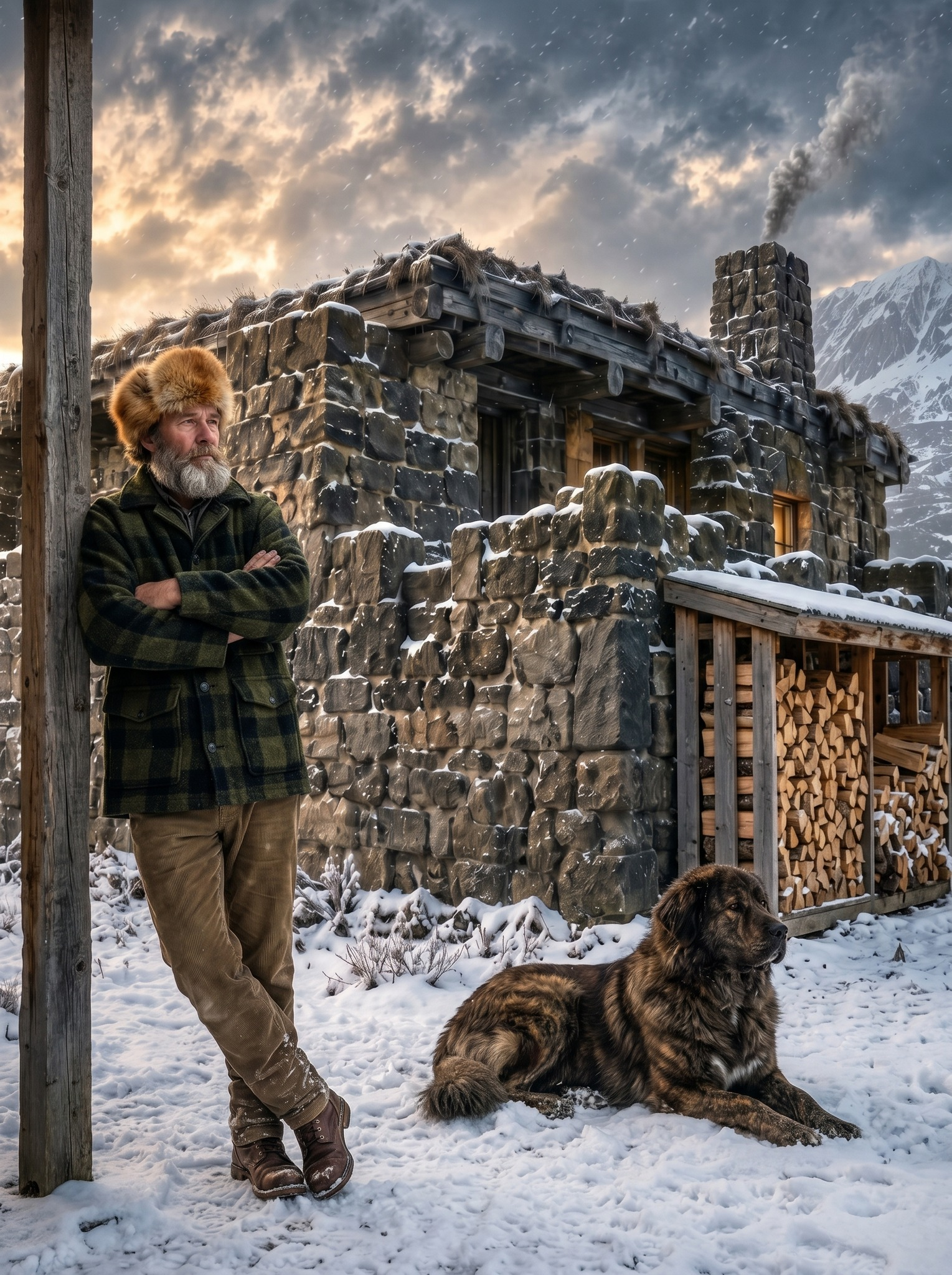
"Don't touch that iron plate!" Thomas Whitcomb shouted.
Gideon Voss stopped with his hand inches from the exposed foundation.
The elderly stranger stumbled through the snow, his military coat flapping in the wind.
Behind him, Ruth held a lantern while Samuel Bell struggled to calm the horses.
Bristle stood beside the damaged wall, watching the stranger with suspicion.
Gideon straightened.
"Why not?"
Thomas stopped beside the drainage trench.
His breathing was ragged.
"Because my father sealed that chamber for a reason."
Gideon looked down at the iron plate.
A narrow line of black mortar surrounded its edges.
The plate was nearly hidden beneath the original foundation stones.
He had uncovered it only because the soil had collapsed during the storm.
"What reason?" Gideon demanded.
Thomas looked toward the northern ridge.
Then toward the old military road.
"Because men died trying to open it."
Ruth stepped closer.
"Who died?"
Thomas didn't answer immediately.
Instead, he knelt beside the trench and examined the exposed iron.
His fingers trembled.
"Twenty years," he whispered.
Gideon watched him.
"Twenty years since what?"
Thomas touched the military insignia pinned to his coat.
"Since my father sent me away from this valley."
The wind rose.
Snow swept across the courtyard.
Samuel approached carrying a shovel.
"If we're going to talk, we'd better do it inside. The temperature's dropping fast."
Gideon looked toward the damaged foundation.
The water had stopped draining.
The exposed soil was already beginning to stiffen.
Every minute mattered.
"First, tell me whether opening that plate will damage the wall."
Thomas shook his head.
"Not if it's done correctly."
"And if it's done incorrectly?"
The old man's expression hardened.
"You could bring down the eastern corner."
Ruth caught Gideon's arm.
"Then we're not opening anything tonight."
Thomas looked at her.
"Mrs. Voss, I agree."
Gideon turned sharply.
"You came all this way to stop me from opening it?"
"No."
Thomas looked toward the iron plate.
"I came to make sure Calvin Rusk didn't get there first."
They moved into the fort.
Gideon closed the temporary door behind them.
The stove still held a small bed of coals.
He added dry kindling and another log.
Flames began licking the iron firebox.
Ruth placed the lantern on the table.
Samuel stood near the entrance, listening for approaching horses.
Thomas removed his wet coat.
Beneath it, he wore a faded wool vest and a white shirt with a carefully mended collar.
He looked older than Gideon had first realized.
His hands were marked by age.
His face carried deep lines.
But his eyes remained sharp.
Gideon placed the wooden box on the table.
"Start at the beginning."
Thomas looked at the military seal.
For several seconds, he said nothing.
Then he sat down.
"My father commanded Fort Elcorn during the final years of the war. It wasn't a large post. A few soldiers, a supply depot, and a road station."
Gideon nodded.
He knew that much from the county records.
Thomas continued.
"The fort stood where it did because of the crossing. Whoever controlled that road controlled the easiest passage through the northern basin."
"Calvin Rusk knows that," Samuel said.
Thomas looked at him.
"Calvin learned it from his father."
Gideon opened the original survey.
"Jonathan Rusk."
Thomas nodded.
"He was the civilian surveyor assigned to help establish the reservation boundaries."
Ruth leaned forward.
"Then why does the newer county map show different lines?"
Thomas looked toward the window.
"Because Jonathan Rusk changed them."
The room fell silent.
Samuel stared at him.
"You're accusing a dead man of fraud."
"I'm telling you what my father discovered."
Gideon tapped the survey.
"Can you prove it?"
Thomas looked at him.
"That's why the records were hidden."
He reached into his leather satchel.
Then removed a small notebook.
The cover was cracked.
The pages were yellowed.
He placed it beside the military document.
"My father's journal."
Gideon opened it carefully.
The handwriting was neat and compact.
Each entry carried a date.
Thomas pointed to a page near the middle.
"Read that."
Gideon brought the lantern closer.
The entry was dated September 9, 1864.
He read aloud.
"Surveyor Rusk has again requested that the northern crossing be excluded from the military reservation. I have refused. The crossing is essential to the post and must remain open to civilian traffic."
Samuel looked toward Ruth.
She said nothing.
Gideon turned the page.
Another entry appeared.
September 21.
He continued reading.
"Discovered inconsistencies between the original field measurements and the revised plat submitted for county filing."
He stopped.
Looked up.
Thomas nodded.
"Keep going."
Gideon read the final sentence.
"Until this matter is resolved, the original survey and supporting records shall remain under military protection."
He lowered the notebook.
"Your father knew the boundaries had been altered."
"Yes."
"Did he report it?"
"He tried."
Thomas folded his hands.
"Then the trouble began."
The fire burned steadily while Thomas explained.
Jonathan Rusk had been a respected surveyor.
He knew the valley.
He knew the roads.
He knew which land would become valuable when settlers began moving north.
And he understood that the military would eventually abandon the small fort.
According to Thomas, Rusk had planned to acquire the creek crossing after the soldiers left.
But Captain Whitcomb refused to surrender the public access rights.
The crossing had been reserved for military and civilian use.
It was not meant to become a private toll road.
"When my father challenged the revised survey," Thomas said, "Rusk insisted it was a clerical mistake."
"Was it?" Ruth asked.
Thomas shook his head.
"The changes all favored the same property."
Samuel gave a low whistle.
"That doesn't sound accidental."
"It wasn't."
Gideon looked at the journal.
"What happened next?"
Thomas hesitated.
"Someone tried to steal the original records."
Ruth glanced toward the chimney.
"The documents hidden in the wall?"
"Yes."
"Who tried to steal them?"
"We never proved it."
Gideon studied the old man's face.
"But you suspected Jonathan Rusk."
Thomas nodded.
"My father did."
He looked toward the stove.
"One night, two men entered the supply office. A sentry challenged them. Shots were fired."
Samuel straightened.
"Was anyone killed?"
"One soldier."
Thomas's voice became quieter.
"Private Daniel Mercer."
Gideon looked up sharply.
"Mercer?"
Thomas nodded.
"Boone Mercer's uncle."
The name settled over the room.
Gideon remembered Boone's anger.
His certainty that the fort would fail.
His willingness to stand beside Calvin Rusk.
He had assumed the sawmill owner was motivated by pride and money.
But now another connection had appeared.
"Did Boone know?" Gideon asked.
Thomas looked uncertain.
"I don't know."
Ruth folded her arms.
"If his uncle died here, surely someone told him."
"Perhaps. But the official report said the private was killed during an attempted theft."
Samuel frowned.
"Was he involved?"
Thomas looked down.
"My father believed Daniel Mercer was innocent."
Gideon waited.
"Then why did the report say otherwise?"
Thomas raised his eyes.
"Because the man who wrote it had been given false information."
"By whom?"
Thomas hesitated.
Then spoke.
"Jonathan Rusk."
For several minutes, nobody said anything.
The stove crackled.
Outside, the snow struck the wooden shutters.
Gideon looked at the old journal.
He had expected to find evidence about property boundaries.
Instead, he had uncovered a twenty-year-old death.
A disputed military report.
And a family name that connected the past to the men threatening his home.
Ruth broke the silence.
"What happened to Captain Whitcomb?"
Thomas looked toward her.
"My father was ordered to close the fort."
"Because of the theft?"
"That was part of it. The war was ending, supplies were being redirected, and the post was considered too expensive to maintain."
"Did he leave the records behind?"
Thomas nodded.
"He feared they would disappear if he carried them through the normal channels."
Gideon looked at the wooden box.
"So he hid them in the chimney."
"Some of them."
Gideon frowned.
"Some?"
Thomas looked toward the eastern wall.
"The most important records were sealed beneath the foundation."
Samuel stared.
"Why would he put papers under a wall?"
"Because they weren't only papers."
Gideon leaned forward.
"What else?"
Thomas looked at him.
"A metal dispatch case."
"Containing?"
"The original field books, the complete boundary measurements, and sworn statements from two soldiers who witnessed the attempted theft."
Ruth's expression changed.
"Statements that could clear Daniel Mercer?"
Thomas nodded.
"And prove the survey was deliberately altered."
Gideon looked toward the damaged foundation.
The iron plate.
The hidden compartment.
The careful masonry.
Suddenly, the construction made sense.
Captain Whitcomb had trusted stone more than people.
He had hidden the evidence where neither weather nor ordinary thieves could reach it.
But Gideon still had a question.
"If your father knew where the case was, why didn't he retrieve it?"
Thomas looked down.
"Because he never returned."
The old man's voice changed.
"He became ill during the journey east. He died the following spring."
Ruth's expression softened.
"I'm sorry."
Thomas nodded.
"Before he died, he told me the records were safe beneath the eastern wall. He said they should only be recovered if someone tried to claim the crossing."
Gideon stared at him.
"Then why wait twenty years?"
Thomas looked toward the lantern.
"Because I believed the records had been destroyed."
"What changed?"
"I received a letter."
"From whom?"
Thomas reached into his satchel.
He removed a folded envelope.
"An attorney named Nathaniel Crowe."
Gideon sat upright.
"Crowe?"
Thomas nodded.
"He wrote that the fort had been sold to a stone mason who was restoring the old foundation. He feared the hidden compartment might be discovered before the records could be protected."
Ruth frowned.
"But Crowe represents Calvin Rusk."
Thomas looked at her.
"That's what makes this dangerous."
Gideon took the envelope.
The letter was dated three weeks earlier.
Crowe had written carefully.
He did not directly accuse his client of wrongdoing.
But he described the disputed boundaries and requested that Thomas come to Elcorn Basin.
At the bottom, a sentence had been underlined.
If the original records still exist, they must be secured before the first hard freeze.
Gideon looked up.
"Why before the freeze?"
Thomas hesitated.
"Because the eastern drainage channel is connected to the compartment."
Samuel frowned.
"How?"
Thomas looked toward the wall.
"My father designed the recess so that water could not collect around the dispatch case. A small passage beneath the foundation allowed moisture to escape."
Gideon felt his stomach tighten.
"The drainage outlet."
"Yes."
He looked at the old man.
"If someone blocks it, water backs up beneath the chamber."
Thomas nodded.
"And when it freezes, the pressure could crack the surrounding stone."
Ruth stared at them.
"That's exactly what someone has been trying to do."
Gideon looked toward the door.
The disturbed foundation.
The wooden plug.
The rope leading toward the creek.
The repeated attempts to block the channel.
He had believed the saboteurs wanted to destroy his house.
But perhaps the house was only part of the target.
Perhaps they wanted to break open the hidden chamber.
Or destroy the records before anyone could retrieve them.
Samuel rubbed his forehead.
"Then Calvin Rusk knows what's under that wall."
Thomas looked grim.
"His father knew."
Gideon stared at the survey.
"And Calvin inherited the secret."
"Most likely."
Ruth moved toward the window.
The snow was falling harder.
She looked back at the men.
"Then we need to get those records tonight."
Gideon shook his head.
"Not without stabilizing the foundation."
"Can you do that?"
"Temporarily."
Thomas stood.
"I can show you how the chamber was built."
Gideon looked at him.
"Then we start now."
The four adults returned to the eastern wall.
Samuel carried two lanterns.
Ruth brought blankets and a bucket of hot water.
Gideon collected his tools.
Thomas carried his father's notebook.
Bristle followed them into the snow.
The wind had become fierce.
Ice was forming along the edges of the drainage trench.
Gideon knelt beside the exposed iron plate.
Thomas studied the masonry.
Then pointed toward a narrow joint beneath the lowest visible stone.
"That one."
Gideon followed his finger.
"The long block?"
"Yes. My father called it the keeper stone."
Gideon examined it.
The stone was nearly four feet long.
Its weight rested across two supporting blocks.
Removing it carelessly could disturb the load above.
Thomas continued.
"The chamber sits behind that stone. The iron plate protects the access opening."
Gideon looked toward the damaged soil.
"The support beneath the eastern edge has washed away."
"Can you brace it?"
"Yes. But I need timber."
Samuel looked toward the woodpile.
"How much?"
"Two heavy posts. A crossbeam. And wedges."
"I'll get them."
He hurried toward the shelter.
Gideon began clearing loose earth from the trench.
The ground was already stiffening.
He worked carefully, removing only what was necessary.
Thomas held the lantern.
Ruth stood beside them, watching the stone.
"How long will this take?" she asked.
Gideon shook his head.
"I can't promise."
She looked toward the sky.
"We may not have much time."
"I know."
Samuel returned with the timber.
Together, he and Gideon positioned the supports.
Gideon set the posts on firm ground away from the undermined section.
Then he placed the crossbeam beneath the exposed stone.
He tightened the wedges slowly.
The timber took part of the load.
The wall remained still.
Gideon stepped back.
"That should hold while we work."
Thomas nodded.
"Now the plate."
Gideon examined the iron.
Four old bolts secured it.
The heads were rusted.
But the surrounding stone was sound.
He applied oil to the threads.
Waited.
Then began loosening the first bolt.
It resisted.
He adjusted his grip.
The bolt moved.
A quarter turn.
Then another.
Ruth held her breath.
One by one, Gideon removed the fasteners.
When the final bolt came free, Thomas stepped closer.
"Carefully."
Gideon slipped the narrow end of his tool beneath the plate.
He lifted.
The iron shifted.
A cold draft escaped from the opening.
Bristle growled.
Gideon stopped.
Thomas raised the lantern.
Behind the plate was a narrow stone-lined passage.
It extended beneath the foundation.
Darkness swallowed the far end.
Samuel stared.
"How deep?"
Thomas looked at his father's drawing.
"Six feet. Perhaps seven."
Gideon crouched.
The passage was too narrow for a man to enter.
But a long iron hook could reach the dispatch case.
He looked toward Thomas.
"How did your father put it in?"
"Before the final stone was set."
"And how did he expect anyone to retrieve it?"
Thomas pointed to the drawing.
"There's a sliding tray."
Gideon examined the passage again.
He saw two narrow grooves cut into the stone.
They ran along the floor.
A metal runner sat between them.
He reached inside with his tool.
Caught the edge.
Pulled gently.
Something moved.
A faint scraping sound came from the darkness.
Gideon looked up.
"It's there."
Thomas closed his eyes.
For a moment, the old man seemed overcome.
Then he whispered, "After twenty years."
The tray moved only a few inches before stopping.
Gideon tried again.
Nothing.
He examined the grooves.
Ice had begun forming near the opening.
Water had seeped into the passage.
He touched the metal runner.
It was painfully cold.
"The tray's frozen in place."
Thomas looked alarmed.
"Can you free it?"
"Not by force."
Samuel frowned.
"Why not?"
"Because the runner could break. Or the case could overturn."
Gideon looked toward the fort.
"We need warmth."
Ruth glanced at the stove pipe.
"Can we bring hot water?"
"Not directly. It could freeze again."
He thought for a moment.
Then looked toward the small iron brazier near the woodpile.
"We can warm the plate and the surrounding air gradually."
Thomas nodded.
"That may work."
Gideon sent Samuel to fetch the brazier.
They placed it a safe distance from the opening and shielded the flame from the wind.
The heat was modest.
But it began warming the iron.
Gideon waited.
Then tried the tray again.
It moved another inch.
A thin line of water appeared beneath it.
He smiled faintly.
"Good."
Ruth looked toward the sky.
The snow was falling faster.
She could barely see the road.
"Gideon, the horses are getting restless."
He looked up.
Bristle was standing near the entrance.
His head was raised.
His ears pointed toward the northern ridge.
Gideon felt uneasy.
"Samuel, check the road."
The trader took a lantern and walked toward the gate.
Gideon returned to the tray.
Another careful pull.
The metal scraped against stone.
The tray moved.
Slowly.
An inch.
Then two.
At last, something dark appeared at the end of the passage.
A rectangular metal case.
Its surface was coated with dust and mineral deposits.
Thomas leaned forward.
"That's it."
Gideon continued pulling.
The case emerged farther.
He could see the old military seal stamped into its lid.
The same seal that appeared on the wooden box.
He felt a surge of relief.
Then Samuel shouted from the entrance.
"Gideon!"
Everyone turned.
The trader was running toward them.
His lantern swung wildly.
"Riders!"
Gideon stood.
"How many?"
"Four. Maybe five."
"Who?"
Samuel shook his head.
"Can't tell."
Thomas looked toward the dark ridge.
His expression changed.
"We have to get the case out."
Gideon looked at the exposed metal box.
Only half of it had emerged.
He reached for the tray again.
The runner scraped.
Then stopped.
He pulled harder.
Nothing.
The case had jammed.
Thomas stepped closer.
"Don't force it."
Gideon released the handle.
He examined the opening.
A small stone fragment had fallen into the groove.
He reached for his narrow chisel.
Behind them, hoofbeats sounded through the snow.
Closer now.
Samuel looked toward the gate.
"We need to leave."
Gideon shook his head.
"Not without the case."
Ruth stepped beside him.
"Gideon, listen to me."
He looked at her.
She held his arm.
"We can come back."
He looked toward the approaching riders.
Then toward the dispatch case.
If Calvin Rusk reached the chamber first, the evidence could disappear.
But if Gideon stayed too long, Ruth could be caught in the confrontation.
He made his decision.
"Samuel, take Ruth to the wagon."
Ruth shook her head.
"No."
"Please."
"I'm not leaving you."
He looked into her eyes.
For a moment, the sounds of the approaching horses seemed distant.
Then he spoke quietly.
"You're right. We leave together."
He turned toward Thomas.
"We'll secure the opening and return with the sheriff."
Thomas stared at the half-exposed case.
His expression was pained.
But he nodded.
"All right."
Gideon reached for the iron plate.
Then Bristle began barking.
Not toward the road.
Toward the wall.
Gideon froze.
The dog stood beside the exposed passage, growling.
A faint sound came from inside.
A metallic click.
Then another.
Gideon looked down.
The tray had moved.
Not outward.
Inward.
He stared.
The metal case was sliding back into the darkness.
Slowly.
As though something were pulling it from the other end.
Thomas's face went white.
"That's impossible."
Gideon grabbed the tray.
It jerked beneath his hands.
He nearly lost his grip.
Ruth gasped.
Samuel stepped closer.
"What happened?"
Gideon pulled with all his strength.
The tray resisted.
Then stopped.
A faint scraping sound came from deep inside the passage.
Thomas stared at the drawing.
His hands began shaking.
"My father never mentioned another opening."
Gideon looked toward the northern wall.
Then toward the creek.
A terrible thought occurred to him.
The passage might not end beneath the foundation.
It might connect to something larger.
Something hidden beneath the fort.
And someone else might already know how to reach it.
The riders arrived at the gate.
Gideon heard horses snorting.
Then a man's voice.
"Voss!"
Calvin Rusk.
Samuel moved toward the entrance.
Gideon stopped him.
"Stay here."
Rusk shouted again.
"I know you're in there!"
Gideon looked toward Ruth.
She stood beside the exposed chamber.
Thomas held the lantern.
The dispatch case remained half-hidden in the passage.
Gideon stepped toward the gate.
"What do you want?"
Rusk appeared through the snow.
Boone Mercer stood beside him.
Two unfamiliar men remained mounted behind them.
And Nathaniel Crowe sat on a dark horse near the road.
Gideon looked at the attorney.
Crowe avoided his eyes.
Rusk smiled.
"Working late?"
Gideon said nothing.
Rusk looked toward the trench.
His smile vanished.
"You opened it."
Gideon watched him carefully.
"Opened what?"
Rusk stepped closer.
"Don't play games."
Boone looked confused.
"Calvin, what is this?"
Rusk ignored him.
His eyes remained fixed on the exposed foundation.
Thomas moved into the lantern light.
Rusk stopped.
For the first time, genuine surprise crossed his face.
"Whitcomb?"
Thomas stared at him.
"Calvin."
Rusk looked toward Crowe.
"You brought him here?"
Crowe remained silent.
Rusk's expression hardened.
"I should have known."
Thomas stepped forward.
"Your father tried to steal those records twenty years ago."
Boone turned sharply.
"What records?"
Rusk ignored him.
Thomas continued.
"Captain Whitcomb preserved the original survey. The sworn statements. Everything."
Rusk laughed.
"Your father was a liar."
Thomas's face tightened.
"My father was an honorable officer."
"Your father destroyed a man's reputation."
Boone looked between them.
"Whose reputation?"
Thomas turned toward him.
"Your uncle's."
Boone froze.
"What?"
Rusk stepped forward.
"Don't listen to him."
Thomas looked directly at Boone.
"Daniel Mercer was innocent."
The sawmill owner's face went pale.
For a moment, he seemed unable to speak.
Then he whispered, "What did you say?"
Thomas reached into his coat.
He removed the journal.
"My father discovered that your uncle was falsely accused of helping steal military records."
Boone stared at him.
"That's not what I was told."
"I know."
"Rusk's father said Daniel was caught stealing."
Thomas shook his head.
"He was trying to stop the thieves."
Boone turned toward Calvin.
His expression changed.
"You knew?"
Rusk's face darkened.
"Don't be a fool."
Boone stepped closer.
"You told me my uncle was a criminal."
"Because that's what the records said."
Thomas raised the journal.
"Records your father helped falsify."
The wind howled through the courtyard.
Snow struck the lantern glass.
Boone stared at Rusk.
For the first time, Gideon saw the sawmill owner look genuinely uncertain.
Then Rusk spoke.
"Enough."
He pointed toward the exposed chamber.
"That case belongs to me."
Gideon stepped between him and the wall.
"No."
Rusk's eyes narrowed.
"My father's papers are inside."
"Then a court can decide who owns them."
Rusk laughed bitterly.
"You think a court will protect you?"
"I think the evidence deserves to be seen."
Rusk took another step.
"Move."
Gideon didn't.
Bristle appeared beside him.
The dog bared his teeth.
One of Rusk's men shifted in the saddle.
Samuel raised his lantern.
"Nobody needs to get hurt."
Rusk ignored him.
He looked toward the dispatch case.
Then toward the rope lying beside the drainage trench.
His expression changed.
Gideon noticed.
The rope.
The wooden plug.
The hidden passage.
Suddenly, the pieces connected.
Rusk hadn't merely tried to flood the foundation.
He had been trying to reach the chamber from beneath the creek bank.
The drainage system was part of the old fort's underground construction.
And someone had found another entrance.
Gideon looked toward the exposed case.
The tray had moved inward because someone was pulling it from the opposite side.
He turned sharply toward Thomas.
"There's another passage."
Thomas stared at him.
"What?"
"Someone's beneath the wall."
Rusk's face went white.
Then he shouted toward the northern ridge.
"Pull it!"
A distant metallic scraping answered.
The tray jerked.
The dispatch case began sliding backward.
Gideon lunged toward the opening.
He caught the metal handle.
The case stopped.
For a moment, he held it.
Then something pulled from the darkness with tremendous force.
Gideon lost his footing.
His shoulder struck the stone.
Ruth screamed.
Samuel grabbed his coat and hauled him backward.
The case disappeared into the passage.
A final metallic clang echoed beneath the foundation.
Then silence.
Gideon stared into the darkness.
The evidence was gone.
Rusk smiled.
Only slightly.
But Gideon saw it.
He turned toward the cattle buyer.
"You planned this."
Rusk said nothing.
Gideon stepped closer.
"You knew about the second passage."
Rusk's smile vanished.
Boone looked at him.
"Calvin?"
The cattle buyer ignored him.
Gideon continued.
"You sent men beneath the fort while you kept us occupied at the gate."
Rusk's eyes hardened.
"You're imagining things."
"No."
Gideon pointed toward the trench.
"Someone pulled that case away from us."
Thomas looked toward the passage.
His face was gray.
"Then the records are gone."
Gideon shook his head.
"Not necessarily."
Everyone turned toward him.
He looked at the exposed stonework.
The original builders had constructed the chamber with extraordinary care.
They had designed drainage passages.
Hidden recesses.
Protective walls.
But Gideon had spent his life studying how masonry carried weight.
And he had noticed something Thomas had overlooked.
The passage beneath the eastern wall sloped downward.
Not toward the creek.
Toward the center of the fort.
If the case had moved inward, it had not necessarily been pulled outside.
It might have been drawn into a larger chamber beneath the building.
Gideon looked toward the chimney.
The thickest part of the original structure.
The place where he had found the first hidden documents.
He felt his pulse quicken.
There was more beneath the fort.
Much more.
But before he could speak, a sharp crack echoed from the eastern wall.
Everyone froze.
The supporting timber shifted.
A wedge fell into the trench.
Gideon turned.
The foundation stone had moved.
Only slightly.
But enough to make his blood run cold.
The saturated ground was freezing.
The wall was beginning to lift.
And beneath it, the hidden chamber was losing its support.
Gideon grabbed his hammer.
"Everyone away from the wall!"
Ruth stumbled backward.
Samuel seized the lantern.
Thomas stepped toward the entrance.
But Rusk remained motionless.
His eyes were fixed on the dark passage.
Then he whispered something Gideon barely heard.
"He's still down there."
Gideon turned sharply.
"Who?"
Rusk looked up.
For one brief moment, the cattle buyer seemed genuinely frightened.
Then a voice came from beneath the stone floor.
Faint.
Muffled.
But unmistakably human.
"Help me!"
Ruth covered her mouth.
Boone stared at the wall.
Samuel raised the lantern.
The voice came again.
Closer this time.
"Please! The door's stuck!"
Gideon dropped to his knees beside the passage.
"Who's there?"
A pause.
Then a desperate answer.
"My name is Peter Rusk!"
Calvin staggered backward.
His face went white.
Gideon stared into the darkness.
Peter Rusk.
Calvin's younger brother.
A man the valley believed had died in a mining accident seven years earlier.
The voice rose again.
"Don't let Calvin open the lower gate!"
Gideon looked toward the cattle buyer.
Rusk was shaking.
Then, beneath the floor, something heavy began moving.
A deep metallic rumble filled the fort.
The stone beneath Gideon's knees trembled.
Thomas Whitcomb stared at the old drawing in his hands.
His expression turned to horror.
"The lower gate," he whispered.
Gideon looked at him.
"What lower gate?"
Thomas raised his eyes.
"The one my father sealed before the fort was abandoned."
Another violent sound came from beneath the foundation.
Then the floor shifted.
A narrow crack opened beside the chimney.
Cold air rushed upward.
Bristle began barking.
Ruth stumbled toward Gideon.
"Gideon!"
He reached for her.
But before their hands touched, the old stone floor dropped several inches.
A hidden iron door appeared beneath the chimney.
Its hinges groaned.
Dust poured from the joints.
And from the darkness below, Peter Rusk screamed:
"He's opening it!"
The iron door began to rise.
Someone was standing on the other side.






Comments 0