Judith Langford had signed the discharge papers for the second baby.
For several seconds, I couldn't move.
I sat in the private meeting room of my apartment building, staring at the hospital document on my phone while Evelyn Price stood beside me.
The signature was unmistakable.
Judith's sharp, elegant handwriting.
The same handwriting I had seen on holiday cards, household instructions, and the cruel little notes she used to leave whenever she disapproved of something I had done.
But this time, her name appeared beneath the words:
Person Accepting Responsibility at Discharge.
I looked at the newborn's identification number.
Then at Oliver's.
They were different.
"Claire," I whispered into the phone, "what happened to that baby?"
The former maternity nurse was silent for a moment.
Then she answered.
"He went home with his mother."
I closed my eyes.
"Then why did Judith sign the discharge record?"
"Because she was listed as the accompanying adult authorized to collect the child while his mother recovered from a medical procedure."
My heart pounded.
"Who was his mother?"
Claire took a breath.
"Anna Sinclair."
I stared at Evelyn.
Anna.
The woman who had stood in my building lobby claiming Oliver was hers.
The woman who carried a supposed court order.
The woman Judith had promised a future inheritance.
Anna had given birth to a baby.
On the same morning Oliver was born.
And Judith had been involved in both hospital records.
"Claire," I said, "are you telling me there were two babies?"
"Yes."
"One was mine?"
"Yes."
"And the other was Anna's?"
"According to the records I saw."
I pressed my hand against my chest.
"Then why did someone try to exchange their identification numbers?"
Claire's voice trembled.
"That's what frightened me."
Evelyn leaned toward the phone.
"Ms. Donovan, please don't send any additional patient records through ordinary messages. We need to arrange for proper preservation and lawful verification of the documents."
"I understand."
"Do you know whether the proposed changes were actually completed?"
"No. I objected when I saw the request. The supervising registrar told me the entries would be reviewed."
I looked up.
"Did anyone switch the babies?"
Claire hesitated.
"I never witnessed a physical exchange. I saw an attempt to alter paperwork."
My knees weakened with relief.
But the question remained.
Had someone managed to do something Claire never saw?
Evelyn seemed to read my thoughts.
"Caroline, we're going to verify everything. Not through assumptions. Through records and independent testing."
I nodded.
For the first time that evening, I understood exactly what I needed.
Not another promise.
Not another explanation from Charles.
Proof.
I went upstairs and stood outside Oliver's bedroom.
The door was open a few inches.
Maya sat beside his bed, reading a story in a soft voice.
Oliver was already asleep.
His dinosaur rested beneath one arm.
His cheeks were pink.
His small chest rose and fell beneath the blanket.
I watched him for a long time.
Then Maya looked up.
She quietly closed the book.
"Is everything all right?"
I stepped inside.
"I don't know yet."
Her expression changed.
I sat beside Oliver and brushed a curl away from his forehead.
Three years.
Three years of bedtime stories, scraped knees, blueberry pancakes, and allergy appointments.
Three years of learning how much love could fit inside one small human being.
Whatever the hospital investigation revealed, none of those years could be erased.
Oliver stirred.
"Mommy?"
"I'm here, sweetheart."
He opened his eyes.
"Did you find my dinosaur?"
I smiled through tears.
"He's right here."
Oliver hugged the toy.
"Good."
Then he closed his eyes again.
I kissed his forehead.
"Good night, my love."
I stayed until his breathing became deep and even.
When I returned to the living room, Evelyn was waiting.
"We've arranged an appointment with an independent physician to discuss appropriate parentage testing," she said. "Rebecca Sloan is also preparing the legal requests for the hospital records."
I nodded.
"And Anna?"
"Her attorney has been contacted. She'll be asked to preserve all documents and communications relating to the claims."
I looked toward Oliver's room.
"What if someone really did switch the babies?"
Evelyn was silent for a moment.
Then she said gently, "We will deal with the facts when we have them."
I nodded.
I had spent years living inside other people's versions of reality.
Judith's certainty.
Charles's excuses.
Richard's reassurances.
I wasn't going to do that anymore.
The following days were the longest of my life.
The hospital began a formal review of the registration discrepancies. Its compliance staff preserved the relevant electronic records, including the audit history of attempted amendments.
Rebecca Sloan arranged for the necessary legal process.
Evelyn coordinated with independent forensic specialists.
And I took Oliver to a medical appointment where the testing process was explained to me carefully.
He thought the cheek swab was funny.
"That tickles," he announced.
The nurse smiled.
"You're very brave."
Oliver looked at me.
"Do I get a sticker?"
"Absolutely," I said.
He chose a dinosaur.
Of course he did.
I watched him place it proudly on his shirt.
Then I stepped into the hallway and cried.
Not because I believed Anna.
Not because I doubted my memories.
But because I hated that my son had been dragged into a scheme he was too young to understand.
I hated that someone had turned the day of his birth into another financial weapon.
And I hated that Charles had allowed his mother so much access to our lives without ever asking why.
The results arrived through the physician several days later.
I was sitting in Evelyn's office when the call came.
I answered with trembling hands.
The physician explained the findings.
The independently collected samples established a biological mother-child relationship between Oliver and me to the laboratory's reported degree of certainty.
There was no indication from the testing that Anna Sinclair was Oliver's biological mother.
I closed my eyes.
Then I began to cry.
Evelyn handed me a tissue.
I pressed it against my mouth.
The physician continued explaining the report, but I barely heard her.
Oliver was my son.
The child I carried.
The child I delivered.
The child I had always known.
When the call ended, I sat silently.
Then Evelyn placed a hand over mine.
"Caroline."
I looked at her.
"He's mine."
She smiled gently.
"Yes."
I began to laugh through my tears.
"He's mine."
And for the first time in days, I felt the terrible pressure around my chest begin to loosen.
The hospital's review provided the explanation for the paperwork.
Anna had delivered a son on the same morning as Oliver's birth.
Her baby required observation after delivery, and Anna underwent an additional medical procedure.
Judith had been listed as an authorized accompanying adult for Anna's child.
The discharge record bearing Judith's signature concerned that baby.
It did not establish that Judith had ever taken Oliver from the hospital.
The audit records showed attempted changes to the registration worksheets associated with both infants.
The proposed alterations included the mother's name and the newborn identification numbers.
But the changes had been flagged before they were accepted into the official birth-registration records.
The verified hospital records, identification checks, and independent testing were consistent.
Oliver had been born to me.
He had remained identified as my child.
He had been discharged into my care.
There had been no completed exchange.
But there had been an attempt to create records suggesting otherwise.
And that was serious enough.
The hospital referred the matter to the appropriate authorities.
Evelyn also provided the investigators with the disputed documents Anna had brought to my building, the earlier false assessment, and the records connected to Martin Vale.
Detective Sarah Mitchell coordinated the Greenwich-related information with the investigators handling the hospital allegations.
I didn't know what every investigation would ultimately establish.
But I no longer needed to rely on Judith's word.
Or Anna's.
Or Charles's.
The records were speaking for themselves.
Anna Sinclair agreed to meet with investigators and later provided a statement through her attorney.
I did not attend that interview.
But after her lawyer obtained permission to share certain information with Evelyn, I finally understood what Judith had promised her.
Anna had grown up believing that her family had been ruined by the Mercer foundation investigation.
Her mother, the other Eleanor Mercer, had signed financial authorizations that were later questioned.
Her parents' marriage collapsed.
Her father left.
Anna spent years hearing that William Mercer had used his wealth and influence to protect his own family while leaving hers disgraced.
Judith encouraged that belief.
She told Anna the Greenwich estate had been taken from the Langfords through an unfair settlement.
She said the Mercer family owed Anna's family restitution.
And she promised that one day, the money would be returned.
The promise became more elaborate over time.
Thomas Whitmore, sometimes operating as Edward Sinclair, helped prepare documents describing a future beneficiary arrangement.
Martin Vale drafted financial structures that supposedly would compensate Anna through distributions connected to the Langford family.
But the arrangements never gave Anna ownership of my property.
They never gave her rights over Oliver.
And they never created a lawful parent-child relationship.
They were promises built on misleading documents and anticipated access to assets Judith did not control.
When Anna became pregnant, Judith began describing the two families' children as part of a future settlement.
After Anna's baby was born, Judith and the people working with her tried to exploit the similarities in the hospital paperwork.
Two mothers.
Two newborn boys.
Two sets of records.
A name that had already caused confusion twenty years earlier.
The attempted amendments failed.
But copies of the disputed worksheets survived.
Years later, when Charles's company began failing and Judith realized she could not obtain the estate through him, those papers became useful again.
Anna was told she could establish a claim involving Oliver.
She was encouraged to believe that the old beneficiary arrangement gave her rights.
She was promised money if she cooperated.
And when the financial pressure increased, she came to my apartment with Dr. Brooks and a packet that made an unsupported claim of biological motherhood.
Her own son had never been Oliver.
He had been living with his father, from whom Anna was separated, and was safe.
The two boys had never been exchanged.
Anna had allowed herself to be used in a scheme that exploited both children.
I could feel sympathy for the child she once had been.
For the young woman who grew up believing her family had been cheated.
But I could not excuse what she had done.
She had frightened me.
She had tried to frighten my son.
And she had participated in an attempt to interfere with his care.
Her cooperation with investigators mattered.
It did not erase her responsibility.
The old foundation records finally revealed the first agreement.
It had begun with a legitimate charitable housing program.
My mother, Eleanor Mercer, had raised money to help families facing eviction and homelessness.
Judith joined the foundation's advisory network and introduced investment proposals involving property-backed financing.
Thomas Whitmore helped structure the transactions.
The other Eleanor Mercer, the foundation's financial administrator, signed certain instructions after receiving representations that the investments had been properly approved.
Some of those funds were routed through entities connected to the Greenwich estate.
My mother discovered discrepancies.
She demanded an accounting.
She found that her name had appeared in correspondence in ways that blurred the distinction between her and the foundation administrator.
That was why she wrote the note.
The authorization came from Eleanor Mercer, but not the Eleanor they think they know.
She wasn't accusing herself.
She was identifying the confusion that had allowed the transactions to proceed.
When my father became involved, independent advisers reviewed the arrangements.
The resulting restitution settlement required repayment and established security interests associated with the property.
Later transactions resolved those interests.
The charitable foundation recovered the amounts established under the settlement, including additional payments negotiated by my father.
The estate eventually passed through legitimate acquisitions before Mercer Property Holdings purchased it.
The ownership history was complicated.
But it was documented.
Judith's claim that my father had stolen the mansion was not supported by the records.
Nor was her claim that my mother had promised to return it.
The letter Charles had seen in Judith's safe was an incomplete copy of settlement correspondence.
It referred to the release of certain property interests if repayment conditions were met.
Those conditions had been satisfied.
Judith had preserved the portion she liked.
And ignored the rest.
When Evelyn showed me the complete documents, I stared at the signatures.
My father.
Judith.
The foundation's representatives.
The attorneys.
Every page had been filed, copied, and preserved.
The truth had been there for years.
It simply hadn't been convenient for Judith to acknowledge it.
Richard Bennett's role was harder to understand.
For weeks, I had feared he was the person who betrayed my father.
His name appeared on the recent asset-integration spreadsheet.
He had known about Judith's financial network.
He had tried to prevent Elizabeth Warren from giving me the letter.
And he had been present during the confrontation recorded the night before my wedding.
When Richard finally agreed to a formal interview with independent counsel, he admitted that he had concealed information from me.
He had also allowed his credentials to remain active in a legacy system used by outside advisers.
That access was later associated with the updated asset spreadsheet.
The technical review found evidence of activity through his account, but it could not attribute every edit to Richard personally.
Richard acknowledged that he had failed to secure the account properly.
He also admitted that, after my father's death, he had continued communicating with Martin Vale about old financial obligations.
He claimed he believed those discussions concerned legitimate settlement matters.
But he had not told me.
And when questions arose, he had chosen silence.
"Why?" I asked him during our final meeting.
He sat across from me in Evelyn's office.
For the first time, he looked like an old man.
"Because I was ashamed," he said.
I stared at him.
"Of what?"
"Of failing your father."
He looked down.
"William suspected the Langfords were trying to gain access to your assets. He asked me to investigate. I should have recognized the full pattern sooner."
"Then why did you keep working with Vale?"
"Because I thought I could monitor him. I thought I could contain the situation."
I shook my head.
"You weren't protecting me."
"I know."
"You were deciding what I should be allowed to know."
He closed his eyes.
"Yes."
I looked at him for a long time.
My father had trusted Richard for years.
I had trusted him too.
But loyalty did not mean allowing someone to keep making decisions for me.
"Richard, you will no longer have access to my personal financial records."
He nodded.
"I understand."
"Any remaining information you possess will go to Evelyn and the investigators."
"Of course."
I stood.
He looked up.
"Caroline, your father loved you more than anything."
My throat tightened.
"I know."
Then I left.
I didn't hate Richard.
But I no longer needed to trust him.
The recording Charles found in Judith's safe became one of the most important pieces of evidence.
Its authenticity and completeness were examined.
The review found no indication that the supplied recording had been materially edited, although the recording itself was only one part of the larger investigation.
It captured my father confronting Judith and Richard before my wedding.
Judith admitted that Charles had not been expected to fall in love with me.
Richard referred to approval by the Mercer family.
But the documents finally explained what he meant.
He had been referring to the old foundation restitution process.
Judith had deliberately blurred that historical settlement with the later marriage arrangement.
She wanted Charles to believe that marrying me was a way to resolve old obligations.
She wanted me to believe that our relationship had begun naturally.
And she wanted the people around her to believe that any access to Mercer wealth was part of a long-standing family understanding.
It wasn't.
The $2.4 million marriage-contingent payment was separate.
It had been arranged through private agreements involving Judith, Vale, and related entities.
The records showed approximately $1.8 million had been paid or transferred under arrangements associated with that schedule, though the source and legal characterization of individual payments required further review.
Daniel Foster helped trace the transactions.
He provided company records showing that some payments had been charged to Langford Development Group through questionable consulting arrangements.
The bank's decision to freeze new credit draws remained in place while it investigated the collateral documents and the attempted use of the estate.
It wasn't because I had called someone and ordered Charles's company destroyed.
It was because the bank had been presented with documents that raised serious questions about authorization and ownership.
The forged signatures were examined.
The disputed documents were preserved.
And the relevant parties were required to explain their roles.
Judith could no longer pretend the problem was simply a daughter-in-law refusing to apologize.
Charles came to see me after the financial investigation reached a point where his company could no longer ignore the findings.
We met in Evelyn's office.
He looked exhausted.
"Daniel says the company may survive," he told me.
I nodded.
"That's good."
"But only if we restructure."
"Then I hope you do it properly."
He looked at me.
"Mother won't be involved."
I said nothing.
"Neither will Vale."
I waited.
Charles took a breath.
"I hired independent counsel. I gave them everything I signed."
"Good."
"I also told them about the documents Mother asked me to sign during your pregnancy."
I nodded.
He looked down.
"Some of those documents were used in ways I never understood."
I studied his face.
"Charles, you keep saying that."
He closed his eyes.
"I know."
"You didn't understand the company documents. You didn't understand the trust papers. You didn't understand the hospital forms. You didn't understand the family agreements."
His eyes filled.
I continued.
"But you understood what happened on the terrace."
He looked up.
I felt my throat tighten.
"You understood when you grabbed my wrist."
He nodded slowly.
"You understood when you told me to apologize to your mother or leave."
A tear slipped down his cheek.
"And you understood that Oliver was watching."
Charles lowered his head.
"I know."
I waited.
Then he whispered:
"I was cruel."
The words settled between us.
For the first time, he wasn't blaming Judith.
Or the company.
Or stress.
Or confusion.
He was naming what he had done.
"I thought you would always forgive me," he said. "I thought you would always stay."
I looked at him.
"I know."
He wiped his eyes.
"I've started counseling."
I nodded.
"That's a good decision."
"I want to be a better father."
"Oliver deserves that."
Charles looked at me.
"And I want to be a better husband."
My chest tightened.
I remembered the man I married.
The man who once made me laugh until I couldn't breathe.
The man who held my hand during Oliver's birth.
The man who told me we would grow old together.
I had loved him.
Part of me probably always would.
But love was not enough to rebuild what he had broken.
"Charles," I said quietly, "I'm filing for divorce."
He closed his eyes.
For a long time, he didn't speak.
Then he nodded.
"I thought you might."
I felt tears rise.
"I don't want to fight you over Oliver."
"Neither do I."
"Then we need to put him first."
Charles nodded again.
"I will."
I wanted to believe him.
This time, I would judge him by what he did.
Not what he promised.
The divorce took time.
There were financial disclosures.
Parenting discussions.
Legal reviews.
Difficult conversations.
Charles initially struggled with the idea that he would no longer return to the estate as though it were his family home.
But the ownership records were clear.
The mansion belonged to Mercer Property Holdings.
The Manhattan apartment was mine.
My inheritance remained separate.
Oliver's trust remained under independent administration, with its safeguards intact.
Charles retained the assets and interests legally belonging to him, subject to the divorce settlement and his company's obligations.
Neither of us received everything we wanted.
But we reached an agreement that protected Oliver's stability.
Charles began with scheduled parenting time appropriate to Oliver's needs, including detailed arrangements for his allergies, medications, and emergency care.
He completed the necessary training.
He learned to read food labels properly.
He stopped dismissing my concerns as overprotective.
And he stopped allowing Judith to make decisions about our son.
The first time Oliver returned from an afternoon with his father, he ran into my arms.
"Mommy!"
I knelt.
"Did you have fun?"
He nodded.
"Daddy made pancakes."
I smiled.
"Really?"
"Blueberry ones."
I looked at Charles.
He stood near the doorway.
"I used the approved ingredients," he said quickly. "Maya checked the list with me."
I nodded.
"Thank you."
Charles looked at Oliver.
"Tell Mommy what else we did."
Oliver grinned.
"We built a castle!"
I laughed.
"Was it a big castle?"
He stretched his arms wide.
"Enormous!"
Charles smiled.
For a moment, I saw the father he could become.
Not perfect.
Not magically transformed.
But trying.
And this time, the effort belonged to him.
Judith's legal problems continued long after the divorce proceedings began.
The authorities examined the alleged forged authorizations, the misleading custody-related materials, the hospital-record alterations, and the financial transactions.
Martin Vale's professional conduct and involvement in the disputed documents were also investigated.
Thomas Whitmore's use of different names and his role in the old and new arrangements became part of the broader inquiry.
Anna's cooperation helped investigators reconstruct the hospital paperwork scheme and the promises Judith had made to her.
I did not follow every hearing.
I no longer wanted Judith's life to occupy the center of mine.
But I attended the proceedings that directly affected my property and my son.
The ownership challenge to the estate failed.
The court found no sufficient basis in the materials presented to disturb Mercer Property Holdings' title.
Judith's historical settlement arguments did not give her a present ownership interest.
Her claims about the marriage agreement did not create one either.
When the decision was issued, Evelyn called me.
"Caroline, the estate is secure."
I was standing in Oliver's bedroom, folding his little shirts.
I sat down on the edge of his bed.
"Are you sure?"
"Yes. The challenge has been dismissed."
I closed my eyes.
For years, Judith had walked through that house as though she were its queen.
She chose which rooms I could use.
Which guests were welcome.
Which traditions mattered.
She criticized the staff.
She spoke about the property as though it had belonged to the Langfords for generations.
And when Charles threw me out, she stood beside him without saying a word.
Now the legal record confirmed what had always been true.
The mansion was mine.
Not because I had married Charles.
Not because I had earned Judith's approval.
Not because someone had finally decided I deserved it.
Because I owned it.
I had owned it all along.
The day Judith moved out, I wasn't there.
I had no desire to watch her carry boxes through the front door.
Peter Collins supervised the agreed access arrangements.
Margaret Ellis helped inventory household items so that personal belongings could be collected without disturbing property belonging to Mercer Holdings.
There was no public humiliation.
No screaming confrontation.
No dramatic scene on the front steps.
Just a woman leaving a house she had spent years pretending was hers.
Later that afternoon, Margaret called me.
"Mrs. Langford?"
I smiled softly.
"Caroline, please."
She laughed.
"Caroline, the house is ready."
I looked toward the window.
"How does it feel?"
Margaret hesitated.
Then she said:
"Quiet."
My throat tightened.
"Good quiet?"
"Very good quiet."
I laughed.
She continued.
"The staff wanted me to tell you they're grateful."
"For what?"
"For letting us stay."
I closed my eyes.
"Margaret, this is their workplace. They shouldn't have had to live under Judith's threats."
"I know, dear."
I took a breath.
"And Margaret?"
"Yes?"
"Thank you for protecting Oliver."
Her voice trembled.
"I love that little boy."
"I know."
"And I love you too, Caroline."
Tears filled my eyes.
"I love you too."
Three months later, Oliver and I returned to Greenwich.
Not because we had nowhere else to go.
Not because I needed to prove anything.
But because I wanted to reclaim the house as a home.
The driveway looked exactly as I remembered.
The trees.
The stone walls.
The long curve leading toward the entrance.
But something felt different.
The house no longer seemed to be watching me.
Waiting for me to make a mistake.
Waiting for Judith to disapprove.
It was simply a house.
A beautiful house.
One I had chosen.
One I had paid for.
One where my son could grow up feeling safe.
Peter opened the front door.
"Welcome home, Mrs. Mercer."
I smiled.
"Thank you, Peter."
Oliver ran inside.
"Mommy! The stairs!"
I laughed.
"Yes, sweetheart. They're still here."
He looked around with wide eyes.
"Where's Grandma Judith?"
I knelt beside him.
"She lives somewhere else now."
He thought about that.
"Okay."
Then he pointed toward the library.
"Can we play dinosaurs?"
I smiled.
"Absolutely."
Margaret appeared in the doorway.
Oliver squealed.
"Margaret!"
She knelt and opened her arms.
He ran into them.
I watched her hold him.
And for the first time in a long time, the entrance hall was filled with laughter instead of tension.
We made changes slowly.
I removed the heavy curtains Judith loved.
I replaced the formal sitting room furniture with comfortable chairs.
I turned one of the unused guest rooms into a playroom.
I asked the kitchen staff to help create an allergy-safe cooking area with clear procedures for Oliver's meals.
And I restored the family photographs Judith had hidden.
My father returned to the mantel.
My mother returned to the library.
The picture of Charles and me from our wedding went into a private box.
I wasn't ready to destroy it.
I didn't need to.
It belonged to a chapter of my life that had ended.
The silver frame Thomas Whitmore had given us was examined and preserved during the investigation.
The folded paper Margaret had noticed behind it turned out to be a copy of an old payment reference, linked to the marriage-contingent agreement.
It had helped investigators establish that the wedding gift came from someone involved in the financial arrangement.
Afterward, the frame remained in evidence storage until it was released.
I never put it back on display.
One afternoon, Elizabeth Warren visited.
We sat in the garden while Oliver played nearby with Maya.
She brought me a small box.
Inside was my mother's gold swallow brooch.
I stared at it.
"Elizabeth told me you should have this," she said, referring to the other Eleanor Mercer, who had returned it through counsel.
I touched the gold bird.
My mother had once told me that swallows always found their way home.
I smiled through tears.
"Thank you."
Elizabeth sat beside me.
For a while, we watched Oliver chase bubbles across the lawn.
Then I asked the question that had been in my heart for months.
"Do you think my father knew how everything would end?"
Elizabeth shook her head.
"No."
I looked at her.
"He left so many instructions."
"He was trying to prepare for possibilities."
I nodded.
"He couldn't protect me from everything."
"No."
She looked toward Oliver.
"But he gave you the means to protect yourself."
I touched the brooch.
My father had left me property.
Financial independence.
Carefully structured trusts.
But the greatest thing he left me was not money.
It was the ability to choose.
I had forgotten that for a while.
Judith made me feel like a guest in my own home.
Charles made me feel as though keeping the peace was my responsibility.
And I had spent years trying to become someone they would finally approve of.
Now I understood that I had never needed their permission.
By the following spring, the most important legal matters affecting Oliver and the estate had been resolved.
The disputed parentage claim had been withdrawn, and the verified records established that I was Oliver's mother.
The false family assessment had been discredited as an adequate basis for the allegations made against me.
The trust remained protected.
The estate remained mine.
The divorce was final.
Charles and I had a functioning parenting arrangement.
His company continued operating under new financial oversight after a difficult restructuring.
Daniel Foster remained involved in its recovery, and Charles finally began treating him as the responsible professional he had been all along.
Judith no longer controlled the company or the household.
The financial and document-related investigations resulted in formal consequences for several people involved. Judith and Martin Vale faced criminal proceedings over conduct established by the evidence; the final outcomes included court-imposed penalties and restitution obligations. Thomas's participation was addressed through the same investigative process.
Anna accepted responsibility for her part in presenting false claims about Oliver and cooperated in correcting the record.
Richard permanently left his advisory role.
None of those outcomes erased what had happened.
But they ended the ability of those people to control my life through secrecy.
I did not need every person who hurt me to suffer forever.
I needed them to stop hurting my son.
And I needed the truth to remain the truth.
On Oliver's fourth birthday, we held a party in the garden.
There were balloons.
A dinosaur cake made with ingredients safe for him.
A small group of children.
Margaret supervised the decorations.
Maya organized the games.
Peter helped set up a little treasure hunt.
And Charles arrived with a wrapped present and a nervous smile.
He had asked whether he could attend.
I said yes.
Not because we were getting back together.
We weren't.
But because Oliver deserved to have both parents celebrate him when we could do so peacefully.
Charles knelt.
"Happy birthday, buddy."
Oliver threw his arms around him.
"Daddy!"
Charles hugged him.
I watched from a few feet away.
There was still sadness in seeing them together.
A reminder of the family I once believed we would be.
But there was relief too.
Oliver didn't have to choose between loving his parents.
And I didn't have to remain married to Charles to allow him to be a father.
Later, while Oliver opened his presents, Charles stood beside me.
"The garden looks beautiful," he said.
"Thank you."
He glanced toward the house.
"Everything does."
I nodded.
For a moment, neither of us spoke.
Then Charles said quietly:
"You were right."
I looked at him.
"About what?"
"The house."
I waited.
He swallowed.
"It was never ours to give you."
I felt my throat tighten.
"No."
He looked toward Oliver.
"And you were right about him too."
I followed his gaze.
Oliver was laughing as Maya helped him open a toy dinosaur.
Charles continued.
"He isn't an inheritance. Or a responsibility someone can transfer. He's our son."
I nodded.
"Yes."
Charles took a breath.
"I'm sorry it took me so long to understand."
I looked at him.
"I hope you keep understanding."
He gave a small, sad smile.
"I will."
Then he returned to Oliver.
I watched them together.
And I felt something I hadn't expected.
Peace.
Not the peace that came from pretending nothing was wrong.
The peace that came from knowing I no longer had to pretend.
That evening, after the guests left, Oliver and I sat on the terrace.
The same terrace where Charles had grabbed my wrist.
The same terrace where Judith had watched me being humiliated.
The same place where my marriage had finally broken.
But tonight, the air was warm.
The garden lights glowed softly.
Oliver sat beside me in his pajamas, holding a new stuffed dinosaur.
He leaned against my arm.
"Mommy?"
"Yes, sweetheart?"
"Is this our house?"
I looked at him.
The question was simple.
But it carried the weight of everything we had survived.
I smiled.
"Yes."
He looked toward the garden.
"Forever?"
I brushed his hair away from his forehead.
"As long as we choose to make it our home."
He considered that.
Then he nodded.
"I like it."
I laughed softly.
"Me too."
He rested his head against my shoulder.
"Can we have pancakes tomorrow?"
"Of course."
"Blueberry?"
"Your favorite."
He smiled.
Then he looked up at the stars.
"Grandpa is up there?"
My throat tightened.
I thought of my father.
His letters.
His warnings.
His quiet determination to protect me.
I thought of my mother.
Her journal.
Her courage.
Her refusal to ignore what she knew was wrong.
I looked at the sky.
"I like to think they're both watching over us."
Oliver smiled.
"Then they can see my dinosaurs."
I laughed through tears.
"I'm sure they can."
He leaned closer.
"I love you, Mommy."
I kissed his forehead.
"I love you more than all the stars."
He looked up.
"That's a lot."
"Yes," I whispered. "It is."
Later, after I tucked him into bed, I walked through the quiet house.
Past the library.
Past the photographs of my parents.
Past the rooms that once felt forbidden.
I stopped at the front door.
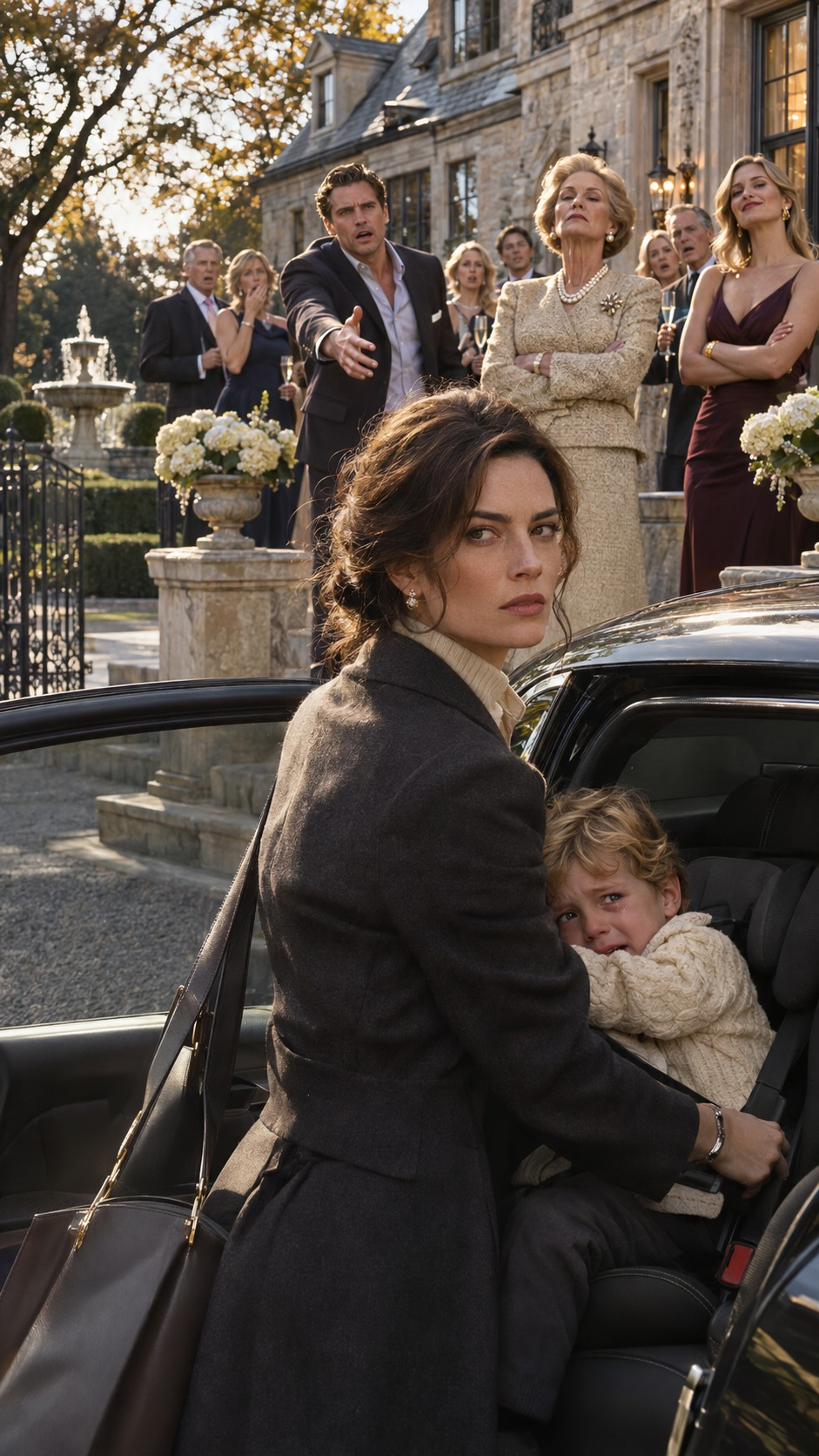
For a moment, I remembered the night Charles told me to leave.
I remembered the fear.
The humiliation.
Oliver crying.
Judith's cold expression.
I remembered walking away with my son, believing I had lost my family.
But I hadn't lost my family.
I had saved the part of it that mattered most.
I had protected my child.
I had found the truth.
I had reclaimed my home.
And I had found my way back to myself.
The house was quiet now.
Not empty.
Not lonely.
Safe.
I turned off the hallway lights and walked upstairs.
Tomorrow, Oliver would wake early.
He would ask for blueberry pancakes.
He would scatter dinosaurs across the floor.
He would laugh.
He would grow.
And I would be there.
Not as the woman Judith Langford tried to make me.
Not as the wife Charles assumed would never leave.
But as Caroline Mercer.
A mother.
A daughter.
A woman who had finally remembered her own worth.
I closed Oliver's bedroom door gently.
Then I went to sleep in the home that had always been mine.






Comments 0