The signature looked perfect.
That was the first thing I noticed when Evelyn sent me the scanned document at 11:07 p.m.
My name appeared at the bottom of the final page in dark blue ink.
Caroline Mercer Langford.
The letters leaned slightly to the right. The capital C had the same long curve I had used since college. Even the final stroke of the d resembled the way I signed formal documents.
Someone had studied my handwriting.
Someone had practiced it.
And someone had placed it on a document authorizing Charles Langford to represent that he controlled assets he did not own.
I enlarged the image.
The signature was convincing.
But there was a problem.
A small one.
The kind of detail a person might overlook if they believed wealth and authority were enough to make paperwork legitimate.
I had stopped signing legal documents as Caroline Mercer Langford almost two years earlier.
My professional signature was Caroline M. Mercer.
The change had been made after my father died, when I assumed greater responsibility for the family holding companies.
The signature on the document was an older version.
Whoever had copied it had used a specimen from the wrong period.
"Evelyn," I said, "where did they get this?"
"We're tracing the document's origin."
"Who submitted it?"
"An employee of Langford Development Group."
"Name?"
"Daniel Foster. Their finance director."
I knew Daniel.
He was a cautious man in his late forties who had worked for Charles for nearly six years.
He had always treated me politely, though with the slightly uncomfortable courtesy of someone who believed I was a wealthy man's dependent wife.
Once, at a company holiday dinner, he had explained to me what a balance sheet was.
I had listened.
Charles had laughed afterward.
"Daniel probably thinks you're going to start investing."
I remembered smiling and changing the subject.
Now Daniel's name appeared on a submission involving a forged authorization.
"Do we know whether Daniel knew the signature was false?"
"No," Evelyn said. "And we must not assume he did."
She was right.
That was why I trusted her.
Evelyn had been my attorney for eleven years. She had helped restructure my father's holdings after his illness, guided me through acquisitions, and warned me against agreements that looked generous until the final page.
She did not encourage emotional decisions.
She did not confuse suspicion with evidence.
And she never promised that the law would produce a satisfying outcome simply because someone deserved one.
"What do you recommend?" I asked.
"Preserve the original submission, request the authentication records, and notify the lender that the signature is disputed."
"Do it."
"We should also consider whether to file a formal report."
"After we establish the chain of custody."
"Agreed."
I looked again at the signature.
Someone had tried to use my name to take control of something valuable.
The question was whether Charles knew.
I wanted to believe he did not.
Even after what had happened on the terrace, some stubborn part of me resisted the possibility that the father of my child had knowingly participated in fraud.
Then I remembered his messages.
Don't forget who owns the roof over your head.
He believed the estate was his.
Or at least he wanted me to believe it.
I opened our old message history.
There were years of ordinary conversations.
Grocery lists.
Photographs of Oliver.
Reminders about pediatric appointments.
Arguments about holidays.
And beneath them, a pattern I had not recognized while I was living inside it.
Whenever I asked Charles to participate in something important, he answered with irritation.
Whenever his mother insulted me, he told me to ignore it.
Whenever I raised concerns about his spending, he accused me of being controlling.
And whenever I tried to discuss the financial arrangements between our families, he changed the subject.
I had mistaken avoidance for discomfort.
Perhaps it had been something else.
At midnight, I received a message from Rebecca.
You embarrassed Mother today. Charles is being generous by giving you a chance to apologize. Don't make this worse.
I stared at the screen.
Rebecca had never liked me.
At first, I thought it was because we were different.
She enjoyed social events, designer clothing, and the attention that came with being a Langford.
I preferred quiet dinners, long walks, and work that rarely required my photograph to appear anywhere.
But our differences had not caused the hostility.
The hostility had begun when I refused to fund a business venture she wanted Charles to support.
She had presented the idea as a luxury wellness brand.
I had reviewed the projections and found that the numbers did not support her claims.
Charles told her I was being difficult.
Rebecca told the family I was jealous of her ambition.
I said nothing.
That silence had become a habit.
I set the phone aside and went to check on Oliver.
He was sleeping with one arm stretched across his pillow.
His stuffed dinosaur was missing.
I had forgotten it at the estate.
I sat beside him and brushed a curl away from his forehead.
Tomorrow, I would need to explain why we were not going back.
Not everything.
Not the financial arrangements.
Not the forged signature.
Only what a three-year-old could understand.
That adults sometimes made choices that hurt people.
That he had done nothing wrong.
That his mother would keep him safe.
I stayed there for several minutes.
Then I returned to the living room and opened my laptop.
My father had taught me that a crisis became more manageable when separated into facts, assumptions, and questions.
I created three columns.
Facts.
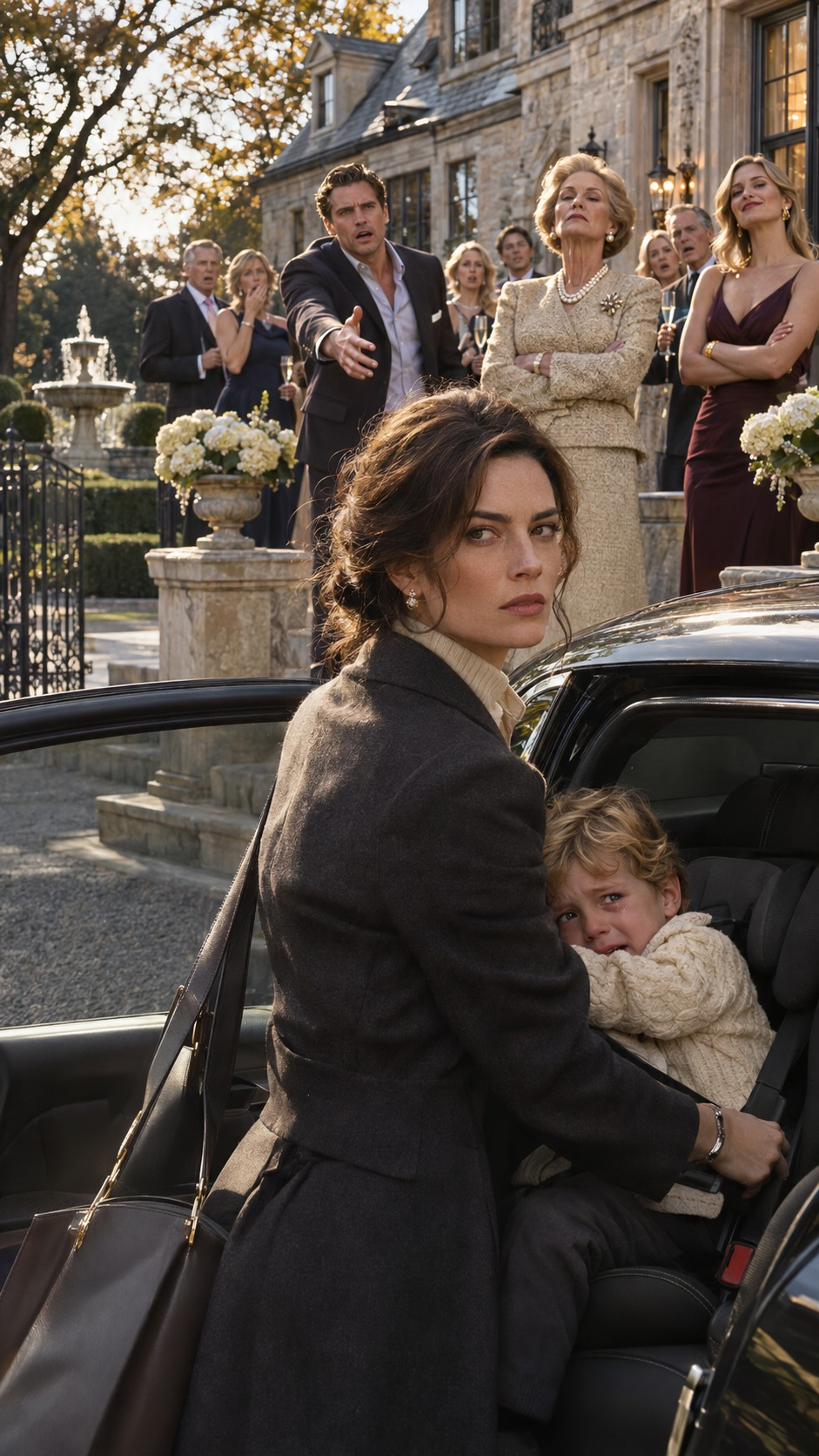
Charles had ordered me to leave.
He had physically grabbed my wrist in front of our son.
His company had submitted a document containing a signature I did not provide.
The estate belonged to Mercer Property Holdings.
A credit facility supporting his company was under compliance review.
Assumptions.
Charles believed I would apologize.
His family believed I depended on him financially.
Someone believed the forged document would go unchallenged.
Questions.
Who created the document?
Who authorized its submission?
What other representations had been made?
And why had Charles chosen that particular afternoon to threaten me?
I looked at the last question for a long time.
It was possible the timing meant nothing.
It was possible he had simply lost his temper.
But something about his certainty bothered me.
He had not sounded like a man making an impulsive threat.
He had sounded like a man executing a plan.
At 6:15 the next morning, Evelyn called.
I had slept for less than three hours.
"The bank has suspended additional draws under the facility pending verification," she said.
I closed my eyes.
"So it's frozen."
"For now. Existing obligations remain, and the lender is reviewing the documentation. We should be precise about what that means."
"Of course."
"Charles's company will be notified shortly."
I looked toward Oliver's bedroom.
"Does the bank understand the disputed signature?"
"Yes. They've received our notice and the supporting records."
"Good."
"There is another issue."
I waited.
"The estate management office received a request yesterday for access to historical ownership files."
"From Charles?"
"From Judith."
I frowned.
"Why would Judith want those?"
"We don't know."
"Did they release anything?"
"Only publicly available information and a request form. The confidential records remain protected."
I walked to the kitchen and poured coffee.
"Send me the request."
"Already in your inbox."
I opened it.
Judith's name appeared at the top.
Her handwriting was unmistakable.
The stated purpose was:
Family estate succession planning.
I read the words twice.
Succession planning.
Judith had been talking about inheritance for years.
She spoke as though the estate would eventually pass to Charles, then to Oliver.
She had even discussed which rooms Rebecca might use for future family celebrations.
I had never corrected her.
The property was mine, but I had allowed the family to continue living there under a carefully structured occupancy arrangement.
It had seemed kind.
My father had once told me that generosity without boundaries could become a form of self-deception.
I had not understood him then.
Now I did.
"Evelyn," I said, "I want to know exactly what Judith was planning."
"We can request an explanation through counsel."
"Do that."
After the call, I made breakfast for Oliver.
He wanted oatmeal with blueberries.
He sat at the kitchen island swinging his feet.
"Are we going to Grandma's house?"
I placed his bowl in front of him.
"Not today."
"Is Daddy coming?"
I sat beside him.
"I don't know, sweetheart."
He looked down.
"Grandma said you were bad."
The words struck harder than anything Charles had said.
I kept my voice steady.
"Grandma was wrong."
"Are you bad?"
"No."
He considered that.
"Am I bad?"
I reached for his hand.
"Never."
He leaned against me.
I held him until he was ready to eat.
At 8:32 a.m., Charles called.
I let it ring.
He called again.
Then again.
Finally, a message appeared.
What did you do?
I did not answer.
Another message followed.
My credit line has been frozen. Call me immediately.
Then:
This is not a game, Caroline.
I looked at the words.
For years, Charles had told me not to involve myself in his business.
Now, suddenly, he wanted my attention.
I called Evelyn instead.
"Charles knows."
"I expected that."
"He thinks I caused it."
"The bank acted because of the documentation issue. We have a record of the sequence."
"Keep everything."
"Of course."
I was about to hang up when she said, "There's one more thing."
I waited.
"The bank's compliance team found an earlier authorization request."
"How much earlier?"
"Six weeks."
I felt a cold pressure settle behind my ribs.
"Was my signature on that one too?"
"No."
"Then whose?"
Evelyn paused.
"Judith Langford's."
I stared at the kitchen wall.
Judith had no ownership interest in the estate.
She had no authority to pledge it.
And she had no legitimate reason to sign documents suggesting otherwise.
"What exactly did she sign?"
"A statement identifying herself as the controlling family representative for the property."
I almost dropped the phone.
"That is false."
"Yes."
"Did Charles know?"
"We're still establishing that."
Oliver looked up from his oatmeal.
"Mommy?"
I forced my face to relax.
"Yes, sweetheart?"
"Can we go to the park?"
I looked at him.
Then at the phone.
"Yes," I said. "We can."
Because whatever was happening in Charles's financial world, Oliver deserved a normal morning.
I dressed him, packed his allergy-safe snacks, and took him to a small park near the apartment.
For forty minutes, I pushed him on a swing.
He laughed.
He asked me to go higher.
He chased pigeons.
And for a little while, the world felt ordinary.
Then my phone rang.
It was Evelyn.
"Caroline, I need you somewhere private."
I stepped away from the playground while keeping Oliver in sight.
"What happened?"
"Daniel Foster contacted our office."
"The finance director?"
"Yes."
"What did he say?"
"He claims he has evidence that the authorization was prepared under direct instructions."
"From Charles?"
Evelyn hesitated.
"He wouldn't say over the phone."
I watched Oliver climb the small slide.
"Where is he now?"
"On his way to our office."
"Has he contacted Charles?"
"Apparently not."
I looked at my watch.
"Tell him I'll be there in an hour."
"Caroline..."
Something in Evelyn's voice stopped me.
"What?"
"Daniel said he wasn't only concerned about the estate."
I waited.
"He said there was another document."
"What document?"
"He called it a transfer agreement."
My heart began to pound.
"A transfer of what?"
Evelyn's voice dropped.
"Oliver's trust."
And before I could ask another question, she said:
"Caroline, Daniel believes someone has already tried to move the money."






Comments 0