The name at the top of the email was Linda Parker.
For a moment, I couldn't move.
I had expected Charles.
Perhaps Robert Ellis.
Even Melissa.
But Linda?
The woman who had brought casseroles after Frank's funeral. The woman who had sat beside me at church, held my hands, and told me God never gave us more than we could bear.
I stared at the printed email.
From: Linda Parker
To: Daniel Whitmore
Subject: Frank's Estate Documents
Beneath it was a message dated six months earlier.
Daniel, I've located the copies your father left with me when we helped organize his papers during his illness. I can send you samples of his signature and handwriting. But please remember that these were entrusted to me for safekeeping, not for creating new documents.
My fingers went numb.
I read the next line.
If Charles prepares the family agreement as discussed, make sure it doesn't contradict the existing estate records.
I looked up at Helen Morris.
"She knew?"
Helen nodded sadly.
"She knew Daniel was trying to produce something."
Rebecca leaned forward.
"Helen, how did you obtain this email?"
"Linda forwarded it to me by mistake. Daniel had asked her to contact me about the old partnership records. She included the earlier correspondence in the email chain."
I looked down again.
There was another message.
This one from Daniel.
We aren't taking anything from Mom. We're making sure Dad's wishes are honored before she does something irreversible.
I almost laughed.
Irreversible.
As though selling my own house were a crime.
As though living the rest of my life on my own terms were something terrible.
I looked at Rebecca.
"Linda had Frank's handwriting."
"Apparently."
"And she gave it to Daniel."
"That's what the email indicates."
I closed my eyes.
Frank had trusted Linda.
So had I.
During his final illness, she had volunteered to help organize church paperwork, medical correspondence, and some household files. I remembered being grateful. I had been exhausted, frightened, and barely able to keep track of the days.
I had never imagined those old papers would become weapons against me.
"Margaret," Rebecca said gently, "this is important evidence. But we still need to distinguish what Linda actually did from what Daniel and Charles may have done afterward."
I nodded.
"Of course."
I looked at Helen.
"Did you tell Daniel you wouldn't help him?"
"Yes."
"What did he say?"
Helen's expression tightened.
"He said I was being sentimental about a man who had been dead for years."
My heart broke a little.
Not because Daniel had insulted me.
Because he had spoken about his father that way.
Frank had taught him to ride a bicycle.
Helped him with homework.
Worked overtime to pay for his education.
Sat through terrible school concerts and cheered as though Daniel were performing at Carnegie Hall.
And now my son had reduced him to an obstacle whose memory could be rearranged to suit a financial plan.
I folded my hands.
"Rebecca, I want this finished."
She nodded.
"So do I."
"No more arguments with Daniel. No more mysterious visitors. No more people telling me what Frank supposedly wanted."
I looked at the papers on the table.
"I want the truth established. I want my house sold. And I want to go home to a place where nobody thinks they own me."
Rebecca smiled.
"Then that's what we'll work toward."
The next several days were the longest of my life.
Rebecca sent formal responses disputing the documents bearing my signature. She provided the title company with Frank's old letter denying Charles any interest in the property, along with Helen's records and the preliminary handwriting findings.
Charles had produced no original agreement, no proof of a contribution toward our mortgage, and no reliable records supporting his claimed interest.
His allegations had created a problem that needed attention.
But they hadn't made him an owner.
Meanwhile, the financial services company confirmed that the proposed $240,000 renovation financing had never been funded. Its review had been suspended when I disputed the authorization.
Daniel had made promises.
He had discussed money.
He had represented that he could control a property he didn't own.
But he hadn't succeeded in borrowing against my house.
I felt relieved.
Then furious.
He had risked my peace of mind for an arrangement that hadn't even been completed.
Robert Ellis gave Rebecca a detailed written account. He acknowledged that he had allowed his name to appear as a witness without witnessing my signature. He also confirmed that Charles had requested a newly formatted version of an old family agreement.
The records were preserved for the appropriate authorities to review.
Rebecca was careful not to promise that anyone would be prosecuted.
"Investigations take time," she told me. "And criminal responsibility is not something we determine ourselves."
"I understand."
"What matters immediately is that the title company has enough reliable information to evaluate the claims."
I nodded.
"And the sale?"
She smiled.
"We're getting close."
Two days later, Charles withdrew his asserted claim after receiving a formal demand for supporting evidence and a warning that further unsupported interference could have consequences.
The title company completed its review.
The buyers confirmed they still wanted the house.
And Patricia called me with the words I had been waiting to hear.
"Margaret, we're cleared to schedule closing."
I sat at the kitchen table.
For a moment, I couldn't speak.
Then I began to cry.
Not loudly.
Just quietly, with my hand pressed over my mouth.
"Margaret?" Patricia asked.
"I'm here."
"Are you all right?"
I laughed through my tears.
"Yes."
And for the first time in weeks, I meant it.
Linda came to see me the following afternoon.
She called first.
I almost refused.
But Rebecca had already obtained the relevant records, and I wanted to hear what Linda had to say.
We met at a small café near the church.
Eleanor sat at a nearby table, giving us privacy without leaving me alone.
Linda looked older than I remembered.
Her face was pale.
Her hands trembled around her coffee cup.
"Margaret," she began, "I owe you an apology."
I waited.
She looked down.
"Daniel told me you were struggling."
"With what?"
"With making decisions. With being alone. He said you were becoming overwhelmed."
I said nothing.
Linda swallowed.
"He told me Frank had wanted the house to stay with Daniel."
"Did you believe him?"
"Yes."
"Why?"
She looked at me helplessly.
"Because he was your son."
I felt a dull ache.
"Linda, you knew me."
"I know."
"You had dinner in my house. You watched me care for Frank. You knew how much work went into keeping that home."
Tears filled her eyes.
"I know."
"And when Daniel told you I couldn't manage my own affairs, you believed him without asking me?"
She lowered her head.
"Yes."
I took a breath.
"Did you give him Frank's papers?"
She nodded.
"I gave him copies."
"Did you know he would use them to create false documents?"
"I knew he wanted evidence of Frank's wishes. I didn't know he would go that far."
I studied her.
"Your email mentioned Charles preparing an agreement."
Linda wiped her eyes.
"Daniel told me they were reconstructing something that had been lost."
"And you didn't question that?"
"I should have."
"Yes," I said quietly. "You should have."
She looked at me.
"I also gave information for the welfare referral."
"I know."
"I thought someone should check on you."
"Did you tell them I couldn't manage my money?"
She hesitated.
"I repeated what Daniel told me."
"And Eleanor's signature?"
Linda shook her head.
"I didn't sign Eleanor's name. I gave her name as someone who knew you well. I don't know who added the signature."
I believed she was telling me part of the truth.
Perhaps all of it.
But trust wasn't something I could restore simply because she was crying.
"Linda," I said, "I needed friends after Frank died. Not people who would decide my future behind my back."
She began to sob.
"I'm sorry."
I felt sadness.
But I didn't reach across the table.
"I accept that you're sorry," I said. "But I need distance from you."
She nodded.
"I understand."
I stood.
Then I looked at her one last time.
"Please tell the truth to anyone investigating these documents."
"I will."
I walked toward Eleanor.
She rose immediately.
Outside, the afternoon air was warm.
Eleanor took my arm.
"How do you feel?"
I thought about it.
"Disappointed."
She nodded.
"That's understandable."
Then I looked toward the street.
"But not confused."
Eleanor smiled.
"No, Margaret. Not confused at all."
Closing day arrived on a Thursday.
I wore a pale blue blouse Frank had always liked.
Eleanor drove me to Rebecca's office.
Patricia was waiting with a folder and a smile.
"Ready?"
I looked at her.
"Very."
The buyers had completed their final walkthrough. The agreed repairs and credits had been addressed. The closing documents had been prepared and reviewed.
I signed carefully.
Every page.
Every line.
This time, nobody was signing for me.
Nobody was pretending to have my permission.
Nobody was telling me I didn't understand.
Rebecca explained each document.
I asked questions when I needed to.
And when the final signature was complete, Patricia smiled.
"Congratulations, Margaret."
The sale price was $875,000.
The proceeds, after the ordinary closing costs and expenses, belonged to me.
Not Daniel.
Not Melissa.
Not Charles.
Me.
I sat back in my chair.
For a moment, I thought about the first mortgage payment Frank and I had made.
We had been young.
Nervous.
And terrified that we'd taken on more than we could manage.
Thirty-two years later, we made the final payment.
Frank had stood in the kitchen holding the confirmation letter.
He'd kissed me and whispered, "Finally ours."
I had laughed.
"It was always ours."
He shook his head.
"Now nobody can take it away."
I looked down at the closing papers.
Frank had been wrong about one thing.
A house could be taken away from you in ways that had nothing to do with a mortgage.
People could make you afraid inside it.
They could turn familiar rooms into battlegrounds.
They could make you feel guilty for wanting a future.
But they couldn't take away the years we'd spent loving each other there.
I touched the small photograph I carried in my handbag.
Frank standing beside the roses.
Smiling into the sunlight.
"Thank you, sweetheart," I whispered.
The cottage purchase closed shortly afterward, and I arranged the move with the help of a local moving company.
The driver was a friendly man named Robert.
Not Robert Ellis.
Robert Hayes, a retired firefighter who had started a small moving business with his nephew.
He was patient, careful, and surprisingly good at packing fragile dishes.
When I told him Frank's chair needed special attention, he nodded solemnly.
"That chair gets first-class treatment."
I laughed.
"Good."
By then, Daniel and Melissa were nearing the end of their European vacation.
I had not told them the sale was complete.
I had told Daniel repeatedly that I was making my own decisions and working with an attorney.
He had chosen not to believe me.
His last message had been:
We'll sort everything out when we get home.
I read it once.
Then put my phone away.
There was nothing left for him to sort out.
The house had been sold.
The new owners had possession under the closing arrangements.
The locks and garage access had been changed with their authorization.
And I had already moved most of my belongings.
On the morning Daniel returned, Robert and I stopped near Cedar Grove to collect the final items I'd arranged to take from storage.
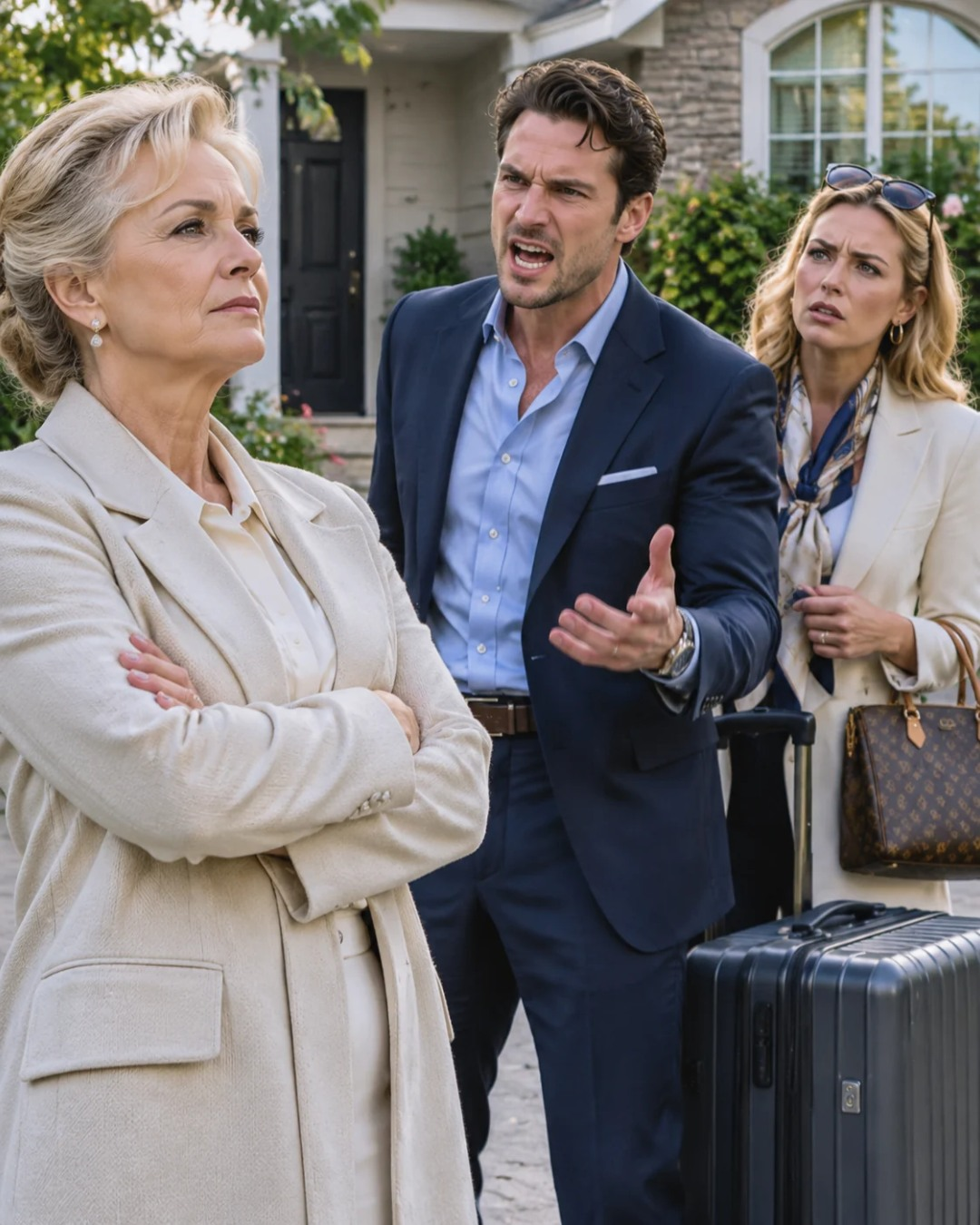
We were parked across the street in the rented moving truck when a familiar car pulled into the driveway.
Daniel.
Melissa.
I watched my son get out.
He looked tanned and rested.
Melissa wore sunglasses and carried an expensive handbag.
They walked toward the front door.
Daniel inserted his key.
It wouldn't turn.
He tried again.
Then he stepped back and entered the garage code.
Nothing happened.
Melissa said something sharply.
Daniel tried the code again.
Then the front door opened.
A woman I recognized as one of the buyers stood inside.
She spoke calmly.
Daniel's expression changed.
He pointed toward the house.
The woman shook her head.
Melissa removed her sunglasses.
Even from across the street, I could see the disbelief on her face.
Robert glanced at me.
"Are you sure you want to watch this?"
I nodded.
"Yes."
A dark sedan pulled up behind Daniel's car.
A man in a charcoal jacket stepped out.
His name was Martin Cole, a representative of the title company who had agreed to meet the buyers about a final document delivery.
He had also been informed that my son might appear and make claims about the property.
Daniel approached him immediately.
Martin showed him the recorded sale information and closing confirmation.
I watched Daniel stare at the page.
Then I saw him point to the number.
$875,000.
Melissa grabbed his arm.
Daniel looked toward the house again.
His face had gone pale.
My phone rang.
Rebecca.
I answered.
"Margaret?"
"Yes."
"Your son isn't the only person who's been asking questions about that house."
I felt my stomach tighten.
"Who else?"
"Charles contacted the title company again this morning. He wanted to know whether the sale had closed."
I looked across the street.
"Did they tell him?"
"They confirmed the public record reflects the completed transaction. His previous claim remains withdrawn."
I exhaled.
"Good."
"Margaret, the house is sold. The buyers own it. Charles's inquiries don't change that."
I closed my eyes.
For weeks, I had imagined hearing those words.
Now they sounded almost too wonderful to believe.
"Thank you, Rebecca."
"You're welcome."
I ended the call.
Across the street, Daniel was staring at the front door.
Then he turned.
And saw me.
He crossed the street so quickly that Melissa had to hurry after him.
"Mom!"
Robert glanced at me.
I opened the truck door.
"Hello, Daniel."
My son stopped beside the vehicle.
His face was flushed.
"What have you done?"
I looked at him.
"I sold my house."
"You can't be serious."
"I am."
Melissa stepped forward.
"Margaret, we had plans!"
"I know."
"We were going to renovate!"
"I know."
Daniel stared at me.
"Mom, you had no right—"
I raised my hand.
"Daniel."
He stopped.
"I had every right."
His mouth opened.
Then closed.
I continued.
"The house belonged to me. I sold it legally. The buyers own it now."
Melissa looked horrified.
"But where are we supposed to live?"
I stared at her.
"In your own home."
She blinked.
"The one you lived in before your vacation," I added.
Daniel looked away.
For a moment, nobody spoke.
Then he said, "You humiliated us."
I felt a sharp pain.
Even now.
After everything.
He was thinking about himself.
"Daniel," I said quietly, "you told me I was becoming a burden."
His expression changed.
"You said you couldn't keep putting your lives on hold because of me."
"Mom, I was frustrated."
"You planned to remove me from my home."
He looked toward Melissa.
"You told strangers I had agreed to move into a retirement community. You discussed renovations and financing. You allowed documents bearing my signature to circulate without my permission."
Melissa's face drained of color.
Daniel swallowed.
"That's not what happened."
"Then you can explain what happened to Rebecca and anyone else reviewing those records."
He stared at me.
I stepped down from the truck.
For a moment, we stood facing each other.
My son was taller than I was.
Stronger.
Younger.
But I wasn't afraid of him anymore.
"I love you, Daniel," I said.
His eyes filled.
"But loving you doesn't mean giving you everything I own."
He looked down.
I continued.
"Your father and I spent thirty-two years paying for that house. We worked. We sacrificed. We built a life there."
My voice trembled.
"And you treated it like something you were waiting for me to leave behind."
Daniel covered his face.
Melissa stood silently beside him.
I looked at her.
"You wanted to remove Frank's roses."
She lowered her eyes.
"You wanted to throw away his chair."
No answer.
"You made plans for my bedroom while I was still sleeping in it."
Melissa began to cry.
I felt no satisfaction.
Only sadness.
I looked back at Daniel.
"If you ever want a relationship with me again, it has to begin with honesty."
He nodded weakly.
"Mom..."
"No more threats. No more paperwork. No more decisions made behind my back."
He wiped his eyes.
"I'm sorry."
I studied his face.
I wanted to believe him.
But an apology spoken in shock wasn't enough.
"Then show me," I said.
He nodded again.
I climbed back into the truck.
Robert started the engine.
As we pulled away, I looked in the side mirror.
Daniel stood beside Melissa.
Neither moved.
Behind them was the house where he had grown up.
A house that now belonged to someone else.
The following months brought consequences.
Charles's claim remained withdrawn, and the documentary evidence was provided to the appropriate investigators. He stopped contacting me after Rebecca formally instructed him to direct any legitimate inquiries through counsel.
The financial company confirmed that I owed nothing under Daniel's abandoned proposal. No loan had been secured against my home.
Robert Ellis cooperated with the document review. The false witness statement and other disputed paperwork were examined, and the authorities continued their work independently of my completed sale.
Linda provided a written correction to Community Support Outreach, acknowledging that she had repeated unverified claims about my abilities. Eleanor confirmed that she had never signed the statement attributed to her.
I received a written apology from the organization.
No court had found me incapable.
No one had been appointed to manage my affairs.
And no one had any legal authority to decide where I lived.
Rebecca helped me update my estate documents.
I made thoughtful arrangements for my future care, my finances, and the people I wanted to benefit from what I left behind.
Daniel was no longer automatically responsible for anything simply because he was my son.
That was a difficult decision.
But it was mine.
He began working with an attorney to address the documents and representations made in my name. He also sent written corrections to the people and companies he had misled.
His marriage with Melissa became strained.
They had to confront the money they'd discussed, the promises they'd made, and the life they'd imagined building in a house that wasn't theirs.
I didn't rescue them.
I didn't pay their expenses.
I didn't offer them my cottage.
For the first time in my life, I allowed Daniel to face the consequences of his own choices.
Autumn arrived quietly.
My cottage was everything I had hoped it would be.
Frank's chair stood beside the living room window.
His photographs lined the bookshelf.
A small garden grew behind the house.
I planted roses near the porch.
Pink ones.
White ones.
And a deep red variety Frank had always loved.
Eleanor visited every Thursday.
We drank coffee, discussed books, and complained about the weather.
Patricia came by occasionally.
Rebecca stopped in one Sunday afternoon with a basket of homemade muffins.
And I joined a local gardening club, where nobody knew me as Daniel Whitmore's mother.
They knew me as Margaret.
The woman with the roses.
The woman who made excellent lemon cake.
The woman who laughed too loudly when someone told a terrible joke.
I liked that woman.
I was beginning to remember her.
One afternoon, Daniel called.
I almost didn't answer.
Then I saw that several months had passed since our confrontation.
He had respected my request for space.
He had stopped pressuring me.
And he had sent a letter taking responsibility for his actions without blaming Melissa, Charles, or me.
I answered.
"Hello, Daniel."
"Hi, Mom."
His voice sounded different.
Quieter.
"How are you?"
"I'm well."
"I'm glad."
There was a pause.
Then he said, "I've been thinking about Dad."
I looked toward Frank's chair.
"Oh?"
"About something he used to tell me."
"What?"
"That mistakes are easier to fix when you stop hiding them."
My eyes filled with tears.
I remembered Frank saying those words.
I remembered the little boy who had broken my favorite coffee mug.
Daniel continued.
"I hid things, Mom. I lied to people. I told myself I was doing what was best for everyone."
I closed my eyes.
"I know."
"But I was doing what was best for me."
I said nothing.
"I wanted the house. Melissa and I wanted a life we couldn't afford. And I convinced myself you were standing in our way."
My throat tightened.
"I'm sorry," he whispered.
This time, he didn't sound angry.
Or frightened.
Or embarrassed.
He sounded ashamed.
And perhaps, finally, honest.
"I know an apology doesn't fix everything," he said.
"No," I answered. "It doesn't."
"I don't expect you to forgive me right away."
I looked out at the roses.
"That's good, Daniel. Because trust takes time."
"I understand."
I took a breath.
"But I'm willing to see whether we can build something better."
He began to cry.
I heard it in his breathing.
"Thank you, Mom."
I wiped my eyes.
"One step at a time."
"One step at a time," he repeated.
A few weeks later, Daniel visited.
Alone.
He brought no paperwork.
No plans.
No demands.
Only a small wooden box.
Inside was Frank's old pocket watch.
Daniel had kept it after the funeral.
"I thought you might want this," he said.
I held it carefully.
The metal was warm from his hand.
Frank used to carry it on special occasions.
I opened the cover.
The hands had stopped.
I smiled through tears.
"Your father loved this watch."
"I know."
Daniel looked around the cottage.
"It's beautiful, Mom."
"Thank you."
He noticed Frank's chair.
Then the photographs.
Then the roses outside the window.
For a moment, he looked like the boy I remembered.
"Are you happy here?" he asked.
I smiled.
"Very."
He nodded.
"I'm glad."
We sat together for nearly an hour.
We didn't pretend nothing had happened.
We didn't rush toward forgiveness.
But we talked.
About Frank.
About Daniel's childhood.
About the mistakes he'd made.
About the kind of relationship we might still have.
When he left, he hugged me.
Not because he wanted something.
Not because he needed me to change my mind.
Simply because I was his mother.
And he was my son.
I held him for a moment.
Then I let him go.
On the first anniversary of my move, I invited Eleanor, Patricia, Rebecca, and several friends for dinner.
We ate on the patio beneath strings of warm lights.
The roses were blooming.
The evening air smelled of lavender.
Someone played soft music.
Eleanor raised her glass.
"To Margaret."
Everyone smiled.
I laughed.
"Oh, please."
Eleanor grinned.
"To the woman who reminded all of us that it's never too late to begin again."
I felt my cheeks grow warm.
We raised our glasses.
Then Patricia said, "And to Frank."
My eyes filled.
"Yes," I whispered. "To Frank."
Later, after everyone had gone, I carried the dishes into the kitchen.
The cottage was quiet.
I turned off the patio lights.
Then I walked into the living room.
Frank's chair stood beside the window.
His photograph rested on the table.
I sat down.
For a long time, I simply looked around.
The books.
The flowers.
The soft lamplight.
The little home that belonged entirely to me.
I thought about Cedar Grove.
The house where I'd spent so many years.
The house where Daniel had taken his first steps.
Where Frank and I had danced in the kitchen.
Where we'd laughed, argued, cried, and grown old together.
I still loved that house.
But I no longer missed living there.
I had taken the important things with me.
The photographs.
The memories.
The roses.
The love.
I picked up Frank's final letter.
The real one.
The one he'd written during his illness.
I unfolded it carefully.
My eyes found the words I'd read so many times.
If you're reading this, I hope you're remembering to live.
Then the final lines.
The house was never the dream, sweetheart. Our life together was.
I smiled.
"Oh, Frank."
For so long, I had believed that staying in our house was the best way to honor him.
I had thought leaving would mean abandoning something sacred.
But now I understood.
Frank had never wanted me to spend the rest of my life guarding empty rooms.
He had wanted me to live.
To laugh.
To make friends.
To grow roses.
To find joy after grief.
And finally, I had.
I placed his letter beside the photograph.
Then I stood and walked toward the window.
Outside, the garden glowed beneath the moonlight.
The roses moved gently in the breeze.
I opened the window.
The air was cool and sweet.
For a moment, I imagined Frank standing beside me.
His hand resting on my shoulder.
His familiar voice asking whether I was happy.
I smiled into the darkness.
"Yes, sweetheart," I whispered.
"I finally am."
Then I turned off the light and went upstairs.
In the morning, I would make coffee.
Water the roses.
Call Eleanor.
Perhaps visit the market.
Perhaps do nothing at all.
The choice was mine.
And that was the happiest ending I could have imagined.






Comments 0