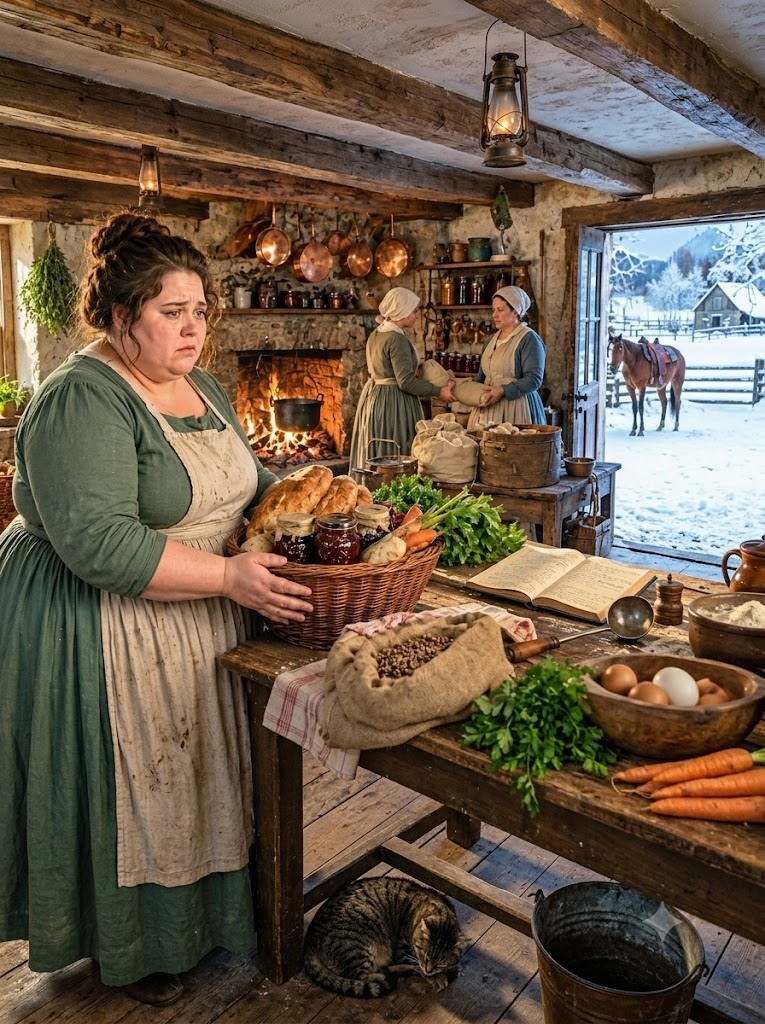
Clara Bennett hurled the cast-iron skillet through the broken window.
"All right," she whispered. "Let's fix you."
When Margaret Hale came to inspect the abandoned cookhouse, she found the broken skillet lying in the Wyoming snow.
Its handle had split completely apart.
But something inside that forgotten kitchen had already begun to change.
Six weeks earlier, Clara Bennett had owned a little house in Nebraska.
It wasn't impressive. The roof leaked whenever the rain became heavy, the front porch creaked beneath anyone heavier than a child, and the kitchen window had been stuck halfway open for as long as Clara could remember.
But it was hers.
Her mother had planted flowers beside the front steps. There were pencil marks on the pantry door showing how tall Clara had grown each year. The kitchen table had a burn mark from the first pie Clara ever baked without help.
Her mother had laughed when the crust came out black.
They had eaten it anyway.
For thirty-four years, Clara had believed that a home was something a person could return to, no matter how difficult the world became.
Then her mother died.
The illness had taken months. The bills had taken everything else.
Clara had spent nearly every dollar she possessed on medicine, doctors, and the small comforts that might make her mother's final weeks easier.
She had never regretted a single payment.
What she had not expected were the debts attached to the property.
Her mother had apparently signed financial agreements years earlier. Some had accumulated interest. Others had been secured against the house.
Clara discovered them only after the funeral.
The creditors were not interested in her memories, her mother's illness, or the thirty-four years she had spent maintaining the property.
They wanted their money.
Within weeks, the house was gone.
Clara packed what remained of her belongings into one battered suitcase.
She took three dresses, a pair of worn boots, a small collection of personal papers, and the most valuable thing she owned.
Her mother's recipe notebook.
Its cover was faded brown. The corners had softened with age, and several pages carried small stains from flour, butter, and apple juice.
Clara had considered leaving it behind.
Then she remembered her mother sitting at the kitchen table, explaining how to stretch a handful of flour into enough biscuits for an unexpected visitor.
"Never confuse having little with having nothing," her mother used to say.
Clara carried the notebook.
She had nowhere else to go.
Red Hollow Ranch offered employment.
The advertisement had been brief. A ranch in Wyoming required a cook. Room and board included. Experience preferred.
Clara had experience.
She had spent most of her adult life cooking, preserving food, maintaining a household, and making sure that her mother never went without a decent meal.
She had written a letter.
Three weeks later, she received a reply.
The journey to Wyoming was long and uncomfortable.
By the time the stagecoach brought her to Red Hollow Ranch, Clara's back ached, her hands were stiff, and the last of her money had disappeared into transportation costs.
Still, she felt something she had not felt since her mother's funeral.
Possibility.
The ranch was larger than she expected.
Several wooden buildings stood beyond the main house. Fenced pastures stretched toward distant hills, and the barns occupied nearly as much ground as the house itself.
Horses moved through the yard.
Men carried supplies between buildings.
Smoke rose from several chimneys.
It looked like a place where people worked hard and depended on one another.
Clara stepped down from the coach with her suitcase.
A woman stood waiting near the main entrance.
Margaret Hale was dressed in an expensive dark traveling coat. Her hair was arranged neatly beneath a fashionable hat, and her gloves appeared too clean for someone who spent time around a working ranch.
She examined Clara without greeting her.
"You are Bennett?"
"Yes, ma'am. Clara Bennett."
Margaret's eyes traveled from Clara's face to her suitcase.
Then they lingered on her plain dress and broad waist.
"The previous cook was more presentable."
Clara tightened her grip on the suitcase handle.
She had heard worse things during the months surrounding her mother's death.
But there was something particularly unpleasant about being judged by a stranger before being allowed to speak.
"I wasn't hired to decorate the kitchen," Clara answered.
Margaret's mouth tightened.
For a moment, neither woman moved.
Then Margaret turned toward the buildings behind the barns.
"Come with me."
Clara followed.
They passed a stable, a storage shed, and a row of wooden fences.
The farther they walked from the main house, the less maintained the buildings became.
Finally, Margaret stopped beside an old stone structure.
Its windows were cracked.
The wooden door hung slightly crooked.
A patch of weeds had grown around the foundation.
Margaret opened the door.
"This is where you'll work."
Clara stepped inside.
The smell reached her first.
Dust.
Damp stone.
Old ash.
Something unpleasant had settled into the cupboards.
The kitchen looked as though nobody had properly cleaned it in years.
Mouse droppings covered parts of the floor. One shelf leaned dangerously toward the wall. The stove door hung crookedly, and a thick layer of soot covered the fireplace.
A broken wooden table stood near the center.
Clara looked toward the window.
Its frame was damaged, and the glass had several cracks.
Beyond it, a garden had disappeared beneath dead weeds.
Margaret watched her reaction.
"You'll prepare the ranch hands' meals here."
Clara turned.
"Here?"
"It keeps things separate."
The words were delivered casually.
That made them worse.
Clara understood what separate meant.
The main house had a proper kitchen. Margaret wanted her new employee working somewhere nobody important would have to see her.
"Where are the cleaning supplies?" Clara asked.
Margaret seemed surprised.
"What?"
"Rags. A broom. Soap. Anything useful."
Margaret studied her.
"You haven't even asked about the stove."
"I can see the stove."
"And you intend to cook on it?"
"I intend to make it work."
For the first time, Margaret looked genuinely irritated.
She pointed toward a small storage cupboard.
"There may be something in there. You'll receive your instructions from the ranch manager."
Then she turned and left.
Clara stood alone.
For several seconds, she listened to the sound of Margaret's footsteps fading across the frozen yard.
She could have walked out.
She could have picked up her suitcase and asked the stagecoach driver to wait.
But where would she go?
Nebraska was behind her.
Her mother was gone.
The house no longer belonged to her.
Clara set down her suitcase.
"All right," she murmured.
"Let's see what we have."
The first hour was unpleasant.
She found two mouse nests behind the lower shelves, a collection of broken crockery beneath the table, and a cupboard containing several sacks of spoiled grain.
She opened every window she could.
Then she began carrying the rubbish outside.
By late afternoon, the floor was visible.
By sunset, three mouse nests were gone.
She discovered a small supply of cleaning cloths in the cupboard and used the least damaged one to scrub the preparation table.
The stove was more complicated.
Its door would not close properly, and the chimney had accumulated years of soot.
Clara examined the hinges, found a loose iron fitting, and managed to secure it using a piece of wire.
She cleaned the chimney opening as best she could.
When she finally lit a small fire, smoke filled the kitchen.
Clara coughed, opened the door, and waited.
Then the smoke began moving upward.
The chimney was drawing again.
She stood there with her hands on her hips.
A small accomplishment.
Nothing more.
But it was hers.
She worked until midnight.
At some point, she discovered an old tin containing flour.
The lid was sealed.
The flour inside smelled clean.
There was enough for a small batch of biscuits.
Clara opened her suitcase and removed her mother's recipe notebook.
The familiar handwriting appeared beneath the lamplight.
She turned to a page marked Buttermilk Biscuits.
Her mother had written instructions in the margins.
Use less butter when supplies are low.
Keep the dough cool.
Never work it too long.
Clara smiled faintly at the memory.
She measured the ingredients.
Mixed the dough.
Cut the biscuits.
Then placed them beside the fire.
The first batch came out uneven.
One was slightly too dark.
Another had barely risen.
But they smelled wonderful.
Clara ate one while sitting beside the stove.
She had not eaten a proper meal since the previous morning.
It tasted like something she had nearly forgotten.
Home.
Not the house.
Not the porch.
Not the garden.
Something smaller.
Something she could still carry.
She closed the notebook and prepared to sleep.
The following morning, she woke before sunrise.
She washed her face using cold water, tied her hair into a practical low braid, and put on her apron.
There was work to do.
She began with an inventory.
The flour tin.
Two sacks of beans.
Several jars of salt.
A small amount of dried meat.
Some onions.
A few potatoes.
An old crate containing apples.
She wrote everything down.
Her mother had taught her that cooking without an inventory was an invitation to waste.
A person who knew what she possessed could make plans.
A person who guessed would eventually run out.
Clara was halfway through counting the pantry when someone appeared in the doorway.
A man in his thirties.
Clean clothes.
Polished boots.
An expensive-looking coat.
He glanced around the kitchen as though he had entered a place he expected to dislike.
"You're the new cook?"
"Yes."
"Warren Hale."
He did not offer his hand.
Clara nodded.
"Clara Bennett."
His attention shifted toward the open notebook.
"What are you writing?"
"Inventory."
He gave a short laugh.
"Around here, cooks cook. Accountants count."
Clara closed the notebook.
"Then we shouldn't have any trouble staying out of each other's way."
Warren looked at her.
His expression changed slightly.
He had expected embarrassment.
Perhaps an apology.
Instead, he found a woman who seemed entirely comfortable with silence.
"How long have you been here?"
"Since yesterday."
"And you've already started counting things?"
"Someone should know what's in the pantry."
Warren glanced toward the shelves.
Then toward the sacks beneath the table.
Something about his expression made Clara pay attention.
It was brief.
A tightening around the mouth.
A momentary pause.
Then the smile returned.
"Well, don't make yourself too comfortable. This place has had plenty of cooks come and go."
"Then perhaps it needs one who stays."
Warren studied her.
He seemed about to say something else.
Instead, he adjusted his coat.
"Margaret will want the kitchen ready for inspection."
"I'll be ready."
He left.
Clara watched him cross the yard.
She did not know why his interest in the inventory bothered her.
Perhaps it was nothing.
But she had learned that people rarely became uncomfortable around ordinary numbers unless those numbers mattered.
She returned to her notebook.
That afternoon, she found an old delivery sheet tucked beneath a loose shelf.
The paper was yellowed.
Several entries were difficult to read.
She brushed away the dust and studied the figures.
Flour.
Salt pork.
Dried beans.
Cooking oil.
The quantities were surprisingly generous.
More generous than the actual pantry suggested.
Clara looked at the shelves again.
Then at the delivery sheet.
She counted the flour sacks.
One.
Two.
Three.
She checked the document.
Four sacks had been recorded.
Clara looked at the paper again.
Perhaps one had been moved.
Perhaps the records were old.
Perhaps there was an explanation.
She folded the delivery sheet carefully and placed it inside her notebook.
She would not make accusations based on a single discrepancy.
Her mother had taught her something else.
Never confuse suspicion with proof.
That evening, Clara made a small pot of beef stew using the ingredients available.
She ate alone.
Outside, the temperature dropped.
The wind moved across the ranch yard, carrying loose snow against the stone walls.
The main house stood dark in the distance.
But one small lamp remained burning inside the abandoned kitchen.
Clara opened her mother's recipe notebook again.
Between instructions for cornbread and apple preserves, she noticed something she had not paid attention to before.
Small columns of numbers.
Prices.
Measurements.
Storage calculations.
Her mother had been recording the cost of ingredients for years.
Clara traced one line with her finger.
Then another.
Her mother had not simply taught her how to cook.
She had taught her how to understand scarcity.
How to make every ingredient count.
How to notice when something was missing.
Clara reached for the ranch delivery sheet.
She placed it beside the recipe notebook.
The handwriting was different.
The dates were different.
But the mathematics were the same.
Something did not add up.
She took a fresh sheet of paper and began copying the figures.
One delivery at a time.
One quantity at a time.
She did not yet know that the missing flour was only the beginning.
She did not know that the ranch's financial records contained irregularities stretching back months.
And she certainly did not know that someone had already noticed her questions.
Across the yard, inside the main house, Warren Hale stood near his desk.
A second delivery ledger lay open beneath his hand.
He turned one page.
Then another.
His eyes stopped at the entry for flour.
He reached for a pen.
And carefully crossed out a name.
Clara Bennett.






Comments 0