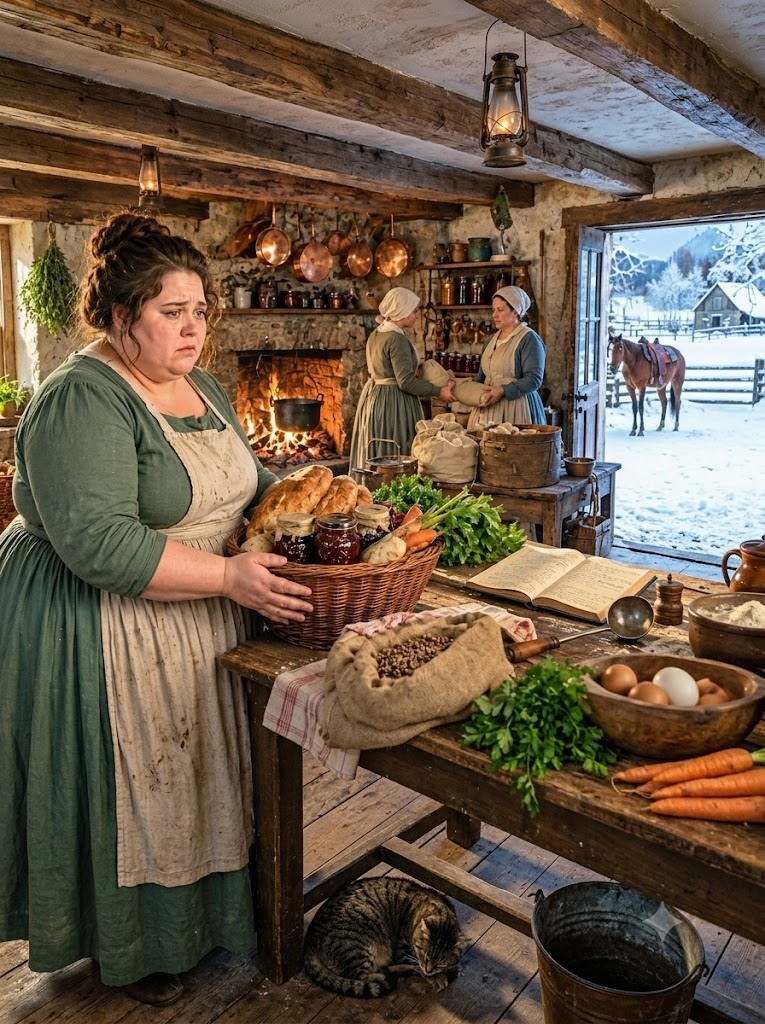
The first man who came looking for supper did not knock.
He simply appeared in the doorway, removed his hat, and stared at the pot simmering over Clara's stove.
"Smells better than anything we've had in weeks."
Clara looked up from the wooden table.
The man was in his fifties, with a weathered face, broad shoulders, and the unmistakable posture of someone accustomed to giving instructions.
"Are you hungry?"
He laughed.
"Ma'am, I've been hungry since Tuesday."
It was Thursday.
Clara put down her spoon.
"Then you'd better sit."
The man hesitated.
He glanced toward the main house, as though expecting someone to object.
Nobody did.
"My name's Luke Dawson. I'm the foreman."
"Clara Bennett."
"I know. Margaret told us the new cook would be working back here."
His eyes traveled around the kitchen.
The repaired shelves.
The clean stone floor.
The fire burning steadily inside the fireplace.
He looked genuinely surprised.
"Didn't recognize the place."
"It needed cleaning."
"That's one way to describe it."
Clara took a bowl from the shelf and filled it with stew.
Luke accepted it.
He sat at the nearest table and tasted the food.
For several seconds, he said nothing.
Then he took another spoonful.
"Good Lord."
Clara continued stirring the pot.
"Too much salt?"
"No."
"Not enough?"
Luke shook his head.
"Just right."
He ate quickly.
When he finished, he looked into the bowl as though hoping another serving might appear.
Clara filled it again.
He smiled.
"You're going to make trouble for the rest of us."
"How?"
"Now we'll expect decent food."
Clara laughed quietly.
It was the first time she had laughed since arriving at Red Hollow.
Luke finished his second bowl and stood.
"Thank you, ma'am."
"You're welcome."
He reached for his hat.
Then stopped.
"Would you mind if I told the others?"
"About supper?"
"About the food."
Clara glanced at the pot.
There was enough left for several more bowls.
"Bring whoever's hungry."
Luke nodded.
That evening, seven ranch hands came through the door.
They were cold, tired, and initially uncertain about eating in a kitchen that had been abandoned for years.
Clara served them without asking questions.
One man had a damaged hand.
Another walked with a slight limp.
A younger cowboy barely spoke.
They sat around the mismatched tables and ate.
Nobody complained.
Nobody asked whether the food had been prepared in the main house.
They simply ate.
When the last man finished, he placed his empty bowl beside the sink.
"Ma'am, I haven't tasted biscuits like those since my mother was alive."
Clara looked at him.
"What was her name?"
The young man seemed surprised.
"Elizabeth."
"Then she must have been a good cook."
He nodded.
"She was."
After they left, Clara washed the dishes.
She found herself thinking about the men.
They worked long hours in freezing weather.
They handled horses, repaired fences, moved cattle, and maintained the ranch.
Yet the meals they had been receiving were barely adequate.
The following evening, Clara made more stew.
She told herself it was because the previous night had gone well.
Sixteen men arrived.
By Friday, nearly every ranch hand had heard about the kitchen behind the barns.
Twenty-three men worked at Red Hollow.
Nearly all of them eventually appeared at Clara's door.
The kitchen became noisy.
Boots scraped across the wooden floor.
Men laughed.
Someone told a story about a horse that had managed to escape through a gate that had been left open.
Another insisted the animal had been planning its escape for months.
Clara listened while preparing food.
She learned their names.
Luke Dawson was fifty-five and had worked at Red Hollow for nearly twenty years.
Ben Carter was young, nervous, and secretly disliked onions.
Samuel Price was older than most of the men and always saved half a biscuit for the dog that slept beneath the porch.
There was also Thomas Reed, who could repair almost anything made of wood, and James Miller, who sang while washing dishes.
Clara remembered all of it.
Not because she intended to impress anyone.
Because she understood something simple.
People noticed when somebody remembered them.
On the fourth evening, Luke finished his second bowl and leaned back.
"Ma'am, men work differently when somebody remembers they're human."
Clara wiped her hands on a towel.
"Maybe they just work better on full stomachs."
"Maybe that's the same thing."
The conversation stayed with her long after the men had left.
She thought about her mother.
Her mother had never had much money.
But nobody who entered their house had ever left hungry.
Even when the cupboard was nearly empty, she found something to offer.
Clara had not realized how much of that lesson she had inherited until she found herself repeating it in Wyoming.
Margaret Hale noticed the change before anyone mentioned it to her directly.
She had expected Clara to complain about the cookhouse.
She had expected requests for better equipment, additional supplies, perhaps even an argument about the working conditions.
Instead, the new cook had become remarkably efficient.
The pantry was organized.
The stove worked.
The kitchen was clean.
And the ranch hands had begun spending their evenings behind the barns.
That last development irritated Margaret.
She had always believed the men should eat their meals quickly and return to their quarters.
There was work to be done.
Socializing was unnecessary.
One morning, she encountered Luke near the main house.
"Why are the men eating at the old cookhouse?"
Luke stopped.
"Because there's food there."
"They have food here."
"Not like that."
Margaret narrowed her eyes.
"What is that supposed to mean?"
Luke adjusted his hat.
"Nothing, ma'am."
She watched him walk away.
Her attention shifted toward the stone building.
A small thread of smoke rose from its chimney.
She could see Clara moving behind the window.
Margaret's expression hardened.
She had assigned the woman to that kitchen for a reason.
She had wanted Clara out of sight.
Now the entire ranch seemed to be gathering around her.
Ethan Walker heard about the kitchen from his cousin.
Warren mentioned it during breakfast.
"Your ranch hands seem to have found themselves a new favorite place."
Ethan continued reading a letter.
"Where?"
"The old cookhouse."
Ethan looked up.
"Why?"
"Apparently the new cook has been feeding them properly."
Ethan folded the letter.
"That's her job."
"Twenty-three men eating in an abandoned building wasn't exactly what I expected."
Ethan looked toward the window.
He could see the stone cookhouse beyond the barns.
For a moment, he remembered Rebecca.
She had always insisted that a ranch was more than fences, horses, and account books.
She believed the people working on the land mattered just as much as the land itself.
Ethan had stopped thinking about those things after she died.
He had stopped thinking about many things.
"Let them eat," he said.
Warren shrugged.
"Your decision."
But he did not look particularly pleased.
That evening, Ethan walked toward the barns.
He had not planned to enter the cookhouse.
He simply wanted to see what was happening.
The sound of conversation reached him before he reached the door.
Someone laughed.
A chair scraped.
Then he heard a woman's voice.
"Ben, there are carrots in that stew. You don't have to pick them out."
A young man protested.
"I don't like carrots."
"Your mother probably spent years trying to convince you to eat vegetables."
The men laughed.
Ben reluctantly took another spoonful.
Ethan stopped outside.
He had not heard laughter like that in the ranch buildings for a long time.
He stepped into the doorway.
The conversation gradually faded.
Luke noticed him first.
He straightened.
"Evening, Mr. Walker."
The other men turned.
Ethan nodded.
He recognized several faces.
Men he had employed for years.
Men whose names he knew but whose families and preferences he rarely remembered.
His eyes moved across the room.
The shelves were clean.
The table was repaired.
Copper pans hung neatly along the wall.
The fire provided enough warmth to make the place comfortable.
Clara stood near the stove.
She was wearing a dusty-blue dress and a charcoal apron.
Her dark auburn hair was arranged in a low braid.
She held a wooden spoon in one hand.
"My cousin says you're feeding half the ranch from here," Ethan said.
Clara looked at the men.
"They keep showing up."
"You could send them away."
Clara lifted another bowl.
"So could you."
A few cowboys suddenly became very interested in their plates.
Ethan stared at her.
Nobody spoke to him that way.
Not because he was cruel, but because he owned the ranch, signed the payroll, and made the decisions.
He had become accustomed to people waiting for his instructions.
Clara pushed a bowl toward an empty chair.
"Sit down before it gets cold."
Luke looked at Ethan.
Then at Clara.
The ranch owner hesitated.
For a moment, Clara thought he might leave.
Instead, he pulled out the chair.
He sat.
She served him stew.
Ethan took a spoonful.
The flavor surprised him.
It reminded him of something.
A meal eaten long ago at a different table.
Rebecca had once made a similar stew during a winter storm.
He remembered coming inside with snow on his coat.
She had been standing beside the stove, laughing because he had tracked mud across the floor.
He had not thought about that evening in months.
His spoon stopped halfway to his mouth.
Clara noticed.
She said nothing.
She understood that grief did not always announce itself.
Sometimes it appeared in the smallest movements.
A hand stopping.
A voice disappearing.
A person staring at something nobody else could see.
Ethan finished the bowl.
He did not ask for another.
But he stayed until the other men had nearly finished their meals.
Then he stood.
"Thank you."
Clara nodded.
"You're welcome."
He walked toward the door.
Before leaving, he looked back at the kitchen.
"Who repaired the shelves?"
"I did."
"And the stove?"
"Mostly."
He nodded.
"Everyone said this place was finished."
Clara wiped her hands on a towel.
"People say that when fixing something becomes less convenient than replacing it."
Ethan studied her.
For a moment, he seemed to want to ask something.
Instead, he left.
Later that night, Clara returned to her inventory.
The flour discrepancy still bothered her.
She had counted the sacks again.
Three.
The delivery sheet recorded four.
She checked the beans.
The numbers did not match perfectly.
Neither did the salt pork.
She found another delivery record in a drawer beneath the preparation table.
It listed supplies from a different week.
Again, the quantities were greater than what had arrived.
Clara placed the two documents side by side.
She began copying the figures.
She was careful.
She checked every date.
Every quantity.
Every price.
Her mother had once told her that mistakes became expensive when people refused to examine them.
Clara had no intention of making that mistake.
The next afternoon, Luke entered the kitchen while she was writing.
He glanced toward the window.
Then at the notebook.
"Still counting?"
"Still trying to understand."
Luke pulled out a chair.
He lowered his voice.
"Keep another copy somewhere else."
Clara stopped writing.
She looked at him.
"Why?"
Luke studied the doorway.
"I don't know."
"That isn't much of an answer."
"No."
He leaned closer.
"But people don't get nervous about numbers unless the numbers know something."
Clara slowly closed her notebook.
"Do you know something, Luke?"
He shook his head.
"Not enough to say."
"Then why warn me?"
Luke stood.
"Because I've worked here long enough to know when something feels wrong."
He reached for his hat.
"And because I don't want you getting blamed for something you didn't do."
Clara watched him leave.
His warning stayed with her.
That night, she made a second copy of the inventory.
She folded it and placed it inside her mother's recipe notebook.
The original remained in the kitchen drawer.
She did not know whether Luke's concern was justified.
But she was no longer willing to take chances.
Two nights later, Ethan returned.
This time, he came alone.
The men had finished supper and gone back to the bunkhouse.
Clara was cleaning the wooden table.
The fireplace was burning low.
An oil lamp illuminated the open ledger.
Ethan removed his gloves.
"What did you find?"
Clara turned.
She looked at him for several seconds.
Then she closed the ledger.
"Don't believe me?"
His expression hardened.
He stepped closer.
"That's not what I asked."
"No."
"Then answer the question."
Clara placed the cloth beside the sink.
"I found differences between the delivery records and the supplies actually received."
"How much?"
"Enough to make me check twice."
"How many deliveries?"
"Several."
Ethan glanced toward the ledger.
"Why didn't you tell Margaret?"
Clara paused.
"Would she have listened?"
The question irritated him.
"She's responsible for the household."
"And you're responsible for the ranch."
Ethan looked directly at her.
"Are you suggesting someone is stealing?"
"I'm suggesting the records are wrong."
"Those are different things."
"Exactly."
He seemed surprised by the answer.
Clara opened the ledger again.
She turned it toward him.
"Four sacks of flour were recorded here. Only three were in the pantry."
Ethan examined the entry.
"Could they have been moved?"
"Possibly."
"Used?"
"Not according to the kitchen records."
He looked up.
"Who else has seen this?"
Clara did not answer immediately.
"Luke knows I've been checking the numbers."
Ethan's jaw tightened.
"Anyone else?"
"Not that I know of."
He turned another page.
Then another.
His expression changed.
There were several entries with discrepancies.
Some were small.
Others were substantial.
Ethan reached the last page.
A name appeared beside a delivery authorization.
He stopped.
His fingers remained on the paper.
Clara watched his face.
She recognized the change immediately.
He knew the name.
And whatever he had expected to find in the ledger, it wasn't that.
Ethan slowly lifted his eyes.
"Where did you get this copy?"
"From the pantry drawer."
He stared at the page again.
Then he looked toward the kitchen door.
For the first time since entering the room, he appeared genuinely worried.
"Clara," he said quietly.
"There's something you need to understand about that signature."
Before he could continue, a shadow moved across the window.
Someone was standing outside.
Someone who had been listening.
Then the kitchen door handle began to turn.






Comments 0