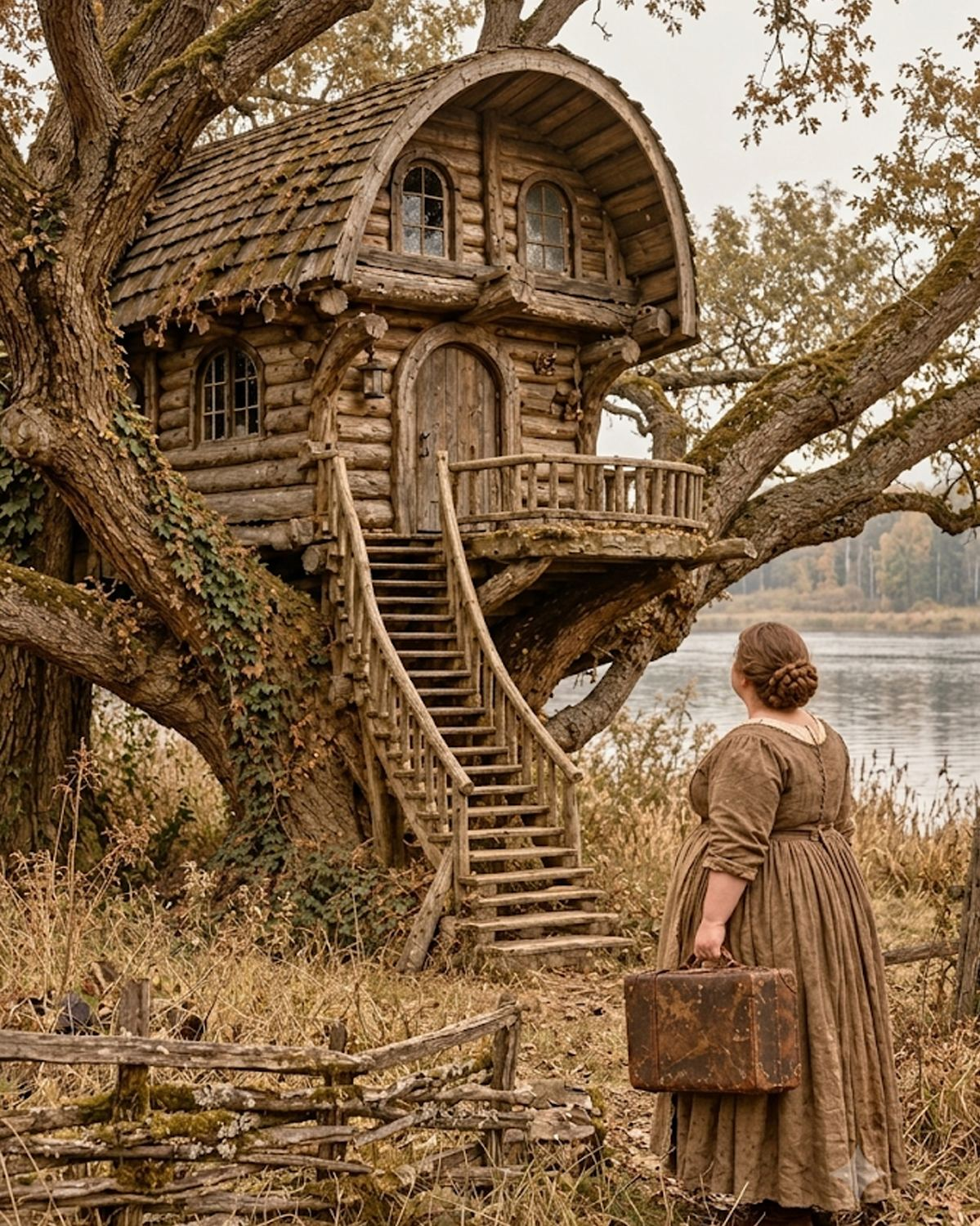
Adelaide Winslow grabbed her suitcase as it struck the dusty ground.
"Please, Mr. Ridgeman! You promised I could stay until Friday!"
Harold Ridgeman stood in the doorway, holding her remaining blanket.
He had just thrown away the only shelter she had.
"Plans change," he replied.
Adelaide looked at the blanket in his hands.
It was an old wool blanket her mother had given her years ago. One corner had been carefully repaired with blue thread. Adelaide had spent countless nights wrapped in it when she was a little girl.
"Could you at least give me that?"
Harold glanced at it.
Then he dropped it beside her suitcase.
"Take your things and leave."
She bent slowly to retrieve the blanket.
Her pregnant belly made the movement uncomfortable. She placed one hand against the wall for support and carefully lowered herself.
Seven months.
That was how far along she was.
Seven months of carrying a child whose father had disappeared before the baby had even begun to move.
Seven months of medical appointments she could barely afford.
Seven months of hearing people tell her that things would somehow work out.
But things had not worked out.
Not even close.
Six months earlier, her husband, Warren, had disappeared with nearly all their savings. He had left behind an empty bank account, a few unpaid bills, and a message that Adelaide had read so many times she could remember every word.
I'm sorry. I can't do this anymore.
He had not asked whether she was eating.
He had not asked whether she had somewhere to live.
He had not even asked whether their child was healthy.
At first, Adelaide had believed he would return.
Then she had stopped believing.
Now she was standing outside a guesthouse in Silver Pine, Colorado, with a suitcase containing almost everything she owned.
Harold Ridgeman folded his arms.
"I've already lost two paying guests because of you."
Adelaide looked up.
"I never disturbed anyone."
"People don't want to see someone in your condition wandering around the property."
"My condition?"
He gave her an impatient look.
"You know exactly what I mean."
She did.
He meant her pregnancy.
He meant her weight.
He meant the fact that she no longer looked like the kind of woman people wanted to see sitting in the lobby of his expensive little guesthouse.
For years, Adelaide had tried to make herself acceptable to everyone.
She had learned to apologize when other people hurt her.
She had learned to smile when strangers made comments about her appearance.
She had learned to make herself smaller whenever someone made her feel unwelcome.
Warren had been particularly good at teaching her those lessons.
He used to tell her that nobody else would put up with her.
He said it during arguments.
He said it when she cried.
Sometimes he said it while they were having dinner, as if he were commenting on the weather.
Eventually, she had believed him.
But standing in front of Harold, with her suitcase lying in the dirt and her unborn child moving gently beneath her dress, something inside her began to change.
She stopped apologizing.
She stopped asking him to reconsider.
"All right," she said quietly.
Harold appeared surprised.
"What's that?"
"I said all right."
She picked up the suitcase handle.
He watched her struggle with its weight.
For one brief moment, Adelaide thought he might offer to help.
Instead, he closed the door.
The sound echoed across the dusty property.
She stood there for several seconds.
Then she began walking.
Nobody followed her.
Nobody called her back.
Across the street, a woman standing outside the hardware store watched the entire scene.
"Poor Harold," the woman whispered to another customer. "He shouldn't have had to deal with all that."
Adelaide heard her.
She kept walking.
She had learned that some people could watch another human being suffer and still find a way to make themselves the victim.
The main street of Silver Pine was nearly empty.
A few cars passed the old pharmacy. A delivery truck backed into the grocery store. Somewhere behind the buildings, a dog barked.
Adelaide stopped beside a wooden bench.
Her feet hurt.
Her lower back ached.
The baby had been moving throughout the morning, and she was beginning to feel the strain of carrying the suitcase.
She set it down and rested both hands on its handle.
Then she reached into her coat pocket.
Seventeen cents.
A nickel, two dimes, and two pennies.
She counted them twice.
The amount did not change.
She could not afford another night at a guesthouse.
She could not afford a motel.
She could barely afford food.
For several minutes, she simply sat there.
Then she remembered the small cedar box.
It was tucked safely inside her suitcase, wrapped in a piece of faded cloth.
She took it out and placed it on her lap.
The box had belonged to her mother, Beatrice Winslow.
Beatrice had died several years earlier, leaving Adelaide with a small collection of photographs, a handful of handwritten recipes, and this unusual wooden keepsake.
Her mother had never explained why the box mattered.
She had only given Adelaide one instruction.
"Keep it somewhere safe. One day, you'll understand."
At the time, Adelaide had been twenty years old.
She had laughed gently and asked what she was supposed to understand.
Her mother had only smiled.
"Some things make sense when you finally need them."
That conversation had always bothered Adelaide.
Beatrice had been a quiet woman.
She rarely discussed her childhood.
Whenever Adelaide asked about her family, her mother would redirect the conversation toward something practical.
Dinner.
School.
The weather.
Anything else.
Adelaide knew Beatrice had grown up somewhere in the Colorado mountains, but she had never learned exactly where.
There were no family stories about grandparents or childhood friends.
No old photographs of the house where Beatrice had lived.
No letters from relatives.
It was as if her mother's early life had been carefully removed from the family history.
Adelaide opened the cedar box.
Inside lay a beautifully carved wooden aspen leaf.
Its edges were smooth from years of handling.
Seven delicate veins ran through its center.
The carving was remarkably detailed.
She had always thought it was beautiful, but she had never understood its significance.
She turned it over.
The back contained a short inscription.
Six words.
WHERE THE MOUNTAIN KEEPS ITS PROMISES.
She traced the letters with her thumb.
For years, she had wondered what her mother meant.
Now, sitting alone on a wooden bench with nowhere to sleep, she found herself looking toward the distant mountains.
Perhaps it was a place.
Perhaps it was a family saying.
Perhaps it was simply something Beatrice had once heard as a child.
But Adelaide had nothing else to follow.
And she had to find somewhere safe before nightfall.
She carefully returned the wooden leaf to the cedar box.
Then she packed it inside her suitcase.
A small gust of wind moved through the street.
Adelaide pulled her coat closer.
She stood slowly, supporting her back with one hand.
At the grocery store, she considered asking whether they needed someone to clean shelves or wash dishes.
But she knew she could not work long hours in her condition.
She also knew that most employers would hesitate to hire someone who might give birth in the coming weeks.
She had tried before.
Three applications.
Three rejections.
One manager had even suggested she return after the baby was born.
As if rent and groceries could wait.
She continued toward the edge of town.
The road gradually narrowed.
The buildings became fewer.
Wooden fences gave way to open fields and patches of pine forest.
The distant mountains rose beyond the trees.
Adelaide stopped at an old roadside diner.
Through the window, she could see families eating lunch.
A little boy was sitting beside his father, laughing as he tried to balance a spoon on his nose.
Adelaide watched them for a moment.
Her hand moved instinctively to her stomach.
The baby kicked.
She smiled faintly, though sadness remained in her eyes.
"I know," she whispered. "We'll find somewhere."
She did not know whether she was speaking to the baby or herself.
Then she noticed a narrow wagon trail leading away from the road.
It passed between two old wooden fences and disappeared into a stand of trees.
A weathered sign stood beside it.
The lettering had almost completely faded.
Adelaide walked closer.
She could barely make out the words.
SILVER PINE HISTORICAL TRAIL.
Someone had attached a small metal plate beneath the sign.
It contained a faded map of the surrounding mountain region.
Most of the markings were illegible.
She studied it for a moment.
A small creek appeared near the northern edge.
There were also several old property boundaries.
But nothing about a treehouse.
She sighed and stepped away.
The sun was beginning to sink behind the mountains.
She needed to make a decision.
Returning to the town would mean facing more closed doors.
Continuing along the main road would leave her exposed to the cold.
The wagon trail at least offered some shelter from the wind.
She picked up her suitcase and followed it.
The first few minutes were easy.
The ground was relatively flat.
Dry leaves covered the path, and tall grass grew along its edges.
But the trail soon began to rise.
Adelaide stopped frequently.
Her breathing grew heavier.
She shifted the suitcase from one hand to the other.
At one point, she had to sit on a fallen tree trunk because her lower back was hurting.
She drank a little water from her bottle.
Then she continued.
She had not walked this far since before her pregnancy.
But turning back was no longer an option.
The trail curved around a small hill.
On the other side, Adelaide discovered an old wooden fence.
Its posts were covered in moss.
Several sections had collapsed.
Beyond it stood a small abandoned shed.
The roof had partially fallen in.
Adelaide looked inside through a broken window.
There was nothing useful.
No blankets.
No food.
No dry firewood.
She continued.
The afternoon became increasingly quiet.
The sounds of town disappeared behind her.
Birds moved among the branches.
Leaves rustled overhead.
The air smelled of damp earth and pine needles.
She was beginning to feel frightened.
Not because she believed something was following her.
But because she was realizing how far she had traveled without seeing another person.
She checked her phone.
No signal.
The battery was nearly empty.
She put it away.
A few minutes later, thunder rolled across the mountains.
Adelaide looked toward the sky.
Dark clouds were gathering above the peaks.
She quickened her pace as much as her body allowed.
Then she saw something beside the trail.
An old wooden marker.
It leaned slightly to one side, surrounded by dry grass.
Most of its carvings had disappeared beneath years of weathering.
But one symbol remained visible.
Adelaide stopped.
She placed her suitcase on the ground.
Then she moved closer.
Carved into the center of the marker was an aspen leaf.
Seven delicate veins.
Her heart began pounding.
She reached into her coat and took out the cedar box.
Opening it, she removed the wooden leaf.
She held it beside the carving.
The two symbols were identical.
Not similar.
Identical.
Even the tiny curved line near the bottom of the leaf matched.
Adelaide looked from the wooden keepsake to the marker.
Then she turned it over.
There was a small arrow pointing toward the left-hand trail.
Below it, nearly hidden beneath the moss, were three words.
FOLLOW THE ROOTS.
She stared at them.
Her mother's inscription returned to her mind.
Where the mountain keeps its promises.
She looked down the left-hand trail.
It disappeared into a thick cluster of trees.
The storm rumbled again.
A cold breeze moved through the grass.
Adelaide placed the wooden leaf back inside the box.
She had no proof that the trail would lead anywhere.
She had no idea who had carved the marker.
And she certainly had no explanation for why her mother had kept the same symbol for so many years.
But for the first time that day, she felt something stronger than desperation.
Hope.
She lifted her suitcase.
Then she followed the arrow.
The trail became narrower.
Massive roots pushed through the soil, twisting across the ground like old wooden ropes.
She had to watch every step.
Several times, she nearly lost her balance.
The suitcase caught on branches.
Her coat brushed against thorny shrubs.
But she kept moving.
Then, through the trees, she heard something.
Water.
A mountain creek.
The sound grew louder as she approached.
She stepped around a large boulder and stopped.
Beyond the trees, something enormous rose above the forest floor.
At first, she thought it was another section of the mountain.
Then she realized it was a tree.
A gigantic cottonwood.
Its trunk was wider than three men standing shoulder to shoulder.
Massive branches extended over the creek, creating a natural canopy.
And high among those branches—
Adelaide saw a roof.
She blinked.
Then she looked again.
It was a house.
A real wooden house built inside the enormous tree.
She stood completely still.
The structure had a curved roof, small arched windows, and a balcony overlooking the water.
A long staircase wound around the trunk.
Its wooden railings looked old, but the steps appeared surprisingly well maintained.
There was even a small entrance porch.
Adelaide slowly lowered her suitcase.
She could hardly believe what she was seeing.
A place like this should not have existed.
Not here.
Not in the middle of the mountains.
Not so close to the trail.
She looked around.
The surrounding grass was overgrown, but the staircase was unusually clear of fallen leaves.
Someone had swept it recently.
Or at least someone had made sure it remained accessible.
Adelaide took one cautious step forward.
Then another.
The treehouse stood silent above her.
A single window reflected the darkening sky.
She moved closer to the trunk.
Beside the staircase, an old wooden birdhouse hung from a small branch.
It looked handmade.
Its roof had been carefully shaped, and its sides were decorated with tiny carved leaves.
Adelaide noticed something on the front.
Two letters.
A.W.
She froze.
Her initials.
Adelaide Winslow.
She stared at them for several seconds.
Then she reached out.
The carving was old.
The edges had darkened with age.
It was not something that had been written yesterday.
Someone had placed those letters there years ago.
Long before she had arrived.
She slowly lifted her hand toward the little birdhouse.
The roof moved slightly.
Something metallic glinted inside.
Adelaide leaned closer.
A brass key lay on a bed of dry moss.
She did not pick it up immediately.
Instead, she looked toward the treehouse door.
Then back at the key.
Her heart was beating so loudly she could hear it.
She reached into the birdhouse.
The key was cold against her fingertips.
And beneath it, hidden in the moss, was a folded piece of yellowed paper.
Adelaide carefully removed both.
She unfolded the paper.
There was only one sentence.
THE HOUSE HAS BEEN KEPT READY.
Her hands began to tremble.
She turned the paper over.
Nothing.
She looked up at the treehouse again.
The storm was approaching.
The creek continued flowing beneath the enormous branches.
And somewhere inside that wooden house was an answer to a question her mother had never been willing to explain.
Adelaide closed her fingers around the brass key.
Then she placed one foot on the first wooden step.
The staircase creaked.
She looked upward.
At the very top, the treehouse door stood slightly open.
And through the narrow gap, she could see a warm glow.
Someone—or something—had left the light on.






Comments 0