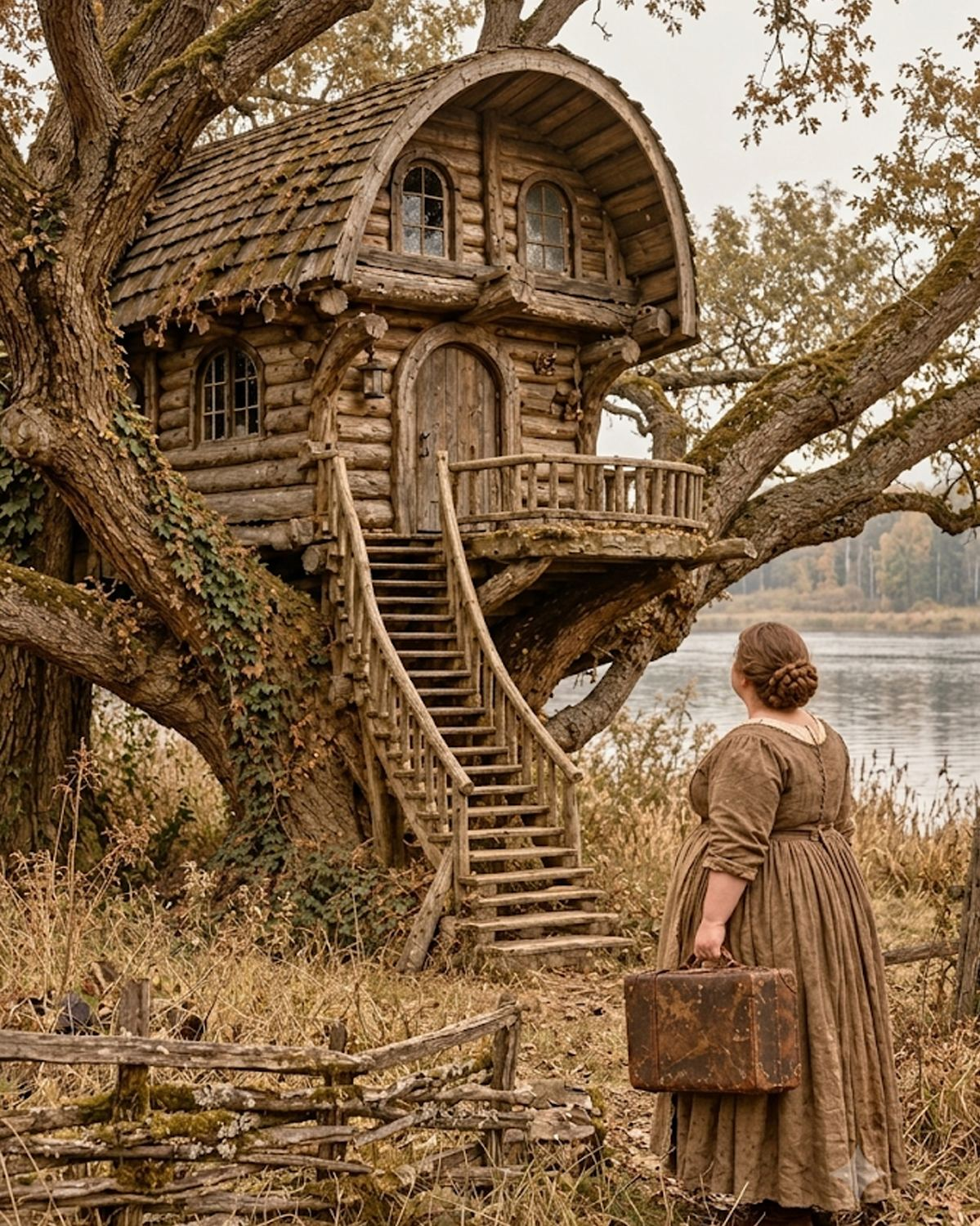
"Adelaide."
The voice came from beneath the staircase.
She stumbled backward, nearly dropping the lantern.
For several seconds, she couldn't move.
Someone had spoken her name.
Not a sound resembling it.
Not a voice she had mistaken for the wind.
Someone had clearly said, "Adelaide."
She stared into the darkness beneath the open floor.
"Who's there?"
Silence.
She raised the lantern higher.
The narrow staircase descended toward the iron-reinforced door. Its surface was covered with scratches and dark stains, but the wood around the frame appeared remarkably well preserved.
Adelaide swallowed.
"Is someone down there?"
Three seconds passed.
Then came another sound.
A slow metallic click.
She stepped backward.
Her heart was racing.
She had entered the treehouse expecting an empty shelter. Instead, she had found her mother's handwriting, an old photograph, a hidden staircase, and a voice that knew her name.
She suddenly remembered the sentence on the paper hidden inside the birdhouse.
The house has been kept ready.
Who had written it?
And why?
Adelaide looked toward the entrance.
She could leave.
The thought was tempting.
She could return to the main trail, find another place to hide from the storm, and pretend she had never discovered the staircase.
But where would she go?
There was nowhere.
She had seventeen cents.
Her phone had almost no battery.
And the baby she carried needed warmth, food, and safety.
She looked down at her stomach.
The baby moved gently.
Adelaide placed her hand against it.
"It's all right," she whispered. "I'm not going anywhere."
She took a careful breath.
Then she approached the staircase again.
"Who are you?" she called.
This time, the answer came immediately.
"You're not supposed to be here."
Adelaide froze.
The voice sounded male.
Older.
Quiet, but firm.
She gripped the lantern.
"Who said that?"
No answer.
She leaned closer to the opening.
"Please. I don't want any trouble. I only needed somewhere to stay until the storm passes."
Something moved beneath the floor.
A faint scraping sound traveled up the staircase.
Then the voice spoke again.
"Did you bring the leaf?"
Adelaide's blood ran cold.
She looked toward the cedar box resting on the table.
The wooden aspen leaf.
How could someone beneath the floor know about it?
"Who are you?" she repeated.
"Did you bring it?"
Adelaide slowly reached for the box.
She did not answer immediately.
Instead, she looked at the inscription carved into the trapdoor.
Adelaide, if you are here, forgive me.
Her mother's handwriting.
She remembered Beatrice sitting beside the fireplace years ago, holding the same little wooden box.
She remembered asking why her mother kept it locked.
Beatrice had smiled and said it contained something precious.
Adelaide had never thought to question her further.
Now she wished she had.
She opened the cedar box.
The carved leaf rested inside.
She lifted it carefully.
"Is this what you mean?"
A long silence followed.
Then the man beneath the floor said something that made her knees weaken.
"That belonged to Beatrice."
Adelaide stared into the opening.
"How do you know my mother?"
No answer.
She moved closer.
"Please. I need you to tell me."
A soft metallic noise followed.
Then a small section of the iron door moved.
Not enough to open.
Just enough for Adelaide to see a narrow line of darkness between the door and its frame.
Someone was standing behind it.
She could feel it.
She lowered the lantern.
"Are you trapped?"
The man did not answer.
Instead, he asked another question.
"How old are you?"
"Thirty-four."
"Did Beatrice raise you?"
"Yes."
"Did she ever tell you about this house?"
Adelaide shook her head before remembering that he probably couldn't see her.
"No. She never told me anything about it."
There was a pause.
Then the voice became quieter.
"She kept her promise."
Adelaide's fingers tightened around the wooden leaf.
"What promise?"
Before he could answer, a loud crack came from somewhere above.
The entire treehouse shuddered.
Adelaide turned.
A heavy branch had struck the outer roof.
Rainwater poured through the gutters.
She heard another crack.
This time, the sound came from the staircase outside.
The storm was getting worse.
She looked toward the open trapdoor.
"I need to close this before the rain gets inside."
"Don't."
The command was immediate.
Adelaide stopped.
"Why?"
"Because the house is not finished with you."
She stared into the darkness.
Then the voice disappeared.
No more knocking.
No more movement.
Nothing.
Adelaide waited nearly a minute.
Finally, she placed the lantern beside the opening and slowly lowered the trapdoor.
She did not lock it.
She wasn't sure she wanted to.
But she needed to think.
She returned to the table and sat down.
The photograph of Beatrice and the unknown man lay beside the journal.
She picked it up again.
Her mother looked happy in the picture.
Not the polite, carefully controlled happiness Adelaide remembered from family photographs.
This was different.
Beatrice was laughing.
Her head was slightly tilted toward the man standing beside her.
One of his hands rested against the enormous cottonwood trunk.
Adelaide studied his face.
There was something familiar about him.
Not his appearance.
His expression.
He looked at Beatrice as if she were the most important person in the world.
Adelaide had never seen anyone look at her mother that way.
She turned the photograph over.
Thirty-one years.
That meant Beatrice had been approximately twenty-three when the photograph was taken.
Adelaide wondered whether the man had been her mother's friend.
A relative.
Perhaps someone who had loved her.
She examined the picture again.
Near the bottom edge, partly hidden by the man's sleeve, was a small wooden sign.
She tilted the photograph toward the lantern.
The lettering was faint.
But she could make out two words.
Whitlock Property.
Adelaide returned to the journal.
Ephraim Whitlock.
The name she had discovered earlier.
Was he the man in the photograph?
She placed the two objects side by side.
The resemblance seemed possible.
She searched the remaining pages.
One contained a short entry.
Ephraim says the house should never be sold. He says a home is not valuable because of what it costs, but because of who it protects.
Adelaide read the sentence again.
Then she looked toward the rocking chair.
The clean blanket.
The firewood.
The food.
Everything in the house seemed connected to the same idea.
Protection.
She turned another page.
The handwriting became smaller.
I told him that one day I might have a daughter. He laughed and said that if she ever needed somewhere safe, the house would be hers.
Adelaide's mouth fell open.
She read it again.
Then a third time.
Her mother had written about having a daughter.
She had written about this exact house.
And she had somehow known that the treehouse would matter someday.
Adelaide pressed the journal against her chest.
She felt suddenly overwhelmed.
Her mother had died without explaining any of this.
Why had she kept the secret?
Had she wanted Adelaide to find the house?
Or had she hoped her daughter would never need it?
A sharp pain in her lower back interrupted her thoughts.
She placed the journal on the table and shifted carefully in her chair.
Her pregnancy was making the long journey increasingly difficult.
She needed to rest.
She needed proper food.
And if the storm continued, she might have to stay here for several days.
She decided to make the treehouse livable before attempting to understand its mysteries.
First, she checked the windows.
The wooden shutters were sturdy, though one had come loose.
She found a small tool kit beneath the table and used a screwdriver to tighten the hinges.
Next, she checked the stove.
There was enough dry wood to keep a fire burning through the night.
She lit it carefully.
The flames caught after a few attempts.
Warmth gradually spread through the room.
She heated a little water and made herself a simple meal from the supplies in the cupboard.
While eating, she noticed something unusual about the dishes.
Each plate had a tiny aspen leaf carved into its edge.
Seven veins.
The same design appeared on the wooden spoons.
The ceramic bowls.
Even the handles of the cupboards.
It was not a random decoration.
The entire house had been built around the symbol.
Adelaide finished her meal and washed the dishes.
Then she opened the cupboards again.
Behind several jars of dried apples, she found a small wooden drawer.
Inside were old envelopes.
Most had yellowed with age.
Some were tied together with faded ribbon.
She removed the top envelope.
It had no stamp.
No address.
Only one name written across the front.
Beatrice.
Adelaide sat down immediately.
She carefully opened it.
Inside was a single sheet of paper.
The handwriting was unfamiliar.
The message read:
Beatrice,
I have finished the eastern staircase. The roof is holding, and the windows have been repaired. The room overlooking the creek is ready.
You said you would return when the time was right.
I hope you do.
Ephraim.
Adelaide stared at the signature.
Ephraim Whitlock.
The man from the photograph.
The man mentioned in her mother's journal.
She looked at the date.
It was thirty years old.
Her mother had received this letter before Adelaide was born.
She had never mentioned it.
Adelaide placed the letter on the table.
Then she opened another envelope.
This one contained a small pressed flower.
An aspen leaf.
Seven veins.
Beneath it was another message.
If you cannot return for yourself, return for the family we once dreamed about.
Adelaide felt her eyes sting.
She blinked rapidly.
She had spent so much of her adult life believing she knew everything important about her mother.
Beatrice had been a quiet, practical woman who worked hard, paid her bills, and rarely discussed her past.
But the woman in these letters was different.
She had dreams.
She had secrets.
She had apparently shared a life with someone named Ephraim.
And there was a house in the mountains that had been prepared for a future family.
Adelaide looked at the photograph again.
She wondered whether Beatrice had ever loved Ephraim.
She wondered whether he had been the father she had never known.
The thought frightened her.
Her mother had never discussed Adelaide's biological father in detail.
She had always said that the past was complicated.
Whenever Adelaide asked for more, Beatrice would change the subject.
Warren had once suggested that Adelaide's mother had been hiding something shameful.
Adelaide had defended Beatrice immediately.
Now, for the first time, she wondered whether Warren had accidentally noticed something real.
She hated the thought.
She placed the letters together.
There were more envelopes in the drawer.
At least twelve.
She decided not to open all of them that evening.
Her eyes were tired.
Her back hurt.
The baby was moving again.
She needed sleep.
She folded the blanket from the rocking chair and made a small bed near the stove.
Before lying down, she checked the entrance door.
It was locked.
Then she returned to the hidden trapdoor.
She stared at the iron ring.
The man beneath it had not spoken again.
Adelaide considered opening it.
But she was frightened of what she might find.
If someone really was down there, why had they not come upstairs?
And if the voice had been a recording or some kind of mechanical device, who had arranged it?
She lowered the lantern.
"Good night," she whispered toward the floor.
No answer.
She closed the trapdoor completely.
Then she returned to her blanket.
The storm continued throughout the night.
Rain struck the curved roof.
Wind moved through the branches.
Occasionally, the old treehouse creaked.
But the structure remained firm.
For the first time in weeks, Adelaide slept without worrying that someone would tell her to leave.
She woke just before sunrise.
The storm had passed.
Soft gray light entered through the arched windows.
The creek looked calmer.
The mountains were covered in mist.
She sat up slowly and rubbed her eyes.
Her first thought was the baby.
She placed her hand against her stomach.
A gentle movement answered her.
"Morning," she whispered.
Then she remembered the hidden staircase.
She looked toward the trapdoor.
It remained closed.
The iron ring sat exactly where she had left it.
She stood and walked toward the table.
The letters were still there.
So was the photograph.
But something was different.
The cedar box was open.
Adelaide stopped.
She was certain she had closed it before going to sleep.
She approached slowly.
The wooden aspen leaf was missing.
She searched the table.
Nothing.
She checked the floor.
Nothing.
Then she noticed a thin line of dust leading from the table toward the trapdoor.
Her stomach tightened.
She knelt.
The iron ring was no longer lying flat.
It had been lifted slightly.
Someone had opened the compartment.
Adelaide stepped backward.
"Hello?"
Silence.
She reached for the lantern.
Then she heard a faint scraping sound from below.
A metal object sliding across wood.
She moved closer.
The trapdoor lifted a fraction.
Adelaide froze.
A small folded piece of paper appeared through the opening.
It slid onto the floor.
Then the trapdoor settled again.
She stared at the paper.
For several seconds, she did not move.
Finally, she bent down and picked it up.
There was a name written on the outside.
Not her mother's.
Not Ephraim's.
A name she had never seen before.
ELEANOR WHITLOCK.
Adelaide unfolded the paper.
Inside was a short message.
Beatrice never told you who your father was.
Her fingers went numb.
She read the sentence again.
Then she turned the paper over.
There was one additional line.
Before you open the seven compartments, you must know what happened to Eleanor.
Adelaide stared at the words.
She had no idea who Eleanor Whitlock was.
But someone beneath the floor had just revealed that her mother had hidden the truth about her father.
And before Adelaide could take another breath, three heavy knocks sounded from beneath the trapdoor.
This time, a voice spoke clearly.
"Adelaide, you need to open the door. It's about your mother."
Then the iron handle began turning from the inside.






Comments 0