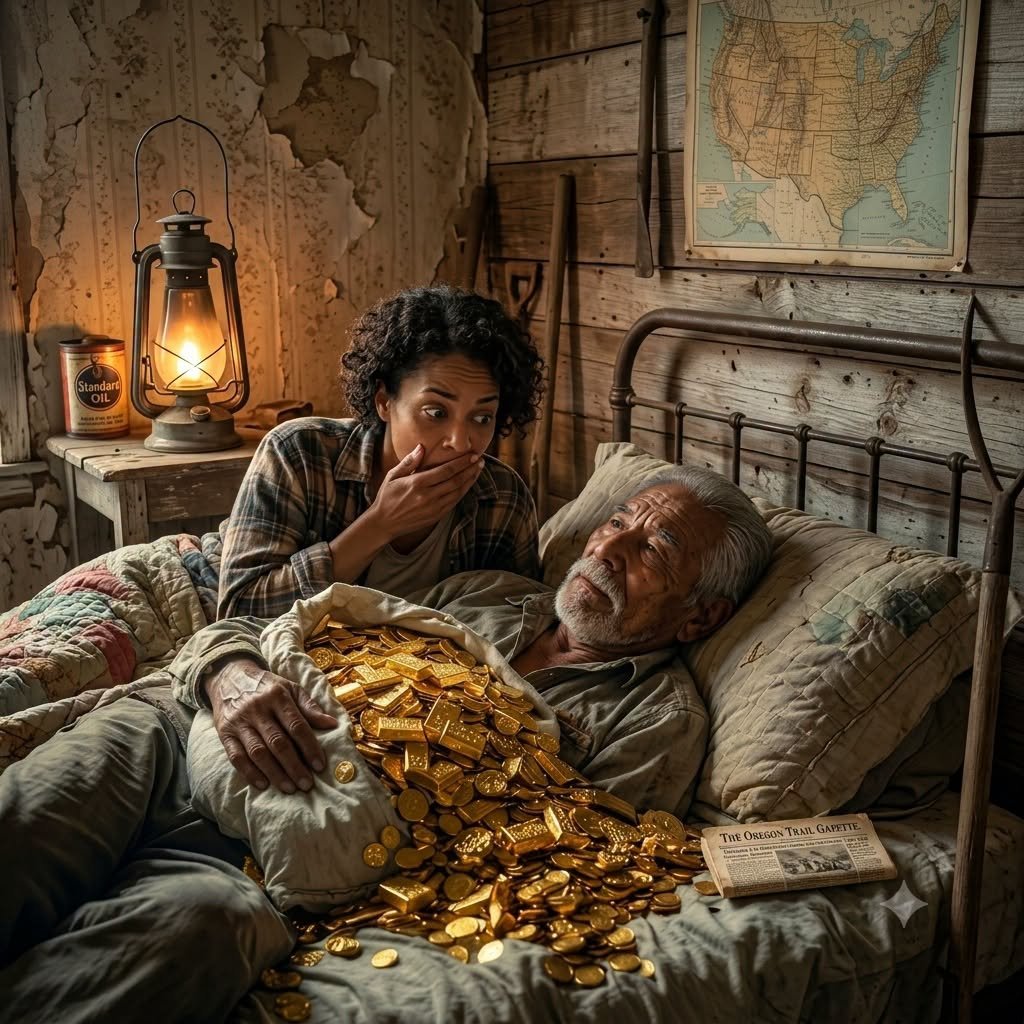
"Lucía... don't let them take it."
Ernesto Molina pushed a torn pillow into my hands and struggled to breathe.
Three days later, his eldest son, Rafael, arrived with a lawyer and a property deed.
There was a small red number stamped on the back of the document.
It matched a number stitched inside Ernesto's pillow.
Rafael had come for the wrong inheritance.
I didn't understand any of that when Ernesto first gave me the pillow.
At that moment, all I understood was that the man I had spent twelve years caring for was dying, and there was nothing I could do to stop it.
"Papa Ernesto," I whispered, leaning closer. "You don't have to talk. Just rest."
He shook his head.
It was barely a movement.
His silver hair lay against the pillowcase, and his thin fingers trembled as he tried to hold my wrist.
"Promise me."
I swallowed.
"Anything."
His eyes searched mine.
For a moment, he looked almost frightened.
Not of dying.
Of something else.
"Don't let them throw it away."
I looked down at the small cushion in my lap.
The fabric had once been cream-colored. Years of use had turned it grayish yellow. Several seams had been repaired with different shades of thread, and one corner had a dark stain I remembered trying to wash out years earlier.
It was ugly.
It was old.
And it was the last thing Ernesto wanted me to have.
"I promise," I said.
His fingers relaxed.
Then he whispered something I would spend the following weeks trying to understand.
"You were the only one who stayed."
I felt my throat tighten.
"Of course I stayed."
He looked at me for a long time.
Then his eyes filled with tears.
I had seen Ernesto cry only twice in twelve years.
The first time was when his wife died.
The second was when he realized he could no longer walk to the bathroom without help.
This was the third.
"Forgive me," he whispered.
I shook my head.
"For what?"
His lips moved.
I leaned closer.
But the words never came.
His chest rose once.
Then again.
Then it stopped.
"Ernesto?"
I waited.
"Papa Ernesto?"
I placed my hand against his chest.
Nothing.
I touched his cheek.
His skin was still warm.
"Please," I whispered.
I don't remember how long I sat there.
I only remember the silence.
For twelve years, my life had been organized around the sounds Ernesto made.
The scrape of his slippers against the floor.
The rattle of his spoon against a bowl.
His coughing at two in the morning.
His voice calling my name when he couldn't remember where he was.
Even when he slept, I listened for his breathing.
And suddenly, there was nothing left to listen for.
I held the cushion against my chest and cried.
Not loudly.
Not dramatically.
I simply cried until my face hurt.
The man who had once told me that tears were a waste of good water was gone.
And I had no idea how to live in a house where he would never call my name again.
My name is Lucía Molina.
I was forty-one years old when my father-in-law died.
By then, I had spent almost a third of my life caring for him.
I married his youngest son, Daniel, when I was twenty-four.
Daniel was different from his siblings.
At least, I believed he was.
He was gentle, funny, and full of plans.
We were going to buy a little house.
We were going to travel.
We were going to have children.
But life has a way of changing plans without asking permission.
When Ernesto's wife, Isabel, died, everything began to fall apart.
Ernesto stopped eating properly.
He forgot to pay bills.
He would sit at the kitchen table for hours, staring at the empty chair across from him.
Daniel and I started visiting every weekend.
Then every other day.
Then every day.
Eventually, we moved into Ernesto's farmhouse because leaving him alone no longer felt safe.
At first, Daniel helped.
He took his father to appointments.
He repaired the porch.
He bought groceries.
But after three years, Daniel received a job offer in another state.
He said it would only be temporary.
Six months.
Maybe a year.
He promised to come home whenever he could.
I believed him.
For a while, he called every evening.
Then twice a week.
Then on Sundays.
Eventually, our conversations became arguments about money, exhaustion, and the life we were no longer living together.
One night, Daniel said something I never forgot.
"Lucía, my father has four children. Why are you the only person acting like he matters?"
I had no answer.
Because I wondered the same thing.
Daniel sent money when he could, but his visits became rare. We remained married on paper for years after we stopped living like husband and wife.
His three older siblings were worse.
Rafael, the eldest, owned a successful construction company.
He wore expensive watches and drove cars that cost more than Ernesto's entire farmhouse.
He visited twice in twelve years.
Both times, he complained about the condition of the property.
His sister, Teresa, worked in real estate.
She called on birthdays.
Sometimes.
Their brother, Miguel, lived several hours away.
He always had an excuse.
A business trip.
A sick child.
A broken car.
A difficult week.
There was always something more urgent than his father.
And then there was Daniel.
The son I had married.
The son who once promised he would never become like his siblings.
He did not disappear completely.
But he was absent when Ernesto needed him most.
I tried not to resent them.
For years, I told myself that people handled responsibility differently.
That everyone had struggles I couldn't see.
That perhaps they loved Ernesto in ways I didn't understand.
But love that never showed up was difficult to recognize.
Especially at three in the morning when Ernesto was feverish and I was trying to lift him from the bed without hurting either of us.
Especially when I had to choose between buying his medication and repairing my car.
Especially when I missed holidays, birthdays, and family gatherings because there was nobody willing to stay with him.
People often called me a good woman.
I never knew what to say to that.
I wasn't trying to be good.
I was trying to make sure an old man didn't die feeling abandoned.
There were days I wanted to leave.
I won't pretend otherwise.
There were mornings when my back hurt so badly that getting out of bed felt impossible.
There were afternoons when Ernesto became confused and accused me of hiding things he had misplaced himself.
Once, during a particularly difficult winter, he refused to eat for two days.
I sat beside him with a bowl of soup and cried from exhaustion.
"Please, Papa Ernesto. Just three spoonfuls."
He looked at me.
Then he looked at the soup.
And quietly, he opened his mouth.
Three spoonfuls.
That was all.
But that night, I felt as though we had won a battle.
Small victories became the measure of our lives.
A good night's sleep.
A day without pain.
A morning when he remembered my name.
A moment when he laughed at one of my terrible jokes.
Those things mattered.
And somehow, they became enough.
The morning Ernesto died, I called Daniel first.
He answered on the fifth ring.
"Lucía?"
His voice sounded sleepy.
"Your father is gone."
There was silence.
Then I heard him sit up.
"What?"
"He passed away a few minutes ago."
Another silence.
"I'm sorry."
I closed my eyes.
I had imagined this conversation many times.
I thought Daniel would cry.
I thought he would ask whether his father had suffered.
I thought he might finally understand what those twelve years had cost.
Instead, he asked, "Did you call Rafael?"
I looked at Ernesto's still face.
"No."
"You should. He's the oldest."
"I know."
"And Teresa. Miguel too."
"I'll call them."
Daniel exhaled.
"I'll see what flights are available."
I almost laughed.
Not because anything was funny.
Because even now, he was discussing his father as though Ernesto were an appointment he needed to fit into his schedule.
"Daniel?"
"Yeah?"
"He asked for you last week."
The silence that followed was different.
He had called Daniel three times.
Each time, Daniel had said he was busy.
"He did?"
"Yes."
"What did he want?"
I looked at the cushion in my lap.
"I don't know."
That was not entirely true.
Ernesto had wanted to hear his son's voice.
Sometimes, that was all a parent wanted.
But I didn't have the strength to explain it.
After the call, I contacted the nurse who had been helping us during Ernesto's final months.
Then I called the funeral home.
Then Rafael.
Rafael answered immediately.
"Lucía. What's wrong?"
"Your father passed away this morning."
"Oh."
Just that.
Oh.
Then he asked, "Was it peaceful?"
"Yes."
"Good. That's good."
I heard traffic behind him.
He was driving.
"Listen, I'll come down as soon as I can. We need to discuss arrangements."
"Of course."
"And Lucía?"
"Yes?"
"Don't start going through Dad's things."
I frowned.
"What?"
"His papers. His personal belongings. Just leave everything where it is until we're all there."
I stared at the wall.
"Rafael, your father has been dead for less than an hour."
"I understand. I'm just saying we should handle things properly."
I said nothing.
He continued.
"There's the house, the land, whatever accounts he had. We don't want misunderstandings."
Misunderstandings.
That was the word he chose.
Not grief.
Not loss.
Not regret.
Misunderstandings.
"His things will be here," I said.
"Good."
Then he hung up.
I sat beside Ernesto for another hour.
I washed his face gently.
I straightened his collar.
I combed his silver hair the way he liked it.
And before the funeral home arrived, I placed the old cushion inside my bedroom closet.
Not because I thought it was valuable.
Because it was mine.
He had given it to me.
And I wasn't going to let anyone throw away the last thing he had touched.
By afternoon, the farmhouse was full of strangers.
The nurse.
The funeral director.
A neighbor who brought food.
Another neighbor who hugged me and cried.
Everyone spoke softly.
Everyone said Ernesto had been fortunate to have me.
I nodded because I didn't know what else to do.
By evening, the house was quiet again.
I stood in his bedroom doorway.
His bed was empty.
His slippers remained beside the nightstand.
A half-finished glass of water sat where I had left it.
I wanted to clean everything.
I wanted to leave everything untouched.
Instead, I went to my room and took out the cushion.
I sat on the edge of my bed.
For the first time, I examined it carefully.
There were four repaired seams.
Three had been sewn with ordinary white thread.
The fourth used dark blue thread.
I recognized the stitching.
Ernesto had done it himself.
Years earlier, before his hands became too weak, he had insisted on repairing the cushion.
I remembered offering to buy him a new one.
He had refused.
"Some things are worth keeping," he'd said.
At the time, I thought he was being sentimental.
Now I wondered why he had been so protective of something so ordinary.
I turned it over.
The cushion was heavier than I remembered.
Not dramatically.
But enough to notice.
I pressed one corner.
Something hard pushed against my fingers.
I frowned.
"Papa Ernesto, what did you put in here?"
The question sounded strange in the empty room.
I almost expected him to answer.
I found a loose thread.
Pulled gently.
A section of stitching came apart.
Inside, I saw old cotton.
Then something brown.
Paper.
I reached in and pulled out a yellowed envelope.
My name was written across the front.
LUCÍA.
I stopped.
Ernesto's handwriting was unmistakable.
The same careful letters he had used to label jars in the kitchen.
The same slightly crooked L.
The same heavy pressure on the final stroke.
My hands began trembling.
I placed the envelope on the bed.
Then I reached inside the cushion again.
My fingers touched something cold.
Metal.
I pulled it out.
A gold coin.
At least, it looked like gold.
It was heavy and worn, with markings I didn't recognize.
I stared at it.
Then I opened the seam wider.
Another coin slipped out.
Then another.
A small rectangular bar followed.
It landed on the quilt with a dull metallic sound.
I froze.
For a moment, I couldn't understand what I was seeing.
Gold.
There was gold inside Ernesto's old cushion.
Not one piece.
Not two.
Dozens.
Coins.
Small bars.
Several tightly wrapped packages.
And beneath them, more papers.
I stared at the growing pile.
My heart hammered against my ribs.
Ernesto had worn the same three shirts for years.
He had refused new shoes.
He had complained whenever I spent too much on groceries.
I had believed he was poor.
Everyone had believed he was poor.
But now I was sitting on my bed with what appeared to be a small fortune spilling out of his pillow.
I picked up the envelope.
My fingers shook so badly I could barely open it.
Inside was a folded letter.
The paper was old but carefully preserved.
I recognized the first line immediately.
My dear Lucía,
I pressed my lips together.
Tears blurred the words.
I wiped my eyes and continued.
If you are reading this, then I am no longer there to explain myself.
I wish I had been brave enough to tell you the truth while I was alive.
You spent twelve years believing you were caring for a man who had nothing.
That was never true.
I stopped.
The room seemed to tilt.
I looked at the gold.
Then back at the letter.
I had more than my children ever knew.
And I knew more about my children than they believed.
My stomach tightened.
I continued reading.
You never asked me for anything. Not money. Not property. Not promises.
You gave me your time when time was the only thing I had left.
I cannot give those years back to you.
But I can make sure they were not forgotten.
I covered my mouth.
For twelve years, I had wondered whether anyone understood.
Whether anyone noticed the nights I stayed awake.
The jobs I turned down.
The holidays I missed.
The life that slowly became smaller because someone else needed me.
And here, in Ernesto's careful handwriting, was proof that he had seen it all.
I cried again.
But then I reached the next paragraph.
And everything changed.
There are things you must know before my children arrive.
Rafael will come first.
He will speak about responsibility, family, and what belongs to him.
Do not argue with him.
Do not show him the gold.
And whatever happens, do not sign anything he places in front of you.
I stared at the words.
A cold sensation spread through my chest.
How could Ernesto have known?
Rafael had already warned me not to touch his father's belongings.
He had already mentioned the property.
The accounts.
The possibility of misunderstandings.
I read the paragraph again.
Then I noticed a smaller line beneath it.
There is a reason Rafael has been asking about the old farm for years.
The answer is in the documents.
I looked at the remaining papers.
There were several photographs.
An old bank envelope.
A folded map.
And a thick packet wrapped in faded cloth.
I reached for the packet.
Before I could open it, my phone rang.
Rafael.
I stared at the screen.
Then answered.
"Hello?"
"Lucía. I'm coming tomorrow morning."
"All right."
"I spoke to Teresa and Miguel. Daniel is trying to get here too."
"Okay."
"We need to make decisions quickly."
"About the funeral?"
"That, and the property."
I looked at the gold scattered across my bed.
"The property?"
"Yes. Dad's house isn't worth much, but the land might be."
I said nothing.
Rafael continued.
"Listen, I know you've been living there a long time. Nobody wants to make things difficult for you."
Something about his tone made my skin crawl.
"But legally, we need to be realistic."
"Realistic about what?"
"The house belongs to Dad's estate. You're not his daughter."
I closed my eyes.
There it was.
Twelve years of cooking.
Cleaning.
Lifting.
Washing.
Comforting.
And suddenly, I was not his daughter.
Not family.
Just a woman who had been living in someone else's house.
"I understand," I said quietly.
"Good. We'll talk tomorrow."
Then he added something unexpected.
"By the way, did Dad give you anything before he died?"
My fingers tightened around the phone.
I looked at the cushion.
"Why?"
"Just asking."
"He gave me an old pillow."
Silence.
Then Rafael laughed.
"A pillow?"
"Yes."
"That's Dad for you."
I didn't respond.
"Well, keep it if you want. I doubt anyone else will fight you for it."
He laughed again.
I looked at the gold.
"Good night, Rafael."
I ended the call.
For a long time, I sat without moving.
Then I carefully gathered the coins and bars.
I wrapped them in a clean towel.
I placed the documents inside a small wooden box.
I put everything beneath the loose floorboard in my bedroom closet, a hiding place Ernesto had shown me years earlier.
At the time, he said it was where his wife used to keep Christmas money.
Now I wondered whether he had been telling me only part of the truth.
I kept the letter.
I read it three more times.
Each time, I noticed something new.
A warning.
A reference to a bank.
A sentence about a promise Ernesto had made to his late wife.
But one detail troubled me more than anything else.
Near the bottom of the page, Ernesto had written:
The gold is not the most important thing inside this cushion.
There is another inheritance.
One that cannot be measured in money.
I looked at the photographs.
One showed Ernesto as a younger man standing beside a woman I didn't recognize.
Another showed an old building.
A third showed four children standing outside the farmhouse.
Rafael.
Teresa.
Miguel.
Daniel.
They were young.
Smiling.
Their mother stood behind them.
But someone had drawn a small red circle around Rafael's hand.
I brought the photograph closer.
He was holding a document.
Or perhaps an envelope.
The image was faded.
I couldn't tell.
On the back, Ernesto had written a date.
And beneath it, five words.
The day everything went wrong.
I felt a chill.
I looked toward the window.
Outside, the yard was dark.
For the first time since Ernesto died, I felt something other than grief.
Fear.
Not because of the gold.
Because Ernesto had known something.
Something serious enough to hide for years.
Something connected to his children.
And somehow, he had chosen me to uncover it.
I returned the photographs to the box.
Then I noticed one final object at the bottom of the cushion.
A small brass key.
It was attached to a faded blue ribbon.
There was a number engraved on its side.
417.
I turned it over.
On the back were three tiny letters.
E.M.M.
Ernesto Molina.
But what did the second M stand for?
I stared at the key.
Then at the letter.
Near the bottom, in handwriting smaller than the rest, Ernesto had added one final instruction.
If Rafael comes with a lawyer, ask him about the deed dated October 17.
Then watch his face.
I read the sentence twice.
October 17.
I didn't know what had happened on that date.
But I knew one thing.
Ernesto had expected Rafael to come.
He had expected a lawyer.
And he had expected a property deed.
I placed the key inside my pocket.
Then I turned off the bedroom light.
I barely slept.
Every sound made me sit up.
Every passing car made me look toward the window.
By sunrise, I had convinced myself I was being ridiculous.
Rafael was difficult.
Selfish.
Insensitive.
But he was Ernesto's son.
Surely there was no reason to be afraid of him.
At eight forty-five, a black SUV pulled into the driveway.
Rafael stepped out wearing a dark suit.
A second man followed.
He carried a leather briefcase.
I watched them approach the porch.
Rafael didn't look toward the barn.
He didn't look at the garden Ernesto had loved.
He didn't even pause at the old rocking chair where his father had spent so many afternoons.
He walked straight to the front door.
I opened it.
"Lucía."
"Rafael."
He gave me a brief hug.
The other man nodded politely.
"This is Mr. Whitmore," Rafael said. "He's helping us settle Dad's affairs."
I looked at the briefcase.
"Already?"
Rafael's expression tightened.
"Better to be prepared."
They entered the kitchen.
I made coffee.
Neither man asked how I was feeling.
Neither asked about Ernesto's final moments.
After a few minutes, Mr. Whitmore opened his briefcase.
He removed a folder.
Then a document.
Rafael folded his hands.
"Lucía, we need to discuss the house."
I sat across from him.
He slid the paper toward me.
"It's straightforward. Dad's estate needs to be settled, and we want to avoid unnecessary complications."
I looked down.
The document had several pages.
A legal description of the property.
A signature line.
A date.
October 17.
My heart stopped.
I remembered Ernesto's warning.
Ask him about the deed dated October 17.
I kept my face calm.
"Rafael?"
"Yes?"
"What happened on October seventeenth?"
His expression changed.
Only for a second.
But I saw it.
His eyes moved toward the lawyer.
Then back to me.
"What do you mean?"
I pointed to the date.
"This one."
Mr. Whitmore leaned forward.
Rafael quickly placed his hand over the document.
"That's just paperwork."
I looked at his hand.
Then at his face.
"Your father mentioned that date."
The room went silent.
Rafael slowly removed his hand.
"What did you say?"
I held his gaze.
"Ernesto mentioned October seventeenth."
His jaw tightened.
"Before he died?"
"Yes."
Mr. Whitmore closed his briefcase halfway.
Rafael leaned toward me.
"Lucía, I need you to think very carefully about what you're saying."
I felt my pulse quicken.
But I remembered Ernesto's letter.
Do not argue.
Do not sign anything.
Watch his face.
So I said nothing.
Rafael studied me.
Then he asked a question that made the hair rise on the back of my neck.
"Did my father tell you where he hid the original?"
I stared at him.
"The original what?"
Rafael didn't answer.
Instead, he looked toward the hallway.
Toward Ernesto's bedroom.
Then he stood.
"Where's that pillow he gave you?"
I remained seated.
"Why?"
His voice became sharper.
"Because I need to see it."
Mr. Whitmore looked confused.
"Rafael, perhaps we should—"
"Not now."
Rafael turned back to me.
"Lucía. The pillow."
I felt the brass key pressing against my leg inside my pocket.
I remembered the gold.
The photographs.
The letters.
And the strange warning Ernesto had left behind.
Then Rafael said something I would never forget.
"My father wasn't supposed to give that to you."
I looked up.
"What?"
His face had gone pale.
He stepped closer.
"Lucía, listen to me carefully. If you opened that pillow, you may have found something that doesn't belong to you."
I stood slowly.
"Your father gave it to me."
Rafael's expression hardened.
"He didn't know what he was doing."
I felt anger rise in my chest.
For twelve years, I had watched Ernesto struggle to remember dates, names, and ordinary things.
But in his final moments, he had known exactly who I was.
He had known exactly what he was giving me.
And he had known Rafael would come looking for it.
"He knew," I said.
Rafael stared at me.
Then his phone rang.
He glanced at the screen.
His expression changed again.
This time, he looked frightened.
He answered without greeting the caller.
I heard a man's voice speaking rapidly.
Rafael turned away.
"What do you mean it's missing?"
A pause.
"No. That's impossible."
Another pause.
Then he looked directly at me.
"Who opened the box?"
My stomach tightened.
The man on the phone said something I couldn't hear.
Rafael's face drained of color.
He lowered the phone.
For several seconds, nobody spoke.
Then he looked at Mr. Whitmore.
And said five words that made the lawyer stand immediately.
"She has the original key."
Mr. Whitmore turned toward me.
His eyes dropped to my pocket.
Then he asked, very quietly:
"Mrs. Molina, did Ernesto give you a brass key marked 417?"
I couldn't speak.
Because I had just realized something.
The lawyer wasn't surprised by the key.
He had been looking for it.
And before I could answer, Rafael's phone rang again.
This time, the name on the screen was visible.
I recognized it immediately.
It belonged to someone who had supposedly been dead for eleven years.
Rafael stared at the screen.
Then he whispered:
"That's impossible. She knows what happened that night."
And when he answered, a woman's voice said:
"Put Lucía on the phone. I know what Ernesto hid inside that pillow."






Comments 0