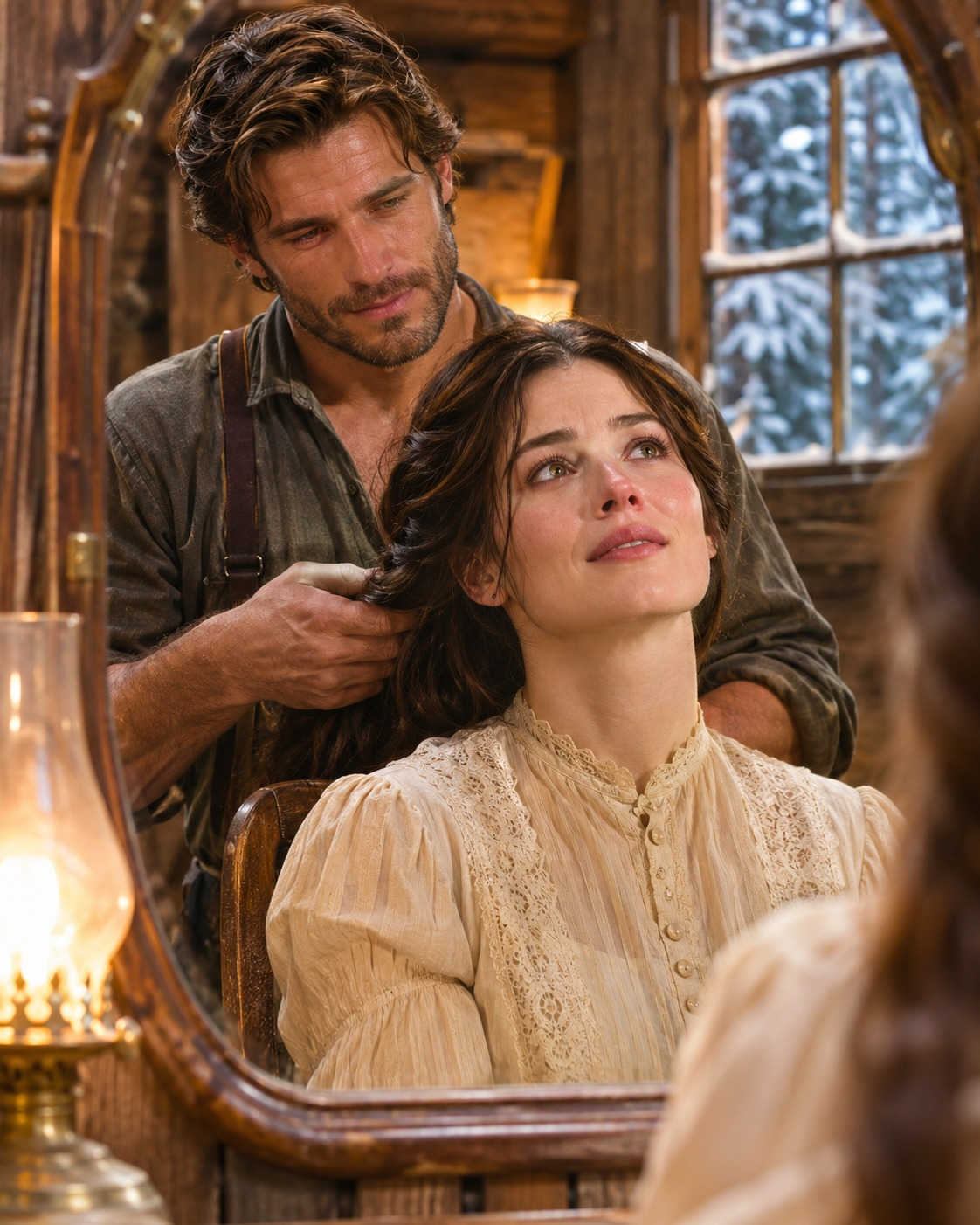
Elias Mercer tore open the envelope at the Laramie post office.
"Do not mistake my honesty for a lack of hope," the letter began.
He stopped reading.
A folded photograph slipped onto the wooden counter.
On the back, four words had been written in careful handwriting.
"I am not pretty."
Elias looked at the photograph again.
Then he reached for a clean sheet of paper.
He had no idea that those four words would eventually change his life.
The post office was nearly empty that afternoon. A thin layer of dust covered the windowsills, and the wooden floor creaked whenever someone crossed the room. Outside, horses shifted impatiently beside the hitching posts while a freight wagon rattled along the muddy street.
Elias had come into town to collect supplies, purchase lamp oil, and check whether any correspondence had arrived.
He was not a man who enjoyed waiting for letters.
For years, he had managed perfectly well without them.
At thirty-eight, he owned three hundred acres of Wyoming land, most of it covered by timber, rocky hills, and long stretches of meadow. His property included a modest cabin, a small barn, a water pump that froze every winter, and enough livestock to keep him occupied from sunrise until darkness.
He had built almost everything himself.
The cabin had taken nearly two years. The barn had required another winter. The fencing was an endless project that seemed to become necessary again whenever he finished repairing the previous section.
His hands were rough from cutting timber, repairing equipment, and working through weather that would have driven most men indoors.
He was accustomed to solitude.
But solitude had a way of becoming heavier as the years passed.
At first, he had appreciated the silence.
He could eat whenever he wanted, sleep without interruption, and spend entire days without speaking more than a few words.
There were no arguments about household expenses.
No expectations.
No one asking where he had been.
No one waiting for him to return.
Yet somewhere along the way, the silence had stopped feeling like freedom.
It had become something else.
Something he rarely admitted.
Loneliness.
That was why, eight months earlier, he had written to a marriage agency advertising brides willing to travel west.
He had not expected much.
The first letters were pleasant enough. One woman described herself as cheerful and affectionate. Another wrote about her beautiful complexion and her love of dancing. A third spoke at length about wanting to experience the excitement of frontier life.
Elias had read them all.
He had answered only a few.
He did not need a woman who imagined the West as a romantic adventure.
He needed someone who understood that life in the mountains was not a painting hanging in a city parlor.
It was cold water, broken fences, difficult roads, sick animals, and long stretches of work.
A person could be cheerful and still find herself miserable after the first serious snowstorm.
He knew that.
And he had no intention of misleading anyone.
The letter on the counter was different.
It came from a woman named Clara Whitmore.
Her first correspondence had been practical.
She explained that she was twenty-nine years old, lived in Garfield, Ohio, and worked as a school librarian.
She had never married.
She had no children.
She had spent much of her adult life surrounded by books and had developed a particular interest in languages, history, and household management.
Elias had found the letter unusual.
Most women who wrote to the agency described what they hoped a husband would provide.
Clara described what she could contribute.
She could read six languages.
She could keep accurate accounts.
She could stretch flour through a difficult winter.
She could preserve food, mend clothing, and repair a water pump.
That last detail had made him smile.
His own pump had been giving him trouble for nearly three months.
He had mentioned it in his reply.
Apparently, Clara had taken the subject seriously.
But it was the final paragraph of her newest letter that held his attention.
She had written that she wanted him to understand something before they continued corresponding.
She was not particularly beautiful.
She knew that appearance mattered to many men.
She had no intention of allowing him to travel through life believing he had been promised someone different.
Elias looked at the photograph again.
It showed a young woman standing beside a bookshelf.
Her dress was simple and neatly arranged. Her dark hair fell around her shoulders. She had a thoughtful expression and a posture that suggested she was more comfortable holding a book than posing for a photograph.
He studied her face for a moment.
Then he turned the photograph over.
"I am not pretty."
He read the sentence again.
It struck him that someone who had never met him had already decided what he might value.
He placed the photograph carefully beside the letter.
The postmaster, a gray-haired man named Walter, glanced toward him.
"Another one from your future bride?"
Elias folded the paper.
"Perhaps."
Walter chuckled.
"Careful, Mercer. Women out east might have different ideas about what a husband ought to be."
"That's possible."
"And what if she expects a house in town? A carriage? A man who wears a clean collar every day?"
Elias glanced at his work-stained sleeves.
"Then she'll be disappointed."
Walter laughed.
But Elias was no longer listening.
He was thinking about the letter.
A woman who had been so honest about her appearance might have been equally honest about everything else.
And honesty was worth more than a pretty description.
He took the letter and photograph home.
That evening, after feeding the animals and checking the water troughs, he sat at the small wooden table inside his cabin.
A lamp burned beside him.
His supper had been a piece of bread, a bowl of beans, and the last of a roast he had prepared two days earlier.
He pushed the plate aside.
Then he read Clara's letter one more time.
There was something between the lines that interested him.
She did not sound desperate.
She did not beg him to choose her.
She simply explained who she was and what she could offer.
He recognized that kind of honesty.
It was the same honesty he expected from himself.
Elias pulled out a sheet of paper.
He dipped his pen into the ink.
For several minutes, he stared at the blank page.
He had never been particularly skilled at romantic writing.
He could explain how much lumber a barn required or how to repair a damaged roof, but finding the right words to describe his feelings was another matter.
He finally began.
"Miss Whitmore,
I received your letter and the photograph.
I appreciate your honesty."
He stopped.
That sounded too formal.
He continued.
"I did not write westward looking for something pretty to hang on my wall."
His pen paused.
He considered the sentence.
Then he continued.
"You tell me you can repair a pump. Mine freezes every January. You say you can keep accounts. Mine are presently kept on scraps of paper inside a coffee tin."
A small smile crossed his face.
He could imagine her reading that sentence.
Perhaps she would laugh.
Perhaps she would think him foolish.
Either way, it was true.
He wrote about the cabin.
He explained that it was small, built from timber he had cut himself, and situated far enough from town that visitors were uncommon.
He described the winters.
He mentioned the nearest trading post and the long road required to reach it.
He explained that she would need warm clothing, sturdy shoes, and patience.
Then he added that he was poor company before breakfast.
He almost crossed that sentence out.
Instead, he left it.
He wanted her to know what she was considering.
A life with him would not be a constant adventure.
It would be ordinary work repeated every day.
There would be mornings when the stove refused to draw properly.
There would be evenings when he returned tired and said very little.
There would be times when snow blocked the road and they might not see another person for weeks.
He could not promise wealth.
He could not promise luxury.
But he could promise honesty.
He reached the bottom of the page.
His pen hovered above the paper.
Then he wrote one final question.
"If none of that frightens you, will you come?"
He signed his name.
Elias Mercer.
He folded the letter and placed it inside an envelope.
Before sealing it, he looked toward the photograph resting beside the lamp.
For the first time in months, the thought of someone arriving at his cabin did not feel like an inconvenience.
It felt like the beginning of something.
He sealed the envelope.
The following morning, he placed it in his coat pocket and rode into town.
He handed it to Walter at the post office.
"Going east?" the postmaster asked.
"Ohio."
Walter raised an eyebrow.
"That's a long way to send a letter."
"Yes."
"Long way for a woman to travel, too."
Elias adjusted his coat.
"I know."
Walter stamped the envelope and placed it with the outgoing mail.
Elias turned toward the door.
"Mercer?"
He looked back.
Walter leaned against the counter.
"You really think she'll come?"
Elias considered the question.
He could not know.
He had never met Clara.
He did not know the sound of her voice or whether she laughed easily. He did not know what she looked like when she was tired or what she might say when something went wrong.
He knew only what she had written.
But that was enough to make him hope.
"I think she'll decide for herself," he answered.
Then he stepped outside.
Two thousand miles away, in a small town in Ohio, Clara Whitmore was preparing to open a letter that would change the direction of her life.
She had spent the morning arranging returned books, correcting a damaged library ledger, and helping a young student find a history volume.
She had been careful not to think too much about the future.
The correspondence with Elias had become important to her, but she had learned not to build expectations around things she could not control.
She had experienced disappointment before.
At school, people respected her intelligence.
They appreciated her ability to organize the library and solve difficult problems.
But respect was not the same as affection.
And affection was not the same as being chosen.
She had watched men become interested in her conversations only to lose that interest when they began comparing her with women they considered more attractive.
Some had been polite.
Others had not.
One had even told her that she would make a wonderful wife for a man who valued books more than beauty.
She had never forgotten that sentence.
It had been delivered with a smile.
That somehow made it worse.
When Clara first heard about the marriage agency, she had dismissed the idea.
Traveling west to marry a stranger seemed like something that happened in adventure novels.
But as the months passed, she began wondering whether there might be someone somewhere who wanted more than a pretty face.
Then she found Elias's advertisement.
It was short.
He described himself as a landowner in Wyoming, a carpenter by experience, and a man seeking a practical companion who understood rural life.
He made no promises of wealth.
He did not describe himself as handsome.
He did not mention romance.
He simply said he wanted a wife who would be comfortable building a life together.
Something about that advertisement had stayed with her.
Now, as the afternoon light faded, the librarian received a small envelope from the post office.
She recognized the handwriting immediately.
Her heart began beating faster.
She carried the letter to her desk.
For a moment, she did not open it.
She looked at her own hands.
Then she carefully broke the seal.
The first sentence made her stop breathing.
"I did not write westward looking for something pretty to hang on my wall."
Clara read it twice.
Then a small smile appeared.
She continued.
The sentence about the water pump made her laugh softly.
The coffee tin made her smile again.
By the time she reached the paragraph describing the cabin, her expression had become thoughtful.
She imagined the wooden walls.
The small windows.
The stove.
The endless mountains.
Then she reached the question at the bottom.
"If none of that frightens you, will you come?"
Clara held the letter against the desk.
Outside, the school bell rang.
Children hurried toward the street.
A few voices echoed through the corridor before fading into the afternoon.
She looked down at Elias's handwriting.
He had not promised to love her.
He had not promised to make her happy.
But he had told her the truth.
And for the first time, that seemed more valuable than a hundred beautiful promises.
Clara reached for a fresh sheet of paper.
She began writing.
She told him that the mountains did not frighten her.
That hard work did not frighten her.
That she understood the difficulties of living far from town.
She even told him that she had no objection to a husband who was poor company before breakfast.
Then she stopped.
There was one thing she wanted him to understand.
She was not traveling west because she believed a husband would solve every problem in her life.
She was traveling because she wanted the chance to build something with another person.
Something honest.
Something lasting.
She dipped her pen into the ink.
And wrote the sentence that would eventually bring her to his cabin.
"I believe I would like to meet you, Mr. Mercer."
She folded the paper.
Outside, the last sunlight disappeared behind the rooftops.
Neither Clara nor Elias knew what the coming weeks would bring.
Neither knew how much their lives would change.
And neither knew that the first meeting between them would test the very insecurity Clara had tried so hard to conceal.
Because six weeks later, when the stagecoach finally reached Wyoming, Elias Mercer would be waiting beside the road.
And Clara would have to look him in the eyes.






Comments 0