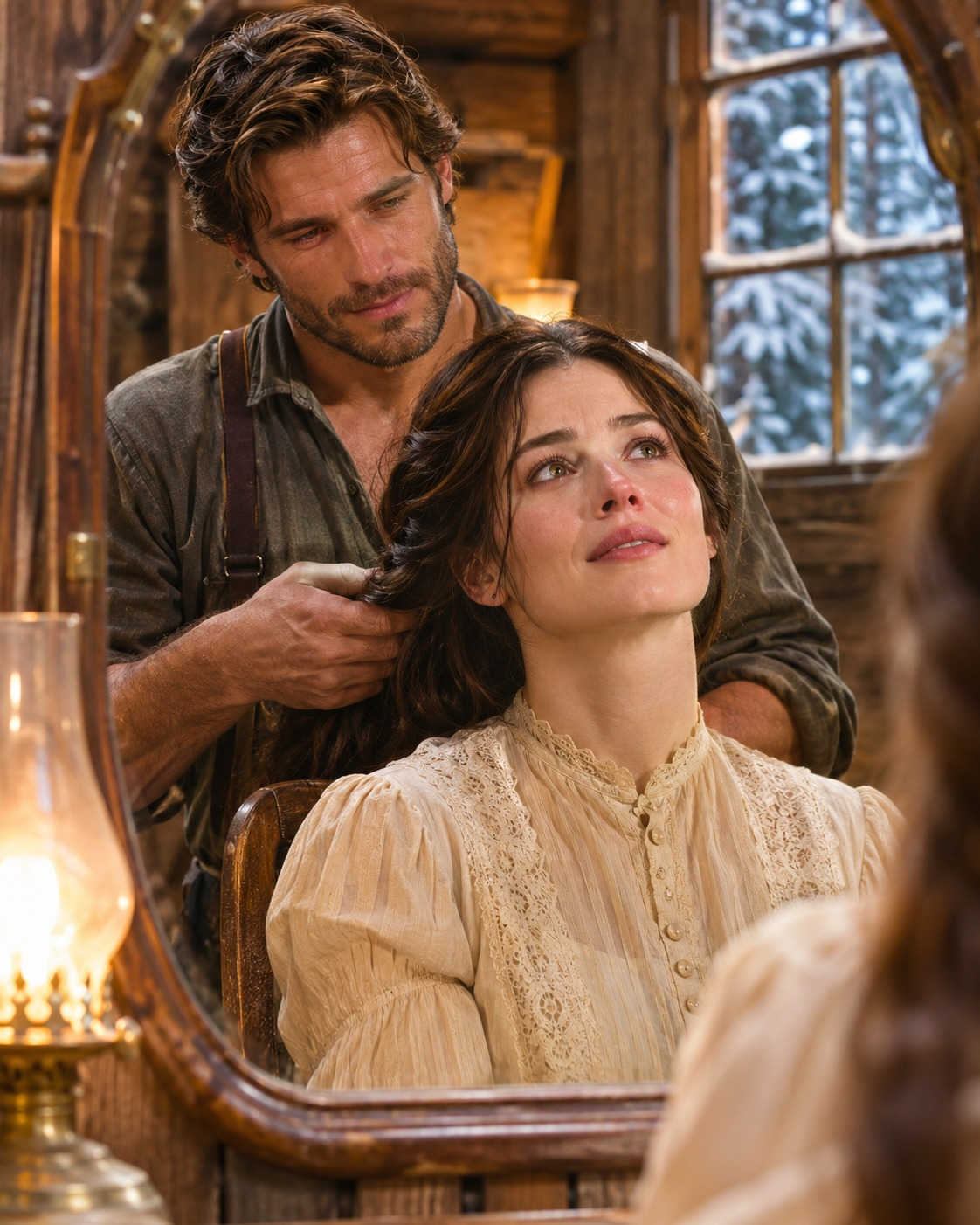
Clara Whitmore folded Elias's letter and placed it inside the top drawer of her desk.
Then she opened it again.
She had read the same paragraphs four times, yet something about his words continued to trouble her.
Not because they were unkind.
Because they were unexpectedly honest.
Most men who had shown interest in her had started by complimenting her intelligence. They praised her reading habits, her careful handwriting, and her ability to discuss almost any subject.
But their enthusiasm usually changed when the conversation became personal.
Clara had learned to recognize the moment.
A man's eyes would linger on her face. His smile would become less certain. Then he would find a polite reason to end the conversation.
She had never been considered ugly.
But she had also never been the woman men turned around to look at when she entered a room.
Her features were ordinary, her nose slightly long, her chin narrow, and her complexion pale from years spent indoors among books.
She had dark hair that refused to remain perfectly arranged and a figure that was neither particularly delicate nor especially striking.
She was simply Clara.
For years, she had wondered whether simply being herself would ever be enough.
Her mother had once told her that a woman's appearance mattered less than her character.
Her father had agreed.
But both had died before Clara was old enough to understand how complicated that advice could become.
Her mother had passed away when Clara was twenty-two.
Her father followed two years later.
After that, the family home had become too expensive to maintain, and Clara had moved into a small rented room near the school.
The library had become her refuge.
She loved the smell of old paper, the quiet arrangement of shelves, and the comforting certainty that a book never changed its opinion of someone because of their face.
People were different.
They could make a person feel invisible without ever saying a cruel word.
That evening, Clara returned to her rented room carrying a small basket of groceries.
She placed the basket on the kitchen table, removed her coat, and checked the stove.
A small fire remained beneath the iron kettle.
She poured herself tea.
Then she retrieved Elias's letter.
The lamp cast a warm circle of light across the paper.
She reread the passage about his cabin.
Three hundred acres.
A barn.
A frozen water pump.
A long road to the nearest trading post.
She tried to imagine living there.
There would be no familiar streets.
No school library.
No friendly shopkeeper who knew her name.
There would be mountains and trees and winters that might last longer than anything she had experienced in Ohio.
She would be marrying a man whose face she had seen only in a photograph.
And she would be placing her future in the hands of someone who lived thousands of miles away.
The thought frightened her.
But another thought frightened her even more.
What if she spent the rest of her life waiting for someone to choose her?
Clara looked at the photograph Elias had sent several weeks earlier.
He was standing beside a wooden fence.
He wore a work shirt and a dark waistcoat.
His hair was short, his face weathered, and his expression serious.
He did not look like the men in romantic novels.
He looked like someone who knew how to repair a broken roof.
She found that strangely comforting.
The following morning, Clara took the photograph to the library.
Her closest friend, Margaret Ellis, was waiting beside the circulation desk.
Margaret had worked at the school for nearly four years and was one of the few people who knew about Clara's correspondence with the marriage agency.
She was a practical woman with a sharp tongue and a generous heart.
When she saw the photograph, she raised an eyebrow.
"Is that him?"
Clara nodded.
Margaret examined the picture.
"He looks serious."
"He lives alone in Wyoming."
"That would explain it."
Clara laughed.
Margaret turned the photograph over.
"What does he say?"
"That he is not particularly handsome."
Margaret looked at the picture again.
"Well, at least he isn't pretending."
Clara smiled.
"He also says he is poor company before breakfast."
"Then you must make certain you never speak to him before breakfast."
They both laughed.
But Margaret soon noticed the seriousness returning to Clara's face.
"You're actually considering going?"
Clara nodded slowly.
"I am."
"Across the country?"
"Yes."
"To marry a man you've never met?"
"Yes."
Margaret put the photograph down.
"Clara, I know you want something different. But this is not a small decision."
"I know."
"What if he is not the man his letters describe?"
Clara looked toward the shelves.
"Then I will have to discover that for myself."
Margaret lowered her voice.
"And what if he doesn't like you?"
The question landed harder than Margaret intended.
Clara looked down at her hands.
"Then at least I will know."
Margaret immediately regretted asking.
She reached across the desk and touched Clara's wrist.
"You are a good woman. Anyone would be fortunate to have you."
Clara offered a faint smile.
"I appreciate that."
"But you must promise me something."
"What?"
"If you go, don't spend your entire life trying to prove that you're worth keeping."
Clara did not answer immediately.
She folded the photograph and returned it to her pocket.
"I will remember."
Over the next several days, she and Elias continued exchanging letters.
Their correspondence became increasingly comfortable.
He told her about the animals.
She told him about the library.
He described the difficult work of preparing firewood before winter.
She explained how she preserved vegetables and calculated household expenses.
He sent her a small drawing of his cabin.
Clara studied it for nearly an hour.
The structure was simple, with a sloping roof, two windows, and a narrow porch.
She imagined herself standing there.
She imagined carrying water from the pump.
She imagined reading beside the stove while Elias repaired his tools.
Sometimes, she even imagined hearing his footsteps outside and knowing that someone was coming home.
That particular thought frightened her more than the mountains.
She had spent so many years expecting disappointment that the possibility of happiness felt almost unreasonable.
Then another letter arrived.
Elias had written that he needed to know whether she intended to travel before the late snow made the mountain roads difficult.
He explained that he could arrange transportation from the nearest railway connection.
He also offered to send money for the journey.
Clara read that section carefully.
She did not want to appear dependent.
She wrote back that she had saved enough to pay for her own travel.
She would accept his help with local arrangements, but she wanted him to understand that she was coming because she had made the decision herself.
Three days later, his reply arrived.
"Miss Whitmore,
I respect that.
I would rather have a woman arrive because she wants to build a life with me than because she believes she has nowhere else to go."
Clara sat very still.
She read the sentence again.
Then she carefully folded the letter.
For the first time, she began to believe that Elias might understand something about her that other people had overlooked.
He seemed to value her independence.
He did not treat her as someone who needed rescuing.
He was offering her a place beside him.
Not beneath him.
That evening, Clara made her decision.
She would go to Wyoming.
The next morning, she visited the agency office and confirmed her travel arrangements.
She would leave Ohio in six weeks.
The clerk asked whether she had any relatives who might object.
Clara explained that her parents were gone and that she had no immediate family.
The clerk made a note.
"Are you certain, Miss Whitmore?"
Clara looked at the paperwork.
Then she signed her name.
"Yes."
The weeks that followed were filled with preparations.
She purchased sturdy shoes, warm stockings, a thick wool coat, and gloves suitable for cold weather.
She packed her books carefully.
She chose only the volumes she considered essential.
A language dictionary.
A book about household medicine.
A collection of poems her mother had once loved.
And a small family Bible.
She also packed her sewing kit and a notebook containing recipes, household calculations, and practical instructions.
Everything she owned had to fit into two trunks and one travel bag.
Margaret helped her organize the belongings.
"You are taking too many books," she complained.
"They are useful."
"Useful? You're traveling to a mountain cabin, not opening another library."
Clara laughed.
"I might need them."
Margaret shook her head.
"Then take the dictionary and leave the poetry."
Clara immediately placed the poetry book back into the trunk.
"That one stays."
Margaret sighed.
"Of course it does."
On the final evening before her departure, Clara visited the library alone.
She walked between the shelves.
She touched the spines of familiar books.
She looked at the desk where she had spent six years recording borrowed volumes and repairing damaged pages.
It was strange to think she might never return.
She had built a life there.
A small life.
A quiet life.
But it had been hers.
She stopped beside the window.
Outside, the streetlights had begun to glow.
For a moment, she wondered whether she was making a terrible mistake.
Then she remembered Elias's letter.
He had not promised her beauty, wealth, or an easy existence.
He had offered her honesty.
Perhaps that was enough to begin with.
She turned off the library lamp.
Then she locked the door.
The next morning, Margaret accompanied her to the station.
They stood beside the trunks while the conductor checked the tickets.
Margaret hugged her tightly.
"Write to me."
"I will."
"And don't pretend everything is wonderful if it isn't."
"I won't."
Margaret stepped back.
Her eyes were shining.
"Clara?"
"Yes?"
"Don't let anyone convince you that you must be grateful simply because they agreed to marry you."
Clara swallowed.
"I won't."
The conductor called for passengers.
Clara climbed aboard.
She found her seat beside the window and placed her travel bag on the floor.
As the train began moving, she watched Margaret grow smaller on the platform.
Then the station disappeared.
Ohio began slipping away behind her.
Clara rested her head against the window.
She did not know what Elias would think when he saw her.
She did not know whether the cabin would feel like home.
She did not know whether the two of them would ever become more than strangers who had agreed to share a life.
But she knew one thing.
She had made the choice herself.
And she was not going to turn back.
Three weeks later, after several difficult connections and an exhausting journey across the country, Clara finally reached the last stagecoach station before Elias's property.
The stationmaster checked the passenger list.
"Miss Clara Whitmore?"
"Yes."
He looked toward the road.
"Someone has been waiting for you."
Clara's heart began beating faster.
She adjusted her coat.
Then she stepped toward the door.
Outside, a tall man stood beside a dark horse.
He wore a brown work coat.
His hands were resting against his belt.
And when he turned toward the station, Clara recognized the face from the photograph.
Elias Mercer had finally come to meet his bride.
But before she could take her first step toward him, she noticed that he was holding something in his hand.
It was a folded letter.
And her name was written across the front.






Comments 0