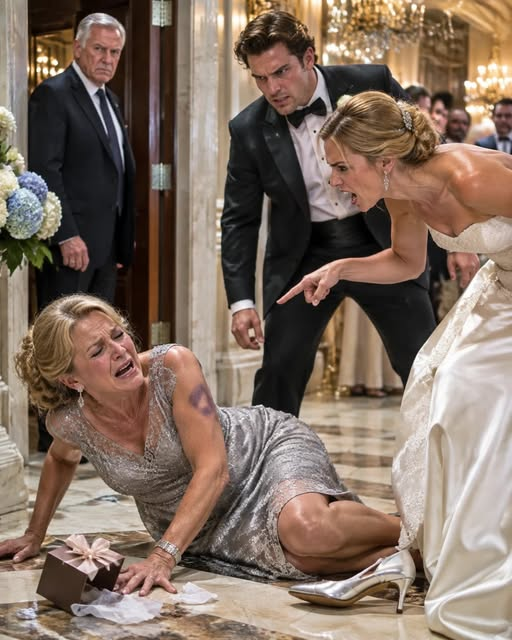
"Robert, please don't call Michael," my wife whispered as I reached for my phone.
She was standing in our kitchen with one shoe missing and a purple bruise spreading across her upper arm.
I picked up the little wedding gift box she had brought home.
The pale ribbon was torn, and three words were written beneath the lid.
For my son.
That was when I knew Ellen hadn't simply fallen.
But I still had no idea how much worse the truth would be.
My wife had always been a terrible liar.
Not because she lacked imagination. Ellen could invent entire bedtime adventures for our son when he was little, stories about astronauts who got lost on the moon and dogs who learned to drive school buses. She could convince a frightened child that thunder was just heaven rearranging its furniture.
But when she tried to hide something that hurt her, she became quiet.
Terribly quiet.
That was how she came home from our son's wedding.
I had left the reception early because of a migraine that had been building behind my eyes since the ceremony. Ellen insisted on staying for the final photographs. She wanted to make sure Michael and Cassandra had everything they needed before leaving for their honeymoon.
"Go home, sweetheart," she'd told me, adjusting my tie. "I'll be right behind you."
That was at nine fifteen.
She didn't come home until almost midnight.
I was sitting at the kitchen island when I heard her key scrape against the front door.
"Ellen?"
No answer.
I walked into the hallway.
My wife stood beneath the entryway light, wearing the dusty lavender evening gown she'd spent three weeks choosing. Her short chestnut curls had come loose around her face. One champagne-colored heel was still on her right foot.
Her left foot was bare.
She was holding her small evening purse against her stomach as though it were something fragile.
"Where's your other shoe?" I asked.
She looked down.
For a moment, she seemed surprised to discover it was missing.
"Oh," she said softly. "I must have left it somewhere."
"At the wedding?"
"I suppose."
I studied her face.
Her makeup was smudged beneath one eye. Her lips were pale. She was standing with most of her weight on her right leg.
"Ellen, what happened?"
"Nothing."
She attempted a smile.
It was the saddest smile I'd seen in forty-three years of marriage.
"Sweetheart."
"I just fell, Robert."
"Fell where?"
"At the venue."
"How?"
She looked past my shoulder toward the stairs.
"I wasn't watching where I was going."
I stepped closer.
She flinched.
It was a small movement. Barely noticeable. But it struck me harder than any scream could have.
My wife had never flinched away from me.
Not once.
I lowered my hands.
"Ellen, look at me."
She did.
There was something in her eyes I couldn't understand.
Fear, certainly.
But beneath it was something deeper.
Shame.
As though whatever had happened was somehow her fault.
"Let me help you sit down."
She nodded.
I guided her into the kitchen and pulled out a chair.
When she tried to bend her left knee, she gasped.
I knelt beside her.
The knee was already swollen beneath the fabric of her gown.
"Good Lord, Ellen."
"It's not as bad as it looks."
"You're hurt."
"I know."
"Who was with you?"
Her expression changed.
Just for a second.
"Nobody."
I looked at her arm.
There were dark marks above her elbow.
Four distinct bruises curved around the outside of her upper arm.
A thumb-shaped mark sat opposite them.
I had spent thirty-seven years working in commercial insurance investigations before retiring. I wasn't a physician, but I'd seen enough injury photographs to recognize when someone's explanation didn't match what was in front of me.
Those marks hadn't come from falling against a wall.
Someone had grabbed my wife.
Hard.
"Who did this?"
She pulled her arm away.
"Robert, please."
"Who touched you?"
"Nobody did anything."
"Ellen."
Her eyes filled.
And then she said something I would remember for the rest of my life.
"Please don't ruin Michael's wedding."
I stared at her.
"His wedding is over."
"Not for him. He's happy. He's finally happy."
"That doesn't answer my question."
She shook her head.
"Please. Not tonight."
I wanted to argue.
I wanted to demand names.
Instead, I looked at the woman I'd loved since we were twenty-two years old and realized she was barely holding herself together.
So I stopped asking.
"All right," I said. "Let's get you comfortable."
I helped her upstairs.
She cried out when I supported her under the injured arm, so I adjusted my grip and let her lean against my shoulder.
We had climbed those stairs together thousands of times.
After birthday parties.
After funerals.
After our son's high school graduation.
After the night we learned Ellen's mother had died.
But never like this.
Never with my wife trembling against me as though she were afraid the world might suddenly become dangerous again.
I helped her change into a nightgown.
The bruising was worse than I'd realized.
Her left shoulder was darkening. There was a scrape along her forearm and another bruise near her hip.
I asked if she'd hit her head. She said no.
I wanted her examined that night. She begged me to wait.
We compromised on an urgent medical appointment first thing in the morning, with the understanding that we'd go straight to the emergency department if her symptoms worsened.
I brought her an ice pack wrapped in a towel.
She thanked me.
Then she apologized.
"For what?" I asked.
"For making such a fuss."
I sat beside her.
"Ellen, you've been hurt. You don't need to apologize."
She stared at the blanket.
"I should have just kept my mouth shut."
My chest tightened.
"About what?"
She shook her head.
"Nothing."
I knew that word.
It was the word people used when the truth was too painful to carry aloud.
I reached for her hand.
"Whatever happened, we'll deal with it together."
She looked at me.
For a moment, I thought she might tell me.
Instead, she whispered, "I don't want to lose him."
I knew who she meant.
Michael.
Our only child.
The boy who had once fallen asleep with his hand wrapped around Ellen's finger.
The teenager who called her every Friday from college because he knew she worried.
The young man who had stood beside me at his grandfather's funeral and promised he would always look after his mother.
I couldn't imagine what he had to do with the bruises on her arm.
And yet, something about the way Ellen said his name frightened me.
The next morning, I drove her to an urgent care clinic.
The physician examined her knee, ordered X-rays, and documented the bruises on her arm and shoulder.
Fortunately, nothing was broken.
She had a significant knee sprain, extensive bruising, and soft-tissue injuries that would take time to heal.
The physician asked how she'd been injured.
Ellen looked at me.
Then she said, "I fell."
The physician glanced at the marks on her arm.
"Did someone grab you?"
My wife went completely still.
"No."
I watched the physician's expression.
She didn't challenge Ellen.
Instead, she asked whether Ellen felt safe at home and whether she wanted to speak privately.
Ellen insisted she was safe.
I understood why the physician asked.
I also understood that my wife was hiding something.
On the drive home, Ellen stared out the passenger window.
I kept both hands on the steering wheel.
"Sweetheart, I need you to know something."
She didn't turn.
"You can tell me anything. Even if it's about Michael."
Her fingers tightened around her purse.
That was my answer.
Not the whole answer.
But enough to make my stomach turn.
Michael called at eleven forty-seven.
I was in the garage getting Ellen's old walking cane from a storage cabinet.
His name appeared on my phone.
I answered.
"Hey, Dad."
He sounded cheerful.
Too cheerful.
"How's married life?" I asked.
"Pretty incredible."
I heard laughter behind him.
Cassandra's voice.
They were supposed to be leaving for their honeymoon that afternoon.
"Listen," he said, "Mom seemed a little upset last night."
I stopped moving.
"Did she?"
"Yeah. You know how she gets."
I looked toward the kitchen door.
"What do you mean?"
"Emotional. Overprotective. She had some trouble understanding boundaries."
I said nothing.
"Dad?"
"I'm listening."
"Just make sure she doesn't call Cassandra and start something. Cass has been through enough wedding stress."
I felt a slow, unpleasant pressure building behind my ribs.
"Your mother came home injured."
There was a pause.
Then Michael laughed once.
Not because anything was funny.
Because he was uncomfortable.
"Yeah, she slipped, right?"
"That's what she told me."
"Well, there you go."
"Did you see her fall?"
Another pause.
"Not exactly."
"What does that mean?"
"Dad, there were two hundred people there. I couldn't keep track of everyone."
"She's your mother."
His voice hardened.
"I know who she is."
The words landed between us.
I waited.
Then he sighed.
"Look, don't turn this into a big thing. Cassandra and I are starting our marriage. We don't need drama."
I thought of Ellen struggling to climb our stairs.
Of the marks around her arm.
Of the way she'd flinched when I reached toward her.
"Michael, I want you to think very carefully about what you're saying."
"What's that supposed to mean?"
"It means your mother is hurt."
"And I'm sorry she fell."
He said it quickly.
Practiced.
As though he'd already decided exactly what his explanation would be.
Then Cassandra spoke in the background.
"Michael, are you still talking about your mother?"
He moved the phone away.
I couldn't hear his reply.
But I heard Cassandra clearly.
"Tell him she needs to stop playing the victim."
The garage seemed to tilt around me.
Michael returned to the call.
"Anyway, Dad, we've got to go."
"Michael—"
"We'll talk when we get back."
He hung up.
I stood there holding the cane.
My son had just referred to his injured mother as drama.
His new wife had called her a victim.
And neither of them had asked whether she was all right.
That afternoon, I went through the photographs from the wedding.
I told myself I was looking for something ordinary.
A misplaced shoe.
A picture of Ellen walking through the reception.
Anything that might explain how she'd been injured.
Our photographer had uploaded a preview gallery.
There were photographs of Michael and Cassandra beneath the floral arch.
Cassandra laughing with her bridesmaids.
Michael raising a champagne glass.
Ellen standing beside the wedding cake.
She looked beautiful in her lavender gown.
Proud.
Happy.
I lingered on that picture.
Then I noticed the time stamp.
8:42 p.m.
I clicked through the next photographs.
8:51.
9:03.
9:17.
There was one photograph of Ellen standing near the entrance to a hallway.
She was holding a small brown gift box tied with a pale ribbon.
I remembered that box.
She'd wrapped it herself three nights earlier.
She had refused to tell me what was inside.
"It's between a mother and her son," she'd said, smiling.
In the photograph, she was looking toward someone outside the frame.
Her smile had faded.
I enlarged the image.
At the far edge, barely visible, was a dark-blue sleeve.
Michael's tuxedo.
I stared at the photograph for a long time.
Then I checked the next image.
It showed the reception hall.
No Ellen.
No Michael.
No Cassandra.
The next photograph was taken twenty-six minutes later.
Michael and Cassandra were dancing.
Ellen was nowhere to be seen.
I closed the laptop.
My heart was beating too fast.
I didn't have proof.
I had photographs, bruises, and a phone conversation that made me want to put my fist through a wall.
But I knew better than to accuse someone without evidence.
Even my own son.
Especially my own son.
That evening, Ellen asked me to help her downstairs.
She wanted to sit in the living room.
I brought her a blanket and made tea.
We watched half an episode of a cooking show neither of us was following.
At nine, her phone buzzed.
She jumped so violently that her tea spilled onto the blanket.
I reached for a towel.
"Who is it?"
"Nobody."
She turned the screen facedown.
I didn't push.
A few minutes later, she excused herself to use the bathroom.
Her phone remained on the couch.
It buzzed again.
I wasn't proud of what I did next.
I looked.
The notification was from Michael.
Mom, we agreed you wouldn't make this a problem.
I felt the blood drain from my face.
Another message appeared.
Don't force me to explain what really happened.
I stood there staring at the screen.
My son wasn't asking about his mother's injuries.
He was warning her.
I put the phone down before Ellen returned.
When she came back, I helped her settle onto the couch.
She looked at me for a long moment.
"Robert?"
"Yes?"
"Do you think people can become someone you don't recognize?"
I swallowed.
"Sometimes."
"Even your own children?"
I wanted to say no.
I wanted to tell her the boy we'd raised was still somewhere inside the man he'd become.
But I couldn't make myself lie.
"I don't know, sweetheart."
She nodded.
Then she leaned her head against my shoulder.
We sat like that until she fell asleep.
I kept thinking about the message.
We agreed.
What agreement?
What had Michael demanded from his mother?
And what did he mean by what really happened?
The following morning, Ellen was still sleeping when the telephone rang.
It was our landline.
An unfamiliar number appeared on the display.
I almost let it go to voicemail.
Then I noticed the area code.
Philadelphia.
I answered.
"Robert Whitaker speaking."
"Mr. Whitaker? My name is Daniel Pierce. I'm the general manager of The Hawthorne Estate."
I straightened.
"Yes?"
"Your son's wedding was held here on Saturday."
"I know."
There was a pause.
"Mr. Whitaker, I'm calling because we've discovered something concerning."
My hand tightened around the receiver.
"What kind of something?"
"We had a technical problem with one of our security cameras that evening."
I stopped breathing.
"The camera in the corridor near the bridal suite," he continued. "Our technician was able to recover the footage."
I looked toward the stairs.
"Why are you calling me?"
Another pause.
When Daniel spoke again, his voice was different.
Lower.
More careful.
"Because I believe your wife may have been involved in an incident."
I closed my eyes.
"What incident?"
"I'd rather not discuss the details over the phone."
"Was she hurt?"
"Mr. Whitaker, I think you need to see this for yourself."
"I'll bring Ellen."
"No."
The answer came so quickly that it startled me.
"Please," he said. "Come alone."
I looked down at the telephone.
"Why?"
For several seconds, I heard nothing but Daniel breathing.
Then he said, "There's something else you should know. After we recovered the footage, someone contacted our security department and asked whether the original recording could still be deleted."
I felt a cold pressure settle in my chest.
"Who?"
Daniel hesitated.
"I think it's better if you come here."
I glanced toward the staircase again.
My wife was sleeping upstairs.
My son was on his honeymoon.
And somewhere in that wedding venue was a recording someone desperately wanted erased.
"Mr. Pierce," I said, "tell me who requested the deletion."
He lowered his voice.
"Sir, the request came from someone in your immediate family."
Then he added one final sentence.
"And the person is here in my office right now."






Comments 0