"Mine?"
I stared at Rebecca Shaw.
The word came out so quietly that I barely recognized my own voice.
Detective Lawson was still speaking through Rebecca's phone.
"Mr. Whitaker, we have a recording in which your son discusses obtaining control of his mother's inheritance. A second male voice responds. Our preliminary comparison suggests it may be yours."
I looked at Ellen.
She was sitting beside me, her face pale, her hands folded tightly in her lap.
"That's impossible," I said.
Lawson paused.
"Do you recall discussing your mother's estate with Michael approximately three years ago?"
I opened my mouth.
Then stopped.
Three years ago.
Michael had come to our house after losing money in a business venture. He'd asked whether my mother's estate had left anything for him.
I remembered that conversation.
And suddenly, I remembered something else.
"Yes," I said slowly. "I spoke to him."
Rebecca leaned forward.
"What did you say?"
I closed my eyes.
"I told him that if he wanted financial security, he needed a plan."
The room went silent.
Lawson asked, "Do you remember anything more specific?"
I looked down.
"I told him to stop looking for shortcuts. I said he should make a plan for his own money instead of expecting his mother to rescue him."
Rebecca watched me carefully.
"Robert, would you be willing to listen to the recording?"
"Yes."
My voice was steady now.
"Play it."
The audio began with the sound of a television in the background.
Then Michael's voice.
Younger.
Impatient.
"Dad, I have a plan for Mom's money."
My stomach tightened.
My own voice answered.
"Michael, we've discussed this. Your mother doesn't have money set aside for you to spend."
Michael laughed.
"Everybody has money somewhere."
"Then earn your own."
There was a pause.
Michael spoke again.
"What if Grandma left something that Mom hasn't told us about?"
My recorded voice sounded tired.
"Then it belongs to whoever Grandma left it to."
"But if Mom has control—"
"Michael, listen to me."
I heard myself sigh.
"Make a plan for your own money. Don't make a plan for somebody else's."
The recording ended.
For several seconds, nobody spoke.
Then Rebecca exhaled.
"That changes the meaning considerably."
Detective Lawson agreed.
"Yes. The voice comparison was preliminary, and the complete recording doesn't support the suggestion that Mr. Whitaker was helping his son obtain the trust."
I stared at the phone.
"Where did Cassandra get it?"
Lawson answered.
"It was found among files associated with Richard Vale's business. We're investigating how it was obtained and whether excerpts were circulated without context."
I closed my eyes.
The recording was real.
The words were mine.
But the meaning Cassandra had attached to them was a lie.
I looked at Ellen.
She was crying quietly.
I reached for her hand.
"Sweetheart."
She looked at me.
"I never planned to take anything from you."
"I know," she whispered.
I felt my throat tighten.
"Do you?"
She nodded.
"Robert, I've known you for forty-three years."
I held her hand.
For a moment, that was enough.
Detective Lawson had more to tell us.
Michael had been located at his apartment. He was safe and had agreed to speak with investigators in the presence of his attorney.
The photograph Cassandra had provided was also genuine.
It showed Michael meeting Richard Vale three years earlier, long before Cassandra had introduced herself to our family.
But the circumstances were different from what Cassandra claimed.
Michael had approached Richard about a proposed real estate investment after meeting him through a business contact.
He'd hoped to obtain financing.
Richard had asked about his family's assets.
Michael had mentioned his grandmother's estate.
That was where the trouble had begun.
"Did Michael know about Ellen's trust?" I asked.
Lawson answered carefully.
"He knew there might be family assets he hadn't received. We haven't established that he knew the specific trust terms at that time."
I nodded.
"Did he propose taking Ellen's money?"
"The evidence suggests he discussed using anticipated family funds to support a business proposal. His attorney acknowledges those discussions took place. The extent of any criminal intent is a separate question."
I looked at Rebecca.
She nodded.
"Robert, we shouldn't confuse an ugly conversation with a completed offense. But we also shouldn't pretend Michael was entirely innocent of the financial pressure that followed."
I looked at my wife.
She was staring at the table.
Michael had been asking questions about money for years.
Cassandra hadn't invented his entitlement.
She'd found it.
Encouraged it.
And used it.
That distinction mattered.
Because if Michael was ever going to become a better man, he would have to confront the part of the story that belonged to him.
Not just the part that belonged to Cassandra.
The next several months were difficult.
There was no dramatic moment when everything suddenly became clear.
Instead, there were meetings, records, interviews, and long afternoons waiting for telephone calls.
Rebecca obtained certified copies of my mother's later estate documents.
The trust was valid.
The old will had been superseded.
The guardianship petition from Michael's childhood had been withdrawn decades earlier, without any order terminating my parental rights.
Michael was my son.
He always had been.
My mother had created the trust for Ellen because she'd witnessed how close my wife had come to dying during childbirth and how much she had sacrificed for our family.
The money was hers.
Not mine.
Not Michael's.
And certainly not Cassandra's.
Patricia Monroe at First Commonwealth Bank confirmed that no unauthorized access to Box 214 had succeeded.
The attempted authorization had been rejected.
The original contents were accounted for.
The insurer confirmed that neither the application using Ellen's information nor the attempted change to my policy's beneficiary had been approved.
The five-hundred-thousand-dollar policy still named Ellen.
The financial damage the Vales had tried to cause had been stopped before they could obtain the funds.
That was a relief.
But the emotional damage was harder to measure.
Ellen began physical therapy.
Twice a week, I drove her to a clinic near our house.
At first, she needed her cane every day.
Then only when she was tired.
Eventually, she began leaving it beside the front door.
One morning, I watched her walk from the kitchen to the garden without it.
She stopped near the roses.
Turned toward me.
And smiled.
"Look at that."
I smiled back.
"You're getting stronger."
She looked down at her knee.
"Slowly."
"Slowly counts."
She laughed.
It was the first easy laugh I'd heard from her in months.
I hadn't realized how much I'd missed it.
Michael continued counseling.
He also accepted responsibility in the assault case.
His attorney negotiated a resolution that included a guilty plea to a misdemeanor assault charge, probation, community service, and mandatory counseling.
Ellen's medical records and the security footage were part of the evidence considered.
Michael did not contest that he had shoved his mother.
He did not blame Cassandra in court.
He stood before the judge and said, "I hurt my mother because I was angry she wouldn't give me something I wanted. I was wrong."
When he finished, he looked toward Ellen.
She sat beside me in the second row.
Her hands were trembling.
But she didn't look away.
Afterward, Michael approached us in the courthouse hallway.
He stopped several feet away.
"Mom."
Ellen nodded.
"Michael."
"I know saying I'm sorry doesn't fix anything."
"No," she said. "It doesn't."
He swallowed.
"But I'm going to keep trying to become someone you can trust."
My wife studied him.
Then she said, "That's the only apology that will matter."
He nodded.
I watched him leave.
He walked alone.
For once, he wasn't asking us to solve his problems.
And for once, I hoped that meant something.
The financial case took longer.
Richard Vale's business records revealed a pattern of misleading financial representations, unauthorized transfers, and documents prepared to obtain access to assets he had no legitimate right to control.
Grace Holloway's records proved important.
So did the bank's preserved authorization forms.
The insurance company's verification records.
The recovered audio files.
And the testimony of the people who had been present at the wedding.
Vanessa Cole admitted that she'd helped Cassandra search Ellen's belongings and had participated in efforts to obtain or suppress security recordings.
She also acknowledged using an email account created in Olivia Bennett's name without Olivia's knowledge.
Olivia had not been involved in the deletion attempt.
She had been frightened, manipulated, and threatened because she'd helped Ellen.
The small device Richard had taken from Vanessa in the service corridor turned out to be a portable storage device containing copies of wedding-related files.
Investigators recovered it during a search of a Vale business office.
It contained photographs of the gift box, copies of documents taken from Ellen's belongings, and a partial copy of the hallway footage.
The records helped establish what the group had known and when.
Adrian Mercer's compromised credentials had been used without his authorization, investigators concluded. His account had provided access to the system, but the evidence did not establish that he had personally deleted anything.
Daniel Pierce's decision to preserve the original footage had prevented the most important evidence from disappearing.
When I called to thank him, he sounded embarrassed.
"I only did my job, Mr. Whitaker."
"No," I said. "You did it when someone was trying very hard to make you stop."
He was quiet.
Then he said, "I'm glad your wife is doing better."
"So am I."
Evelyn Price admitted her role in preparing unauthorized financial documents and impersonating Margaret Ellis.
The real Margaret had died years earlier.
Evelyn had used her name because Richard believed it would persuade Ellen to hand over the original trust papers.
The false visit to our house had been another attempt to obtain documents before investigators could secure them.
The man who had come to our back door was identified as a driver hired through a company associated with Richard.
He claimed he'd been instructed to collect us for a family meeting and had been told we were expecting him.
The police investigated the incident separately.
The six place settings at the Vale house had been real.
So had the planned dinner.
But it wasn't an invitation.
Richard had intended to pressure Ellen into signing a financial agreement while Michael was present.
He'd believed the sight of her son pleading for help would be enough.
He had underestimated her.
And he had underestimated the people willing to stand beside her.
Cassandra eventually entered a guilty plea to several financial and document-related charges.
Richard did the same on more serious charges.
Their agreements included restitution obligations, and both received custodial sentences, with Richard's longer than Cassandra's.
Vanessa and Evelyn received separate sentences reflecting their respective conduct and cooperation.
Victor Hale's lending practices were investigated independently. Michael's personal obligation was resolved through counsel as part of the broader financial proceedings, without any payment from Ellen's trust.
The two-hundred-thousand-dollar loan had not been money Michael received and spent.
The records showed most of it had been routed through Vale Development Holdings and into accounts controlled by Cassandra and her father.
But Michael had signed enough documents carelessly, and had made enough reckless promises about anticipated family assets, to expose himself to serious consequences.
He was not innocent of bad judgment.
He was not innocent of what he did to Ellen.
But he had not knowingly agreed to have either of us harmed.
The evidence established that Cassandra and Richard had deceived him about the insurance paperwork and concealed their plans to dissolve the marriage after obtaining the money.
Michael filed for divorce.
The marriage ended without reconciliation.
When he told me the decree was final, he didn't sound triumphant.
He sounded tired.
"I thought I knew her, Dad."
I looked at him.
"I know."
He was quiet.
Then he said, "I don't think I knew myself very well either."
For the first time, I believed he was asking the right question.
Thomas came to see me in early spring.
He stood on our porch holding a small box.
I opened the door.
"Thomas."
"Robert."
We looked at each other.
He seemed older.
Perhaps I did too.
"I brought something for Ellen."
I stepped aside.
"Come in."
My wife was in the living room, arranging flowers.
She looked up.
"Thomas."
He smiled sadly.
"Ellen."
He placed the box on the coffee table.
Inside was a photograph of my mother.
She was standing in her garden, holding a bouquet of roses.
I'd never seen the picture before.
"Found it in an old album," Thomas said.
Ellen touched the frame.
"Oh, Thomas."
He swallowed.
"She loved you very much."
My wife nodded.
"I loved her too."
Thomas sat down.
For a while, nobody spoke.
Then he looked at me.
"Robert, I owe you an apology."
I folded my hands.
He continued.
"I thought I could manage Richard Vale. I thought I could keep Cassandra from doing something terrible by staying close enough to know what she was planning."
He shook his head.
"I was arrogant."
I said nothing.
"I should have warned you. I should have warned Ellen. Instead, I kept telling myself I had everything under control."
His voice broke.
"And Ellen got hurt."
My wife looked at him.
"Thomas, Michael hurt me."
"I know."
"But your silence made it easier for everyone else to pretend nothing was happening."
Thomas nodded.
"Yes."
He wiped his eyes.
"I'm sorry."
I looked at my brother.
I remembered the years we'd spent together.
The arguments.
The holidays.
The funerals.
The births.
The ordinary days that had made us family.
Then I remembered the photograph of him pointing toward the security camera.
I couldn't erase either memory.
"Thomas," I said, "I don't know whether things will ever be exactly as they were."
He nodded.
"I understand."
"But I don't want to spend the rest of my life hating you."
His eyes filled.
"Neither do I."
We didn't embrace that afternoon.
We talked.
And a few weeks later, we talked again.
Trust returned slowly.
Not because we'd forgotten what happened.
Because Thomas finally understood that admitting the truth was more important than defending himself.
Summer arrived.
Ellen planted lavender beside the roses.
I repaired the old garden bench.
We began taking walks in the evening.
At first, we went only to the corner.
Then around the block.
Eventually, we returned to the park where we'd walked when Michael was little.
One evening, we sat beside the pond.
Ducks moved through the water.
Children played near the swings.
Ellen rested her head against my shoulder.
"Robert?"
"Yes?"
"Do you ever think about what would have happened if Daniel hadn't called?"
I looked across the pond.
"Sometimes."
She was quiet.
"I might have kept lying."
I turned toward her.
"About the fall?"
She nodded.
"I might have convinced myself that Michael didn't mean it."
I took her hand.
"And I might have let you."
She looked at me.
"What do you mean?"
I swallowed.
"I wanted to believe our family was all right. Even when things were clearly wrong."
Ellen squeezed my hand.
"We both did."
I nodded.
For a long time, we watched the ducks.
Then she said, "I don't want to live like that anymore."
"Neither do I."
She looked up.
"Promise me something."
"Anything."
"If something hurts, we'll talk about it."
I smiled sadly.
"Even when it's difficult?"
"Especially then."
I kissed her forehead.
"I promise."
Michael visited us for Thanksgiving.
It was the first holiday he'd spent in our home since the wedding.
Ellen had invited him herself.
She'd thought about it for weeks before making the call.
When he arrived, he carried a pumpkin pie from a bakery.
He stood awkwardly in the doorway.
"Hi, Mom."
Ellen smiled.
"Hello, Michael."
He looked at me.
"Dad."
"Come in."
He stepped inside.
The house smelled of turkey and cinnamon.
Margaret was helping Ellen in the kitchen.
Thomas was arriving later.
It wasn't the Thanksgiving we'd had before.
It was quieter.
More careful.
But it was real.
During dinner, Michael spoke about his job.
He'd taken a position with a smaller company, earning less than before.
He was paying his own bills.
He was continuing counseling.
He'd completed his community service and was complying with the remaining conditions of his sentence.
He didn't complain.
He didn't ask for money.
And when Ellen needed help carrying dishes, he stood.
"Mom, can I get those?"
She hesitated.
Then handed him the plates.
"Thank you."
He smiled.
"Of course."
It was such a small exchange.
But I saw what it cost both of them.
Trust had been broken in a hallway at a wedding.
It would not be rebuilt in one holiday.
Still, that afternoon, something began to change.
After dinner, Michael helped me wash the dishes.
We stood side by side at the sink.
For a while, neither spoke.
Then he said, "Dad?"
"Yes?"
"Do you think Mom will ever forgive me completely?"
I dried a plate.
"I don't know."
He nodded.
"I figured."
I looked at him.
"Michael, forgiveness isn't a finish line you can demand she reach."
He stared at the water.
"I know."
"She may always remember what happened."
His eyes filled.
"I know."
"But that doesn't mean you can't build something better with her."
He looked at me.
"How?"
I set down the towel.
"By becoming someone she feels safe with."
He swallowed.
"Every day?"
"Every day."
He nodded.
Then he returned to washing the dishes.
And I let him.
That evening, after everyone had gone home, Ellen found me in the study.
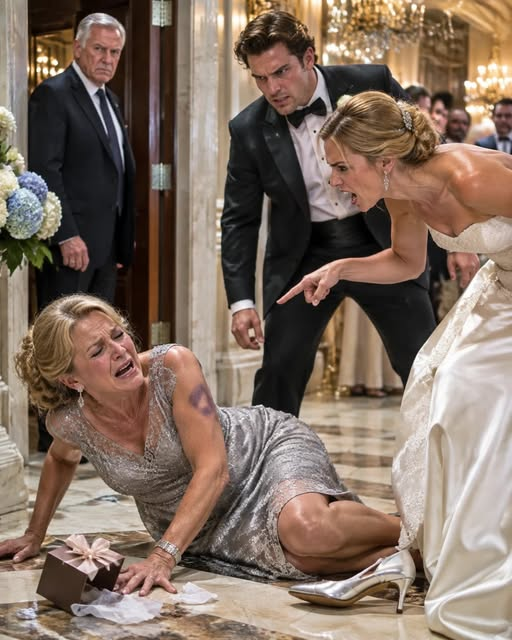
She was holding the old brown gift box.
The same box she'd carried at the wedding.
The same box Cassandra had knocked from her hands.
The pale ribbon had been replaced.
The torn corner had been repaired.
I looked at her.
"What's that?"
She smiled.
"I thought it was time."
She opened the box.
Inside were my mother's photograph, her letters, the brass key marked 214, and the gold flower brooch.
Ellen lifted the key.
"I've decided what to do with the trust."
I felt my stomach tighten.
"Sweetheart, you don't have to decide anything because of what happened."
"I know."
She smiled.
"That's why I'm deciding now."
I sat beside her.
"What do you want?"
She looked at the photograph.
"I want to use part of the money to help people who have been hurt by someone they love."
I stared at her.
She continued.
"Not to rescue people who refuse to change. Not to make excuses for them. But to help the people who need a safe place to go."
My throat tightened.
"That sounds like you."
She smiled.
"I'd like to establish a small fund. Something that helps older people get legal advice, medical care, or temporary housing when family members mistreat them."
I took her hand.
"Then we'll find the right people to help you do it."
She shook her head gently.
"We?"
I smiled.
"Only if you want me involved."
She laughed.
"Of course I do."
Then she added, "But the decision is mine."
I kissed her hand.
"Absolutely."
The following spring, the Eleanor Whitaker Family Safety Fund made its first grants through an established local nonprofit.
Ellen insisted that her name appear on the paperwork.
Not mine.
Not Michael's.
Hers.
She met with the organization's director.
She reviewed the proposed budget.
She asked questions about how the money would be used.
And when she signed the documents, her hand didn't shake.
I sat beside her, watching.
For years, Ellen had been the quiet center of our family.
The person who remembered birthdays.
Who brought soup when someone was sick.
Who stayed late to clean up after everyone else had gone home.
Now she was doing something entirely for herself.
Something she believed in.
Something nobody had pressured her to do.
When we left the office, she looked at me.
"Robert?"
"Yes?"
"I think your mother would have liked this."
I smiled.
"I think she'd have loved it."
On our forty-fourth wedding anniversary, I took Ellen back to the restaurant where I'd proposed.
It was a small place outside Philadelphia.
The wallpaper had changed.
The tables were newer.
But the windows still overlooked the same little garden.
We ordered dinner.
Ellen wore a blue dress.
The gold flower brooch rested on her shoulder.
I watched her read the menu.
Then I said, "You look beautiful."
She looked up.
"Robert Whitaker, are you trying to charm me?"
"Is it working?"
She smiled.
"After forty-four years? A little."
I laughed.
She reached across the table.
I took her hand.
For a moment, I thought about everything we'd survived.
The wedding.
The hospital.
The security footage.
The trust.
The courtrooms.
The fear.
The nights when neither of us slept.
And the long, difficult work of putting our lives back together.
Then I looked at the woman sitting across from me.
The woman who had loved me when I had nothing.
The woman who had nearly died bringing our son into the world.
The woman who had spent decades believing everyone else's needs mattered more than her own.
And I realized something.
For years, I had thought my greatest responsibility was keeping our family together.
But a family wasn't something you kept together by pretending nobody had been hurt.
It was something you protected by refusing to let love become an excuse for cruelty.
I squeezed Ellen's hand.
"Sweetheart?"
"Yes?"
"I need to tell you something."
She smiled.
"That sounds serious."
"It is."
I took a breath.
"When Michael was born, I thought becoming a father was the most important thing I'd ever done."
She watched me.
"And it was important. More important than I can explain."
I swallowed.
"But somewhere along the way, I started believing that being a good father meant keeping him happy."
Her expression softened.
"I think we both did."
I nodded.
"And when he hurt you, I realized I'd been wrong."
She squeezed my hand.
I looked into her eyes.
"I love our son. I always will."
"I know."
"But if I ever have to choose between protecting him from the consequences of his actions and protecting you from being hurt again, I will choose you."
Tears filled her eyes.
"Robert..."
"I should have said that a long time ago."
She shook her head.
"You've shown me."
"Maybe."
I smiled.
"But I wanted you to hear it."
She stood slowly.
I rose to meet her.
She wrapped her arms around me.
And for the first time in a long time, she held me without fear, without hesitation, without looking over her shoulder.
Just Ellen.
My Ellen.
When we sat down again, she wiped her eyes and laughed.
"You're going to make me cry into my anniversary dinner."
I smiled.
"Wouldn't be the first time."
"No," she said. "But this time, they're happy tears."
Later that evening, we returned home.
The porch light was on.
The garden smelled of lavender.
Inside, a photograph of my mother stood on the mantel beside a newer photograph of Ellen and me.
Michael had taken it at Thanksgiving.
We were standing in the garden, holding hands.
Ellen was laughing.
I was looking at her.
It was my favorite photograph.
I helped her out of her coat.
Then she took my hand.
"Come outside with me."
I smiled.
"It's getting late."
"I know."
We stepped onto the porch.
The night was warm.
The neighborhood was quiet.
Ellen leaned against the railing.
I stood beside her.
For a while, we simply watched the stars.
Then she looked at me.
"Robert?"
"Yes, sweetheart?"
"Are we going to be all right?"
I thought about the question.
A year earlier, I would have answered immediately.
I would have promised that everything would be fine.
That nothing could hurt us.
That our family would always be exactly as it had been.
But I knew better now.
We would grow older.
We would make mistakes.
There would be difficult days.
And there would be things neither of us could control.
But we had learned to tell each other the truth.
We had learned that love didn't require surrender.
And we had learned that even after terrible pain, a life could become beautiful again.
I took her hand.
"Yes," I said.
She smiled.
"How do you know?"
I looked at her.
"Because whatever comes next, we're going to face it together."
She rested her head against my shoulder.
I kissed her hair.
And standing there beneath the stars, with the woman I had chosen forty-four years earlier, I understood that I hadn't lost my family.
I had finally learned what it meant to love them without losing myself.
Ellen squeezed my hand.
"Happy anniversary, Robert."
I smiled.
"Happy anniversary, my love."
Then we went inside, closed the door, and began the rest of our lives.






Comments 0