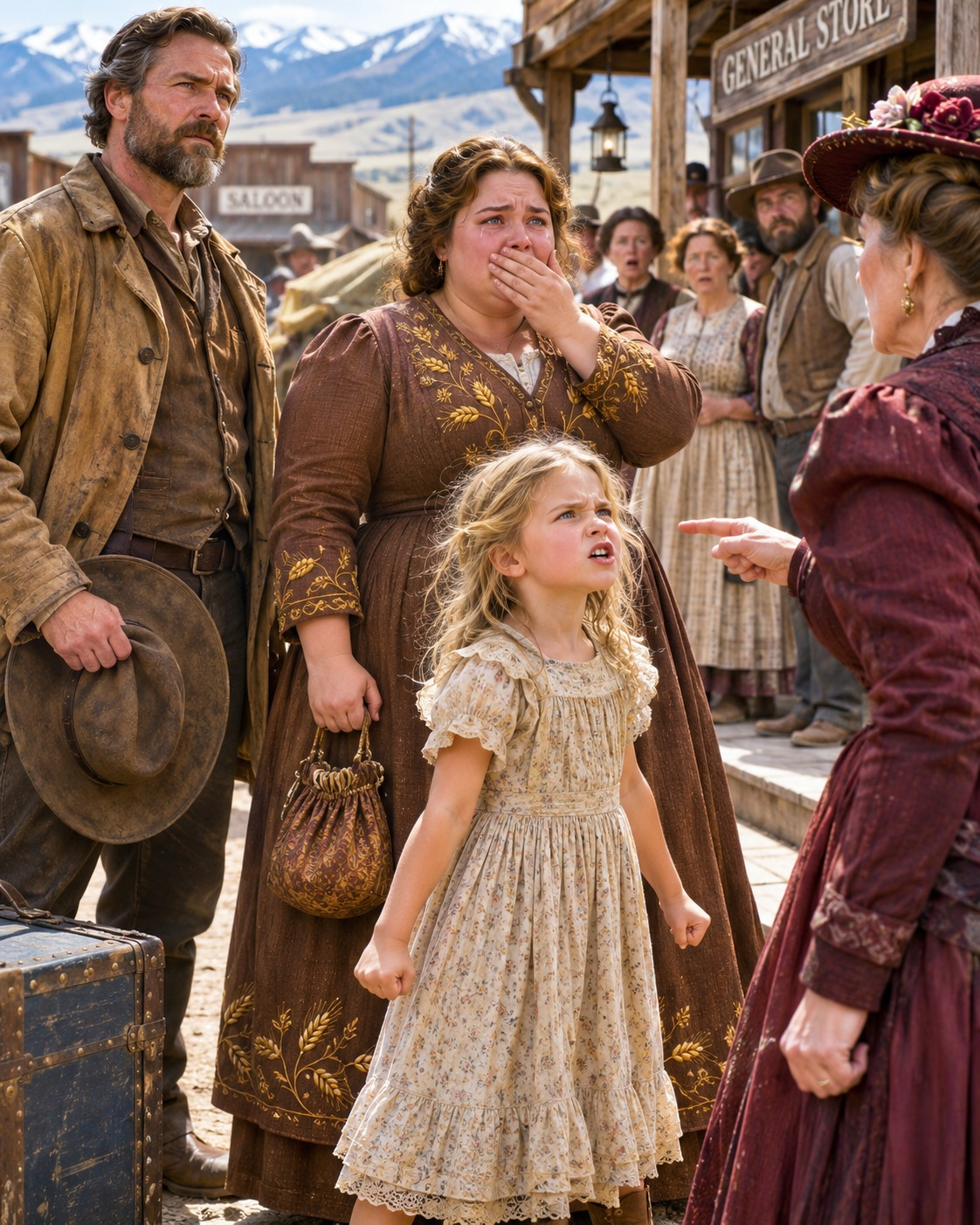
"STOP BEING MEAN TO HER!"
A six-year-old girl threw herself between a trembling bride and the wealthiest widow in Bitter Creek.
Rancher Amos Cutler stopped beside a battered blue trunk. A small brass plate on its handle bore two carefully scratched letters.
C. H.
He looked at the woman who had traveled across the country to become his wife.
Then he looked at the little girl defending her.
Something had changed.
And Martha Cobb was about to discover exactly what.
One hour earlier, Clara Higgins had stepped down from the stagecoach with everything she owned packed inside that battered blue trunk.
Thirty-six years old.
Unmarried.
Nearly penniless.
And, according to nearly everyone she had ever known, too large to deserve a happy ending.
She had spent the last twelve years working in Boston, first as a seamstress, then as a cook, and finally as the woman wealthy families summoned whenever their regular servants disappeared without warning.
She could prepare a meal for twenty people without wasting a scrap of flour. She could mend a torn winter coat so carefully that the damage became almost invisible. She could lift heavy sacks of potatoes, scrub floors until her knees ached, and sit beside a sick child through an entire night without once complaining.
But none of those things had ever seemed to matter.
People noticed her size first.
They always did.
Her broad shoulders, generous hips, round cheeks, and strong hands became the subject of whispers before she had the opportunity to introduce herself.
Some women looked at her with pity.
Others looked at her with disgust.
Men generally looked straight through her.
Once, at a church social, a man had asked whether she intended to eat the entire dessert table.
Everyone laughed.
Clara had laughed too.
Then she had gone home and cried into her pillow.
She had learned that sometimes joining in the laughter hurt less than standing alone beneath it.
But she was tired of laughing at herself.
Tired of apologizing for taking up space.
Tired of pretending that kindness from others was something she had to earn by making herself smaller.
That was why, three months earlier, she had answered a newspaper advertisement.
WIDOWER. WYOMING RANCHER. ONE YOUNG DAUGHTER. SEEKING HONEST WOMAN FOR MARRIAGE. MUST BE WILLING TO WORK. KINDNESS ESSENTIAL.
The advertisement had been signed:
AMOS CUTLER, BITTER CREEK, WYOMING TERRITORY.
Clara had stared at those words for nearly an hour.
Kindness essential.
Not beauty.
Not youth.
Not a slender waist or fashionable manners.
Kindness.
She had written him a letter that evening.
She told him she could cook, sew, preserve vegetables, care for animals, and manage a household.
She told him she had never been married.
She told him she loved children, although she had none of her own.
And then she told him the truth that had frightened away every man who had ever expressed an interest in her.
"I am a large woman, Mr. Cutler. I have been large all my life. If that troubles you, I would rather you know before either of us suffers disappointment."
She had sealed the letter with trembling hands.
Three weeks later, a train ticket arrived.
Inside the envelope was a short note.
Miss Higgins,
I asked for an honest woman, not a particular dress size.
Come before the first snow.
Amos Cutler.
Clara had read those words so many times that the paper had begun to soften along its folds.
Now, standing in Bitter Creek with the Wyoming mountains rising beyond the wooden rooftops, she wondered whether she had made the bravest decision of her life.
Or the most foolish.
"Miss Higgins?"
The voice came from behind her.
Clara turned.
A tall man stood beside a weathered ranch wagon.
He appeared to be in his mid-forties, with broad shoulders, a salt-and-pepper beard, and pale blue eyes that seemed accustomed to studying distant horizons.
His charcoal-gray coat was worn at the elbows.
His boots carried the dust of honest labor.
He held a dark cowboy hat in one hand.
"Yes," Clara answered.
"I'm Amos Cutler."
For a moment, neither spoke.
Clara became painfully aware of her green traveling dress.
She had spent weeks making it presentable.
The fabric was inexpensive, but she had embroidered tiny golden stalks of wheat along the cuffs and hem, threading ivy between them with careful stitches.
It was the prettiest dress she owned.
And suddenly it felt terribly inadequate.
Amos looked at her.
Not quickly.
Not with the embarrassed glance she had learned to recognize.
He simply looked.
Clara's heart hammered.
"You received my letter?" she asked.
"I did."
"And you understood what I wrote?"
"Every word."
She swallowed.
"I thought perhaps you might have imagined someone different."
Amos glanced toward her trunk.
"Are those your belongings?"
"Yes, sir."
He bent and lifted the trunk into the wagon.
Then he turned back.
"Name's Amos. No need for sir."
That was all.
No disappointed sigh.
No insulting remark.
No suggestion that the train had delivered the wrong woman.
Clara did not know what to make of him.
A small movement behind the wagon caught her attention.
A little girl was peering over the edge of a burlap sack.
She had strawberry-blonde braids, green eyes, and freckles scattered across her nose.
When Clara noticed her, she ducked.
Amos followed Clara's gaze.
"That's Sadie."
The little girl reappeared.
"She's six," Amos continued. "Takes a while to warm up to people."
Clara smiled gently.
"Hello, Sadie."
The child said nothing.
But her eyes traveled to the golden embroidery on Clara's dress.
Clara noticed.
"Do you like flowers?"
Sadie gave the smallest nod.
"These aren't quite flowers," Clara said. "They're wheat stalks. My mother taught me to sew them when I was little."
Sadie leaned forward.
"Did you make them?"
"Every stitch."
The little girl looked impressed.
Then she glanced at her father.
Amos cleared his throat.
"We should get moving. Magistrate's office is behind the post office. We'll have the papers signed, pick up supplies, and head to the ranch before dark."
Clara nodded.
Marriage.
Just like that.
No courtship beneath flowering trees.
No long walks along the harbor.
No handsome gentleman promising eternal devotion.
Only a quiet rancher, a shy child, and a wagon waiting in the dust.
Yet somehow, the simplicity comforted her.
Perhaps a practical beginning could become something beautiful.
Perhaps affection could grow where honesty had been planted first.
She gathered her reticule.
Amos offered his arm to help her step onto the boardwalk.
Clara hesitated.
He waited.
She accepted.
And for one brief, extraordinary moment, she felt like a woman being welcomed rather than inspected.
Then a voice rang out from the general store.
"Well, mercy me!"
Clara turned.
A woman stood beneath the wooden awning.
She was tall and rigid, dressed in expensive plum-colored fabric with black lace at the collar. Silver-gray hair rose beneath a decorated hat, and her sharp eyes moved over Clara with undisguised interest.
Three women stood nearby.
Two ranch hands leaned against the porch railing.
All five looked toward the newcomers.
The woman smiled.
It was not a pleasant smile.
"Amos Cutler," she announced. "So the rumors were true. You've finally ordered yourself a wife."
Amos's expression changed.
Only slightly.
But Clara felt his arm stiffen.
"Afternoon, Martha."
Martha Cobb stepped forward.
Her gaze traveled from Clara's face to her shoulders, then down the length of her dress.
She took her time.
Clara knew that look.
She had seen it in Boston drawing rooms, church halls, and crowded marketplaces.
It was the look people gave an animal at an auction.
"Well," Martha said, drawing out the word. "Isn't this a surprise?"
One of the women covered her mouth.
A ranch hand chuckled.
Clara's stomach tightened.
Martha tilted her head.
"Tell me, Amos. Did you order yourself a bride, or did you buy that woman by the pound?"
Laughter exploded across the boardwalk.
Clara stopped breathing.
The words struck with the familiar precision of a knife sliding into an old wound.
She had heard worse.
That was the terrible part.
She had heard worse, and yet this still hurt.
One of the ranch hands slapped his knee.
"Reckon Cutler won't have to worry about the winter wind blowing her away!"
More laughter.
Clara stared at the ground.
Her face burned.
She could feel every inch of herself.
Her broad waist.
Her thick arms.
The way her skirt stretched across her hips.
She wished she could disappear into the boards beneath her feet.
Martha stepped closer.
"Now, don't look so wounded, dear. We enjoy a little humor out here. You'll have to develop a thicker skin."
Another woman laughed.
Clara's fingers tightened around her reticule.
"I understand," she whispered.
But she didn't.
She had traveled thousands of miles.
She had sold nearly everything she owned.
She had trusted four handwritten words from a stranger.
And before she had even reached her new home, the world had reminded her exactly where it believed she belonged.
At the bottom.
Where people could laugh without consequence.
"Perhaps," Martha continued, "we ought to warn the dressmaker. She may need to order extra fabric."
Clara blinked rapidly.
She would not cry.
Not here.
Not in front of these people.
Not in front of the man who was supposed to become her husband.
She could endure humiliation.
She had endured it for thirty-six years.
But she could not bear the thought of Amos regretting his decision before they had even signed the marriage papers.
She glanced toward him.
His jaw was tight.
His eyes were fixed on Martha.
Yet he said nothing.
For one dreadful second, Clara wondered whether he agreed with them.
Perhaps he was embarrassed.
Perhaps he had been hoping the woman who stepped from the stagecoach would be smaller.
Prettier.
Easier to present to the town.
Clara lowered her head.
"I'm sorry," she whispered.
Amos turned.
"What for?"
She could barely meet his eyes.
"For causing trouble."
His brow furrowed.
Before he could answer, a small hand touched Clara's skirt.
Sadie stood beside her.
The little girl had climbed down from the wagon without anyone noticing.
She was looking at the golden wheat embroidered along Clara's hem.
"These are pretty," Sadie whispered.
Clara managed a trembling smile.
"Thank you, sweetheart."
Sadie touched one of the stitches.
"My mama used to sew."
The words were so quiet that Clara almost missed them.
She crouched carefully, bringing herself closer to the child's height.
"Did she?"
Sadie nodded.
"She made me a blanket. It has blue birds on it."
"That sounds lovely."
"She said birds always know how to find their way home."
Clara felt something tighten in her chest.
"Your mama sounds like she was very wise."
Sadie looked down.
"She died."
Clara's expression softened.
"I'm very sorry."
The child studied her face.
"Do you know how to sew birds?"
"I believe I could learn."
Sadie considered that answer.
Then she smiled.
It was a small smile.
But it was the first one Clara had received in Bitter Creek.
Behind them, Martha laughed again.
"Good heavens, Amos. The woman's already making herself comfortable. I suppose that's what happens when a man gets desperate."
Sadie's smile disappeared.
She turned.
Her little face tightened with confusion.
"Why are you laughing?" she asked.
Martha looked down at her.
"Because grown people are talking, child."
"But you're being mean."
The street quieted slightly.
Martha's eyebrows rose.
"Excuse me?"
Sadie moved closer to Clara.
"You made her sad."
Martha gave an irritated laugh.
"Oh, don't be ridiculous. Your father's bride needs to learn to take a joke."
Sadie looked at Clara.
At the tears Clara was desperately trying to hide.
At the beautiful golden embroidery.
At the hands that had sewn it.
Then the little girl turned back toward Martha.
Her fists tightened.
"STOP BEING MEAN!"
The words rang across the boardwalk.
Every conversation stopped.
One ranch hand straightened.
A woman gasped.
Amos looked at his daughter.
Sadie stepped directly in front of Clara.
She planted her boots firmly against the wooden boards.
"She's not a pound!" she shouted. "She's a lady, and she has golden flowers on her dress!"
Nobody laughed.
Sadie's little chest rose and fell.
Her face was flushed.
Her green eyes shone with anger.
"She made them herself," she continued. "And they're beautiful!"
Clara covered her mouth.
A tear slipped down her cheek.
She had been insulted by strangers for most of her life.
She had been dismissed by employers, overlooked by suitors, and mocked by people who knew nothing about her.
But no one had ever stood in front of her like this.
No one had ever looked at the world and declared that she deserved kindness.
And certainly no one had ever done it at six years old.
Martha's face hardened.
"Amos Cutler!"
Her voice cracked like a whip.
"You had better teach that disrespectful brat some manners!"
Sadie flinched.
Only slightly.
Then she lifted her chin.
Amos did not move.
Martha pointed toward the child.
"I will not be spoken to that way by a little girl who hasn't learned her place!"
Clara instinctively rested a hand on Sadie's shoulder.
"Please," she whispered. "There's no need—"
Martha snapped her attention toward Clara.
"And you! Don't encourage her insolence. This is precisely what happens when a household lacks proper feminine guidance."
Clara fell silent.
Martha turned back to Amos.
"Well? Are you going to discipline your daughter or stand there looking foolish?"
The entire street waited.
Amos slowly lowered Clara's trunk onto the boardwalk.
The brass fittings struck the wood with a heavy thud.
He straightened.
Removed his hat.
And stepped beside Sadie.
His face was calm.
Too calm.
Clara had seen angry men before.
She knew the warning signs.
A raised voice.
A clenched fist.
A face reddening with rage.
Amos displayed none of them.
He simply looked at Martha.
"Martha," he said.
She folded her arms.
"Yes?"
"My daughter knows more about respect than this whole town."
The silence deepened.
Martha blinked.
Amos continued.
"She saw a woman being humiliated. She saw grown people enjoying it. And she had the courage to say it was wrong."
His voice remained steady.
"If that's what you call disrespect, then I reckon you and I have very different ideas about manners."
One ranch hand looked away.
A woman lowered her eyes.
Martha's lips tightened.
"Now see here—"
"No," Amos interrupted quietly. "You see here."
Clara stared at him.
Amos took one step closer.
"You've known me for eleven years. You knew my wife. You brought food to my house when she died."
Martha's expression flickered.
"Of course I did."
"And I thanked you."
"Naturally."
"But kindness isn't something you get to use as a receipt for the rest of a person's life."
Martha's face reddened.
Amos gestured toward Clara.
"This woman traveled across the country because I asked her to. She came honestly. She came with nothing but her belongings and her willingness to build a life with me and my daughter."
His eyes hardened.
"She hasn't harmed a soul in this town."
Nobody moved.
"And yet you welcomed her by making her ashamed of the body God gave her."
Martha drew herself upright.
"I was merely—"
"Being cruel."
The words landed without force.
That made them worse.
Martha opened her mouth.
Nothing came out.
Amos looked toward the ranch hands.
"Funny thing about a joke. Usually everybody gets to laugh."
Neither man met his eyes.
Then Amos turned back toward Martha.
"You will not speak to Clara that way again."
Martha's gloved hands trembled.
"You cannot dictate what I say!"
"No," Amos replied. "But I can decide what I allow around my family."
The word hung in the air.
Family.
Clara felt it settle somewhere deep inside her.
Not hired help.
Not an unfortunate bargain.
Not a woman he had purchased because nobody else would have her.
Family.
Amos turned toward Sadie.
The little girl looked up at him anxiously.
For the first time, her courage seemed to waver.
"Papa?"
He crouched beside her.
"Yes, sweetheart?"
"Am I in trouble?"
Amos shook his head.
"No."
Sadie's lower lip trembled.
"But Mrs. Cobb said—"
"Mrs. Cobb was wrong."
The child stared at him.
Amos placed one hand on her shoulder.
"You stood up for someone who was being hurt. I'm proud of you."
Sadie's eyes filled with tears.
She threw her arms around his neck.
Amos held her tightly.
Clara turned her face away.
She could no longer stop crying.
Not because of Martha.
Not because of the laughter.
But because, for the first time in her adult life, someone had defended her without asking for anything in return.
Amos rose with Sadie beside him.
He turned toward Clara.
"Miss Higgins."
She quickly wiped her cheeks.
"Yes?"
"I'm sorry."
Clara blinked.
"For what?"
"For letting that go on as long as it did."
She shook her head.
"You don't need to apologize."
"Yes," he said. "I do."
His voice softened.
"You came here trusting me. I should've made sure you were treated with respect the moment you arrived."
Clara looked at him.
She had spent so many years apologizing for herself that she did not know what to do when someone apologized to her.
"I don't want to cause trouble," she whispered.
Amos glanced toward Martha.
"Trouble was here long before you stepped off that stagecoach."
A faint sound escaped Clara.
Almost a laugh.
Almost a sob.
Sadie slipped her small hand into Clara's.
"Are you still going to come home with us?"
Clara looked down.
The little girl's face was full of concern.
"Would you like me to?"
Sadie nodded vigorously.
"Yes."
Clara smiled through her tears.
"Then I would like that very much."
Amos picked up the trunk.
"Come on. We've got papers to sign."
He offered Clara his arm again.
This time, she accepted without hesitation.
They walked toward the post office.
Behind them, Martha Cobb stood motionless.
Her face had gone pale beneath its powder.
The townspeople began murmuring.
One of the ranch hands removed his hat.
The other stared at his boots.
Martha watched Amos walk away with Clara on his arm and Sadie holding her hand.
Her eyes narrowed.
Because there was something Clara did not know.
Something Amos had never told her.
And something Martha Cobb had spent years ensuring nobody in Bitter Creek would ever discover.
The magistrate's office occupied two rooms behind the post office.
A thin, elderly man named Mr. Whitcomb greeted them from behind a desk piled with ledgers.
He glanced at Amos.
Then Clara.
Then Sadie.
"Well, well," he said warmly. "Looks like we're having a wedding."
Clara's cheeks flushed.
Amos nodded.
"If Miss Higgins is still willing."
The words surprised her.
She turned toward him.
Amos met her eyes.
"I won't hold you to a promise made before you knew what kind of town you were coming to."
Clara stared at him.
"You would let me leave?"
"Of course."
"But you paid for my ticket."
"That doesn't mean I own you."
She felt her throat tighten.
Amos continued.
"If you want to go back East, I'll arrange it. If you want time to think, I'll find you somewhere respectable to stay."
Sadie looked alarmed.
"But Papa—"
He rested a hand on her head.
"Clara gets to decide, sweetheart."
Clara studied the man standing before her.
He was not handsome in the polished way Boston gentlemen tried to be.
His coat was worn.
His hands were rough.
He spoke as though every word cost something and ought not be wasted.
Yet he had just offered her something no one had ever given her freely.
A choice.
She looked at Sadie.
The little girl was watching her with enormous hopeful eyes.
Then Clara looked at Amos.
"I didn't come all this way to turn around because one woman has an ugly tongue."
A faint smile touched his mouth.
"Glad to hear it."
Clara drew a steady breath.
"If you're still willing, Mr. Cutler, then so am I."
"Amos," he corrected.
She smiled.
"Amos."
Mr. Whitcomb cleared his throat.
"Well, then. Shall we begin?"
The ceremony was simple.
There were no flowers.
No music.
No crowd of smiling relatives.
Only a dusty office, a wooden desk, a quiet rancher, a nervous bride, and a six-year-old girl who insisted on standing between them.
When Mr. Whitcomb asked whether Amos took Clara as his lawful wife, he answered without hesitation.
"I do."
When Clara was asked the same question, her voice trembled.
But the words came clearly.
"I do."
Amos placed a plain gold band on her finger.
It was slightly worn.
Clara noticed.
He saw her glance.
"It belonged to my mother," he explained quietly. "I hope that's all right."
Clara looked at the ring.
Then at him.
"It's beautiful."
Sadie tugged her sleeve.
"Does this mean you're my new mama?"
The room became very still.
Clara crouched beside her.
"Sweetheart, nobody could ever replace your mama."
Sadie's expression grew solemn.
Clara continued.
"But if you'll let me, I'd be honored to be someone who loves you and takes care of you."
Sadie thought about that.
Then she wrapped her arms around Clara's neck.
Clara closed her eyes.
And held her.
They were preparing to leave when Mr. Whitcomb called Amos back to the desk.
"One more thing."
Amos turned.
The magistrate's pleasant expression had disappeared.
He reached beneath a stack of papers and withdrew a sealed envelope.
"This came for you yesterday."
Amos frowned.
"From who?"
"County office."
Amos took the envelope.
His eyes moved across the writing.
Clara noticed his expression change.
Only slightly.
But enough.
"Something wrong?" she asked.
Amos folded the envelope without opening it.
"Probably nothing."
Mr. Whitcomb looked uncomfortable.
"Amos, I think you ought to read it before you leave town."
Amos glanced toward Sadie.
Then Clara.
"Not now."
The magistrate lowered his voice.
"She's been asking questions again."
Amos went still.
Clara felt the air change.
"Who has?" she asked.
Neither man answered.
Mr. Whitcomb leaned closer.
"She says she has documents this time."
Amos's jaw tightened.
"Documents don't make lies true."
"No," the magistrate replied. "But they can make trouble."
Clara looked from one man to the other.
"What kind of trouble?"
Amos slipped the envelope into his coat.
"Nothing you need to worry about today."
But his expression said otherwise.
Sadie had grown unusually quiet.
She moved closer to Clara and took her hand.
Outside, the sound of wagon wheels drifted through the afternoon air.
Amos thanked the magistrate and guided his new family toward the door.
Clara followed.
But as they reached the threshold, she noticed Sadie staring at the envelope protruding from her father's coat.
The child's fingers tightened around hers.
"Clara?" Sadie whispered.
"Yes, sweetheart?"
Sadie looked up.
Her green eyes were suddenly frightened.
"Mrs. Cobb came to our house last week."
Clara stopped.
"What did she want?"
Sadie glanced toward her father.
Then lowered her voice.
"She said Papa was going to lose something."
Clara crouched beside her.
"Lose what?"
Sadie's lips trembled.
"She said he was going to lose me."
Before Clara could answer, a sharp knock sounded against the magistrate's office window.
Amos turned.
Martha Cobb stood outside.
She was no longer smiling.
In one gloved hand, she held a folded legal document.
With the other, she pointed directly at Sadie.
Mr. Whitcomb hurried toward the window.
He took one look at the paper.
And his face went white.
"Amos," he whispered. "You need to see this."
Amos stepped forward.
The magistrate unfolded the document.
At the top, beneath the county seal, were five words that made his blood run cold.
PETITION FOR REMOVAL OF CHILD.
And beneath them was a signature Amos recognized immediately.
The signature belonged to someone who was supposed to be dead.






Comments 0