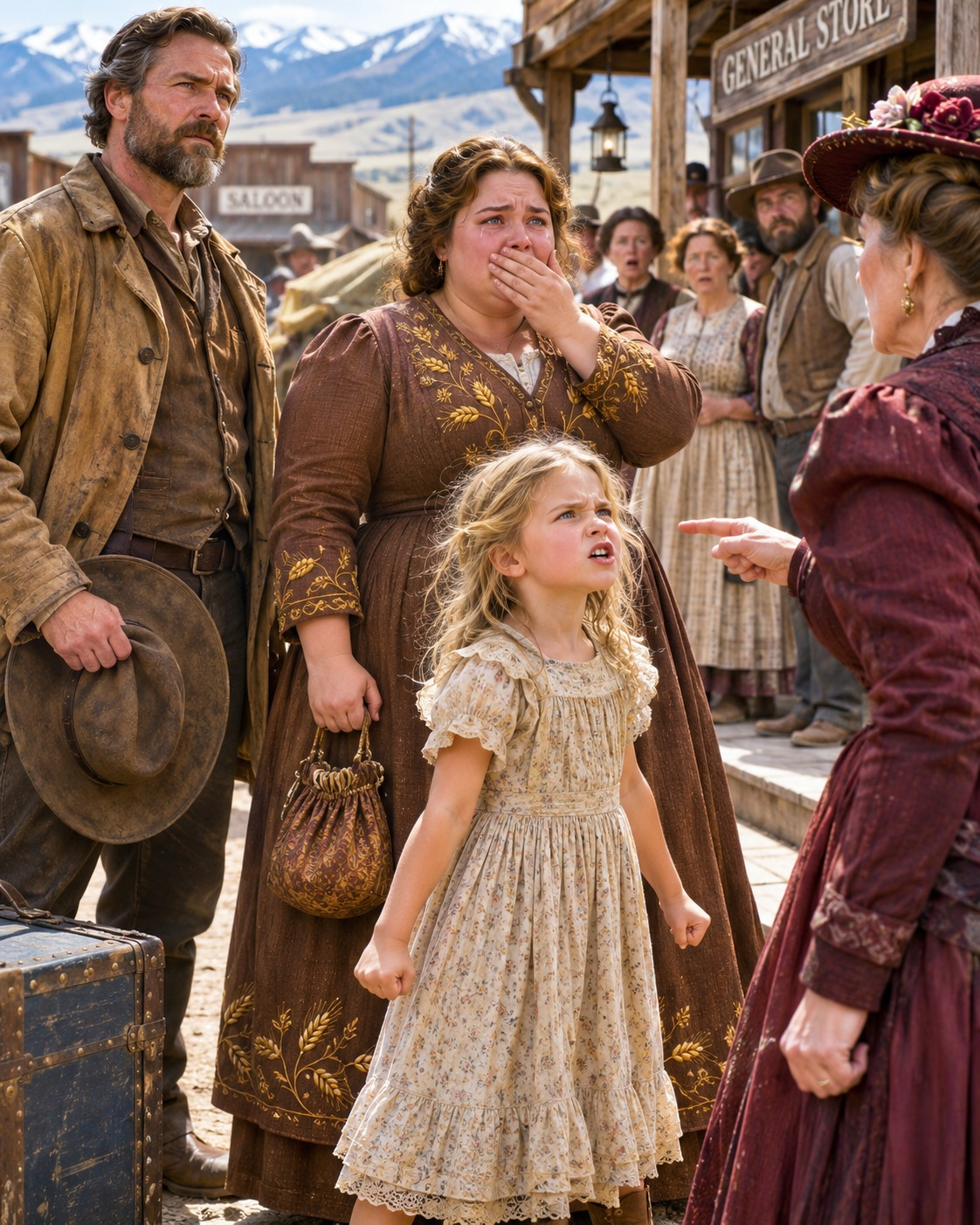
"The woman who signed this petition has been dead for three years."
Amos Cutler's voice was so quiet that Clara almost failed to hear him.
He stood inside the magistrate's office, holding a legal document that had turned his weathered face pale.
Outside the window, Martha Cobb watched with a satisfied expression.
And beside Clara, six-year-old Sadie began to tremble.
"Papa?" the little girl whispered. "Are they going to take me away?"
Amos looked down at his daughter.
For one terrible moment, he could not answer.
Then he folded the document, placed it on the magistrate's desk, and said five words that made Martha's smile disappear.
"Nobody is taking my daughter."
Mr. Whitcomb adjusted his spectacles.
"Amos, I strongly suggest you lower your voice."
"My voice is perfectly calm."
"Then I suggest you listen carefully."
The elderly magistrate glanced toward the window, where Martha Cobb stood beneath the afternoon sunlight.
Her expensive plum-colored dress was perfectly arranged.
Her gloved hands rested against her waist.
She looked like a woman waiting for a carriage rather than someone attempting to destroy a family.
Clara had known her for less than an hour.
Already, she understood that Martha's cruelty was not accidental.
It was practiced.
Deliberate.
And, apparently, far more dangerous than a few insults outside the general store.
"What does the petition say?" Clara asked.
Whitcomb hesitated.
Amos looked at her.
"Clara, you don't have to involve yourself in this."
She stared at him.
"Amos Cutler, we were married less than twenty minutes ago."
"I know."
"Then whatever concerns your daughter concerns me."
His expression shifted.
Not into a smile.
Something quieter.
Something almost grateful.
Whitcomb cleared his throat.
"The petition requests that Sadie Cutler be removed from her father's custody pending an investigation into the suitability of her home."
Clara felt her stomach tighten.
"On what grounds?"
"Neglect. Improper supervision. Emotional instability following her mother's death."
"That's a lie!" Sadie cried.
The adults turned.
The little girl stood beside Clara, her strawberry-blonde braids resting against her pale blue dress.
Her small face had gone white.
"Papa takes care of me!"
Amos immediately crouched.
"Sadie, sweetheart, look at me."
She shook her head.
"Mrs. Cobb said I had to go live with her!"
Clara felt a cold sensation travel down her spine.
Amos placed both hands gently on his daughter's shoulders.
"You're coming home with us."
"But she said—"
"Listen to me."
Sadie's frightened eyes met his.
"I have never broken a promise to you, have I?"
She shook her head.
"Then believe me when I say I'm going to do everything I can to keep you safe."
Sadie threw herself into his arms.
Amos held her tightly.
Clara watched them.
She had known this man for barely an hour, but she recognized something unmistakable in the way he embraced his child.
He was afraid.
Not for himself.
For her.
And he was working desperately to make certain she never noticed.
Whitcomb waited until Sadie had settled beside Clara.
Then he unfolded the petition again.
"The document contains a sworn statement supposedly made by Eleanor Cutler."
Amos's face hardened.
"My wife died three years ago."
"I know that."
"Then explain how she signed a statement dated last month."
Whitcomb looked down.
"That's precisely the problem."
Clara leaned forward.
"May I see it?"
The magistrate hesitated before sliding the paper across the desk.
Clara examined the document.
She had never studied law.
She knew little about legal proceedings.
But she knew handwriting.
For twelve years, she had copied household accounts, written letters for employers, and repaired old family books whose pages had begun to crumble.
She had learned that people revealed themselves in the smallest movements of a pen.
The statement appeared official.
It carried a county seal.
It named Amos Cutler as an unsuitable guardian.
And at the bottom was a flowing signature.
Eleanor Margaret Cutler.
Clara studied it.
Something bothered her.
"Do you have another example of your late wife's handwriting?" she asked Amos.
He looked surprised.
"At the ranch."
"Letters?"
"A few."
"Then we should compare them."
Whitcomb shook his head.
"Mrs. Cutler, this is a legal matter."
Clara looked up.
"And legal matters depend on evidence, don't they?"
"Certainly."
"Then evidence is exactly what we need."
The magistrate removed his spectacles.
For the first time, he seemed to look at Clara as something other than the woman Amos had just married.
Amos stepped closer.
"What do you see?"
"I'm not certain yet."
She examined the signature again.
"The writing is unusually careful. Whoever signed this wanted the name to be recognized."
Whitcomb frowned.
"That isn't proof of anything."
"No," Clara agreed. "But a dead woman's signature on a recent document is certainly reason to ask questions."
Amos studied her.
Then he turned toward the magistrate.
"Who filed it?"
Whitcomb's expression tightened.
"Martha Cobb delivered it to the county clerk yesterday."
"On whose authority?"
"She claims she was acting on behalf of Eleanor's family."
Amos gave a short, humorless laugh.
"Eleanor's parents died before Sadie was born."
"She claims there is another relative."
"Who?"
Whitcomb looked toward the window.
Martha had moved closer.
She was watching them through the glass.
"She hasn't identified that person yet."
Amos's jaw tightened.
"Convenient."
Martha Cobb entered without knocking.
Her boots clicked against the wooden floor.
"Well," she said pleasantly, "I see everyone has become acquainted with the unfortunate situation."
Amos turned.
"You forged my dead wife's signature."
Martha's smile vanished.
"Be very careful, Amos."
"Answer me."
"I did no such thing."
"Then who did?"
"I merely delivered documents entrusted to me."
"By whom?"
"That is not your concern."
Amos took one step forward.
Clara noticed Martha stiffen.
But he stopped several feet away.
His hands remained at his sides.
His voice never rose.
"My daughter is my concern."
Martha folded her arms.
"Your daughter is a child who has been raised without proper feminine guidance for three years."
Clara felt Sadie's fingers tighten around her hand.
Martha continued.
"And now you've brought a complete stranger into your home. A woman you've known for less than a day."
"She's my wife," Amos replied.
"On paper."
The words landed sharply.
Clara felt their intended cruelty.
Martha turned toward her.
"No offense, Mrs. Cutler, but you cannot possibly believe that a hurried marriage to a woman from Boston will convince respectable people that Amos has suddenly become a suitable father."
Clara held her gaze.
"I believe a suitable father is one who loves and protects his child."
Martha laughed.
"How touching."
"Sadie appears well cared for."
"Appearances can be deceiving."
Clara glanced at the document.
"Indeed they can."
Martha's eyes narrowed.
For a brief moment, the two women studied each other.
Clara had spent years learning how to survive women like Martha Cobb.
Women who used social standing as a weapon.
Women who spoke sweetly while destroying someone else's reputation.
But Clara had never before had anyone worth defending as fiercely as herself.
Now she did.
A little girl stood beside her.
A little girl who had defended her when every adult in the street had remained silent.
Clara was not about to forget that.
"Mrs. Cobb," she said calmly, "why do you want Sadie removed from her father?"
Martha lifted her chin.
"Because someone must consider the child's welfare."
"Has Amos harmed her?"
"That's not the point."
"Has he failed to feed her?"
"Of course not."
"Has he abandoned her?"
"Don't be absurd."
"Then what exactly has he done?"
Martha's cheeks reddened.
"He has refused to listen to people who know better!"
Clara nodded slowly.
"I see."
Something in her expression made Martha uncomfortable.
"Don't look at me that way."
"What way?"
"As though I'm the one being unreasonable."
Clara's voice remained gentle.
"I only asked you to explain your concerns."
Martha looked toward Whitcomb.
"Are you going to allow this woman to interrogate me?"
The magistrate sighed.
"Mrs. Cobb, she has a reasonable question."
Martha stared at him.
Then at Amos.
Then at Clara.
And for the second time that afternoon, she discovered that the people around her were no longer responding as she expected.
The magistrate explained that the petition had not yet been approved.
A hearing would be required.
The county judge was expected in Bitter Creek within the next two weeks.
Until then, Sadie would remain with Amos unless evidence of immediate danger emerged.
Amos demanded a copy of every document.
Whitcomb agreed.
Martha protested.
Whitcomb ignored her.
Clara noticed that.
It was a small thing.
But small things mattered.
By the time they left the office, the afternoon sun had begun descending toward the mountains.
Sadie was exhausted.
She clung to Clara's hand as they walked toward the wagon.
Amos carried the trunk.
Martha followed them onto the boardwalk.
"This isn't finished," she announced.
Amos stopped.
"No," he agreed. "It isn't."
Martha's eyes moved toward Clara.
"You should understand something, Mrs. Cutler."
Clara turned.
"Bitter Creek is a small town. People here remember things."
Clara looked at her steadily.
"So do I."
Martha's smile became thin.
"You may find that life on a ranch is considerably harder than you imagined."
"I expect it will be."
"And a child who has lost her mother can be difficult."
Clara felt Sadie move closer.
"Children need patience," she answered.
"They need discipline."
"They need love."
Martha's expression hardened.
"Love doesn't keep a roof over anyone's head."
Amos stepped beside Clara.
"That's enough."
Martha looked at him.
"You always were stubborn."
"And you've always mistaken stubbornness for something you can purchase."
Her face changed.
Just for an instant.
Clara noticed.
Purchase.
It was a peculiar word.
And Martha reacted to it as though Amos had touched a hidden wound.
But before Clara could think further, Amos helped Sadie into the wagon.
Then he turned toward his new wife.
"Ready to go home?"
Clara looked at the child waiting among the burlap sacks.
Then at the man standing beside her.
Home.
The word felt unfamiliar.
Almost dangerous.
But she nodded.
"Yes."
The wagon left Bitter Creek behind as the sun lowered over the Wyoming hills.
For the first mile, nobody spoke.
The wheels rattled over the uneven road.
The horses moved steadily.
Sadie sat between Amos and Clara, holding a small wooden horse with one broken ear.
Clara watched the mountains rise against the distant sky.
She had never seen so much open country.
In Boston, buildings pressed close together.
People crowded the streets.
Even the air sometimes seemed to belong to someone else.
Here, the land stretched farther than she could imagine.
And yet she felt the weight of an entire town following her.
Amos broke the silence.
"I'm sorry your first day turned out this way."
Clara looked at him.
"You've apologized twice already."
"Probably owe you a third."
She smiled faintly.
"I don't think you do."
He glanced toward her.
"You could still change your mind."
"About what?"
"Staying."
Clara considered him.
"Would you like me to?"
"No."
The answer came immediately.
It surprised them both.
Amos cleared his throat.
"I mean, you're welcome to stay. I just don't want you feeling trapped."
Clara looked down at the wedding ring on her finger.
"I spent most of my life feeling trapped, Amos."
He said nothing.
"In Boston, I worked for people who believed they were doing me a favor by employing me. They paid me less than other women because they assumed I had nowhere else to go."
She paused.
"I suppose they were right."
Amos kept his eyes on the road.
"That sounds like a hard life."
"It was honest work."
"Honest work can still be hard."
Clara looked at him.
Something about that simple statement made her chest ache.
She had expected questions about her cooking.
Her sewing.
Her ability to manage a household.
She had not expected someone to recognize that her life might have been difficult.
Sadie leaned against her arm.
"Clara?"
"Yes, sweetheart?"
"Do you know how to make biscuits?"
Clara smiled.
"I do."
"Good biscuits?"
"I've been told they're quite good."
Sadie considered that.
"Papa's biscuits are terrible."
Amos sighed.
"Sadie."
"They are."
Clara laughed.
It was a genuine laugh.
The first one she had managed all day.
Sadie grinned.
"Sometimes they're so hard you could throw them at a wolf."
"That's enough," Amos muttered.
But Clara saw the corner of his mouth twitch.
"Then perhaps," she said, "we should make biscuits together tomorrow."
Sadie's face brightened.
"With honey?"
"If we have some."
"We have honey!"
"Then with honey."
Sadie leaned against her.
And before the wagon had traveled another mile, the little girl fell asleep.
The Cutler ranch appeared beyond a low ridge.
A modest wooden house stood near a weathered barn.
A fenced pasture stretched toward a creek lined with cottonwood trees.
There were chickens near the porch.
Two horses grazed beyond the fence.
Smoke rose from the chimney.
It was not grand.
It was not fashionable.
But it was beautiful in a way Clara had never expected.
Amos pulled the wagon to a stop.
"Well," he said. "Here we are."
Clara stared.
"Is all this yours?"
"Most of it belongs to the bank until the mortgage is paid."
He said it plainly.
Without embarrassment.
Clara appreciated that.
"How much land?"
"About four hundred acres."
She turned toward him.
"Four hundred?"
"Not all good grazing."
Still, she was astonished.
Amos climbed down.
Then he reached up to help her.
Clara hesitated.
She was accustomed to managing without assistance.
But Amos waited patiently.
She placed her hand in his.
He helped her down as though it were the most natural thing in the world.
Then he lifted the sleeping Sadie from the wagon.
The little girl murmured something against his shoulder.
Amos kissed the top of her head.
Clara watched.
She thought of all the stories she had heard about frontier men.
Hard men.
Rough men.
Men who believed affection made children weak.
Amos Cutler carried his daughter as though she were the most precious thing he owned.
And perhaps she was.
Inside, the house smelled of wood smoke, leather, and coffee.
The furniture was simple.
A large kitchen table stood near the stove.
There were shelves filled with chipped dishes and carefully folded linens.
A faded quilt lay across the back of a chair.
Clara noticed that the house was clean.
Not perfectly arranged.
But cared for.
Someone had tried.
Amos carried Sadie into a small bedroom.
Clara waited near the kitchen.
On the mantel stood a framed photograph.
A young woman sat beside Amos, holding a baby.
She had gentle eyes and dark hair arranged beneath a simple bonnet.
Clara approached.
Eleanor.
She knew without asking.
The woman in the photograph was beautiful.
Not in a grand or fashionable way.
She possessed the kind of beauty that came from warmth.
From happiness.
From being loved.
Clara studied the photograph.
Then she looked at her own reflection in the dark window.
For a moment, the old familiar insecurity returned.
How could she possibly belong in a house where another woman had once been so deeply loved?
"That was taken the year Sadie was born."
Amos stood in the doorway.
Clara turned.
"I'm sorry. I didn't mean to pry."
"You're not prying."
He approached the mantel.
For a long moment, he looked at the photograph.
"Eleanor loved this place."
Clara said nothing.
"She planted the roses outside the kitchen window. Most died the winter after she passed."
His voice grew quieter.
"I never was much good with flowers."
Clara looked toward the window.
"Perhaps we could try again in spring."
Amos turned toward her.
The suggestion seemed to surprise him.
Then he nodded.
"Perhaps."
Clara looked back at the photograph.
"She was lovely."
"She was."
There was no hesitation in his answer.
Clara respected him for that.
He did not pretend his first wife had never existed.
He did not erase the woman who had given him Sadie.
And somehow, that made Clara trust him more.
"Amos," she said carefully, "I don't expect to replace her."
He looked at her.
"I know."
"I only hope I can make this home a little easier for you both."
He studied her for a moment.
Then he said something she had not expected.
"You already have."
That evening, Clara prepared supper.
Amos protested at first.
She ignored him.
There was flour in the pantry, dried beans, onions, salt pork, and enough vegetables to make a proper meal.
She moved through the kitchen with practiced confidence.
Within an hour, the stove was warm, the table was set, and the smell of fresh biscuits filled the house.
Sadie woke just as Clara removed the baking pan.
The little girl appeared in the doorway rubbing her eyes.
She stopped.
Sniffed.
Then looked at her father.
"Papa."
"Yes?"
"Those aren't your biscuits."
Amos sighed.
"No, sweetheart."
Sadie grinned.
"I knew it."
Clara laughed.
They ate together at the kitchen table.
Sadie talked more than she had all afternoon.
She told Clara about the chickens.
About the creek.
About a stubborn calf named Button who liked to escape through a loose section of fence.
Clara listened to every word.
Amos watched them quietly.
Once, when Sadie reached for a second biscuit, he looked at Clara.
There was something in his expression she could not quite name.
Relief, perhaps.
Or hope.
After supper, Sadie insisted on showing Clara her bedroom.
The room contained a narrow bed, a wooden rocking horse, and a small chest filled with treasures.
Clara noticed a blue quilt folded carefully at the foot of the bed.
Tiny birds had been stitched across its surface.
Sadie touched it reverently.
"Mama made this."
Clara sat beside her.
"It's beautiful."
"She said the birds would always bring me home."
Clara traced one careful stitch.
"Your mother had very talented hands."
Sadie looked at her.
"Can you fix it?"
Clara frowned.
"Fix what?"
Sadie unfolded one corner.
A seam had torn.
The stuffing was beginning to escape.
"Papa tried," Sadie explained. "But his stitches look like spiders."
Clara smiled.
"I think I can manage."
Sadie's face brightened.
"Really?"
"Really."
The little girl leaned against her.
"Will you stay forever?"
Clara's heart tightened.
She knew better than to make promises lightly.
Especially to a child who had already lost someone she loved.
"I intend to stay," she answered softly.
Sadie considered that.
Then she wrapped her arms around Clara.
"Good."
Later, after Sadie had fallen asleep, Clara returned to the kitchen.
Amos sat at the table.
The envelope from the magistrate's office lay open before him.
His expression was troubled.
Clara stopped in the doorway.
"Is everything all right?"
He looked up.
"No."
She approached.
"May I sit?"
He pulled out a chair.
Clara sat across from him.
For a moment, neither spoke.
Then Amos pushed the letter toward her.
"You deserve to know what you've married into."
Clara unfolded the paper.
The county clerk's notice was brief.
A formal complaint had been filed.
The allegations included neglect, financial instability, and failure to provide a suitable household for Sadie.
But one paragraph caught Clara's attention.
It claimed that Eleanor Cutler had expressed concerns about Amos's ability to care for their daughter shortly before her death.
Clara looked up.
"Did she?"
Amos shook his head.
"Never."
"Then why would someone say she did?"
His expression darkened.
"Because someone wants Sadie taken away."
Clara studied him.
"Why?"
Amos leaned back.
For a long moment, he stared toward the dark kitchen window.
Then he spoke.
"Three years ago, Eleanor died during a fever that swept through the valley."
Clara listened.
"After the funeral, Martha Cobb came to the ranch almost every day. Brought food. Helped with Sadie. Said she wanted to honor Eleanor's memory."
"That sounds kind."
"It was. At first."
He paused.
"Then she started making decisions."
"What kind?"
"How Sadie should dress. What she should eat. Which neighbors she could visit."
Clara frowned.
"And you objected?"
"Eventually."
Amos rubbed a hand across his beard.
"One afternoon, she told me Sadie would be better off living with her."
Clara went still.
"What did you say?"
"I told her my daughter belonged with me."
"And?"
"She didn't take it well."
Clara looked down at the petition.
"So this has been going on for years."
"Not like this."
Amos leaned forward.
"She complained. Spread rumors. Told people I was neglecting Sadie because I worked long hours."
"Was there ever an investigation?"
"Once. The sheriff came out, looked around, and told her to mind her own business."
Clara considered that.
"Then why now?"
Amos's eyes shifted toward the envelope.
"That's what worries me."
He reached into his coat and withdrew another folded paper.
"This arrived last month."
Clara accepted it.
It was a notice from the bank.
The Cutler ranch mortgage was overdue.
A substantial payment would be required before winter.
Clara looked up.
"Amos..."
"I had a bad season. Lost cattle in the spring floods. Then the price of beef dropped."
"How much do you owe?"
He told her.
The amount made her stomach sink.
It was more money than she had earned in several years.
"Can you pay it?"
"I can manage part of it."
"And the rest?"
He said nothing.
Clara looked at the bank notice again.
Then at the petition.
"Do you think Martha knows?"
Amos nodded slowly.
"She knows everything that happens in this town."
"Then perhaps the two things are connected."
His eyes met hers.
"That's what I've been afraid of."
A clock ticked above the kitchen doorway.
Outside, wind moved through the cottonwood trees.
Clara folded the bank notice carefully.
"Amos, I need to ask you something."
"Go ahead."
"Why did you advertise for a wife?"
He looked surprised.
"That's a strange question to ask after we're married."
"Perhaps. But I'd still like an answer."
He considered her.
Then he spoke plainly.
"Sadie needed someone."
Clara lowered her eyes.
"I see."
Amos continued.
"And I was lonely."
She looked up.
He stared at his hands.
"I didn't realize how lonely until I wrote that advertisement."
The admission seemed difficult for him.
Clara waited.
"I wasn't looking for someone to replace Eleanor. I knew that couldn't happen."
"I understand."
"I wanted someone honest. Someone who wouldn't resent Sadie. Someone who could build a life here."
He looked directly at her.
"And when I read your letter, I thought perhaps I'd found her."
Clara felt warmth rise in her cheeks.
"You barely knew me."
"I knew you told the truth when you had every reason to hide it."
She swallowed.
"About my appearance?"
"About everything."
Amos leaned forward.
"You told me what you could do. What you couldn't. What frightened you. You didn't pretend to be someone else."
Clara stared at him.
"And you thought that was enough?"
He frowned slightly.
"Shouldn't it be?"
For a moment, she could not speak.
She thought of Boston.
Of the employers who praised her work but refused to let her sit at their tables.
Of the men who laughed at her body.
Of the years spent believing that affection was something reserved for prettier women.
Then she looked at Amos Cutler.
A man who had married her without asking her to become smaller.
"Yes," she whispered.
"It should."
Amos rose.
"You must be exhausted."
Clara nodded.
"A little."
"I made up the spare room."
She looked surprised.
"The spare room?"
He seemed suddenly uncomfortable.
"I thought you might appreciate some privacy. We don't know each other very well."
Clara studied him.
He was offering her another choice.
Another small kindness.
She smiled.
"Thank you."
Amos picked up the lamp.
"I'll show you."
The spare room was modest but clean.
A narrow bed stood beside a window overlooking the pasture.
There was a wooden dresser, a washstand, and a small chair.
Clara's trunk had already been placed near the foot of the bed.
Amos set the lamp on the dresser.
"If you need anything, my room's across the hall."
Clara looked around.
"It's lovely."
He gave a faint smile.
"Not much."
"It's more than enough."
He hesitated at the doorway.
"Clara?"
"Yes?"
"I'm glad you came."
Her throat tightened.
"So am I."
He nodded.
Then he left.
Clara stood alone in the quiet room.
For a long moment, she did not move.
Then she sat on the bed and removed her boots.
Her feet ached.
Her shoulders were sore.
Her heart felt as though it had traveled farther than the train that brought her here.
She looked at the wedding ring on her finger.
Plain gold.
A little worn.
Beautiful.
She had been married for only a few hours.
Already, she had been humiliated, defended, threatened, and welcomed.
She had gained a husband.
A stepdaughter.
And an enemy.
Clara sighed.
Then she opened her trunk.
Inside were carefully folded dresses, a sewing box, two books, and a small packet of letters tied with blue ribbon.
At the bottom lay a photograph of her mother.
Clara lifted it gently.
Her mother had been a large woman too.
Strong.
Warm.
Always working.
And always telling Clara that the world was full of people who mistook cruelty for honesty.
"Never let them teach you to be ashamed of kindness," her mother used to say.
Clara pressed the photograph against her chest.
"I think you'd like them, Mama," she whispered.
She placed it on the dresser.
Then she opened her sewing box.
Tomorrow, she would repair Sadie's quilt.
Perhaps she would bake more biscuits.
Perhaps she would begin learning the rhythms of ranch life.
But first, there was something she needed to understand.
She reached into her reticule and withdrew the copy of the custody petition.
Amos had given it to her before leaving the kitchen.
She unfolded it beneath the lamplight.
The signature still troubled her.
Eleanor Margaret Cutler.
Clara examined the letters carefully.
The capital E was unusually ornate.
The final flourish beneath the surname curved sharply upward.
She had seen something similar before.
Not in Boston.
Not in a letter.
Earlier that afternoon.
She closed her eyes.
Tried to remember.
Martha Cobb.
The general store.
The magistrate's office.
The folded document.
The gloved hand.
Then she remembered.
Martha had carried a small embroidered handkerchief.
At one corner was a monogram.
The same looping style.
The same unusual flourish.
Clara's heart began to beat faster.
She knew that handwriting and embroidery were different arts.
A resemblance proved nothing.
But it gave her a place to begin.
She placed the petition beside the lamp.
Tomorrow, she would ask Amos to show her Eleanor's letters.
She would compare every stroke.
Every curve.
Every hesitation.
And perhaps she would discover why a dead woman's name had appeared on a document threatening her daughter's future.
A faint sound interrupted her thoughts.
Clara looked toward the window.
Something had moved outside.
She waited.
The sound came again.
A soft scrape.
Then a dull thump.
Clara stood.
She approached the window and pulled back the curtain.
The pasture lay beneath the moonlight.
The barn stood beyond the fence.
Nothing moved.
Then she noticed the gate.
It was open.
Amos had closed it when they arrived.
She was certain.
Clara leaned closer.
A dark figure crossed the yard.
Someone was walking toward the house.
She stepped back.
Her first thought was to call Amos.
Then she noticed something that made her blood turn cold.
The stranger wasn't approaching the front door.
They were moving toward Sadie's bedroom window.
Clara hurried into the hallway.
"Amos?" she whispered.
No answer.
She moved toward his room.
Then stopped.
Sadie's bedroom door stood slightly open.
A thin line of moonlight stretched across the floor.
Clara heard a voice.
Low.
Unfamiliar.
A man's voice.
"Come here, little girl."
Clara froze.
The voice continued.
"Your mama sent me."
Her heart slammed against her ribs.
Eleanor Cutler had been dead for three years.
Clara reached for Sadie's bedroom door.
Before her fingers touched the handle, she heard the window slide upward.
Then came the sound of a child's frightened gasp.
And a man's whisper.
"Don't scream, Sadie. Your real family has come to take you home."






Comments 0