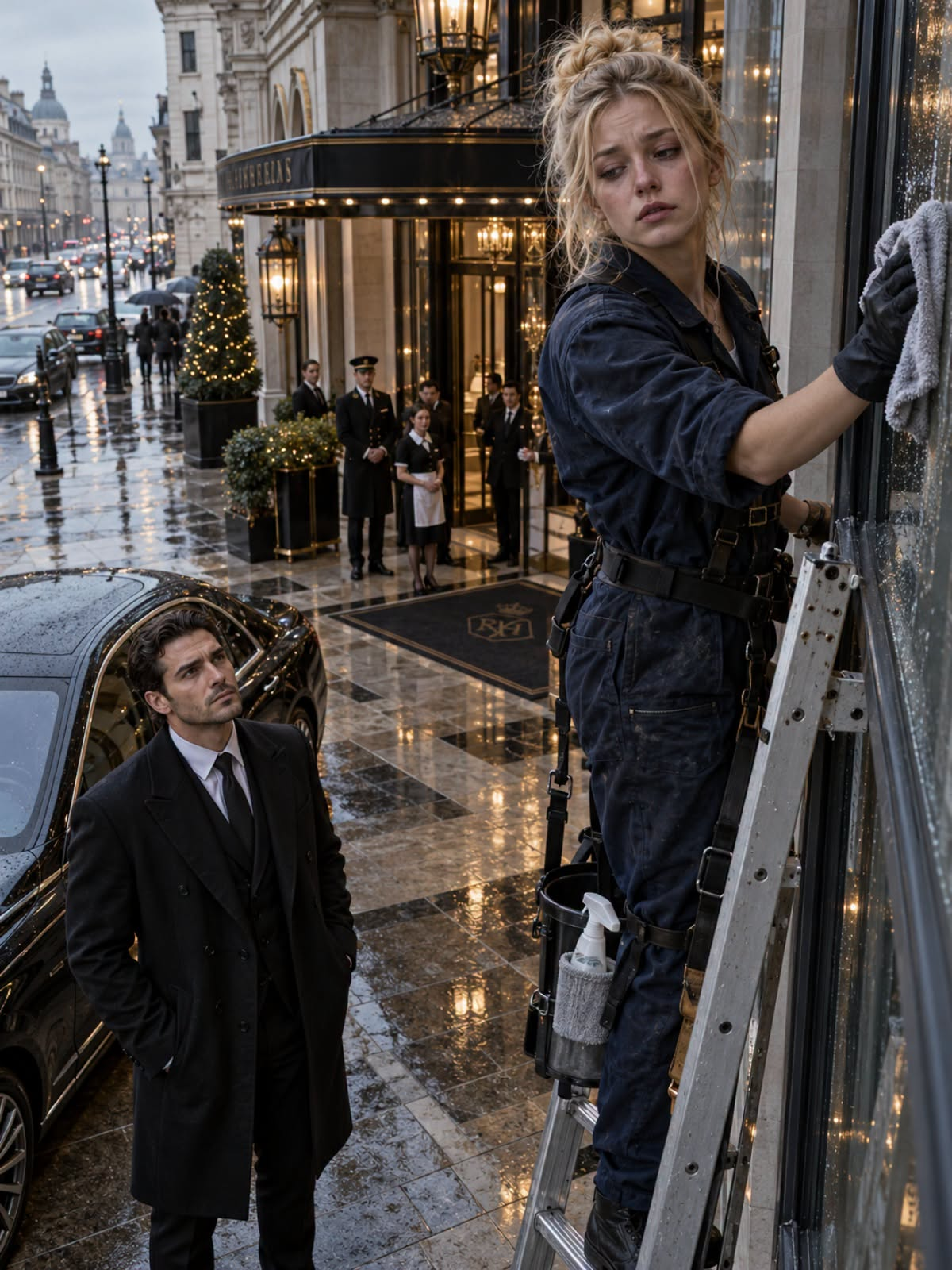
"Get down from that ladder, you filthy thief!" Gerald shouted.
Rosalind Hartley gripped the aluminum rung with one hand while the cleaning cloth slipped from the other.
When Lincoln Marsh arrived outside the Wexford Hotel, he noticed a torn employee identification card lying beside the ladder.
On the back, someone had written three words in blue ink:
"Mommy, come home."
Lincoln looked up at the woman everyone was laughing at.
This wasn't an ordinary employee dismissal.
And he already knew her face.
"Did you hear me, Rosalind?"
Gerald's voice rose above the traffic moving along the wet Chicago street.
"I said get down here!"
Rosalind swallowed.
She was fourteen feet above the pavement, balanced on an aluminum ladder that shifted slightly whenever the wind pushed against the building.
Her dark auburn hair had come loose from its ponytail. Rainwater had soaked through the shoulders of her faded olive-green jacket, and her fingers were beginning to lose feeling inside her cleaning gloves.
She looked down.
Gerald stood beneath the hotel's magnificent black-and-gold entrance canopy, surrounded by two employees who seemed delighted by the spectacle.
A wealthy guest paused beside the revolving doors.
Another woman lifted her phone.
Rosalind could feel their eyes on her.
"I'm almost finished, sir," she said.
Gerald laughed.
"Almost finished? You've been almost finished for twenty minutes."
"The rain keeps leaving marks on the glass."
"Then perhaps you should learn how to clean properly."
One of the employees snickered.
Rosalind lowered her eyes.
She had worked at the Wexford Hotel for nearly four years.
She knew every corridor, every service elevator, every stubborn stain on the eighteenth floor. She knew which guests wanted extra towels, which rooms required special cleaning products, and which supervisors would invent complaints simply because they could.
She also knew something far more important.
She could not afford to lose her job.
Not today.
Not this week.
Not while Daisy was waiting at home.
"Please, Mr. Gerald," she said quietly. "I need to finish my shift."
Gerald removed a folded piece of paper from his coat.
"Oh, you'll finish the windows."
He smiled.
"But your shift is the last one you'll ever work here."
He unfolded the paper.
TERMINATION OF EMPLOYMENT.
Rosalind stared at the words.
For a moment, the sounds of Chicago seemed to disappear.
"What?"
"You're fired."
Her throat tightened.
"Sir, I don't understand."
"Of course you don't. People like you never understand consequences."
He raised his voice deliberately.
"A valuable item disappeared from one of our premium suites. You were assigned to that floor. And now management has decided we don't need dishonest employees."
Rosalind shook her head.
"I didn't steal anything."
"That's what every thief says."
"I've never taken anything from this hotel."
Gerald stepped closer to the ladder.
"Do you know what your problem is, Rosalind?"
She said nothing.
"You think because you're a struggling single mother, everyone owes you sympathy."
The words struck harder than she expected.
Behind him, the employees exchanged amused glances.
"Your personal problems are not our responsibility," Gerald continued. "Neither is your daughter's medical condition."
Rosalind felt something twist inside her chest.
"Please don't talk about my daughter."
Gerald's smile widened.
"Then stop using her as an excuse."
Rosalind gripped the ladder.
She wanted to scream.
She wanted to tell him about the nights Daisy woke struggling to breathe, about the hospital bills stacked beside the kitchen sink, about the secondhand shoes she had repaired with glue because buying new ones meant sacrificing groceries.
But she knew Gerald.
Every word she spoke would become another weapon in his hands.
So she lowered her head.
"May I please finish the windows?"
Gerald looked almost disappointed.
"That's better."
He shoved the termination notice into her apron pocket.
"Finish them. Then collect your belongings and leave."
He turned toward the entrance.
"And Rosalind?"
She looked down.
"Don't bother asking for a recommendation."
The employees laughed.
Rosalind waited until they walked away before she allowed herself to breathe.
Then she picked up her cloth and returned to work.
Six weeks earlier, Rosalind's greatest fear had been a medical bill.
Now she was about to lose the only income keeping her daughter alive.
Daisy Hartley was six years old.
She had inherited her father's soft brown curls, his curious eyes, and his habit of asking questions that adults never knew how to answer.
Her favorite question was simple.
"Mommy, when will my heart be fixed?"
Rosalind always answered the same way.
"Soon, sweetheart."
She hated that word.
Soon.
It sounded like a promise.
But promises did not pay surgeons.
Daisy had been born with a congenital heart defect. Her doctors had explained that an opening inside her heart had failed to close properly during development.
She needed surgery.
Before that could happen, however, she needed to gain weight and remain medically stable enough to tolerate the operation.
The specialists were hopeful.
Rosalind held on to that hope with everything she had.
But the appointments were expensive.
The medication was expensive.
The emergency visits were expensive.
Even hope seemed to come with a bill attached.
Two years earlier, Daisy's father had died unexpectedly.
Rosalind still remembered the morning she received the call.
She remembered standing in their tiny kitchen, holding a mug of coffee she never drank.
She remembered Daisy asking why Mommy was crying.
And she remembered realizing that every responsibility her husband had once shared was now hers alone.
There was no family fortune.
No inheritance.
No savings large enough to survive the hospital bills.
Only Rosalind.
And a little girl who believed her mother could fix anything.
That morning, before leaving for work, Rosalind had found Daisy sitting at the kitchen table.
The child was drawing.
"What's that, sweetheart?"
"Our family."
Rosalind leaned closer.
Three figures stood beneath a yellow sun.
One tall man.
One woman.
One little girl.
Beside them was a strangely shaped animal.
"Is that a dog?"
Daisy giggled.
"No, Mommy. It's a cat."
"Oh. Of course."
"His name is Pickles."
"Pickles?"
"Because he's green."
Rosalind laughed.
It was the first time she had laughed in days.
Daisy pointed at the tall man.
"That's Daddy."
Rosalind's smile softened.
"I know."
"And that's you."
"Yes."
"And that's me."
Rosalind kissed her daughter's forehead.
"Beautiful."
Daisy looked up.
"Mommy?"
"Yes, baby?"
"When I get my new heart, can we get a real cat?"
Rosalind felt her smile tremble.
"You aren't getting a whole new heart, sweetheart. The doctors are going to repair the one you already have."
Daisy considered that.
"Will it make me strong?"
"That's what we're hoping."
"Strong enough to run?"
Rosalind brushed a curl away from her daughter's face.
"Strong enough to do all kinds of wonderful things."
Daisy smiled.
"Then I want a cat."
Rosalind hugged her.
"We'll talk about it."
The little girl folded the drawing carefully.
"Take this to work."
"Why?"
"So when you miss me, you can look at it."
Rosalind placed the picture in her apron pocket.
"I'll keep it with me all day."
Daisy touched her mother's cheek.
"Don't be sad today, Mommy."
Rosalind kissed her small hand.
"I'll try."
She had no idea how difficult that promise would become.
At the Wexford, nobody cared about promises made to children.
The hotel was one of Chicago's most prestigious properties.
Its marble floors gleamed beneath chandeliers worth more than Rosalind's apartment building.
Guests arrived in expensive vehicles.
They wore watches that could have paid for Daisy's surgery.
They ordered dinners costing more than Rosalind earned in a week.
And they rarely looked directly at the people who cleaned their rooms.
Rosalind had learned to become invisible.
She moved quietly.
Worked quickly.
Apologized even when she had done nothing wrong.
Her supervisor, Gerald, seemed to consider her silence an invitation.
He inspected her work more aggressively than anyone else's.
He accused her of moving too slowly.
Then complained when she finished too quickly.
He assigned her extra rooms without additional pay.
When she requested time off for Daisy's cardiology appointment, he told her that children got sick every day.
"That's life, Rosalind."
She remembered those words.
She remembered every one.
But she stayed.
Because leaving meant unemployment.
And unemployment meant telling Daisy that the medicine might have to wait.
Rosalind could endure humiliation.
She could endure exhaustion.
She could endure hunger.
What she could not endure was watching her daughter suffer.
Three days before her dismissal, something unusual happened.
Rosalind had been assigned to the premium corner suite on the eighteenth floor.
The room was larger than her entire apartment.
Its windows overlooked the Chicago skyline.
The bathroom had heated marble floors.
Fresh flowers stood beside a grand piano nobody had played.
She knocked three times.
No answer.
She entered with her cleaning cart.
The room was empty.
She changed the towels, replaced the toiletries, and began straightening the furniture.
Then she noticed something between the cushions of a leather armchair.
A small object.
Metal.
She reached into the gap.
It was a wristwatch.
Old.
Scratched.
Its leather strap had cracked near the buckle.
The metal casing had lost much of its shine.
It looked almost worthless beside the expensive furnishings.
But Rosalind knew better.
During one particularly desperate month, she had visited several pawnshops hoping to sell her late husband's belongings.
She had learned that old watches could sometimes be worth extraordinary amounts.
This one had the unmistakable weight of something carefully made.
She turned it over.
There was a small engraving on the back.
The lettering had faded with age.
She could make out only part of it.
Forever, my dearest...
Rosalind stood motionless.
For one terrible second, she imagined what selling it might mean.
Daisy's next appointment.
Her medication.
The overdue rent.
Perhaps even a meaningful payment toward surgery.
Her fingers closed around the watch.
Nobody had seen her find it.
Nobody would know.
She could slip it into her pocket and walk away.
The thought frightened her.
Not because she was incapable of stealing.
Because she finally understood how desperation could make an honest person consider it.
Then she remembered Daisy's drawing.
Three people.
One green cat.
A smiling sun.
And a little girl who trusted her mother completely.
Rosalind opened her hand.
"No," she whispered.
She finished cleaning the suite.
Then she carried the watch directly to the front desk.
The receptionist looked surprised.
"Where did you find this?"
"Suite 1801."
"Did anyone see you discover it?"
"No."
The receptionist examined the watch.
"You could have left it with housekeeping."
"I'd prefer that the owner receive it personally."
"Why?"
Rosalind hesitated.
"Because it looks important to someone."
The receptionist studied her for a moment.
Then she picked up the telephone.
Rosalind waited until the item had been formally recorded.
Only then did she return to work.
She never asked who owned the watch.
She never asked whether it was valuable.
And she never expected to hear about it again.
The owner was Lincoln Marsh.
Forty-three years old.
A man whose name could silence a crowded room.
Publicly, Lincoln was the head of a powerful corporation controlling hotels, real estate, and numerous private investments across Chicago.
Privately, he controlled a criminal organization whose influence extended into businesses most people never suspected.
He had enemies.
He had informants.
He had men who obeyed him without question.
But he had very few people he trusted.
His mother had been one of them.
She had died years earlier.
The old wristwatch was among the last personal belongings he had kept from her.
It was not particularly valuable compared with his other possessions.
That was precisely why its disappearance had terrified him.
Money could replace almost anything.
It could not replace the last object his mother had worn every day.
When his assistant informed him that a hotel housekeeper had found and returned the watch, Lincoln asked a single question.
"Did she know whose it was?"
"No, sir."
"Did she ask for a reward?"
"No."
Lincoln examined the worn leather strap.
For several seconds, he said nothing.
Then he asked for the employee's name.
"Rosalind Hartley."
He repeated it quietly.
"Rosalind Hartley."
His assistant offered to send her a generous reward.
Lincoln shook his head.
"Not yet."
"Sir?"
"I want to know why someone who clearly needs money would return something she could have sold."
His assistant looked uncomfortable.
"Perhaps she's simply honest."
Lincoln studied the watch.
"That's becoming an expensive quality."
He placed it inside his coat.
And remembered her name.
Now, three days later, Rosalind stood outside the Wexford Hotel, trying to finish cleaning a window after being fired for theft.
Her fingers had become stiff.
The cold had reached her bones.
She checked the time.
Almost four o'clock.
Daisy would be waiting for her.
The babysitter had already warned Rosalind that she could not continue providing care without receiving the money she was owed.
Rosalind had twelve dollars.
Twelve.
She had counted them three times that morning.
The hospital had called twice.
The landlord had left another message.
And now Gerald had taken away her job.
She wiped the glass harder.
The cloth squeaked.
A tear slipped down her cheek.
She quickly brushed it away.
"No," she whispered.
Not here.
Not where they could see.
She reached higher.
The ladder shifted.
Rosalind froze.
For one horrifying moment, her weight moved away from the building.
She grabbed the frame with both hands.
The ladder settled.
Her heart hammered.
Below, someone laughed.
"Careful!" one employee called. "We don't want paperwork!"
More laughter.
Rosalind closed her eyes.
She thought of Daisy.
Of her small hands.
Of her crooked green cat.
Then she opened her eyes and continued cleaning.
A black sedan pulled up beside the curb.
It was the kind of vehicle that made hotel staff move before anyone had even opened the door.
The doorman hurried forward.
Two security officers stepped into position.
Gerald straightened his jacket.
The rear passenger door opened.
Lincoln Marsh emerged.
He wore a dark navy overcoat over a tailored forest-green suit.
His expression was unreadable.
He did not glance at the expensive cars around him.
He did not acknowledge the pedestrians who recognized his face.
He walked toward the entrance with the quiet confidence of a man who had never needed to announce his authority.
Gerald hurried forward.
"Mr. Marsh!"
Lincoln continued walking.
"What an unexpected pleasure, sir. We weren't informed you would be visiting today."
Lincoln gave a slight nod.
He had come to examine irregularities in the hotel's financial records.
For months, someone inside his organization had been leaking confidential information.
Suspicious transactions had repeatedly led back to the Wexford.
He intended to discover why.
But before he reached the revolving doors, he heard laughter.
Then a man's voice.
"Hey, room girl! Maybe if you worked harder, you wouldn't have to beg for money!"
Lincoln stopped.
He looked toward the sound.
High above the pavement, a woman was cleaning the windows.
Her work clothes were soaked.
Her boots were worn.
Her face was pale from the cold.
Something about her seemed familiar.
Lincoln narrowed his eyes.
Then the woman turned her head.
He saw her face.
And stopped breathing for a moment.
He knew her.
The woman from the eighteenth floor.
The housekeeper who had returned his mother's watch.
Rosalind Hartley.
Lincoln slowly looked at Gerald.
"Who is that woman?"
Gerald followed his gaze.
"Oh, her?"
He laughed nervously.
"Just a housekeeping employee, sir. Nothing you need to concern yourself with."
Lincoln did not move.
"Her name."
Gerald's smile weakened.
"Rosalind Hartley."
Lincoln's eyes returned to the ladder.
"Why is she cleaning windows in this weather?"
Gerald hesitated.
"Well, sir, she's completing her final assignment."
"Final?"
"Unfortunately, we discovered some serious misconduct."
Lincoln turned toward him.
"What misconduct?"
Gerald adjusted his tie.
"Theft, sir."
Silence.
Lincoln's face did not change.
But the security officer standing behind him noticed the subtle tightening of his jaw.
"Theft," Lincoln repeated.
"Yes, sir. We have very strict standards here."
Lincoln looked back at Rosalind.
She was struggling to reach the final corner of the glass.
Her hand trembled.
A small piece of paper fell from her apron.
It fluttered downward and landed near Lincoln's shoes.
He bent to pick it up.
It was a child's drawing.
Three people beneath a yellow sun.
A green cat stood beside them.
On the back, written in uneven blue letters, were three words.
Mommy, come home.
Lincoln stared at the paper.
Then he looked toward the woman on the ladder.
For the first time that afternoon, his expression revealed something beyond calculation.
Concern.
He carefully folded the drawing.
"Mr. Marsh?" Gerald asked.
Lincoln ignored him.
He stepped toward the ladder.
"Rosalind."
She did not hear him.
"Rosalind Hartley."
Her hand stopped.
She looked down.
A tall man stood beneath her, holding the drawing Daisy had made.
Rosalind's stomach dropped.
"That's mine," she said quickly.
Lincoln looked up.
"I know."
She frowned.
"I'm sorry, sir. It must have fallen from my pocket."
He studied her face.
"Do you remember me?"
Rosalind shook her head.
"No, sir."
Lincoln reached inside his overcoat.
Gerald watched uneasily.
The security officers remained motionless.
Lincoln removed an old wristwatch.
Its cracked leather strap rested against his palm.
Rosalind recognized it immediately.
Her lips parted.
"The watch..."
Lincoln nodded.
"My mother's."
Rosalind looked from the watch to his face.
"I returned that to the front desk."
"I know."
"I didn't take anything, sir. I swear."
Lincoln's expression hardened.
"I know that too."
Behind him, Gerald took a small step backward.
Rosalind swallowed.
"I don't understand."
Lincoln looked toward Gerald.
"Neither do I."
His voice was quiet.
Dangerously quiet.
Then he asked a question.
"Who accused this woman of stealing?"
Gerald opened his mouth.
No sound came out.
Lincoln waited.
The silence stretched.
Finally, Gerald forced a smile.
"Mr. Marsh, perhaps we should discuss this privately."
Lincoln did not look away.
"Why?"
"Because the matter involves confidential employee information."
Lincoln slipped the watch back into his coat.
"Then bring me the evidence."
Gerald's face changed.
"Sir?"
"The evidence that proves she stole something."
Gerald swallowed.
"Of course."
"Now."
The word was barely louder than a whisper.
But everyone heard it.
Gerald hurried toward the entrance.
Rosalind remained on the ladder, confused and frightened.
She had no idea why a powerful stranger was defending her.
She did not know that he owned the hotel.
She did not know that men far more dangerous than Gerald were afraid of him.
All she knew was that he had remembered an old watch.
And somehow, that seemed to matter.
Gerald returned several minutes later carrying a thin folder.
His hands were shaking.
Lincoln took it without speaking.
Inside was a copy of Rosalind's termination notice.
A handwritten complaint.
And a printed photograph of the missing item.
Lincoln examined the photograph.
It showed a luxury gold bracelet.
He looked at the complaint.
Then at the signature.
"Who filed this?"
Gerald cleared his throat.
"One of our senior employees."
"Name."
Gerald hesitated.
"Foster's office provided the information, sir."
Lincoln's eyes lifted.
Foster.
The former financial manager he had removed from his organization.
The man who had stolen money.
The man whose accounts had led Lincoln to the Wexford.
Lincoln slowly turned another page.
A handwritten note was attached to the back.
It contained an instruction that had nothing to do with hotel housekeeping.
His expression became completely still.
"Gerald."
"Yes, Mr. Marsh?"
"Who told you to fire Rosalind Hartley?"
Gerald's mouth opened.
Then closed.
Lincoln stepped closer.
"Answer me."
Gerald looked toward the hotel doors.
For the first time, genuine panic entered his eyes.
Before he could speak, Lincoln's phone vibrated.
A message had arrived from his private security investigator.
Lincoln glanced at the screen.
The message contained a photograph.
A photograph taken from the Wexford Hotel's eighteenth-floor security camera.
Lincoln enlarged the image.
His eyes narrowed.
He looked from the photograph to Gerald.
Then toward Rosalind, still standing on the ladder.
His phone vibrated again.
A second message appeared.
SIR, WE FOUND THE ORIGINAL SECURITY FOOTAGE. THE PERSON WHO PLANTED THE STOLEN BRACELET IS SOMEONE YOU KNOW.
Lincoln opened the attached video.
The screen went black for one second.
Then the first frame appeared.
And the person entering Rosalind Hartley's cleaning cart was...






Comments 0