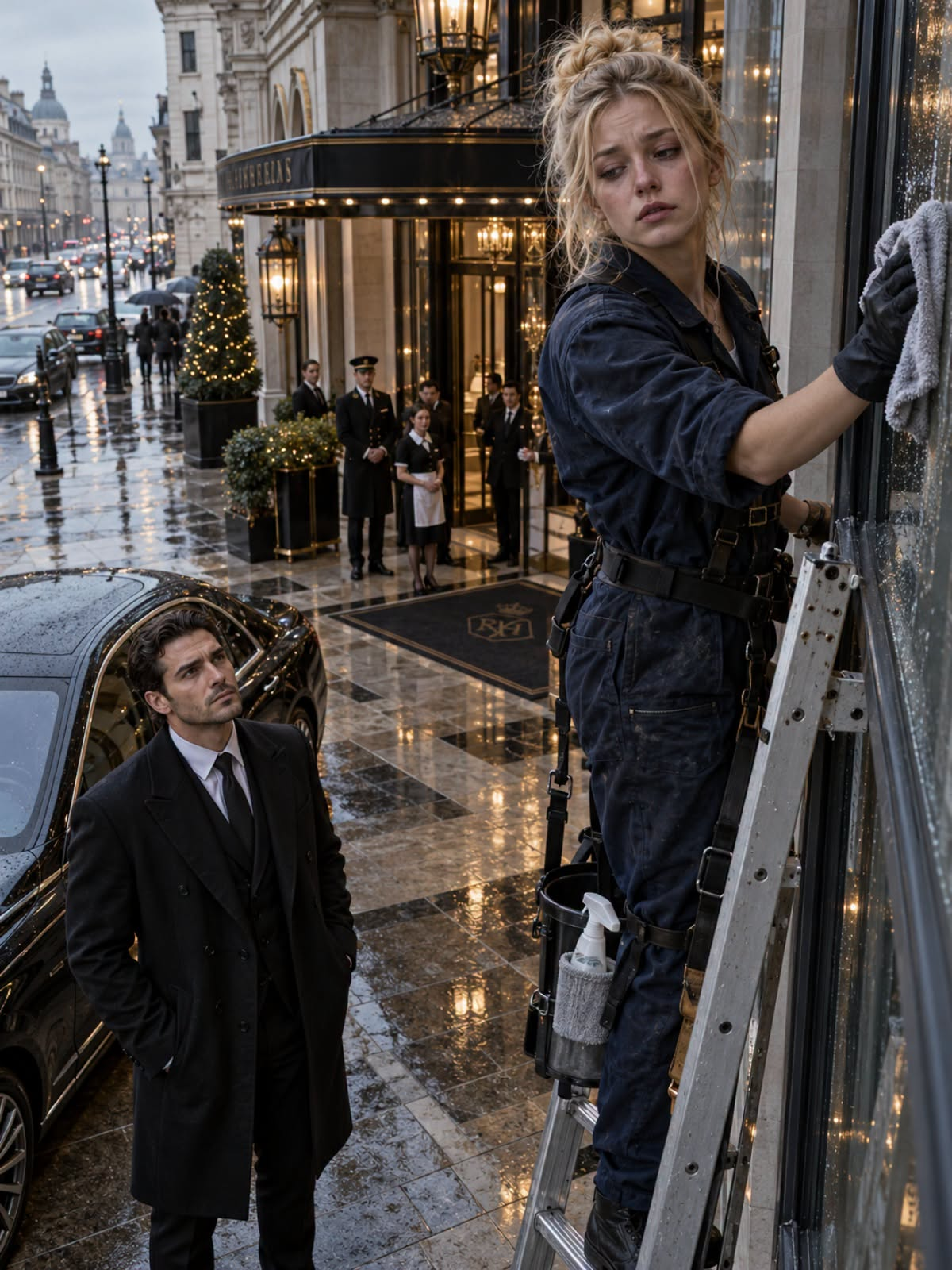
The woman who appeared on Lincoln Marsh's phone was wearing a Wexford Hotel housekeeping uniform.
But she wasn't Rosalind Hartley.
She was older, with short blond hair and a silver bracelet around her wrist.
Lincoln recognized her immediately.
"Margaret Voss," he said.
Gerald's face turned white.
The video continued playing.
Margaret, the hotel's assistant housekeeping director, approached Rosalind's unattended cleaning cart on the eighteenth floor. She glanced down the corridor, opened a side compartment, and slipped something beneath a folded towel.
Then she walked away.
The entire exchange lasted eleven seconds.
Lincoln watched it twice.
He didn't need to watch it a third time.
"Interesting," he said quietly.
Gerald swallowed.
"Mr. Marsh, I can explain—"
"Then explain."
Gerald glanced toward the ladder.
Rosalind was still standing several feet above them, holding her cleaning cloth against the window. She couldn't hear every word, but she could see the change in Gerald's expression.
The man who had humiliated her in front of strangers was suddenly trembling.
"I was informed that an expensive bracelet had gone missing," Gerald began. "Margaret brought me the evidence. I followed hotel procedure."
Lincoln looked at him.
"Hotel procedure requires you to accuse an employee publicly?"
"No, sir."
"To dismiss her without an investigation?"
"Sir, I—"
"To make her finish cleaning exterior windows in freezing rain after terminating her employment?"
Gerald opened his mouth.
Nothing came out.
Lincoln turned toward one of his security officers.
"Daniel."
"Yes, sir."
"Get her down."
Daniel approached the ladder.
"Miss Hartley? Please come down carefully."
Rosalind hesitated.
"Am I in trouble?"
The question made Lincoln look up.
She was frightened.
Not of the height.
Not of the rain.
Of losing the last opportunity to earn enough money to feed her daughter.
"No," Lincoln said.
His voice was unexpectedly gentle.
"You're not in trouble."
Rosalind looked down at him.
"Then why is everyone staring at me?"
Lincoln held up the small drawing that had fallen from her pocket.
"Because I think someone owes you an apology."
Rosalind descended slowly.
Her knees ached.
Her hands were so cold that she struggled to release the ladder's side rails.
When her boots finally touched the pavement, she reached for the drawing.
Lincoln handed it to her.
"Your daughter?"
Rosalind nodded.
"Daisy."
"How old?"
"Six."
Lincoln looked at the three figures beneath the smiling sun.
"And the cat?"
Despite everything, Rosalind almost smiled.
"Pickles."
"Pickles?"
"She wants a cat. She decided to draw one first."
Lincoln studied the picture for another moment.
"Smart girl."
Rosalind carefully folded the paper and returned it to her apron pocket.
She was suddenly conscious of her appearance.
Her wet hair.
Her stained jacket.
Her worn boots.
The wealthy man standing before her looked as though he belonged to another world.
And perhaps he did.
"Sir," she said, "I appreciate whatever you're trying to do, but I really need to collect my things."
Lincoln's eyes narrowed slightly.
"Why?"
"Because I've been fired."
"No, you haven't."
Gerald made a small choking sound.
Rosalind stared.
"I'm sorry?"
Lincoln turned toward him.
"Tell her."
Gerald looked confused.
"Sir?"
"Tell Miss Hartley she's not fired."
Gerald's lips trembled.
"Miss Hartley, there appears to have been a misunderstanding."
Rosalind looked at him.
"A misunderstanding?"
"Yes."
"You called me a thief."
Gerald lowered his eyes.
"That was unfortunate."
"You said I was worthless."
"Miss Hartley—"
"You told everyone my daughter was an excuse."
Gerald said nothing.
Rosalind's voice remained quiet.
But something had changed.
For four years, she had swallowed every insult because she believed silence was the price of keeping her job.
Now the words were coming out before she could stop them.
"You told me that if I fell from that ladder, the hotel wouldn't pay my hospital bills."
Lincoln turned his head.
Very slowly.
"Did he?"
Rosalind immediately regretted speaking.
"I don't want any trouble."
Lincoln looked at Gerald.
"Answer the question."
Gerald's forehead glistened.
"It was a joke."
Lincoln remained motionless.
"A joke."
"Yes, sir."
Lincoln glanced toward the aluminum ladder.
Then at Rosalind's trembling hands.
"Tell me which part was funny."
Gerald couldn't answer.
Lincoln waited.
The silence became unbearable.
Finally, he turned toward Daniel.
"Remove Mr. Gerald's access to employee records and security footage. He is suspended pending a formal investigation. Have human resources preserve every complaint filed against Miss Hartley."
Daniel nodded.
"Understood."
Gerald stepped forward.
"Mr. Marsh, please. I've worked here for eleven years."
Lincoln looked at him.
"Then you should have learned how to treat people."
Rosalind had never seen anyone speak to Gerald that way.
Not the general manager.
Not the hotel director.
Not even the wealthy guests who complained about everything from the temperature of their coffee to the color of their towels.
Gerald always found a way to make other people uncomfortable.
Now he stood beneath the hotel canopy, looking like a schoolboy waiting outside the principal's office.
Rosalind didn't enjoy seeing him frightened.
She only wanted to go home.
"Mr. Marsh?"
Lincoln turned.
"Yes?"
"I don't understand why you're doing this."
He studied her face.
"Do you remember finding a watch?"
She nodded.
"Of course."
"It belonged to my mother."
Rosalind looked down.
"I'm glad it reached you."
"She wore it for almost thirty years."
Something in his voice made Rosalind look up.
Lincoln wasn't smiling.
But his expression had softened.
"She wasn't a wealthy woman," he continued. "Not when I was growing up."
Rosalind remained silent.
"She worked two jobs. Sometimes three. She used to come home so tired that she'd fall asleep sitting at the kitchen table."
He glanced at the watch on his wrist.
"I bought her a better one when I started making money."
Rosalind waited.
"She refused to wear it."
"Why?"
Lincoln's mouth moved slightly.
Almost a smile.
"She said the old one still told the correct time."
For a moment, the cold street seemed strangely quiet.
Rosalind thought of Daisy's drawings.
The ones she kept even when the paper became wrinkled.
The ones she couldn't imagine throwing away.
"She sounds wonderful," Rosalind said.
Lincoln looked at her.
"She was."
Rosalind nodded.
"Then I'm especially glad I returned it."
Lincoln watched her closely.
Most people who learned who he was immediately changed their behavior.
They became eager.
Nervous.
Overly respectful.
Some asked for favors.
Others pretended not to want anything while calculating exactly how much they could obtain.
Rosalind did none of those things.
She stood before him in wet work clothes, looking embarrassed by the attention.
"Did you know the watch was valuable?" he asked.
Rosalind hesitated.
"I thought it might be."
"How valuable?"
"I don't know."
"Enough to pay some bills?"
Her eyes dropped.
"Possibly."
Lincoln noticed.
"You considered keeping it."
It wasn't an accusation.
Rosalind could have lied.
Instead, she nodded.
"For a moment."
Lincoln remained silent.
"I was ashamed of that," she admitted.
"Why?"
"Because it wasn't mine."
He looked at her for a long time.
Then he asked, "What made you return it?"
Rosalind touched the pocket containing Daisy's drawing.
"My daughter."
Lincoln glanced toward her hand.
"She told you to?"
"No. She doesn't know anything about it."
"Then how?"
Rosalind took a breath.
"Because someday she's going to ask me what kind of person she should become. I want to be able to answer her without being ashamed of myself."
Lincoln said nothing.
He had spent years surrounded by men who could explain away almost anything.
Theft.
Betrayal.
Dishonesty.
They always had reasons.
Debts.
Ambition.
Family obligations.
Survival.
And here stood a woman who had every reason to take something valuable.
Yet she had chosen not to.
He remembered his mother saying something similar when he was a boy.
Being poor doesn't give you permission to become cruel, Lincoln.
He hadn't thought about those words in years.
"Come inside," Lincoln said.
Rosalind stiffened.
"Why?"
"You're freezing."
"I'm fine."
"Your hands are shaking."
"It's just the weather."
"Then let's get you somewhere warm."
Rosalind glanced toward the hotel entrance.
"I don't think I'm allowed."
Lincoln's expression changed.
"Who told you that?"
"Gerald."
Lincoln looked toward the doors.
"Gerald no longer gets to decide where you can stand."
He gestured toward the entrance.
"Please."
Rosalind hesitated.
Then she followed.
The revolving doors carried them into a lobby filled with polished marble, expensive flowers, and golden light.
Rosalind had entered this building thousands of times.
But never through the main entrance beside someone like Lincoln Marsh.
Employees turned to stare.
The receptionist straightened.
A bellman stepped aside.
A woman in a designer coat stopped speaking mid-sentence.
Rosalind wished she could disappear.
Lincoln noticed.
"Does this make you uncomfortable?"
"A little."
"Why?"
She glanced at her dirty boots.
"Because I'm tracking water onto a floor someone just polished."
Lincoln looked down.
Then, unexpectedly, he laughed.
It was a quiet sound.
Almost unfamiliar.
"Miss Hartley, I own the floor."
Rosalind blinked.
"You what?"
"The hotel."
She stopped walking.
Lincoln turned toward her.
"Among other properties."
Rosalind stared at him.
Then at the employees who were suddenly pretending not to watch.
"Oh."
Lincoln raised an eyebrow.
"That's all?"
She looked mortified.
"I'm sorry, sir. I didn't know."
"Would it have changed anything?"
Rosalind thought about the watch.
"No."
"Good."
He gestured toward a private seating area near the lobby fireplace.
"Sit down."
A few minutes later, Rosalind was holding a cup of hot tea.
Someone had brought her a clean towel.
Another employee had offered to dry her jacket.
She refused politely.
The attention was overwhelming.
She had spent years serving people in this hotel.
Now people were serving her.
It felt wrong.
Not because she believed she deserved less.
Because she had forgotten what it felt like to be treated gently.
Lincoln sat across from her.
His phone rested on the table.
He had already instructed Daniel to preserve the original security footage and arrange interviews with the staff who had handled the bracelet complaint.
The investigation would continue without Rosalind having to defend herself in front of a crowd.
But Lincoln wasn't finished asking questions.
"How long have you worked here?"
"Almost four years."
"Full-time?"
"Yes. Sometimes extra shifts."
"Doing what?"
"Housekeeping. Laundry when they need help. Exterior windows when they're short-staffed."
"Do they pay you extra for the windows?"
Rosalind hesitated.
"Sometimes."
Lincoln's expression hardened.
"Sometimes?"
"It's complicated."
"Does Gerald decide?"
She looked at her tea.
"Usually."
Lincoln made a note on his phone.
Rosalind immediately became nervous.
"Please don't get anyone else in trouble because of me."
He looked up.
"Why would you worry about that?"
"Because people need their jobs."
"So do you."
"Yes."
"Yet Gerald had no difficulty taking yours away."
Rosalind had no answer.
Lincoln leaned back.
"Miss Hartley, protecting people who mistreat you won't make them kinder."
She looked at him.
Something about the sentence stayed with her.
For years, she had believed that if she worked hard enough, stayed quiet enough, and apologized often enough, people would eventually leave her alone.
Instead, they had learned how much she would tolerate.
"I just want to work," she whispered.
Lincoln studied her.
"Then you will."
His phone vibrated.
Daniel had sent another message.
The original security recording was being secured.
Margaret Voss had not yet been located.
More importantly, the video file had been accessed shortly before Rosalind's dismissal by an account connected to Foster's former financial department.
Lincoln's eyes narrowed.
Foster.
Again.
He had removed Foster from his corporation only days earlier after discovering years of financial deception.
But the man's influence had apparently survived his dismissal.
Lincoln had expected retaliation.
He had not expected it to involve an impoverished housekeeper.
Unless Rosalind had seen something she wasn't supposed to see.
He looked at her.
"Miss Hartley, did anything unusual happen on the eighteenth floor recently?"
Rosalind frowned.
"Unusual?"
"Anything you noticed while cleaning."
She considered the question.
"There was the watch."
"Anything else?"
She shook her head.
Then stopped.
Lincoln noticed.
"What?"
Rosalind hesitated.
"There was something strange about the suite."
"Tell me."
"The morning I found the watch, someone had moved the furniture."
Lincoln leaned forward.
"Moved it how?"
"The armchair was turned toward the window. Usually it faces the coffee table."
"Anything else?"
Rosalind thought carefully.
"There was a smell."
"What kind?"
"Something like burned paper."
Lincoln's expression became still.
"Burned paper?"
She nodded.
"I checked the wastebasket, but it was empty. The fireplace hadn't been used."
"Did you report it?"
"No. There wasn't anything to report."
Lincoln's eyes narrowed.
"Did you see any documents?"
Rosalind hesitated.
"Not exactly."
"What does that mean?"
"There was a small piece of paper beneath the armchair. I thought it was trash."
"What happened to it?"
"I put it in the cleaning cart."
Lincoln sat forward.
"Do you remember what was written on it?"
Rosalind closed her eyes.
She could picture the paper.
Cream-colored.
Thick.
Not the kind of paper used for ordinary hotel receipts.
There had been numbers printed along one edge.
And a name.
Or perhaps part of a name.
"I remember a number," she said.
Lincoln waited.
"Eighteen."
"Anything else?"
"Six fourteen."
Lincoln went completely still.
"Six fourteen?"
Rosalind nodded.
"That's what I remember."
He slowly reached for his phone.
"Are you certain?"
"I think so."
Lincoln looked toward the lobby entrance.
Room 614.
One of the hotel rooms repeatedly appearing in the financial records connected to Foster's suspicious transactions.
It had been used under false reservations.
Payments had been routed through accounts that did not belong to ordinary guests.
And the room had supposedly remained unoccupied for months.
Lincoln's investigator had flagged it that morning.
He looked back at Rosalind.
"Did anyone see you pick up that paper?"
She frowned.
"I don't know."
"Think carefully."
Rosalind searched her memory.
Then she remembered.
"Margaret came into the room."
Lincoln's jaw tightened.
"When?"
"While I was cleaning."
"What did she want?"
"She asked whether I'd found anything."
Lincoln said nothing.
"I told her about the watch."
"And the paper?"
Rosalind shook her head.
"I hadn't noticed it yet."
Lincoln leaned back.
His mind was moving quickly.
A missing watch.
A burned document.
A suspicious room number.
A housekeeping director planting evidence.
And a woman who had unknowingly walked into the middle of an investigation.
Someone had wanted Rosalind removed from the hotel.
Not necessarily because of the bracelet.
Perhaps because she had been in the wrong room at the wrong time.
"Miss Hartley," Lincoln said carefully, "I need you to tell me something."
Rosalind looked up.
"Yes?"
"Has anyone contacted you outside work recently?"
She shook her head.
"Not about the hotel."
"Any strange calls?"
"No."
"Messages?"
She hesitated.
"Well..."
Lincoln waited.
"Someone called my apartment yesterday."
"Who?"
"I don't know. They didn't give a name."
"What did they say?"
Rosalind looked uncomfortable.
"They asked whether I still worked at the Wexford."
Lincoln's expression darkened.
"What did you tell them?"
"Yes."
"Anything else?"
"They asked if I had found something in a hotel room."
Lincoln's fingers became still against the table.
"What did you say?"
"I thought it was about the watch, so I told them I'd already returned it."
"And then?"
"They hung up."
Lincoln looked toward Daniel, who had just entered the lobby.
"Find out who called her."
Daniel nodded.
Rosalind's anxiety increased.
"Mr. Marsh, am I in danger?"
Lincoln didn't answer immediately.
He disliked lying.
But he also understood that telling a frightened woman she might be connected to a criminal conspiracy would accomplish nothing.
"Right now," he said, "you're safe here."
Rosalind looked at him.
"That wasn't what I asked."
Lincoln almost smiled.
She was more perceptive than she appeared.
"No," he admitted. "It wasn't."
Rosalind's phone began vibrating inside her apron.
She pulled it out.
The screen displayed the babysitter's name.
Her face changed immediately.
"Excuse me."
She answered.
"Hello, Mrs. Alvarez?"
Lincoln watched her expression.
At first, she looked merely concerned.
Then her face drained of color.
"What do you mean she's breathing fast?"
She stood so quickly that the teacup rattled.
"Did you give her the medication?"
A pause.
"Okay. Okay, listen to me."
Her voice trembled.
"Is she conscious?"
Lincoln rose.
Rosalind pressed a hand against her mouth.
"Oh, God."
She listened.
Then whispered, "Call an ambulance. Right now."
Lincoln stepped closer.
"Rosalind?"
She barely heard him.
"Tell them she has a congenital heart defect. Tell them she's six years old. Tell them her cardiologist is at St. Catherine's."
Her eyes filled with tears.
"I'm coming, baby. Mommy's coming."
The call ended.
For a moment, Rosalind stood completely motionless.
Then she began searching through her apron pockets.
Her wallet.
Her keys.
Her phone.
She couldn't seem to find anything.
Lincoln gently touched the back of a nearby chair.
"What happened?"
Rosalind looked at him.
"My daughter."
Her voice broke.
"She's having trouble breathing."
Lincoln's expression changed.
"Where is she?"
"At home. The babysitter's calling an ambulance."
"Which hospital?"
"St. Catherine's."
Lincoln turned toward Daniel.
"Bring the car around."
Daniel moved immediately.
Rosalind shook her head.
"No, I can't—"
Lincoln looked at her.
"Can't what?"
"I can't afford—"
"Rosalind."
She stopped.
"Your daughter needs you."
The words cut through her panic.
He continued.
"Everything else can wait."
They reached the hotel's private entrance less than a minute later.
A black sedan was waiting.
Daniel opened the rear door.
Rosalind stopped beside it.
She looked at Lincoln.
"Why are you helping me?"
He could have given her a dozen answers.
Because she had returned his mother's watch.
Because he suspected she was being targeted.
Because the hotel belonged to him.
Because he remembered what poverty looked like.
But none of those answers seemed sufficient.
Instead, he said, "Because no mother should have to choose between keeping her job and getting to her sick child."
Rosalind's eyes filled.
She looked away before the tears could fall.
"Thank you."
Lincoln opened the door wider.
"Get in."
She climbed inside.
For the first time in years, she allowed herself to accept help without apologizing for needing it.
Lincoln sat beside her.
Daniel took the front passenger seat.
The driver pulled away from the hotel.
Rosalind gripped her phone.
Every second felt unbearable.
She imagined Daisy lying on the floor.
Daisy reaching for her inhaler.
Daisy calling for Mommy.
Rosalind pressed her hands together.
"Please," she whispered.
Lincoln looked toward her.
"She's in good hands. The ambulance is coming."
Rosalind shook her head.
"You don't understand."
"Then tell me."
She looked at him.
"She asked me this morning if she would be strong enough to run after her surgery."
Lincoln remained silent.
"I told her yes."
Her voice cracked.
"I promised her she'd get better."
Lincoln watched her.
Rosalind covered her face.
"What if I lied to her?"
For several seconds, he said nothing.
Then he spoke.
"You told her what you hoped was true."
She looked up.
"There's a difference."
Rosalind began crying.
Not loudly.
Not dramatically.
Just silent tears sliding down the face of a woman who had spent too many years pretending she wasn't afraid.
Lincoln looked away to give her privacy.
He had seen grown men beg for their lives.
He had watched powerful executives collapse when their fortunes disappeared.
He had learned to remain unmoved by desperation.
But this was different.
This woman wasn't asking him for money.
She wasn't asking him for protection.
She was asking the world for one simple thing.
More time with her daughter.
And Lincoln found himself wanting to give it to her.
His phone vibrated again.
Daniel turned slightly in his seat.
"Sir."
Lincoln glanced up.
"What?"
"We found Margaret Voss."
"Where?"
"She left the hotel forty minutes ago."
"Destination?"
"Unknown."
Lincoln's expression hardened.
"Find her."
Daniel hesitated.
"There's something else."
Lincoln waited.
"The security team recovered a copy of the document that was partially burned in Suite 1801."
Lincoln looked sharply toward him.
"How?"
"An employee photographed it before it was destroyed."
"What does it contain?"
Daniel glanced toward Rosalind.
Lincoln understood.
"Send it to me."
A moment later, his phone vibrated.
He opened the attachment.
It was a photograph of a damaged document.
Most of the page was blackened.
But several lines remained readable.
One contained the number Rosalind had remembered.
614.
Another contained a date.
And beneath it was a name.
Lincoln stared at the screen.
His expression changed.
He looked toward Rosalind.
Then back at the photograph.
For the first time that afternoon, something resembling genuine alarm crossed his face.
"Daniel," he said quietly.
"Yes, sir?"
"Call the hospital."
Daniel frowned.
"Why?"
Lincoln looked toward Rosalind, who was still staring out the window, unaware of their conversation.
"Find out whether Daisy Hartley has already been admitted."
Daniel reached for his phone.
Before he could dial, Lincoln's screen lit up with an incoming call.
Unknown number.
He answered.
"Marsh."
A man's voice spoke.
Low.
Distorted.
Almost amused.
"You should have left the maid alone."
Lincoln's expression became ice.
"Who is this?"
The caller ignored him.
"You think you found her by accident?"
Lincoln sat forward.
"What do you want?"
A pause.
Then the voice whispered:
"Ask Rosalind what really happened to her husband."
The call ended.
Lincoln stared at the phone.
Beside him, Rosalind suddenly gasped.
Her own phone had received a message.
She opened it.
The color disappeared from her face.
"Mr. Marsh..."
Lincoln turned.
"What is it?"
Her hands began shaking.
She held the screen toward him.
It was a photograph of Daisy.
The little girl was lying in a hospital bed.
A stranger's hand rested on the metal railing beside her.
Beneath the photograph was a message.
YOUR DAUGHTER ISN'T THE ONLY ONE WHO KNOWS WHAT HAPPENED TWO YEARS AGO.
Rosalind stared at the screen.
Then another message arrived.
This one contained only five words.
ASK LINCOLN ABOUT YOUR HUSBAND.






Comments 0