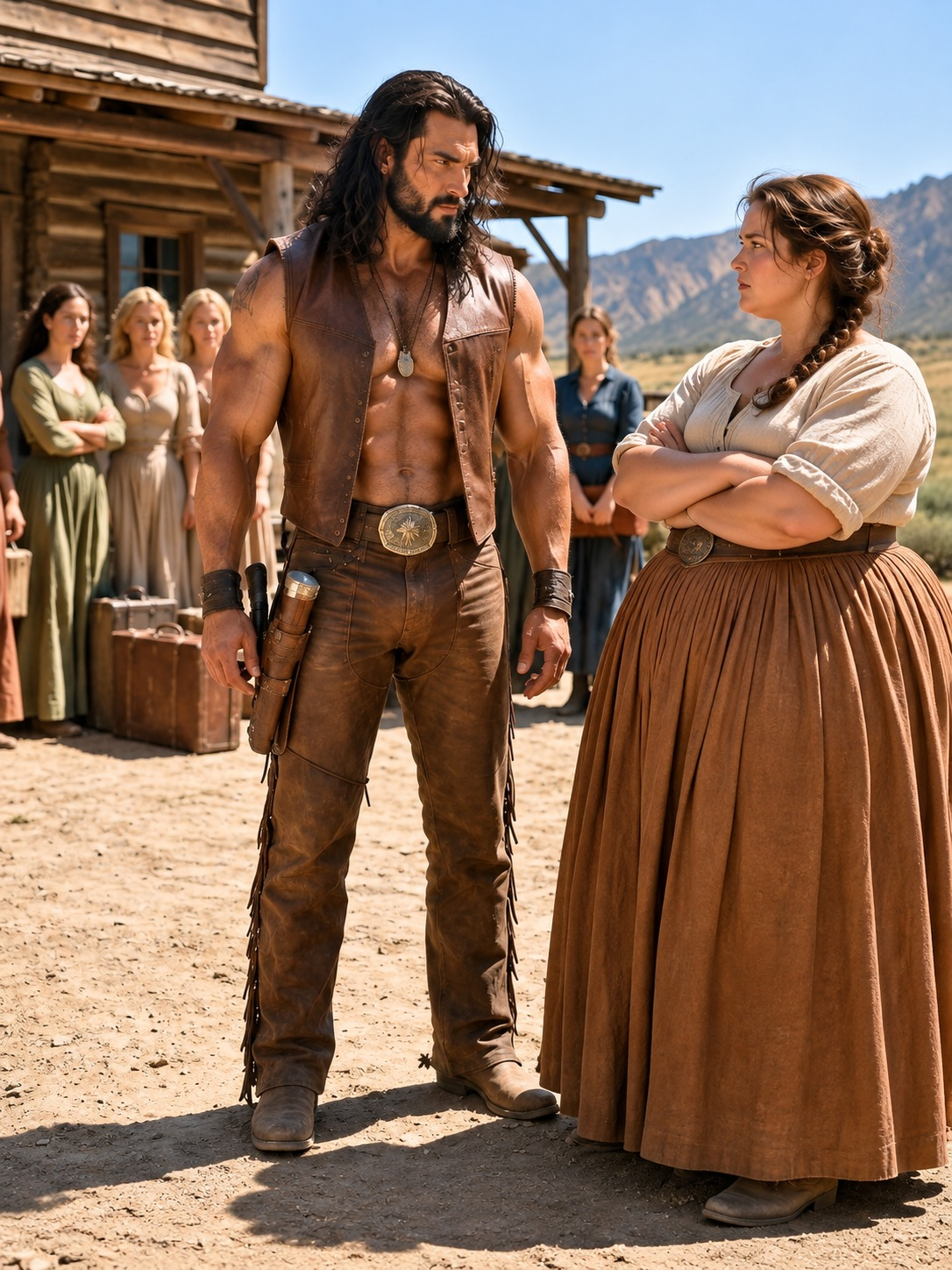
The mountain road grew narrower as they climbed.
Eleanor kept one hand on the saddle and the other around Mason's canteen. The water was warm, but she drank it gratefully.
Behind them, the pack mule followed with her suitcase secured to its back.
Mason walked beside the dun horse, occasionally reaching for the reins when the path became steep.
He had not spoken much since leaving Red Hollow.
Eleanor had begun to suspect that silence was not merely a habit for him.
It was a wall.
A wall he had spent years building, one conversation at a time.
"Do you always walk beside your horse?" she asked.
"Only when the trail gets narrow."
"You're a rancher. I assumed you would ride."
"I've got a woman on the horse."
Eleanor looked down at him.
"Is that your way of saying I'm too heavy for the saddle?"
Mason stopped.
For a brief moment, she thought he might be offended.
Then he looked at the horse.
"No. It's my way of saying I don't want you falling off a cliff."
Eleanor almost smiled.
Almost.
The path curved around a rocky slope. Far below, Red Hollow Valley appeared as a collection of small wooden buildings surrounded by dry fields.
The town looked smaller from above.
So did its opinions.
"How long have you lived here?" she asked.
"All my life."
"Did you ever want to leave?"
Mason considered the question.
"Once."
"What stopped you?"
"My father."
He said nothing more.
Eleanor understood that the subject was closed.
She let the silence return.
They continued climbing.
After nearly an hour, the landscape changed. The dry grass gave way to patches of pine and scrub oak. The air became cooler, and a narrow stream crossed the trail.
Mason stopped to let the animals drink.
Eleanor looked at the water.
"Is this the spring Bracken wants?"
"No. This is one of the lower streams. The spring is farther up."
"Does it really run all year?"
"Even in the worst drought."
"Then I understand why he wants it."
Mason crouched beside the water.
"Most people don't understand what it means."
He dipped his hands into the stream.
"When the summer gets hot, the lower creeks dry up. Cattle need water. Crops need water. Families need water. The spring keeps running when everything else stops."
He stood.
"Whoever controls it controls this valley."
Eleanor looked at him carefully.
"And your father owned it?"
"He claimed it."
"What's the difference?"
"Sometimes the difference is a piece of paper."
He adjusted the reins.
"Bracken knows that better than anyone."
They started moving again.
Eleanor wondered whether the banker had told her the truth about Mason's financial troubles.
She had seen the entries in his ledger.
The debts were real.
But she also understood that a man who wanted another person's land could make almost any debt sound like a reason to take it.
"Why didn't you tell me about Bracken in your letters?" she asked.
Mason looked ahead.
"Didn't want to bring you into my problems before you arrived."
"Those problems became mine the moment I agreed to marry you."
He slowed.
For the first time, he seemed to consider her words rather than simply hear them.
"That's not what I meant."
"I know."
She looked toward the mountain.
"But I didn't come here expecting a perfect life."
Mason's expression hardened slightly.
"You should have."
Eleanor frowned.
"Why?"
"Because you had a choice."
He looked at her.
"I didn't."
Before she could answer, he turned and continued up the trail.
The sentence stayed with her.
She wondered what he meant.
She also wondered whether the nine women before her had ever asked.
By late afternoon, the ranch finally came into view.
It stood on a broad stretch of land between two mountain ridges.
The main house was made of weathered timber. Its porch ran along the front, and a small barn stood several yards away. Beyond it were a corral, a feed shed, and a collection of fencing that needed attention.
There were cattle grazing near the far pasture.
The property was not grand.
It was not even particularly comfortable-looking.
But it was clean.
The yard had been swept. The tools were arranged near the shed, and the wooden steps leading to the porch appeared recently repaired.
Eleanor noticed something else.
There was no clutter.
No abandoned clothing.
No broken furniture.
Everything had its place.
Mason dismounted and tied the horse.
"Here we are."
Eleanor looked at the house.
"This is yours?"
"Has been since my father died."
He helped her down from the saddle.
She landed carefully.
Mason took the reins and led the animals toward the barn.
"I'll get your things."
Eleanor walked toward the porch.
The front door was unlocked.
Inside, she found a modest sitting room with a wooden table, two chairs, a small stove, and a shelf containing several books.
There was a rifle above the fireplace.
A pair of worn gloves sat beside the door.
The house smelled faintly of wood smoke, coffee, and clean soap.
It was simple.
Almost painfully simple.
But it was spotless.
Eleanor ran her fingers over the edge of the table.
"Do you live here alone?"
Mason entered carrying her suitcase.
"Yes."
"How long?"
"Eleven years."
He placed the suitcase near the wall.
Eleanor glanced at him.
"Since your father died?"
He nodded.
She waited for him to say something else.
He did not.
Mason picked up a lantern.
"Your room's in the back."
He led her down a narrow hallway.
The room was small but comfortable. A sturdy bed stood against one wall, with a clean quilt folded neatly over it.
There was a washstand, a wooden wardrobe, and a small window overlooking the pasture.
A folded towel lay beside a basin of fresh water.
Eleanor looked around.
"You prepared this?"
"Yes."
"Thank you."
Mason nodded toward the door.
"There's a bolt on the inside."
She turned.
He pointed to the heavy metal latch.
"If you want privacy, use it. Nobody will come in without your permission."
Eleanor looked at him.
"Not even you?"
"Especially not me."
He placed the lantern on the dresser.
"I'll be in the other room."
He turned to leave.
"Mason?"
He stopped.
"Yes?"
"Do you always make sure people have a way to lock their doors?"
He seemed uncomfortable.
"After the first one, I decided it was important."
"The first one?"
He looked at the floor.
Then he left without answering.
Eleanor stood alone in the room.
She walked to the door and examined the bolt.
It was strong.
Recently installed.
She slid it into place.
The metal made a heavy clicking sound.
For a moment, she imagined the nine women who had slept in this same room.
Had they felt welcomed?
Had they felt frightened?
Had they wondered why their new husband was so determined to keep his distance?
She sat on the edge of the bed.
There was something deeply sad about a man who prepared a locked room for his bride but could not bring himself to ask whether she was comfortable.
A few minutes later, she heard Mason moving around in the kitchen.
She washed her face, changed into a cleaner blouse, and pinned her copper-red hair back.
When she entered the kitchen, Mason was standing beside the stove.
He had already prepared supper.
There was a pot of stew, fresh bread, and a small plate of butter.
Eleanor looked at the table.
One plate.
One fork.
One spoon.
One tin cup.
She stopped.
Mason noticed her expression.
"What?"
"Are you expecting someone?"
He looked at the table.
"No."
"Then why only one place setting?"
Mason followed her gaze.
His face changed.
It was a small change, almost invisible.
He picked up the second cup that had been sitting near the stove.
For a moment, he held it in his hand.
It was an old tin cup with a dent along the rim.
He looked at it as though it belonged to someone who might walk through the door at any moment.
Then he placed it in the wash basin.
"I forgot."
Eleanor did not ask who had used it.
She had already understood enough.
Mason took another plate from the cupboard.
He placed it on the table.
Then another spoon.
And finally, a second cup.
"Sit down," he said.
Eleanor took the chair opposite him.
He served her stew before filling his own bowl.
She noticed that he had given her the larger portion.
"Thank you."
He nodded.
They ate in silence for several minutes.
The food was simple but well prepared.
Eleanor had spent enough time in boardinghouses to know the difference between a man who could not cook and a man who had learned to cook because there was nobody else to do it.
Mason belonged to the second kind.
"You're a good cook," she said.
"Had to learn."
"Your father didn't cook?"
A brief shadow crossed his face.
"He did."
Mason broke a piece of bread.
"Better than me."
Eleanor waited.
"He used to make biscuits every Sunday. Said a ranch could survive almost anything if the people in it remembered to sit down and eat together."
His voice became quieter.
"I haven't made them in years."
Eleanor looked at the bread in her hand.
"Perhaps you should again."
Mason did not answer.
They continued eating.
After a while, he put down his spoon.
"I should explain something."
Eleanor looked up.
"All right."
"About the women who came before you."
She waited.
"I don't know what you heard in town."
"Quite a lot."
"Most of it isn't true."
"Which part?"
Mason rubbed his thumb against the edge of the table.
"I don't know."
It was an unexpected answer.
He looked at her.
"Every woman who answered the advertisement got a room. The same room you have now. I made sure it was clean. I gave them food. I fixed things they needed fixed."
He paused.
"I never laid a hand on any of them."
Eleanor listened carefully.
"Did you ask them what they wanted?"
Mason looked away.
"I told them they could have whatever they needed."
"That's not the same thing."
He frowned.
"I kept my distance. I thought that would make them feel safe."
"Did they ask you to keep your distance?"
He did not answer.
Outside, the wind moved against the wooden shutters.
Mason leaned back.
"One left after three days. Another after five. The longest stayed a month."
"Did any of them tell you why?"
"No."
"Did you ask?"
"I did."
"And?"
"They said they couldn't do it."
He lowered his eyes.
"Then they packed."
Eleanor put down her spoon.
She could see the humiliation in his expression.
It was not the anger of a man who believed he had been wronged.
It was the shame of someone who had tried repeatedly to do something right and had never understood why it failed.
"I think you did everything a person could ask in terms of providing food and shelter," she said gently.
Mason looked at her.
"But?"
Eleanor considered her words.
"And I think a person can starve to death in a house that is safe and fed if nobody in it will ever let them close enough to matter."
Mason became completely still.
The words seemed to reach somewhere he had spent years avoiding.
He looked at the second cup on the table.
Then at Eleanor.
"You don't know anything about me."
"You're right."
She met his eyes.
"That's why I'm still here."
For several seconds, he did not move.
Then he picked up his cup and drank.
"Tomorrow will be busy," he said.
"What needs doing?"
"There's a fence near the north pasture that needs repairing. A calf is due soon. The barn roof needs attention."
Eleanor nodded.
"I can help."
"You don't have to."
"I know."
He seemed unable to understand why she kept saying that.
She finished her supper.
Mason cleared the plates and washed them while Eleanor dried the cups.
He looked uncomfortable when she began helping.
"You don't need to do that."
"I know."
He almost smiled.
But the expression disappeared before it fully formed.
Later, he showed her where the firewood was kept and where she could find extra blankets.
Then he returned to the kitchen.
Eleanor went to her room.
She closed the door and slid the bolt into place.
The house grew quiet.
She lay awake for a long time, listening to the wind moving through the trees.
Somewhere outside, Mason crossed the porch.
She heard his boots stop near the front door.
Then she heard something she had not expected.
A drawer opening.
A faint rustle of paper.
And finally, a sound like a man quietly putting something away before anyone could discover it.
Eleanor sat up.
She listened.
The footsteps moved toward the sitting room.
Then stopped.
A moment later, she heard Mason speak.
Not loudly.
Not to anyone in particular.
Just three quiet words.
"Not this time."
Eleanor stared at the ceiling.
She did not know what he meant.
But she was beginning to suspect that the nine women had not been the only people who had left something behind in this house.
And the next morning, when she walked into the kitchen, she would discover that Mason had made one decision he had not made in eleven years.






Comments 0