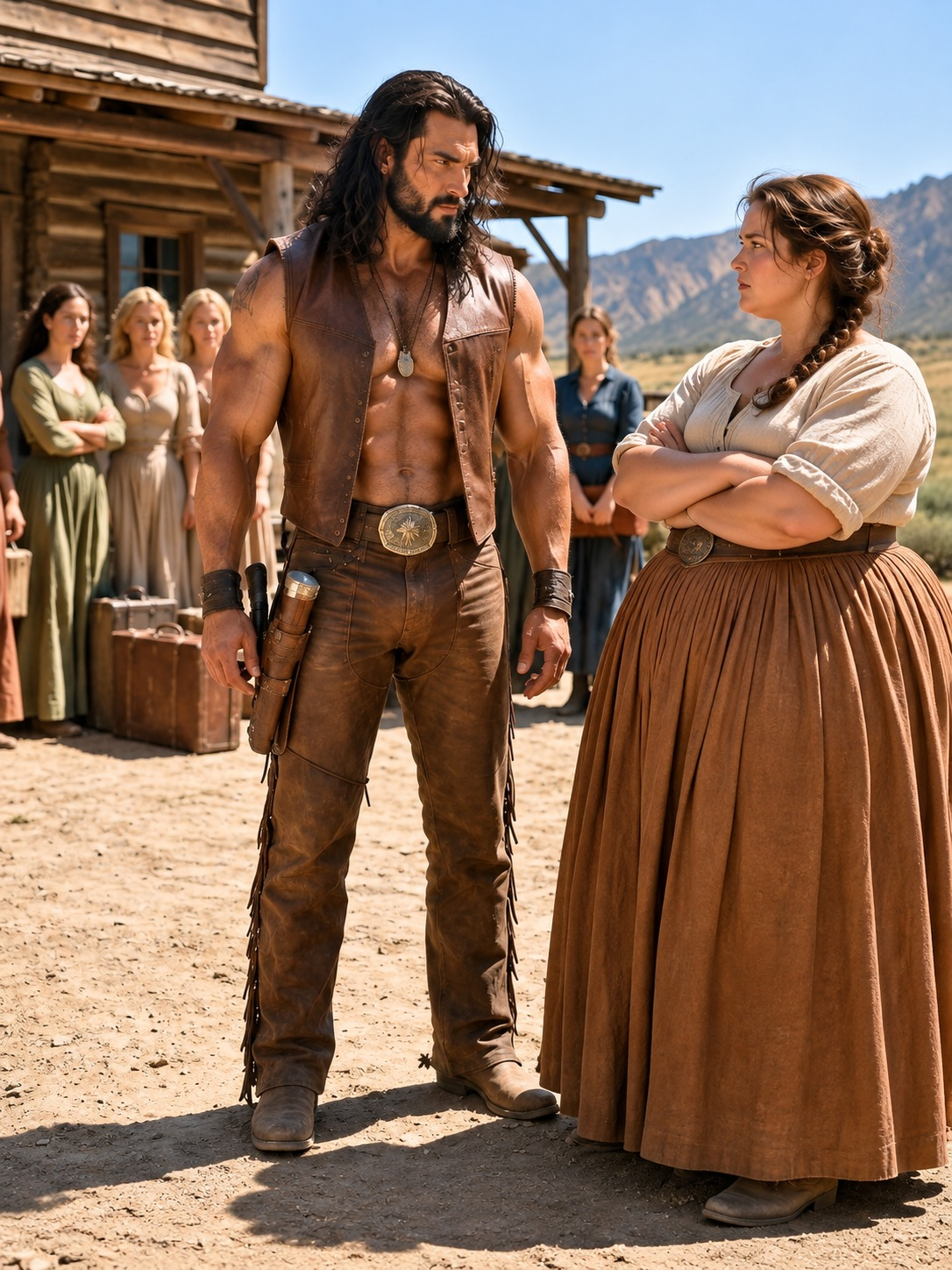
Mason Callahan dropped the coffee pot when Eleanor mentioned his father's name.
The metal struck the kitchen floor.
Coffee splashed across the wooden boards.
Neither of them moved.
Eleanor stood beside the table, holding a folded dish towel. Mason stared at the dark liquid spreading beneath his boots.
For several seconds, the only sound was the ticking of the old clock above the fireplace.
"Did I say something wrong?" Eleanor asked quietly.
Mason bent down and picked up the coffee pot.
"No."
His voice was rough.
"Then why did you look at me like that?"
He wiped the floor with a rag.
"Because some things are better left alone."
Eleanor watched him.
She had heard those words before, although never from him.
They were the words people used when they were afraid of what might happen if someone asked the next question.
She folded the dish towel and placed it beside the sink.
"All right."
Mason looked up.
He seemed surprised that she had not pressed him.
She picked up her coffee cup.
"But if something is hurting you, pretending it isn't there won't make it disappear."
Mason said nothing.
He finished cleaning the floor, hung the rag beside the stove, and reached for his hat.
"I have work outside."
Eleanor nodded.
She let him leave.
But she noticed that he had forgotten his coffee.
The morning passed slowly.
Eleanor washed the breakfast dishes and swept the kitchen.
Afterward, she decided to organize the pantry.
Mason had plenty of supplies, but everything was arranged according to a system only he understood.
There were sacks of flour, dried beans, jars of preserved vegetables, and several tins of coffee.
She found a small wooden box behind a stack of canned peaches.
Inside were old household receipts.
Some were more than ten years old.
Others were recent.
She sorted them into piles, intending to ask Mason where he wanted them kept.
One paper caught her attention.
It was a handwritten receipt for repairs to the barn.
The signature at the bottom belonged to Thomas Callahan.
Mason's father.
Eleanor looked at the date.
Eleven years earlier.
The paper had been folded several times, but the handwriting remained clear.
She traced the signature with her eyes.
Thomas Callahan.
There was something about seeing the name that made her feel she had discovered a small piece of the man who had once filled this house with life.
She returned the receipt to the box.
Then she noticed another envelope.
It was addressed to Mason.
The handwriting was different from the one on the receipt.
The envelope had never been opened.
Eleanor did not touch it.
She placed it back exactly where she had found it.
When she finished organizing the pantry, she carried the box toward the sitting room.
A narrow staircase led to the loft above the kitchen.
She had noticed it when she first arrived but had never gone upstairs.
Mason had told her where the extra blankets were kept.
He had not mentioned the loft.
At the top of the stairs, she found an old wooden chest.
It was larger than a traveling trunk, with iron corners and a heavy brass lock.
Dust covered its lid.
A faded leather strap ran around the middle.
Eleanor stopped.
She did not need to ask whose belongings were inside.
She recognized the initials carved into the wood.
T.C.
Thomas Callahan.
She stood there for a long moment.
Then she heard footsteps below.
"Eleanor?"
Mason's voice came from the kitchen.
She turned.
"I'm upstairs."
His boots stopped moving.
"What are you doing up there?"
"I was looking for the extra blankets."
A pause followed.
Then he climbed the stairs.
When he reached the top, he saw her standing beside the trunk.
His expression changed immediately.
"Don't."
Eleanor stepped away.
"I haven't touched it."
Mason approached the chest.
He looked at the initials.
His jaw tightened.
"Come downstairs."
She obeyed.
He followed her, but before leaving the loft, he looked back once more.
It was not the expression of a man who had forgotten something.
It was the expression of someone who remembered everything.
They worked separately for the rest of the morning.
Mason repaired a section of the barn roof.
Eleanor prepared lunch.
Neither mentioned the trunk.
At noon, Mason came inside with dust covering his shoulders.
He washed his hands and sat at the table.
Eleanor placed a plate in front of him.
"Beef stew."
He nodded.
They began eating.
After several minutes, Mason finally spoke.
"My father kept everything."
Eleanor looked up.
"Everything?"
"Receipts. Letters. Old contracts. Newspaper clippings. Maps. Even the instructions that came with the first plow he bought."
A faint, almost invisible smile crossed his face.
"He once kept a broken horseshoe for six years because he thought it might be useful."
Eleanor smiled.
"Did he ever use it?"
"No."
"Then perhaps he was simply sentimental."
Mason looked down at his bowl.
"He was."
The smile disappeared.
"He believed that if you kept something long enough, eventually you'd understand why it mattered."
Eleanor put down her spoon.
"Is that why you haven't opened his trunk?"
Mason's hand stopped.
For a moment, she thought he would leave the table.
Instead, he leaned back.
"I was supposed to go through his things after the funeral."
Eleanor waited.
"He died in the spring. We buried him on the hill behind the house."
Mason looked toward the window.
"I remember the morning after. The house was quiet. His coat was still hanging by the door. His boots were beneath the bench."
He swallowed.
"I went upstairs and found that trunk."
"What happened?"
"I couldn't open it."
His voice became quieter.
"I knew his things were inside. His handwriting. His clothes. His papers. Everything he had touched."
Mason rubbed his thumb against the handle of his spoon.
"I thought if I opened it, that would be the last time I could pretend he was still somewhere in this house."
Eleanor felt her chest tighten.
She had known loss.
But there was something particularly painful about losing the person who had made the world feel safe.
"Did you ever go back?"
"Once."
"When?"
"About a year later."
He looked at her.
"I climbed the stairs. I put my hand on the lock. Then I came back down."
"Why?"
"Because I could still hear him."
Eleanor remained silent.
Mason gave a short, humorless breath.
"Sounds foolish, doesn't it?"
"No."
"You haven't even seen the trunk."
"I don't need to."
He looked at her for a long moment.
She continued gently.
"Sometimes people leave us things because they want us to remember them. Not because they want us to remain trapped in the day they died."
Mason lowered his eyes.
"I know."
But his expression suggested that knowing and accepting were two very different things.
That afternoon, Eleanor went outside to collect laundry.
The sun had moved behind a thin layer of clouds.
A breeze crossed the pasture.
She was hanging a clean shirt on the line when she noticed Mason standing near the barn.
He was holding a small leather object.
At first, she thought it was a glove.
Then she saw that it was an old photograph.
Mason looked at it for several seconds before slipping it into his pocket.
Eleanor did not approach.
She understood that he needed moments in which nobody asked him to explain himself.
But she also noticed something else.
He had begun leaving the front door open while he worked.
Before her arrival, it had always been closed.
It was a small change.
Still, she wondered whether the house was beginning to feel less empty to him.
On the fifth morning, Eleanor woke before sunrise.
She went into the kitchen and found Mason already there.
He was standing beside the table.
Two cups had been set out.
The coffee pot was warm.
But Mason was not drinking.
He was staring at the second cup.
Eleanor walked over.
"Good morning."
He looked at her.
"Morning."
She picked up the pot.
"Shall I pour?"
"Please."
She filled his cup first, then hers.
They sat together.
Mason looked unusually distracted.
"Did you sleep?" she asked.
"Some."
"Something troubling you?"
He hesitated.
Then he pushed a folded newspaper across the table.
Eleanor opened it.
The paper was several weeks old.
A small notice had been marked in pencil.
It concerned a meeting at the county seat regarding land and water claims.
"Why are you showing me this?"
"Bracken's been asking questions about the spring."
Eleanor read the notice again.
"Does he have a claim?"
"He has a mortgage on the ranch."
"That isn't the same thing."
"No."
Mason took a drink of coffee.
"But he wants it to be."
He explained that Bracken had spent years acquiring debts from struggling ranchers.
Some had borrowed money for livestock.
Others needed funds to repair wells, buy feed, or survive a bad season.
When they could not repay their loans, Bracken acquired their property through legal agreements.
Mason's father had warned him about the banker.
"He used to say Bracken never bought land because he wanted to farm it."
"Then why does he want it?"
"The water."
Mason looked toward the mountains.
"That spring is the strongest source in the valley. If Bracken controls it, every rancher below us will have to negotiate with him for water."
Eleanor put down the newspaper.
"How much land does he own?"
"Enough to make people nervous."
"Then why hasn't anyone stopped him?"
Mason's expression hardened.
"Because people are afraid of losing what little they have."
He stood and carried his cup to the sink.
"I need to check the cattle."
Eleanor folded the newspaper.
She had begun to understand that Bracken's power did not come only from money.
It came from knowing exactly what people feared.
And he knew how to use that fear against them.
Later that morning, Eleanor found Mason repairing a gate.
She brought him a fresh canteen.
He accepted it.
"Thank you."
"You're welcome."
She stood beside him.
"Do you have any idea how much Bracken knows about your father's claim?"
Mason tightened a bolt.
"He knows enough."
"Did your father keep copies of his legal documents?"
Mason stopped working.
"Probably."
"Where?"
He looked toward the house.
"In the trunk."
Eleanor nodded.
"Then perhaps we should look."
His expression closed.
"No."
She did not argue.
Instead, she watched him finish repairing the gate.
A few minutes later, he put down the wrench.
"I told you. I can't."
"I understand."
He looked at her.
"Do you?"
"Yes."
She took the wrench from his hand and placed it beside the toolbox.
"But I also know that your father spent years protecting this ranch. If there is something in that trunk that could help you, I don't think he would have wanted you to leave it there forever."
Mason stared at the ground.
He seemed to be fighting a thought he could not quite bring himself to say aloud.
Then a distant sound interrupted them.
Hooves.
Both turned toward the lower road.
A rider was approaching at considerable speed.
The horse was lathered, and the rider leaned forward in the saddle.
Mason recognized him before Eleanor did.
"Harlon."
The postmaster reached the ranch and pulled his mule to a stop.
He looked exhausted.
His hat was crooked, and his shirt was dark with sweat.
"Mason!"
Mason walked toward him.
"What happened?"
Harlon dismounted awkwardly.
He glanced at Eleanor, then back at Mason.
"It's Bracken."
Mason's expression became still.
"What has he done?"
Harlon took a folded document from inside his coat.
"They've filed against your water rights at the county seat."
Mason accepted the paper.
He read the first few lines.
Then his face changed.
"What is this?"
"Bracken is claiming your father's original water claim was never properly recorded."
Mason looked up.
"That's impossible."
"I know."
"My father filed it in 1861."
"That's what you always said."
"Amos Dutton witnessed it."
Harlon nodded heavily.
"That's where the trouble begins."
Mason gripped the paper.
"What trouble?"
"Bracken says the original document is missing from the county records."
Mason stared at him.
"Missing?"
"The clerk couldn't find it."
"Then he needs to look again."
"He has."
"Who searched?"
Harlon hesitated.
"The clerk."
Mason's eyes narrowed.
"Which clerk?"
Harlon did not answer immediately.
Then he said the name.
Mason understood.
The clerk was one of Bracken's employees before taking the county position.
He looked down at the document again.
"What about Amos?"
Harlon removed his hat.
"He's been approached."
"Approached how?"
"Bracken holds the note on his farm. He told Amos that if he testifies for you, he'll call the debt immediately."
Mason's fingers tightened around the paper.
"Amos is eighty-one years old."
"I know."
"He can't lose his farm."
"I know, Mason."
For several seconds, nobody spoke.
The wind moved through the corral.
A cow called from the lower pasture.
Mason turned toward the barn and gripped the top rail of the fence.
His shoulders stiffened.
"He has the clerk. He's got the paper missing. He's frightened the witness."
Harlon lowered his voice.
"He's been planning this for a long time."
Mason stared at the mountains.
"I can't fight him."
Eleanor stepped closer.
"Why not?"
Mason turned.
"Because he's got everything."
"Not everything."
He looked at her.
"The document is gone."
"From the county records."
"That's where it belongs."
"Perhaps."
She glanced toward the house.
"But your father was a careful man, wasn't he?"
Mason's expression changed.
"What are you getting at?"
"You told me he kept every receipt, every letter, and every contract."
He said nothing.
Eleanor continued.
"Would a man who understood how important that spring was really trust the only copy of his claim to one county office?"
Mason stared at her.
For the first time since Harlon arrived, something other than defeat appeared in his eyes.
He looked toward the loft.
The old wooden trunk.
The brass lock.
The eleven years of silence.
Then he looked back at Eleanor.
"There's a trunk upstairs."
"I know."
"My father's things are in it."
"I know."
He took a slow breath.
"I haven't opened it since he died."
Eleanor moved beside him.
"Then perhaps it's time."
Mason looked toward the house.
Harlon followed his gaze.
"What are you thinking?"
Mason did not answer.
He walked toward the porch.
His steps were slow at first.
Then quicker.
He reached the front door and stopped.
For eleven years, he had avoided the stairs.
For eleven years, he had allowed a wooden box to become the keeper of everything he could not bear to remember.
Now that box might contain the only thing standing between him and the loss of his father's ranch.
Mason looked over his shoulder.
"Eleanor."
She turned.
"Yes?"
"If we open it, I don't know what we'll find."
She met his eyes.
"Neither do I."
He looked at the stairs.
Then he walked inside.
But before he could reach the first step, Harlon called after him.
"Mason, wait."
The postmaster was holding another paper.
His face had gone pale.
"There is something else you need to know."
Mason stopped.
"What?"
Harlon unfolded the document.
At the bottom was a signature Mason had not seen in eleven years.
His father's.
And beside it was a second name.
A name that made Mason turn completely still.
"Who gave you that?" he whispered.
Harlon looked toward the mountain road.
"Silas Bracken."
Then he placed the document on the table.
And Eleanor saw that someone had written a message across the back in red ink.
DO NOT OPEN YOUR FATHER'S TRUNK.






Comments 0