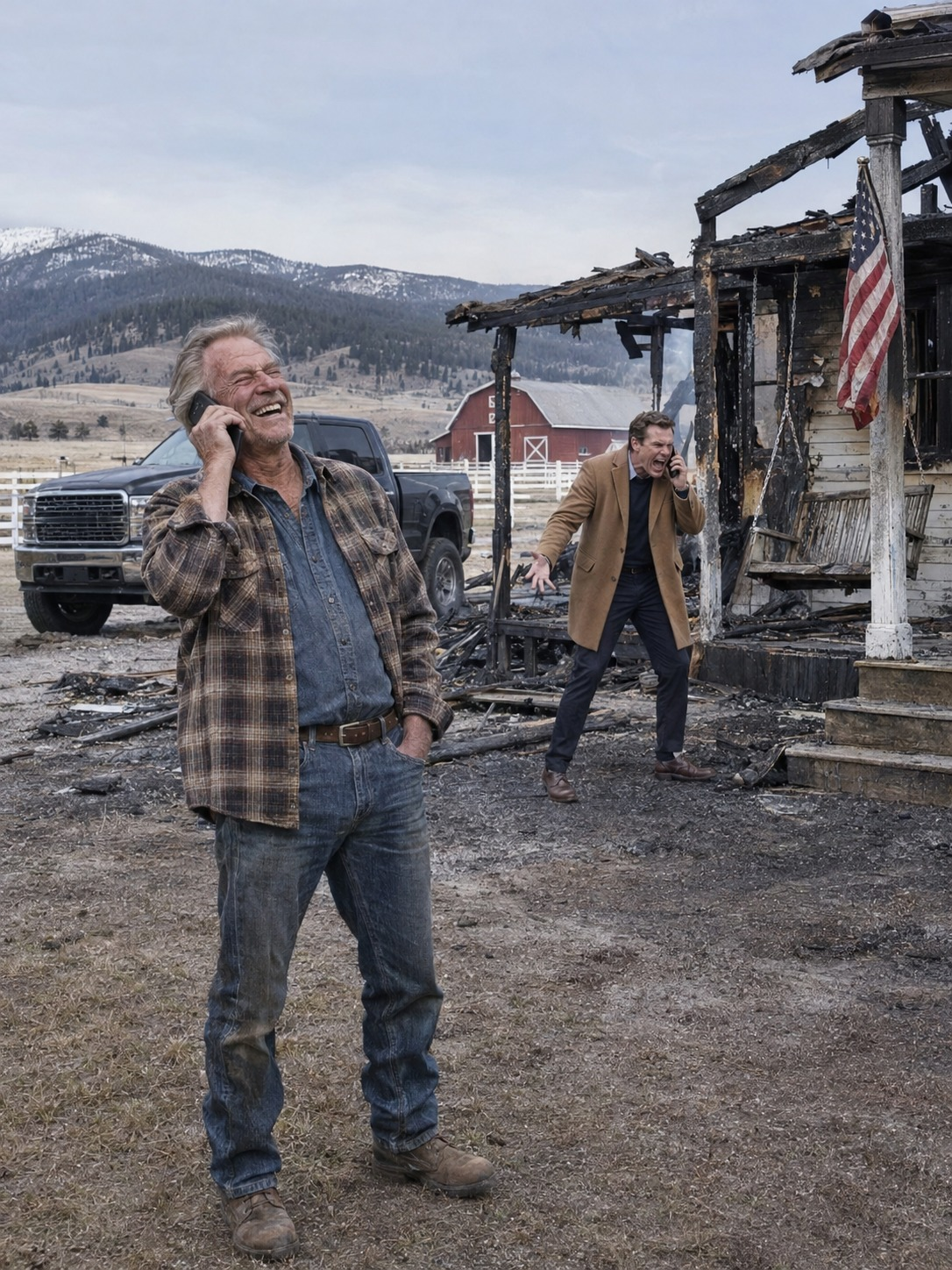
I gripped the bathroom sink as my son screamed through the phone.
“I burned that pigsty to the ground!”
On the counter beside me lay my grandfather's brass house key.
The number 1912 was engraved along its worn edge.
My son had made a terrible mistake.
For several seconds, I said nothing.
The man on the other end of the call apparently mistook my silence for shock.
“You hear me, Dad? It's gone. Every rotten board. Every stupid little thing you've been holding on to.”
I looked at myself in the hotel mirror.
My white shirt was buttoned. My black tie hung loosely around my neck. A small American flag pin rested beside my wallet, waiting to be attached to the jacket I would wear to my friend's funeral.
I had come to Virginia to bury a man who had once helped save my life.
Instead, I was listening to my only son celebrate the destruction of my home.
“Jason,” I said.
“What?”
“Where are you?”
He laughed.
“Where do you think? I'm standing right outside your precious house.”
I closed my eyes.
I could almost picture him standing near the driveway, wearing one of those expensive coats he liked so much, staring at the blackened remains of a building he had spent the previous six months calling worthless.
The house my great-grandfather had built.
The house where my children had learned to walk.
The house where my wife had spent the last afternoon of her life.
“It's over,” Jason continued. “You're homeless now, old man.”
That was when I started laughing.
It wasn't the response he expected.
It wasn't even the response I expected.
The laughter came from somewhere deep inside me, rising until my shoulders shook and I had to sit on the edge of the bathtub.
“Dad?”
I couldn't answer.
“What the hell is so funny?”
I pressed a hand against my forehead.
For six months, I had endured threats, accusations, betrayal, and sleepless nights. I had watched my own son attempt to dismantle everything my wife and I had built together.
And now he was calling to congratulate himself.
He had no idea what he had done.
More importantly, he had no idea what he hadn't done.
“Nothing, son,” I finally managed. “Keep talking.”
There was a brief silence.
Then Jason began speaking again.
And every word made the situation worse for him.
But to understand why I laughed that morning, you need to understand what my home meant to me.
And why, until six months earlier, I would have trusted Jason Walker with my life.
My name is Ronald Walker.
Most people around Livingston, Montana, call me Ron.
I was sixty-seven years old when my son decided that my life had become an obstacle to his financial ambitions.
I had never considered myself a wealthy man.
We owned land, certainly. Quite a bit of it.
Twelve hundred and eighty acres of pasture, creek bottoms, rolling hills, and open country that had belonged to the Walker family for four generations.
But land and money aren't the same thing.
Land demands something from you.
It demands early mornings, difficult winters, expensive repairs, patience, and an understanding that no matter how carefully you plan, nature always gets the final vote.
Money, on the other hand, had become something Jason believed could solve every problem.
That difference between us would eventually destroy our relationship.
My great-grandfather built the original ranch house in 1912.
According to family history, he completed the front porch before he finished the upstairs bedrooms because my great-grandmother wanted somewhere to sit and watch the sunset.
He gave her that porch.
Decades later, my father repaired its railings.
When Connie and I married, I replaced several damaged boards and installed a wooden swing.
That swing became her favorite place in the world.
She would sit there with a cup of coffee in the mornings, wrapped in an old cardigan, watching the cattle move across the lower pasture.
Sometimes I joined her.
Sometimes we didn't speak for half an hour.
We didn't need to.
After forty years of marriage, silence could be a kind of conversation.
Connie understood me better than anyone.
She knew when I was worried about money, when I was disappointed in myself, and when I was pretending that my knees didn't hurt.
She also knew how deeply I loved our children.
Hannah came first.
She was curious, stubborn, and determined to rescue every injured animal she encountered.
When she was eight, she brought a half-frozen barn cat into the kitchen and insisted that we couldn't go to church until it had eaten something.
Connie canceled our plans.
The cat survived.
Hannah eventually became a veterinarian.
Jason was different.
He was energetic, charming, and ambitious from the time he could talk.
He wanted to win every game.
He wanted the fastest bicycle, the biggest Christmas present, and the highest score on every school assignment.
Connie used to say that ambition could be a wonderful thing when it had a conscience attached to it.
I wish I had remembered those words sooner.
As a boy, Jason followed me everywhere.
He rode beside me in the pickup while I checked fences. He helped carry feed buckets that were almost too heavy for him. He slept against my shoulder during long drives home from cattle auctions.
When he was eleven, he asked whether the ranch would belong to him someday.
“Part of it might,” I told him. “But owning something isn't the same as deserving it.”
“What do you mean?”
“You take care of the land, and the land takes care of you. That's how it works.”
He nodded solemnly.
At the time, I thought he understood.
Years later, I would realize that he had heard something entirely different.
He had heard that someday the ranch would be his.
And everything else I said had been forgotten.
Jason left Montana after college.
He wanted a career that involved polished offices, expensive restaurants, and people who discussed investments instead of rainfall.
I didn't blame him.
A father shouldn't demand that his children live the same life he chose.
When Jason introduced us to Renee Simmons, I tried to welcome her with an open heart.
She was intelligent, fashionable, and accustomed to a lifestyle that seemed impossibly expensive to me.
Her father, Jerry Simmons, was chairman of Owens Group, a major real estate development company.
Jerry spoke about property differently from anyone I had ever known.
To him, an empty field wasn't an empty field.
It was an opportunity.
A mountain wasn't a mountain.
It was a view that could increase the price of a luxury condominium.
A river was an amenity.
A family home was an asset.
During our first meeting, he asked how much land I owned.
When I told him, he nearly dropped his fork.
“Ronald, you're sitting on a fortune.”
“I'm sitting on a chair,” I replied.
Connie laughed.
Jerry didn't.
He spent the rest of dinner asking about property boundaries, road access, water rights, and whether I had ever considered selling.
I told him I hadn't.
He smiled and said everyone had a number.
I told him some people didn't.
We never became friends.
Still, I attended Jason and Renee's wedding.
I gave a speech.
I danced with Connie.
I shook Jerry's hand and wished our children a lifetime of happiness.
For several years, I believed Jason was building a good life.
Then Connie became ill.
Everything changed.
There are moments in a marriage when the future suddenly becomes smaller.
Ours arrived in a doctor's office.
Connie sat beside me, listening quietly while a specialist explained treatment options and uncertain outcomes.
I remember staring at the doctor's pen.
It was a blue plastic pen with a pharmaceutical company's name printed along the side.
For some reason, I couldn't stop looking at it.
The doctor was telling me that my wife might die, and all I could think about was that ordinary little pen.
Connie reached over and took my hand.
“We'll handle it,” she whispered.
She was comforting me.
Even then.
Hannah rearranged her work schedule to help us.
She drove Connie to appointments, brought groceries, prepared meals, and called every evening.
Jason visited less frequently.
He always had a reason.
A business meeting.
A delayed flight.
A commitment involving Renee's family.
I accepted his explanations because I wanted to believe them.
Connie did too.
Whenever Jason called, she smiled as though he had given her something precious.
She never complained that the calls were too short.
She never asked why he didn't come home more often.
In 2021, she passed away.
The ranch became unbearably quiet.
I continued waking before sunrise.
I continued feeding cattle and repairing fences.
I continued making coffee for two people for nearly three weeks before I finally stopped.
Her favorite chair remained beside the fireplace.
Her cardigan hung behind the bedroom door.
Her handwritten recipes stayed in the kitchen drawer, some of them stained with butter or marked with notes she had written years earlier.
Hannah suggested that we organize Connie's belongings whenever I felt ready.
I told her I wasn't ready.
She understood.
Jason came to the funeral.
He stood beside me while people offered their condolences.
He hugged his sister.
He cried when the pastor spoke about Connie's kindness.
For a little while, I saw my boy again.
After the service, we returned to the ranch.
Jason wandered into the living room and stood beside the fireplace.
He looked at Connie's chair.
Then he turned toward me.
“Have you thought about what you're going to do with this place?”
I assumed he meant how I would manage the ranch alone.
“I'll manage,” I said.
“You shouldn't have to.”
“I've been doing this my whole life.”
He glanced around the room.
“Things change, Dad.”
I thought he was worried about me.
That was the terrible thing about being a father.
Even when the warning signs appeared, love gave me a reason to explain them away.
Over the next two years, Hannah became my closest companion.
She came every Sunday, sometimes carrying groceries, sometimes bringing veterinary paperwork she needed to finish.
We ate dinner together.
We talked about Connie.
Occasionally, we laughed so hard that I forgot, for a few seconds, that someone was missing.
Jason rarely visited.
When he did, Renee usually accompanied him.
They complained about the drive.
They complained about the weak cell phone signal.
Once, Renee asked whether I had considered replacing the old kitchen cabinets.
I told her Connie had painted them herself.
She looked at the cabinets again.
“Oh,” she said.
She didn't mention them afterward.
But I noticed the way she studied the house.
Not like someone appreciating a family home.
Like someone calculating how much work it would take to remove it.
By the beginning of January, I hadn't seen Jason in nearly four months.
Then, one snowy Thursday afternoon, my phone rang.
“Dad?”
“Hey, son.”
“Renee and I are coming out this weekend.”
I nearly dropped the wrench I was holding.
“You are?”
“Yeah. Thought we should have dinner together.”
I smiled.
“Well, that sounds pretty good.”
“Nothing fancy. Just family.”
After we hung up, I called Hannah.
“Your brother's coming home.”
There was a pause.
“Really?”
“Saturday.”
“Did he say why?”
“To have dinner.”
Another pause.
“Okay,” she said. “I'll come early and help.”
I spent the next two days preparing for a visit that should have required no preparation at all.
I cleaned the guest room.
I bought Jason's favorite coffee.
I found an old photograph of him holding a fishing rod beside the creek and placed it on the living room shelf.
He had been nine years old.
His smile was enormous.
I wanted him to see it.
I wanted him to remember that this place had once made him happy.
On Saturday afternoon, Hannah arrived carrying potatoes, vegetables, and a homemade apple pie.
She found me polishing the dining room table.
“Dad, you're acting like the president is coming.”
“Can't a man clean his own house?”
She smiled.
“Of course.”
But her smile faded when she noticed how nervous I was.
She placed a hand on my shoulder.
“You don't have to impress him.”
“I know.”
“Do you?”
I didn't answer.
At five thirty, headlights appeared beyond the front windows.
I stood immediately.
A black pickup pulled into the driveway.
Jason stepped out wearing an expensive camel-colored overcoat. Renee followed, carefully avoiding the snow near the porch steps.
I opened the front door before they reached it.
“Come on in!”
Jason smiled.
“Hey, Dad.”
He hugged me.
For one beautiful, foolish moment, I believed everything was going to be all right.
Dinner was wonderful.
We talked about Hannah's veterinary practice, Jason's business projects, and the neighbors who had recently sold their cattle.
Jason even asked about an old horse he remembered from childhood.
I told him the horse had been gone for years.
He looked disappointed.
After dinner, Hannah brought out the apple pie.
Jason accepted a second slice.
Renee complimented the food.
I found myself wishing Connie could have seen us.
When we moved into the living room, Jason removed his coat and checked his gold wristwatch.
Then he sat down.
In Connie's chair.
Hannah noticed immediately.
Her eyes met mine.
I said nothing.
Jason reached into the leather briefcase he had brought from the truck.
He removed a thick envelope and placed it on the coffee table.
Across the front, in elegant black lettering, were two words.
OWENS GROUP.
“Dad,” he said, leaning forward.
“We need to talk about Jerry.”
I looked at the envelope.
Then at my son.
And suddenly I understood that he hadn't come home for dinner.






Comments 0