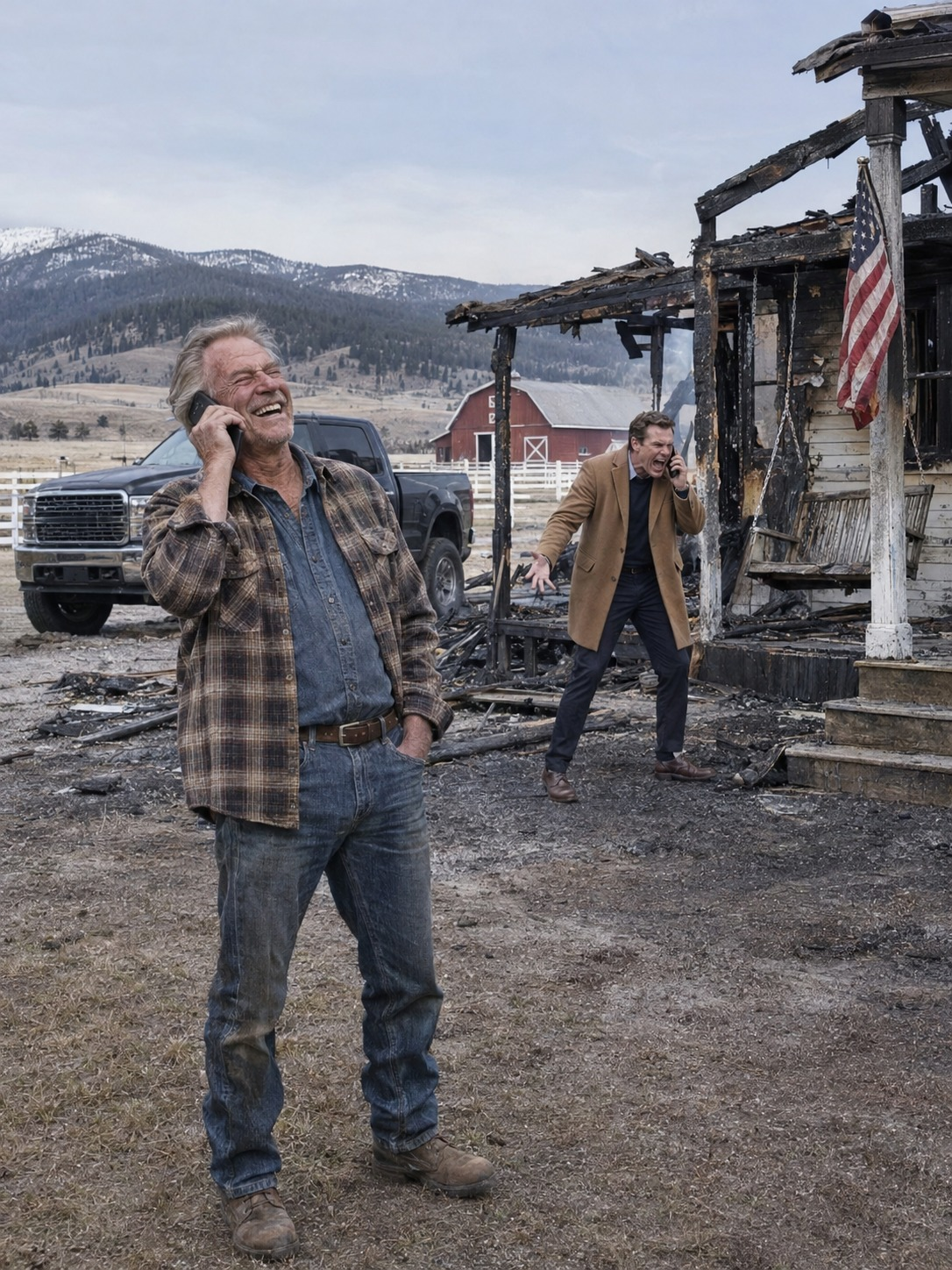
“I burned that pigsty to the ground!”
Jason's voice exploded through the phone.
“You're homeless now, old man!”
I stopped adjusting my black tie.
For several seconds, I stared at my reflection in the hotel bathroom mirror.
My son was breathing heavily.
Behind him, I could hear the wind.
“Did you hear me?” he shouted. “Your precious house is gone!”
I placed my free hand against the bathroom sink.
Then I started laughing.
I couldn't help myself.
After months of threats, betrayal, expensive legal battles, and sleepless nights, something inside me finally broke.
But it wasn't my heart.
It was the fear that had controlled my life since January.
Jason stopped talking.
“What the hell is so funny?”
I took a slow breath.
“Nothing, son. Keep talking.”
He cursed.
“You think I'm joking?”
“No.”
“I'm standing right here! There's practically nothing left!”
I looked down at the partially knotted tie hanging against my white shirt.
I had been preparing to attend a funeral.
Apparently, Jason believed he had arranged another one.
A funeral for the home my family had occupied for four generations.
“You should see it,” he continued. “All that old wood. All those worthless memories. Gone!”
I closed my eyes.
Worthless memories.
He had no idea how much those words revealed about him.
“Was anybody hurt?” I asked.
He laughed.
“That's what you're worried about?”
“Answer me.”
“Nobody was there.”
I released a breath.
Whatever else had happened, that was the most important thing.
Carl had promised that the necessary precautions would be taken.
I trusted him.
But hearing Jason confirm that nobody had been inside brought a measure of relief.
“Where are you now?” I asked.
“Where do you think? At your ranch!”
He sounded almost proud.
I imagined him standing beneath the Montana sky, looking at the destruction he believed represented his victory.
For months, he had been waiting for me to surrender.
Now he apparently believed he had removed my final reason for refusing.
“It's over, Dad,” he said. “You don't have anything left to protect.”
I glanced at my phone.
A new message from Carl appeared across the screen.
No injuries reported. Everyone is safe. Stay calm.
I read it carefully.
Then I returned my attention to Jason.
“Why are you calling me?”
He seemed surprised by the question.
“What?”
“Why did you call?”
“To tell you what happened!”
“You could've let somebody else tell me.”
He laughed again.
“I wanted to hear your reaction.”
There it was.
He hadn't simply wanted to destroy a building.
He had wanted to hurt me.
He wanted to hear his father cry.
He wanted to hear me beg.
Perhaps he wanted me to admit that he had finally won.
Instead, I laughed.
And that was apparently the one reaction he hadn't prepared himself for.
“You're unbelievable,” he muttered.
“Am I?”
“Your house just burned down, and you're laughing!”
I straightened my tie.
“I'm listening, Jason.”
He became quiet.
Then his voice changed.
“Maybe now you'll understand what you've done to us.”
I leaned against the sink.
“What I've done?”
“You ruined everything!”
“How?”
“You know how!”
“Explain it to me.”
He began shouting again.
“Jerry's company is finished! People want their money! Renee's talking about leaving me! Everything would've been fine if you'd just signed those papers!”
I waited until he finished.
Then I asked, “And destroying my home fixes those problems?”
“It changes things.”
“How?”
“You'll have to move now.”
“Will I?”
“What are you going to do? Sleep in the barn?”
He laughed at his own remark.
“You're sixty-seven years old. You can't rebuild everything from scratch.”
I looked at myself in the mirror.
My gray hair.
The wrinkles around my eyes.
The black tie I had worn to Connie's funeral.
Jason saw my age as a weakness.
He believed that because I had fewer years ahead of me than behind me, I would surrender anything to make those remaining years easier.
He had never understood that growing older sometimes made a man harder to intimidate.
I had already survived things that money couldn't repair.
Losing Connie had taught me that.
“Dad?”
“I'm here.”
“You're going to have to make some decisions.”
“I imagine so.”
“Good. Then we can finally start talking about the future.”
I almost laughed again.
The future.
My son was standing beside what he believed were the remains of our family home, and he was already discussing financial arrangements.
“Tell me what you have in mind,” I said.
Jason's breathing slowed.
He apparently mistook my calmness for resignation.
“Well, first we need to figure out what happens with the property.”
“The property's protected.”
“Forget that conservation nonsense.”
“It's legally recorded.”
“Jerry knows people. There are ways to deal with these things.”
I shook my head.
Even now, he refused to accept reality.
“And then?” I asked.
“Then we figure out your living arrangements.”
“My living arrangements?”
“You can't stay out there anymore.”
“According to whom?”
“According to common sense!”
I glanced at the bathroom clock.
Frank's funeral was only a few hours away.
Somewhere in Virginia, his family was preparing to say goodbye to a man who had spent his life honoring his responsibilities.
Meanwhile, my son was explaining why destroying his father's home was supposedly an act of common sense.
The contrast was almost unbearable.
“Jason,” I said quietly, “did you think about your mother before doing this?”
Silence.
Then he sighed.
“Don't start with Mom.”
“I'm asking you a question.”
“She isn't here anymore.”
“I know.”
“Then stop acting like everything has to stay exactly the way she left it!”
I tightened my grip on the sink.
“Your mother loved that house.”
“It was a dump.”
“She raised you there.”
“So what?”
I swallowed.
There were insults a father could tolerate.
There were accusations he could dismiss.
But hearing my son speak about the place where Connie had devoted forty years of her life to our family was almost more than I could bear.
I wanted to tell him about the nights she had stayed awake when he was sick.
The meals she had prepared.
The sacrifices she had made without ever expecting recognition.
Instead, I said nothing.
Jason continued.
“You've been living in the past for years, Dad. Somebody had to make you move on.”
“And you decided that somebody was you?”
“Apparently.”
I looked down at the photograph of Connie resting beside my toiletries.
I had taken it from my wallet that morning.
She was smiling.
Her hair was blowing across her face.
The picture had been taken during a summer picnic near the creek.
I touched its edge with my finger.
Then I returned my attention to the call.
“Tell me something, Jason.”
“What?”
“Did Jerry know what you were planning?”
He hesitated.
“Why does that matter?”
“I'm curious.”
“Jerry doesn't need to know everything I do.”
“Does Renee?”
“Leave her out of this.”
I nodded slowly.
He was becoming defensive.
I didn't press him further.
Instead, I let the silence continue.
Carl had explained before my trip that investigators were handling the evidence and monitoring relevant developments under the appropriate legal arrangements.
My responsibility was simple.
Stay safe.
Avoid confrontation.
Don't interfere.
And if Jason contacted me, let him speak.
That was exactly what I intended to do.
“Anyway,” Jason continued, “you shouldn't worry too much about money.”
I raised my eyebrows.
“Why not?”
“You've got insurance.”
“Do I?”
“Of course you do.”
“How much?”
He laughed.
“Enough.”
“Enough for what?”
“To start over.”
I looked at my reflection.
“That's interesting.”
“What is?”
“You seem to know quite a bit about my insurance.”
Jason went silent.
For several seconds, I heard nothing but the wind.
Then he said, “Everybody insures their house.”
“That's true.”
“So you'll get paid.”
“Perhaps.”
“And then we can work something out.”
“We?”
He sighed impatiently.
“Dad, don't make this difficult.”
I almost admired his ability to speak as though he hadn't just confessed to destroying my property.
He sounded like a man negotiating the final details of a business transaction.
“Jason, what exactly are you expecting from me?”
“I'm expecting you to act like a father for once.”
I closed my eyes.
There it was again.
Every refusal had become evidence that I didn't love him.
Every boundary had become a personal betrayal.
Every consequence of his decisions had somehow become my responsibility.
“What would a father do?” I asked.
“He'd help his son.”
“Even after his son burned down his house?”
Jason laughed nervously.
“You're going to keep bringing that up, aren't you?”
“I imagine I will.”
“Look, what's done is done.”
I stared at the bathroom tiles.
What's done is done.
He spoke as though he had accidentally broken a window.
Then he said something that made me stand completely still.
“At least the safe should've survived.”
I didn't answer.
“Dad?”
“I'm listening.”
“Grandpa always said that thing was practically indestructible.”
“Did he?”
“Yeah. Remember?”
I remembered.
I also remembered Carl asking me about that safe weeks earlier.
The coins.
The bearer bonds.
The family documents.
Jason had been thinking about those possessions for much longer than I had realized.
“What about the safe?” I asked.
He cleared his throat.
“Well, somebody's going to have to recover it.”
“Somebody?”
“I can take care of it.”
“That's generous of you.”
He ignored the remark.
“Those gold coins are probably worth a fortune now.”
I remained silent.
“And the bonds,” he added. “Grandpa kept those old bearer bonds in there.”
“Is that right?”
“You know he did.”
I looked toward the bathroom door.
For the first time during the conversation, I felt something resembling disbelief.
Not because Jason remembered the contents.
But because he was discussing them so openly.
He had apparently convinced himself that the destruction of my home would create an opportunity to claim possessions that didn't belong to him.
He wasn't even trying particularly hard to conceal his intentions anymore.
“Dad, listen,” he said. “Whatever's left belongs to the family.”
“I'm still part of the family, aren't I?”
He groaned.
“You know what I mean.”
“No. Explain it.”
“I'm your son. Hannah's your daughter. Eventually, all that stuff is going to belong to us anyway.”
“Eventually?”
“Yeah.”
“I'm not dead yet, Jason.”
He became quiet.
Then he muttered, “That's not what I meant.”
I waited.
He continued.
“Look, I'm trying to be practical.”
“By helping yourself to my belongings?”
“By protecting family assets!”
I shook my head.
It was remarkable how often he used the word protecting when he meant taking.
He had tried to protect me by seeking control of my finances.
He had tried to protect the ranch by pressuring me to sell it.
Now he wanted to protect our family possessions by placing them under his own control.
The words changed.
The objective never did.
My phone vibrated again.
Another message from Carl.
Authorities are handling the scene. The arrangements we discussed remain secure.
I read the final sentence twice.
Then I smiled.
Jason heard something in my breathing.
“Are you laughing again?”
“A little.”
“What is wrong with you?”
“Nothing.”
“Your entire house is gone!”
“So you've told me.”
“Everything Mom left behind!”
I looked at Connie's photograph.
“Are you certain about that?”
“What?”
“Everything she left behind.”
“Of course I'm certain!”
He sounded increasingly irritated.
“I was here, Dad. I saw it!”
I picked up the photograph and slipped it into my shirt pocket.
Then I asked, “Did you ever wonder why I stopped arguing with you?”
He didn't respond.
“After the court hearing,” I continued, “after the conservation agreement, after all those conversations. Did you ever wonder why I became so quiet?”
“Because you knew you were losing.”
I smiled.
“Is that what you thought?”
“What else would I think?”
I walked out of the bathroom and sat on the edge of the hotel bed.
Morning sunlight was beginning to enter through the curtains.
Outside, people were starting their ordinary Monday routines.
Cars moved through the parking lot.
A hotel employee pushed a cart along the sidewalk.
Nobody knew that a father sitting upstairs was listening to his son describe the destruction of their family home.
“Jason, do you remember Carl?”
He sounded confused.
“Your Army buddy?”
“Yes.”
“What about him?”
“He's been helping me with a few things.”
“Like what?”
“Protecting the ranch.”
Jason laughed loudly.
“Well, he did a terrible job!”
I smiled.
“Did he?”
“Look around, Dad. Oh, wait. You can't!”
He laughed again.
Then he added, “Maybe you should call him and ask for your money back.”
I let him enjoy the moment.
He believed Carl had failed.
He believed I was powerless.
He believed the insurance money and the contents of the safe would somehow solve his problems.
And he believed the destruction he was looking at had finally ended my resistance.
There was something almost tragic about how certain he sounded.
“Jason,” I said, “how much money do you actually owe?”
He sighed.
“Why are you asking me that now?”
“Because I want to understand.”
“It doesn't matter anymore.”
“Doesn't it?”
“We'll be fine once everything gets sorted out.”
“Everything?”
“The insurance. The property. The valuables.”
I stood.
“And you think those things are yours?”
“I'm entitled to something!”
His voice rose again.
“I've spent my whole life watching you sit on millions while everybody else struggles!”
I looked down at my hands.
Hands that had repaired fences.
Delivered calves.
Worked through winters so cold that my fingers sometimes went numb inside my gloves.
Hands that had held Connie's during her final hours.
Jason saw the result of decades of work.
He didn't see the decades.
“Son,” I said quietly, “I didn't spend my life sitting on millions.”
“Whatever.”
“I worked for what I have.”
“Congratulations.”
“And I would've helped you if you'd come to me honestly.”
He laughed bitterly.
“Too late for that now.”
I felt a sudden sadness.
He was right about one thing.
Some opportunities had already passed.
There had been countless moments when Jason could have stopped.
Before paying Pamela.
Before contaminating the creek.
Before signing the court petition.
Before becoming involved in the suspicious insurance arrangements.
Before standing on my porch demanding access to the safe.
Every time, he had chosen to continue.
And now he was standing beside the consequences of those choices.
“Jason, listen carefully,” I said.
“What?”
“Whatever happens next, I want you to remember that I gave you opportunities to walk away.”
He snorted.
“Are you threatening me?”
“No.”
“Sounds like it.”
“I'm telling you something you need to hear.”
“Well, save your lectures.”
I returned to the bathroom.
My tie was still unfinished.
I stood before the mirror and completed the knot.
Then I adjusted my collar.
“Dad?”
“Yes?”
“You should probably come home.”
“I'm attending a funeral.”
“This is more important.”
“No, it isn't.”
He sounded stunned.
“Your house just burned down!”
“And my friend deserves to be buried with dignity.”
“You're seriously going to a funeral?”
“Yes.”
He cursed under his breath.
I checked my reflection one final time.
Then another message arrived from Carl.
This one was longer.
I read it slowly.
Every word confirmed that the preparations we had made during those confidential weeks had accomplished exactly what we had hoped.
The irreplaceable possessions were secure.
The necessary evidence was being preserved.
And the people responsible for the investigation were doing their jobs.
I felt my shoulders relax.
For months, Jason had believed he understood everything happening around him.
He had purchased confidential information.
He had examined my finances.
He had studied my schedule.
He had discussed my property with developers.
He had even tried to convince a court that I was incapable of making my own decisions.
Yet he had overlooked the most important possibility of all.
That his father might have been paying attention.
“Jason?”
“What now?”
I picked up my jacket.
“Are you absolutely certain you know what you burned?”
He laughed.
“What kind of stupid question is that?”
I didn't answer.
“Dad?”
I remained silent.
His laughter faded.
“What are you talking about?”
I looked at Carl's message again.
Then I said, “You should take another look.”
Jason stopped speaking.
For several seconds, I heard only the wind.
Then his breathing changed.
“Wait a minute.”
I held the phone against my ear.
“What the hell?”
His voice was no longer confident.
“Dad?”
I waited.
“Where's the foundation?”
I said nothing.
“Something's wrong here.”
Then I heard another voice in the background.
Someone called Jason by his full name.
My son stopped breathing into the phone.
“Who are you?” he demanded.
The stranger answered.
“Mr. Walker, we need to speak with you about the fire.”
Jason whispered something I could barely understand.
Then Carl sent me a photograph.
I opened it.
And there, standing behind my son, was the one person he had believed would never testify against him.






Comments 0