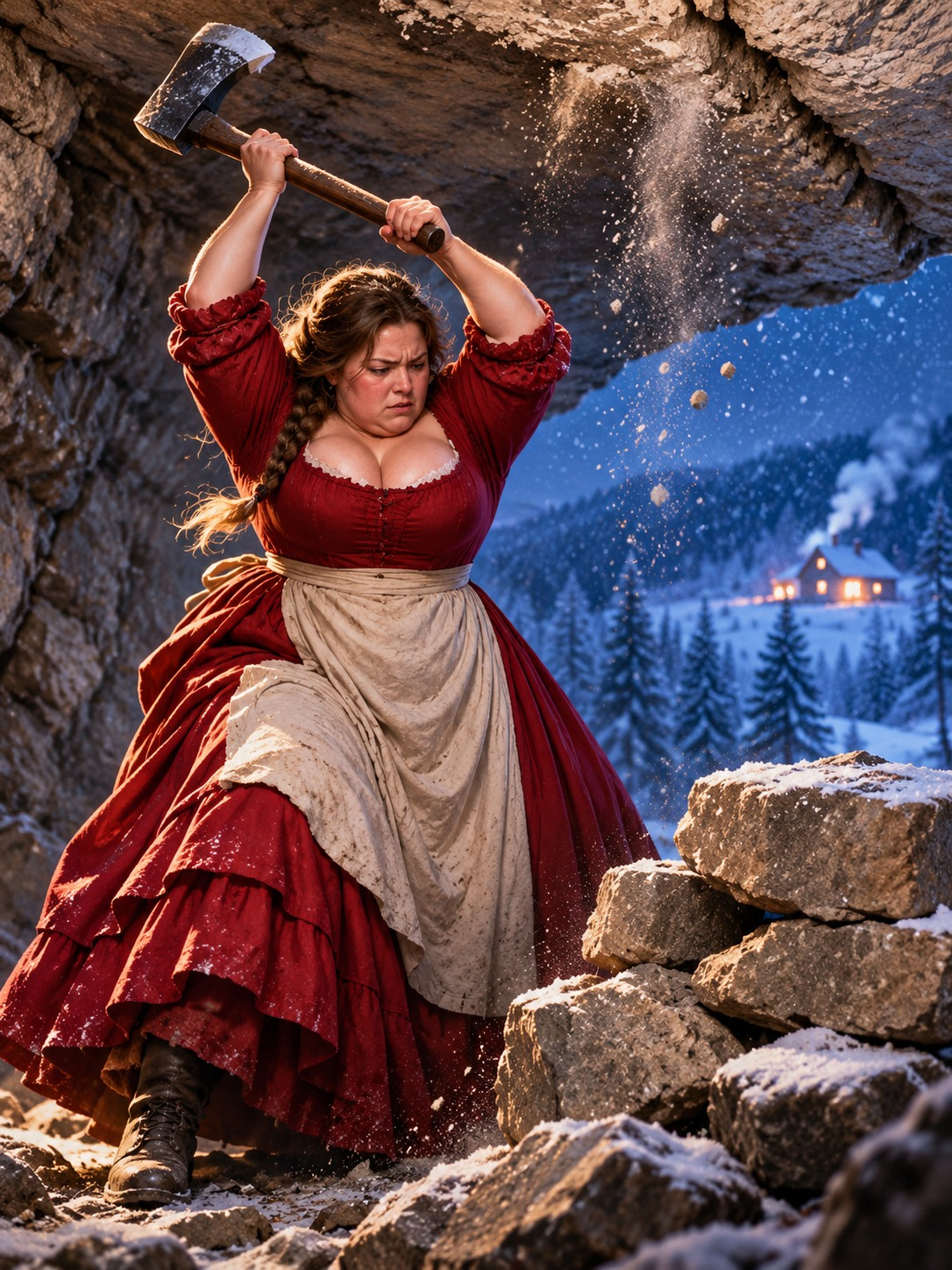
Ruth Calder pressed her ear against the limestone wall.
Three knocks came from the other side.
Then a man's voice whispered her name.
"Ruth."
She jerked backward so violently that her shoulder struck the stone shelf beside her.
The blanket slipped from her lap.
For several seconds, she could hear nothing except her own breathing.
"Who's there?"
No answer.
She tightened her grip around Samuel's hatchet.
"Whoever you are, I have an ax, and I know how to use it."
Silence.
Then came a low scraping sound.
Something moved behind the wall.
Ruth stared at the limestone.
It was solid.
She had examined it before choosing the hollow. There were no openings, no visible passages, and no gaps large enough for a rabbit.
Yet something had spoken her name.
And the voice had sounded disturbingly familiar.
She swallowed.
"Samuel?"
The name escaped before she could stop it.
Immediately, she felt foolish.
Her husband had been dead since April.
She had watched six men lower his coffin into the ground outside Casper. She had stood beside his grave while Reverend Bell read from a Bible stained by rain.
Samuel was not hiding inside a mountain.
But someone had scratched his name into that wall.
And someone had just whispered hers.
Ruth knelt beside the inscription and brushed away more limestone dust.
The four words beneath Samuel's name slowly became visible.
THE STONE KEEPS WITNESS.
She read them twice.
Then a third time.
The handwriting was unmistakable.
Samuel had always made his capital letters too large. His W looked like two crooked Vs, and his S leaned backward as though it were trying to escape the rest of the word.
Ruth had teased him about it whenever he wrote supply lists.
Now those same crooked letters stared back at her from the mountain.
"What were you doing here?" she whispered.
She touched the date.
April 17.
Samuel had supposedly died that morning on the freight road outside Casper.
But the limestone hollow was nearly two miles from their ranch, in the opposite direction.
There was no reason for him to have been here.
Unless the date meant something else.
Ruth studied the marks until her eyes began watering.
Then she noticed something strange.
The inscription was not carved directly into the rear wall.
It was carved into a rectangular section of limestone whose edges were almost invisible beneath mineral deposits.
She ran her fingers along the surface.
There.
A narrow vertical seam.
Another along the bottom.
Someone had fitted a separate stone into the mountain.
Ruth leaned closer.
A faint current of air touched her cheek.
Warm air.
Not enough to heat the shelter.
Just enough to be unmistakable.
She sat back.
Her father had taught her that limestone held warmth, but he had never told her solid stone could breathe.
A sudden knock came from the darkness beyond.
Ruth rose.
"All right," she whispered. "I'm listening."
Nothing answered.
She waited another minute.
Then she stepped away.
Whatever lay behind that wall had been there before she arrived.
Whatever Samuel had discovered, he had chosen not to tell her.
And whatever had whispered her name could wait until morning.
She needed to survive the night first.
Outside, the snow had begun falling harder.
Ruth carried the blanket to the driest corner of the hollow and spread it over a bed of gathered grass.
She placed the hatchet beside her.
Then she sat with her back against the opposite wall, where she could watch both the entrance and the mysterious inscription.
Sleep came in short, miserable pieces.
Each time she closed her eyes, she saw Samuel standing beside the wagon on the morning he left.
He had kissed her forehead.
"Back by Thursday," he promised.
"You said that last time."
"And I was."
"Friday morning."
"Thursday in spirit."
She had laughed.
He had climbed onto the wagon.
And that was the last time she saw him alive.
Near dawn, Ruth woke with her teeth chattering.
Her boots were stiff.
Her fingers ached.
A thin layer of frost covered the coffee pot.
She sat up and forced herself to move.
"Cold kills by inches," she murmured.
Her father had said those words every winter.
A wet boot.
A leaking roof.
A draft beneath a door.
Small things that became deadly when ignored.
Ruth flexed her fingers until the pain eased.
Then she went outside.
The valley had disappeared beneath fresh snow.
Across the basin, smoke poured from the chimney of the house Vernon had stolen.
He was already burning through the woodpile.
Ruth could tell by the thickness of the smoke.
Samuel had always liked a hot house.
Vernon, apparently, liked one even hotter.
She watched for a moment.
Then she turned away.
There was no sense wasting strength on anger.
Anger did not build walls.
Anger did not keep blankets dry.
And anger certainly did not make breakfast.
She gathered several handfuls of snow and melted them in the coffee pot over a small, carefully controlled fire near the shelter entrance.
She mixed cornmeal into the water and stirred it with a stick.
The result was thick, lumpy, and nearly tasteless.
She ate every bite.
Then she examined her shelter.
The limestone overhang faced south, which meant it would receive sunlight whenever the clouds cleared.
Its floor sloped gently toward the entrance, allowing melted snow to drain away.
The walls were dry.
The ceiling was high enough for her to stand comfortably.
And the entrance was narrow enough to protect with a barrier.
It was not a house.
But it could become a place where a determined woman survived December.
Ruth pulled her shawl tighter and began working.
She selected broad, flat limestone slabs from the scattered rocks outside.
The first weighed perhaps forty pounds.
The second was heavier.
By the fifth, her arms were trembling.
She rested.
Then continued.
Her body had always attracted attention.
At thirty-four, Ruth weighed nearly three hundred pounds. People who met her sometimes assumed she was slow, lazy, or incapable of difficult work.
Those people had never watched her carry feed sacks through knee-deep mud.
They had never seen her hold down a frightened calf while Samuel treated an infected wound.
They had never watched her split firewood for four hours because a blizzard was coming.
Ruth knew her limitations.
She also knew her strength.
She used leverage instead of trying to lift every stone.
She rolled the largest slabs over smaller rocks.
She dragged others across the ground using a length of rope salvaged from her bundle.
When a block refused to move, she studied it until she found another angle.
Her father had called that working with the stone instead of fighting it.
By noon, the barrier stood nearly knee-high.
She left a narrow opening along one side for entering and leaving.
Then she began arranging smaller stones along the bottom to block the wind.
Her fingers were numb.
Her shoulders burned.
But the difference was immediate.
The shelter no longer felt like a tunnel through which the winter wind could race.
It felt enclosed.
Protected.
Almost private.
Ruth stood inside and listened.
The wind struck the outer stones.
The sound softened.
She smiled faintly.
"Well, Papa," she whispered, "you were right again."
She reached toward the rear wall.
The stone felt different from the others.
Not warm exactly.
But less cold.
Ruth pressed her palm against it.
She remembered the faint current of air from the night before.
And the knocking.
And Samuel's inscription.
For a moment, she considered prying at the rectangular stone.
Then she looked at the unfinished barrier.
"One problem at a time."
She returned to work.
By midafternoon, the clouds broke.
A narrow shaft of sunlight entered the shelter and struck the limestone floor.
Ruth watched the light spread across the stone.
Then she remembered something her father had once shown her in Pennsylvania.
He had built a small warming chamber beside the family's kitchen.
Thick stone walls surrounded a brick stove. Even after the fire died, the chamber remained warm for hours.
"Stone remembers," he had told her.
Ruth had been twelve.
She had asked whether stone could remember people.
Jacob Mercer had laughed.
"Only if they leave something worth remembering."
Now, standing inside the mountain, she wondered whether Samuel had done exactly that.
She moved several dark stones into the sunlight.
They absorbed what little warmth the winter afternoon offered.
Then she arranged them near the place where she intended to sleep.
She gathered more dry grass.
She repaired a tear in her blanket using a needle from the sewing kit hidden inside her coat.
She checked her food.
Beans.
Cornmeal.
Not nearly enough.
She would need to set snares, search for edible roots, and perhaps return to the creek for fish if the water remained open.
But first she needed a secure shelter.
And she needed to understand the mountain.
Late in the afternoon, Ruth discovered another unusual feature.
A shallow groove ran across the limestone floor near the rear wall.
At first she thought it was a natural crack.
Then she followed it with her fingers.
The groove was too straight.
It extended nearly six feet before disappearing beneath loose rubble.
Someone had cut it.
She examined the surrounding stone.
There were tool marks.
Old ones.
The kind left by a steel chisel.
Ruth sat back on her heels.
Samuel had owned a chisel.
He had used it to shape the foundation stones beneath their barn.
After his death, Ruth had found it missing from the tool chest.
She had assumed he had lost it.
Now she wasn't so certain.
She cleared more rubble from the groove.
A small metal object appeared beneath the dust.
Ruth picked it up.
A bent iron nail.
Not remarkable by itself.
But wrapped around it was a thin strand of faded blue thread.
Her breath caught.
Samuel had worn a blue wool coat whenever he traveled.
Ruth had repaired its torn cuff the winter before his death.
She had used thread from her mother's sewing box.
The same faded blue.
She turned the nail between her fingers.
"Samuel," she whispered, "what did you find?"
A sound came from outside.
Boots crunching through snow.
Ruth immediately closed her hand around the nail.
She reached for the hatchet.
"Who's there?"
A boy appeared at the entrance.
He was perhaps twelve years old, with a narrow face, wind-reddened cheeks, and a wool cap pulled low over his ears.
Ruth recognized him.
Thomas Calder.
Vernon's oldest son.
The boy stopped when he saw the hatchet.
"Aunt Ruth?"
She lowered it slightly.
"Thomas."
He looked around the shelter.
His eyes widened.
"You're really living here?"
"For the moment."
"Pa said you'd gone to Casper."
"Your father says many things."
Thomas shifted awkwardly.
He carried a small cloth bundle.
"Ma sent me."
Ruth studied him.
"Did she?"
He nodded.
"She said you might need food."
He held out the bundle.
Inside were two biscuits, a small piece of salt pork, and three dried apples.
Ruth looked at the food.
Then at the boy.
"Did your mother know you were coming?"
Thomas hesitated.
That answered her question.
Ruth softened.
"You shouldn't have come alone."
"I know the trail."
"That's not what I meant."
He glanced toward the ranch.
"Pa says you're stubborn."
"He's right."
"He says you could come back if you apologized."
Ruth gave a humorless laugh.
"For what?"
Thomas stared at his boots.
"I don't know."
She accepted the bundle.
"Thank you."
He looked relieved.
Then his gaze drifted toward the limestone wall.
His expression changed.
Ruth noticed immediately.
"What is it?"
Thomas pointed.
"That's the place."
"What place?"
He looked frightened.
"The place Uncle Samuel told me never to come."
Ruth's heart began beating faster.
"When did he tell you that?"
"Last spring."
"Before he died?"
Thomas nodded.
"He caught me hunting rabbits up here."
"What did he say?"
The boy glanced over his shoulder.
"He said the mountain wasn't safe."
Ruth stepped closer.
"Did he tell you why?"
Thomas shook his head.
"Not exactly."
"What does that mean?"
The boy swallowed.
"He said if I ever heard knocking inside the rocks, I was supposed to run."
Ruth felt the cold settle deeper into her bones.
"Thomas, did Samuel come here often?"
The boy hesitated.
"Sometimes."
"Alone?"
"Usually."
"Usually?"
Thomas looked toward the entrance again.
"Sometimes another man came with him."
Ruth's fingers tightened around the hatchet.
"What man?"
"The big one."
She stared at him.
"The man who came with your father?"
Thomas nodded.
"The one with the beard."
Ruth remembered the stranger standing behind Vernon in her kitchen.
His silence.
His watchful eyes.
The way he had followed her outside.
And his warning about the storm.
"Do you know his name?"
Thomas shook his head.
"Pa calls him Gideon."
Ruth repeated it quietly.
"Gideon."
The boy stepped closer.
"Aunt Ruth?"
"Yes?"
"Don't tell Pa I came."
"I won't."
"He gets angry when people talk about Uncle Samuel."
Ruth studied him.
"Why?"
Thomas opened his mouth.
Then closed it.
His face had gone pale.
"Thomas?"
The boy shook his head.
"I have to go."
He turned and hurried into the snow.
"Thomas, wait!"
But he was already running downhill.
Ruth watched until the trees swallowed him.
Then she looked at the food in her hand.
A child had risked his father's anger to bring her supper.
That kindness hurt more than she expected.
She carried the bundle inside.
For the first time since leaving the ranch, she felt something besides grief and anger.
Hope.
Small.
Fragile.
But real.
She placed the biscuits beside the coffee pot.
Then she returned to the rear wall.
Gideon.
The bearded giant had known Samuel.
He had come to this mountain with him.
And he had stood silently while Vernon took Samuel's home.
Ruth pressed her hand against the rectangular stone.
"Why didn't you tell me?" she whispered.
She wasn't certain whether she was speaking to Samuel or the mountain.
The answer came as a faint vibration beneath her palm.
Ruth pulled her hand away.
A deep sound traveled through the limestone.
Not a knock.
A groan.
She looked toward the entrance.
Outside, the snow had stopped.
The wind had vanished.
The entire valley seemed unnaturally still.
Then a sharp cracking sound echoed above her.
Ruth looked up.
A thin fracture appeared in the ceiling.
Dust drifted down onto her dark green dress.
She grabbed the hatchet.
Another crack split the silence.
Louder.
Closer.
A fist-sized chunk of limestone struck the ground beside her boot.
Ruth stumbled backward.
The rear wall began vibrating.
A hollow boom rolled through the mountain.
She turned toward the entrance.
A huge silhouette appeared through the falling dust.
Gideon.
The bearded frontiersman stared at the ceiling.
His expression changed instantly.
"RUTH! GET OUT!"
He lunged toward her.
Another piece of limestone crashed down.
Gideon seized her arm.
But before he could pull her toward the entrance, a terrible grinding sound erupted from the rear wall.
Both of them froze.
A vertical fracture appeared beneath Samuel's name.
The stone began shifting outward.
Gideon's face drained of color.
He stared at the widening crack.
Then he whispered something Ruth could barely hear.
"No. They weren't supposed to open it."
Ruth turned toward him.
"Who?"
Gideon didn't answer.
The limestone wall shuddered.
A narrow black opening appeared.
Something struck the stone from the other side.
Once.
Twice.
Then a third time.
Gideon tightened his grip on her arm.
"Ruth," he said, his voice trembling, "there's something Samuel never told you."
The wall split wider.
A rush of warm air escaped from the darkness.
And from somewhere deep inside the mountain, a man's voice called out—
"RUTH CALDER, DON'T TRUST GIDEON!"






Comments 0