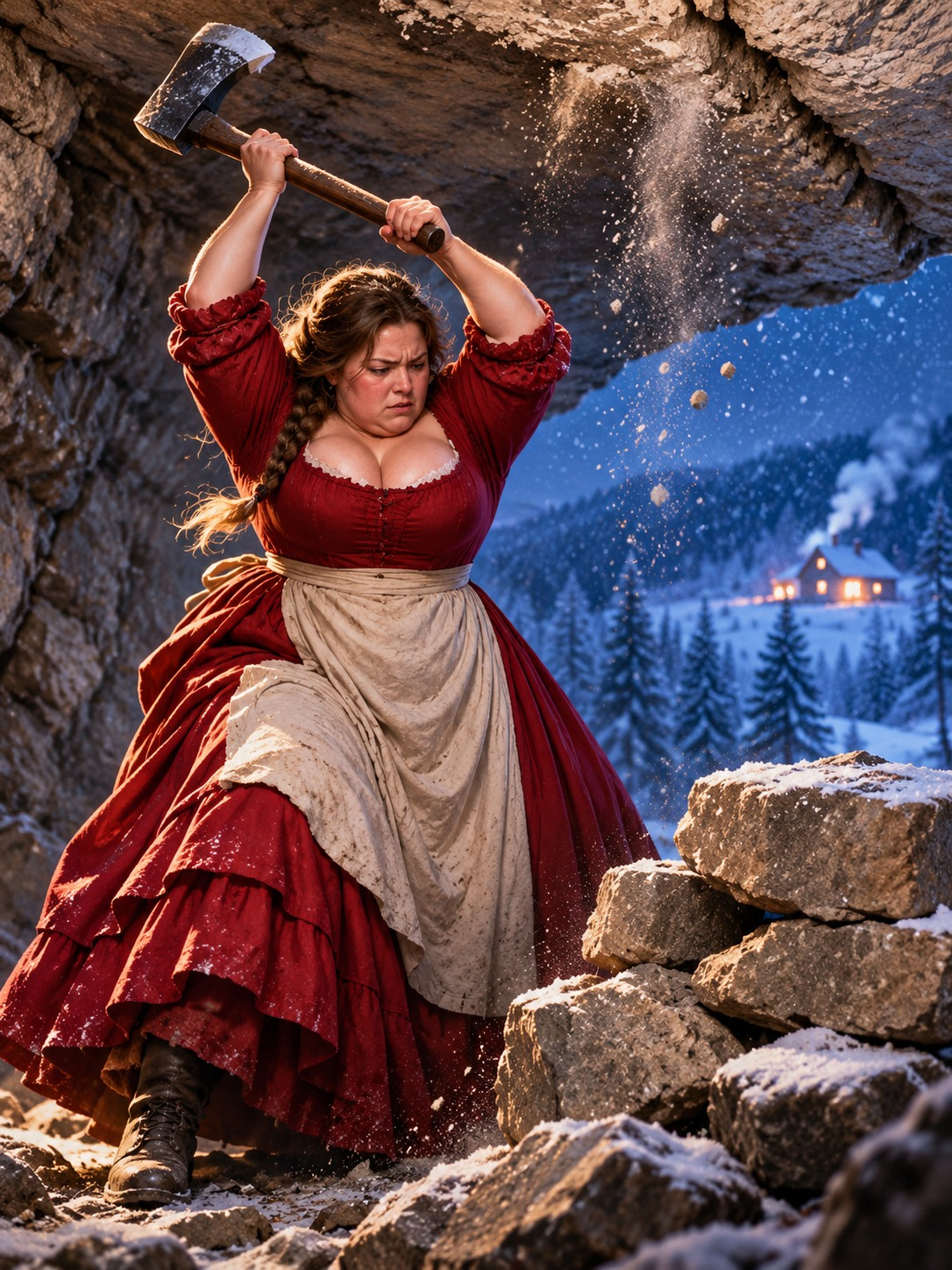
"GET OUT OF MY HOUSE!" Vernon Calder shouted, slamming a folded land claim onto the kitchen table.
Ruth Calder stood beside the stove as Vernon pointed to the official seal on the paper.
Beneath the seal was a handwritten date.
It was three weeks before Samuel's death.
Ruth suddenly understood that someone had been preparing to steal her home long before her husband was buried.
The paper lay between them like a loaded pistol.
Ruth did not touch it.
She had spent the morning kneading bread, repairing a torn feed sack, and carrying enough firewood into the kitchen to last until supper. There was flour on her sleeve and a small burn on her left wrist from the stove. Her feet ached inside her worn boots.
She had not expected company.
Certainly not company that arrived with two wagons, three children, and the intention of staying forever.
"Read it," Vernon demanded.
Ruth looked at him.
"I heard what you said."
"Then you understand."
"I understand you're standing in my kitchen telling me it belongs to you."
Vernon adjusted his coat.
"Legally, that's exactly what I'm telling you."
He was Samuel's older brother, a narrow-faced man with pale eyes and the irritating habit of speaking as though every disagreement were proof of someone else's stupidity.
Ruth had never liked him.
Samuel hadn't trusted him either.
But Samuel had been dead seven months, and dead men were notoriously poor at defending their wives.
Behind Vernon stood Margaret, his wife, wearing a blue traveling dress and a satisfied expression she was trying unsuccessfully to disguise as sympathy.
Their three children hovered near the doorway.
And behind them stood another man.
A giant.
He had shoulders wide enough to fill the entrance and a thick beard streaked with gray. A rough fur vest hung open over his bare chest despite the November cold. Snow melted slowly in his dark hair.
Ruth recognized him from the yard.
He had helped unload the wagons.
He had also watched Vernon speak to her without saying a word.
His silence bothered her more than Vernon's threats.
"Where's the registration?" Ruth asked.
Vernon frowned.
"What?"
"The registration proving this property was transferred to you."
He tapped the document.
"Right here."
"That's a claim. I asked for the registration."
Margaret sighed.
"Ruth, please don't make this unpleasant."
Ruth turned toward her.
"You're putting your children in my house before I've agreed to leave. I'd say we're already past pleasant."
Margaret's mouth tightened.
Vernon stepped forward.
"Samuel inherited this land jointly with me after Father died. He was supposed to register the transfer into his own name. He never did. The property remained under the family claim."
"Samuel paid for this ranch."
"He paid improvements."
"He built this kitchen."
"Improvements."
"He dug the well."
"Improvements."
"He bought the cattle."
Vernon hesitated.
"Livestock attached to the property."
Ruth stared at him.
For six years, she had lived on that land.
She had planted beans behind the cabin, hauled water through two droughts, patched the roof during a hailstorm, and helped Samuel deliver calves in weather so cold their eyelashes froze.
She had buried two unborn children beneath a cottonwood tree at the edge of the pasture.
She had buried Samuel in April.
Now his brother stood in the room where they had shared their last breakfast and called their lives improvements.
"Get out," Ruth said quietly.
Vernon blinked.
"Excuse me?"
"Take your family and get off my property."
He gave a short laugh.
"You don't seem to understand your position."
"I understand it perfectly."
"No, Ruth. You don't."
He leaned across the table.
"You are a widow without a registered claim, without children, and without a legal right to occupy this house."
Something shifted in the giant man's expression.
It was small.
A tightening around his eyes.
Ruth noticed.
Vernon didn't.
"Where do you expect me to go?" she asked.
"That's not my responsibility."
"Winter's coming."
"Then perhaps you should have thought of that before Samuel died without settling his affairs."
The room went silent.
Even Margaret looked uncomfortable.
Ruth stared at Vernon for a long moment.
Then she smiled.
Not because anything was funny.
Because her father had once told her that some men became most dangerous when they mistook cruelty for cleverness.
"Samuel didn't choose to die," she said.
Vernon looked away first.
Margaret began opening cupboards.
"Children, bring the dishes from the wagon."
Ruth turned.
"What are you doing?"
"Making supper," Margaret answered. "The little ones are hungry."
"Those are my dishes."
"They belong to the household now."
Ruth felt something inside her go very still.
She could have screamed.
She could have thrown the claim into the stove.
She could have taken Samuel's shotgun from above the door and frightened every Calder on the property.
Instead, she walked to the cupboard and removed her mother's iron skillet.
Margaret watched.
"Where are you taking that?"
"With me."
"That belongs in the kitchen."
"It belonged to my mother before this kitchen existed."
She placed it on the table.
Then she took the coffee pot.
A sack of beans.
A small bag of cornmeal.
One blanket.
Samuel's hatchet.
Vernon watched her with increasing satisfaction.
He had expected a fight.
He had prepared himself for tears and pleading.
Instead, Ruth was packing.
That made him feel powerful.
"There's no need to leave immediately," he said. "You can stay in the shed until the weather turns."
Ruth stopped.
"The shed?"
"It's dry enough."
"The roof leaks."
"Then repair it."
She turned slowly.
"You're offering me a leaking shed on land I spent six years helping your brother build?"
"I'm offering charity."
"No," Ruth said. "You're offering yourself an audience."
The giant man lowered his eyes.
For the first time, Ruth wondered whether he might be ashamed.
But shame did not stop him from standing beside Vernon.
And silence was a kind of permission.
She carried her belongings into the bedroom.
Samuel's coat still hung behind the door.
It was too large for her shoulders but thick enough to stop the wind.
She put it on.
Inside the lining, beneath a patch she had sewn after their second winter together, was a narrow opening.
Ruth slipped two fingers inside.
Thirty-two dollars.
Their emergency money.
She had sewn it there after Samuel died because she trusted neither banks nor relatives who suddenly became interested in her finances.
She left the bedroom without looking at the bed.
If she looked, she might remember Samuel sitting on its edge, pulling on his boots and telling her he would be home before dark.
He hadn't been.
The freight wagon overturned outside Casper.
A broken axle, they said.
Bad luck.
A terrible accident.
Ruth had believed them.
At the kitchen door, Vernon held out his hand.
"The house key."
Ruth looked at it.
Then at him.
Samuel had made that key himself after replacing the old lock.
She could still remember him holding it up, grinning.
"Now nobody gets in unless my wife says so."
She placed the key in Vernon's palm.
He closed his fingers around it.
"Good."
Ruth picked up her bundle.
"Enjoy the stove," she said.
Vernon frowned.
"What?"
"You'll need it."
Outside, the air smelled of snow.
The ranch stretched beneath a gray Wyoming sky, its fences disappearing into the basin.
Ruth's cattle stood near the hay barn.
The cottonwood tree beside the creek had lost its last leaves.
Beyond it lay the small fenced patch where two wooden markers stood beneath the branches.
She did not go there.
Not yet.
She knew if she knelt beside those graves, she might never find the strength to stand again.
The giant frontiersman followed her onto the porch.
"Mrs. Calder."
She kept walking.
"Mrs. Calder."
"What?"
He stopped several feet away.
Up close, he was even larger than she had realized.
His beard concealed most of his face, but his eyes were gray and unusually watchful.
"There's a storm coming."
"I noticed."
"You shouldn't be traveling alone."
"Then perhaps you should tell the man who just threw me out."
He looked toward the house.
"I don't agree with what he's doing."
Ruth gave a bitter laugh.
"Then you're disagreeing very quietly."
His jaw tightened.
"I can't stop him."
"You could have tried."
She walked away.
He did not follow.
By the time Ruth reached the northern ridge, the ranch was a small dark shape behind her.
Her legs burned.
At three hundred pounds, she was accustomed to hard work, but climbing uneven ground with a bundle on her back was different from carrying water between the well and the kitchen.
Every step required care.
She rested twice.
Once beside a fallen cottonwood.
Once beneath a cluster of boulders where the wind could not reach her.
She ate a handful of dry cornmeal mixed with cold water.
It tasted terrible.
She ate it anyway.
Near sunset, she found the limestone overhang.
It was larger than she expected.
Twenty feet wide.
Perhaps twelve feet deep.
A natural shelf of stone protected the floor from rain and snow.
The entrance faced south.
Ruth studied the ceiling.
She studied the walls.
She pressed her palm against the limestone.
Dry.
Solid.
Cold, but not as cold as the open air.
Her father would have approved.
Jacob Mercer had worked the Pennsylvania stone yards for thirty years.
He understood limestone the way Samuel understood cattle.
He had taught Ruth that stone could be dangerous, stubborn, and useful.
He had also taught her that a person who understood the difference might survive things that killed stronger people.
"Wood gives heat away," he used to say. "Stone remembers it."
Ruth set down her belongings.
"Then remember," she whispered.
She spent the remaining daylight collecting flat stones.
She arranged them across part of the entrance, creating a low barrier that would interrupt the wind without sealing the shelter.
She gathered dead cottonwood.
She did not burn it.
Not yet.
A fire without a place to hold its warmth was simply a gift to the sky.
When darkness arrived, Ruth wrapped herself in the blanket and sat against the rear wall.
Across the valley, a thin trail of smoke rose from her old chimney.
Vernon was feeding Samuel's stove.
Probably with the wood Ruth had cut in September.
She imagined Margaret using her skillet.
The children sitting at her table.
Vernon sleeping beneath Samuel's roof.
Her throat tightened.
For a moment, she allowed herself to grieve.
Not loudly.
There was nobody to hear.
She touched the thirty-two dollars hidden inside her coat.
Then she looked at the little wall she had built.
"Tomorrow," she whispered, "we do better."
She closed her eyes.
But sleep would not come.
A faint sound traveled through the stone behind her.
Three soft knocks.
Ruth opened her eyes.
She waited.
Nothing.
She told herself it was the mountain settling.
Rock cracked.
Water froze.
Cold changed things.
Her father had taught her that too.
She pulled the blanket tighter.
Then she heard it again.
Three knocks.
This time they came from directly behind her head.
Ruth turned toward the limestone.
A thin line of pale dust drifted down the wall.
She leaned closer.
There was something scratched into the stone.
Not a natural fracture.
Letters.
Old, shallow letters hidden beneath decades of mineral dust.
Ruth rubbed them with her thumb.
One word became visible.
SAMUEL.
Her breath caught.
She brushed away more dust.
Beneath her husband's name was a date.
April 17.
The day he died.
And below the date, scratched so deeply that the marks had cut through the weathered surface, were four words.
Ruth moved closer to read them.
Then the stone behind her answered with another knock.
This time, something knocked back from the other side.






Comments 0