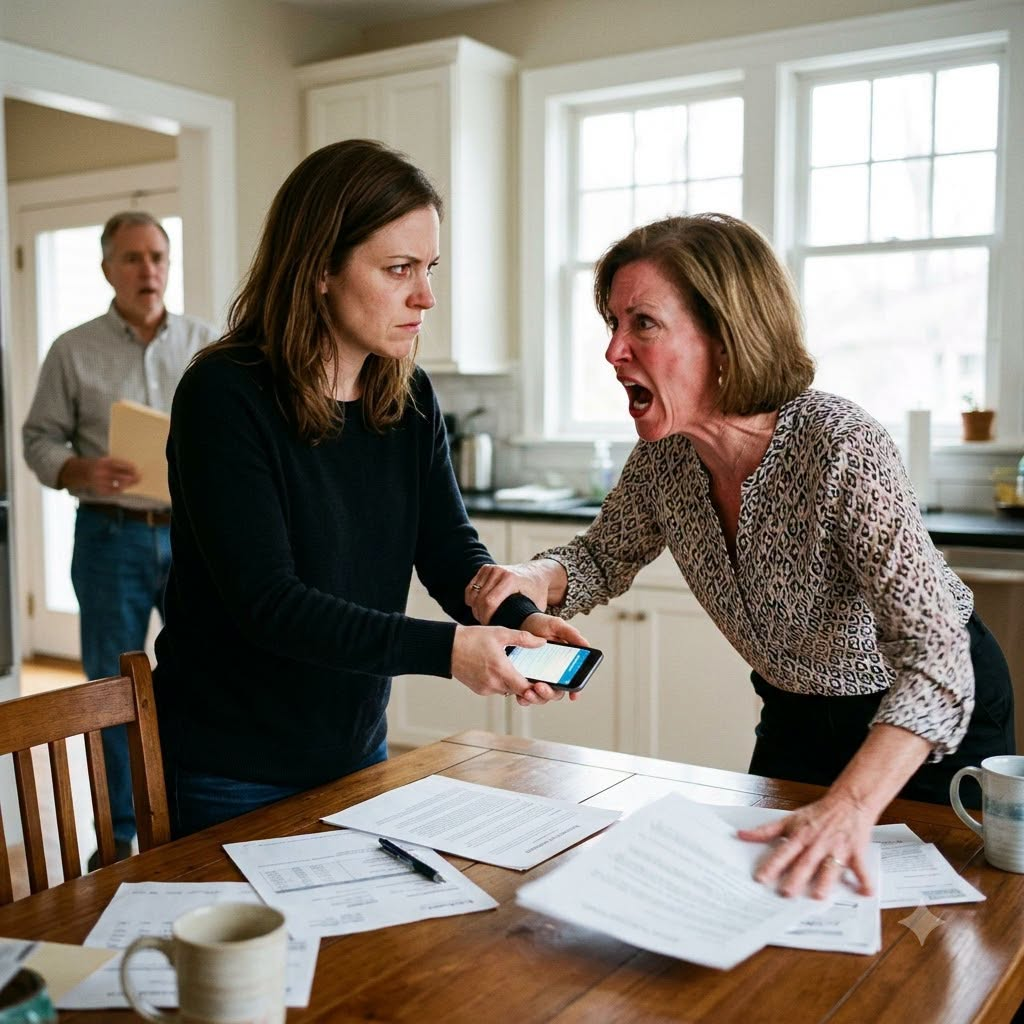
"Emily, it's time you gave me my life back."
The woman stood beneath the fluorescent lights of St. Catherine's Hospital, holding my driver's license between two fingers.
She had my face.
My eyes.
My mouth.
Even the small scar beneath my chin.
For one terrible moment, I wondered whether I had finally lost my mind.
Then I noticed something.
The scar was on the wrong side.
Mine was beneath the left corner of my chin.
Hers was beneath the right.
I took a slow breath.
"Who are you?"
She smiled sadly.
"That's the question everyone's been asking for thirty years."
Behind me, Rebecca stepped forward.
"Please identify yourself."
The woman looked at her.
"My name is Catherine Morgan."
Across the room, the woman who had introduced herself as Claire made a small, strangled sound.
"Catherine."
The newcomer turned toward her.
"Hello, Elizabeth."
The room went silent.
I looked between them.
"Elizabeth?"
The woman I'd been calling Claire closed her eyes.
Then whispered, "Yes."
Benjamin sank into a chair.
Natalie moved closer to me.
I could feel her hand against my back.
Warm.
Steady.
Real.
Rebecca's voice remained calm.
"I think everyone needs to stop making statements until we establish who is who."
Catherine nodded.
"That's why I'm here."
She handed my driver's license to the police officer.
"I didn't steal this from Emily. I found it in a packet Daniel Mercer gave me. I brought it here because I wanted the police to see what he'd been using."
The officer accepted it.
Rebecca looked at me.
"Emily, we're going to preserve everything and make sure these identities are verified independently."
I nodded.
For once, I didn't want another dramatic revelation.
I wanted facts.
Documents.
Dates.
A truth that would remain true the next morning.
Catherine reached into her handbag.
She removed a thick envelope.
"Then let's start with the original birth records."
We moved into a private conference room with hospital security nearby.
Detective Harris arrived twenty minutes later.
Rebecca explained the situation.
Nobody was allowed to take the original documents away without properly recording where they came from.
The detective photographed the envelope and its contents.
Then Catherine began.
"Thirty-four years ago, Linda Brooks gave birth to three daughters."
She looked at me.
"Emily Anne Brooks."
Then toward the woman beside Benjamin.
"Elizabeth Rose Brooks."
Finally, she touched her own chest.
"Catherine Grace Brooks."
I stared at her.
Three girls.
Three daughters.
Three lives separated by a decision none of us had made.
"But Anna?" I whispered.
Catherine nodded.
"Anna is one of us."
I frowned.
"Then how can there be four women who look alike?"
Catherine looked toward the door.
"Because Anna isn't a fourth sister."
I stared at her.
"Explain."
She took a breath.
"Anna Marie Ellis is Elizabeth's adoptive identity."
I turned toward the woman I'd been calling Claire.
Her face crumpled.
She nodded.
"I was adopted by Margaret and Thomas Ellis. They named me Anna."
I couldn't speak.
The woman who'd arrived at my house.
The woman who'd sat beside me holding childhood photographs.
The woman who'd called herself Anna.
She was Elizabeth.
Then who was the woman sitting across from me now?
She looked down.
"When Daniel started looking for the old settlement records, I began using the name Claire Morgan. It was the name associated with a deceased child in the adoption paperwork."
My stomach tightened.
"So you lied to me."
She nodded.
"Yes."
"Why?"
Her eyes filled.
"Because I thought Daniel was watching everyone connected to the original records. I wanted to find out what he knew before he knew I had found you."
I shook my head.
"You could have told Rebecca."
"I should have."
I stared at her.
"Where were you when I called Anna?"
She swallowed.
"With Daniel."
My heart stopped.
"Voluntarily?"
"At first."
Benjamin leaned forward.
"She was trying to recover the missing page of Linda's letter."
Elizabeth nodded.
"Daniel said he had it. When I arrived, he refused to let me leave until I told him what we'd discovered."
Detective Harris looked up.
"Did he threaten you?"
"Yes."
She wiped her eyes.
"He took my phone and used it to call Emily."
I remembered the fear in Anna's voice.
The warnings.
The sudden silence.
I looked at Elizabeth.
"How did you get away?"
"Benjamin contacted the police when I missed our agreed check-in. Daniel left before officers arrived."
The detective made a note.
Catherine continued.
"The fourth name was never another daughter. It belonged to a child named Claire Morgan who died at four years old. Her records became entangled with ours during the guardianship proceedings."
I stared at the table.
"Why?"
Catherine's expression darkened.
"Because someone wanted to make one of Linda's daughters disappear on paper."
I closed my eyes.
There it was.
The center of everything.
The missing child.
The changed hospital records.
The photographs.
The settlement.
The false identities.
I opened my eyes.
"Which daughter?"
Catherine looked directly at me.
"You."
My breath caught.
"Me?"
She nodded.
"Emily Anne Brooks."
I stared at her.
"But I'm here."
"Yes."
"Then whose death certificate did Daniel show Anna?"
Catherine took another document from the envelope.
"The death certificate belonged to Claire Morgan. The original name was altered in a later photocopy to make it appear that Emily Brooks had died."
I looked at Rebecca.
She examined the copy.
"That can be tested against the issuing authority's records."
Catherine nodded.
"The original is in the county archive. I've already requested certified copies."
I took a shaky breath.
"So I'm Emily."
Rebecca turned toward me.
"Your identity is supported by your lifelong records, but we'll independently verify the disputed childhood documents. Nobody here gets to decide your identity by producing a photocopy."
I nodded.
Catherine reached across the table.
"And I don't want your life, Emily."
Her voice broke.
"I just want mine."
For the first time, I saw past the resemblance.
Past the identical eyes.
Past the face that had frightened me.
I saw a woman who'd spent her entire life wondering why she'd been separated from her sisters.
I whispered, "Then tell me what happened."
The truth took months to establish.
Not because anyone wanted to delay it.
Because thirty years of lies couldn't be untangled in one hospital conference room.
There were original court files.
Hospital records.
Adoption documents.
Bank statements.
Property transfers.
Old letters.
And witnesses who had spent decades convincing themselves that silence was the same thing as protection.
The investigation eventually established that Linda had given birth to triplets.
Emily.
Elizabeth.
Catherine.
I was the eldest by seven minutes.
Elizabeth was born four minutes after me.
Catherine came three minutes later.
When we were infants, my parents struggled financially.
Dad worked long hours.
Mom had serious difficulties coping with three babies.
Margaret and Thomas Ellis, close friends of the family, began helping with childcare.
Elizabeth spent increasing amounts of time with them.
Catherine was later placed with the Morgans through a separate adoption arrangement.
I remained with Linda and Robert.
For several years, the adults maintained limited contact.
We played together.
We celebrated birthdays.
We appeared in photographs.
Then came the accident at Willow Creek Road.
The one event that changed everything.
I learned what happened from Eleanor Price's original nursing notes, the recovered home video, and testimony from the adults who had been present.
I was four.
Mom had come to Willow Creek to argue with Margaret about the guardianship arrangements.
She wanted Elizabeth returned to her household.
Margaret refused.
The argument became heated.
I followed Mom toward the staircase.
She turned suddenly.
Reached toward me.
And I fell.
The video showed her arm extending.
It did not establish beyond doubt whether she had pushed me or tried to catch me.
But Eleanor's notes recorded something important.
Mom had initially told hospital staff that Benjamin Ellis had pushed me.
Benjamin was five.
A frightened little boy who had been standing downstairs.
He had not touched me.
Dad knew.
Margaret knew.
Thomas knew.
And eventually, Eleanor knew.
The hospital paperwork was altered after Linda insisted the wrong child's identity had been entered during the emergency admission.
The available records showed that the injured child was me.
Emily.
But someone later attached portions of Catherine's identification records to the file.
The change complicated the guardianship proceedings and created confusion about which child had received medical treatment.
Mom used that confusion.
She argued that Margaret's home was unsafe.
She tried to reverse Elizabeth's guardianship.
When the court refused to give her everything she wanted, she began cutting the children out of one another's lives.
She told Margaret that I had died from complications after the accident.
She told Elizabeth the same thing.
She told Catherine's adoptive parents that the other children had no interest in contact.
And she told me nothing.
Not a word.
Not even when I was old enough to ask why there were gaps in our family photographs.
Benjamin became another casualty.
He had been falsely blamed for my fall.
After the investigation, Thomas arranged for him to live temporarily with relatives while the family situation stabilized.
The separation became permanent.
Benjamin grew up believing his father's relationship with the Brooks family had destroyed his childhood.
He searched for answers as an adult.
Dad turned him away.
Mom threatened him with legal action if he continued.
He eventually found Catherine.
Then Elizabeth.
And together, they began reconstructing the history everyone else had tried to bury.
When I finally understood the timeline, I sat in Rebecca's office and cried for nearly an hour.
Not because I'd lost my identity.
Because I hadn't.
I was Emily Anne Brooks.
I always had been.
But three little girls had lost thirty years together.
And no amount of money could give those years back.
The financial investigation took longer.
It also revealed why my mother had become so desperate.
The settlement following my childhood accident had totaled approximately $680,000.
The money was intended to cover medical expenses, care, and financial provisions for the affected children.
Some funds had been properly spent.
Others had been placed in restricted arrangements.
A portion was eventually connected to the purchase of my parents' current house.
Over the years, Linda and Robert had treated that property as though it belonged entirely to them.
But the records contained obligations that had never been properly resolved.
When Daniel Mercer became involved with Jason's failed real estate venture, he discovered the old settlement documents.
Daniel wasn't simply a lender trying to recover a debt.
He was a man who recognized leverage.
Jason owed money under disputed investment agreements.
The amount Daniel claimed had grown to $310,000.
But Rebecca's forensic accountant found that some charges were unsupported, duplicated, or inconsistent with the original agreements.
The actual legitimate debt was substantially lower.
Daniel had used the larger figure to frighten my parents.
He told Linda that selling their house would solve everything.
Then he discovered the unresolved settlement interests.
The house sale could expose decades of financial irregularities.
So he proposed another arrangement.
I would buy the $720,000 house.
Jason would be added to the deed.
Daniel would attempt to use Jason's interest as additional security.
And my parents would use the proceeds from their existing house to settle whatever claims they could.
The problem was simple.
I hadn't agreed.
I wouldn't agree.
So they tried to create documents suggesting I had.
My missing driver's license had been copied.
My signature had been reproduced.
An account had been opened in my name at Franklin Community Bank.
The bank's security footage eventually showed Patricia Reynolds, my mother's sister, presenting my identification while another person assisted with the paperwork.
Patricia admitted she'd been promised money to help complete the transaction.
Dad had attended the appointment.
He claimed he'd believed Martin Cole's explanation that the account was temporary family financing.
The evidence showed he knew more than he'd admitted.
But it did not show that he personally forged my signature.
He had, however, provided my financial information without permission.
That betrayal hurt almost as much as Mom's.
The $42,000 transfer to Mercer Property Holdings was traced.
The account was flagged as fraudulent.
The bank reversed the unauthorized activity after its investigation and the appropriate legal process.
The false guarantee was challenged.
The suspicious supplemental agreement was removed from the canceled purchase file.
The title company preserved the document history.
And the recorded authorization supposedly containing my voice was examined by an independent digital forensic specialist.
It was not genuine.
The recording had been assembled from fragments of my voice taken from business presentations and family videos.
Someone had created a sentence I had never spoken.
I listened to the forensic expert explain it in Rebecca's office.
Then I thought about the first time I'd heard the recording.
My own voice saying:
"Yes. I authorize it."
I remembered how frightened I'd been.
How, for a moment, I'd wondered whether there was something I'd forgotten.
The expert looked at me.
"You didn't authorize this."
I nodded.
But hearing someone else say it made me cry.
Because the truth mattered.
The evidence mattered.
And finally, someone was looking at the evidence instead of asking me to sacrifice myself for the family.
The $750,000 life insurance paperwork was also investigated.
It had been an application submitted through Mercer Financial Solutions.
It was never approved.
No valid policy had been issued.
Jason's name appeared as the proposed beneficiary, but that did not make him entitled to anything.
He admitted he'd seen the application.
He claimed he had not understood how it had been submitted or that my consent was required.
The investigators examined his role separately.
I didn't excuse him.
But I stopped trying to decide his guilt myself.
That was no longer my job.
Martin Cole's involvement was documented through emails, billing records, and the history of the forged supplemental agreement.
Erin Wallace had not created the fraudulent documents.
Her office had received material from Martin's office, and someone had improperly routed it into the title company's revised packet.
Erin's failure to catch the problem had serious consequences.
She apologized to me.
She also cooperated with the investigation.
Our professional relationship ended.
Not because I hated her.
Because trust, once damaged, couldn't simply be restored by an apology.
The financial records also clarified the confusion surrounding Claire Wallace, Erin's younger sister.
Claire Wallace was a real person, unrelated to my sisters.
She had worked with Martin's firm and later handled administrative paperwork connected to Daniel.
Her name had been confused with Claire Morgan, the identity Elizabeth had used while investigating our family history.
Claire Wallace provided the original emails showing how the supplemental agreement had been circulated.
Her disappearance had been temporary.
She'd gone into hiding after Daniel threatened her.
She eventually testified.
Patricia Hale, the former care facility administrator, was also located.
She had received payments from a Mercer company in exchange for information and assistance obtaining old records.
Her disappearance had been an attempt to avoid the people pressuring her.
The investigators found her alive.
She cooperated after obtaining legal counsel.
For the first time, all the names stopped spinning around in my head.
They became people.
People who had made decisions.
People whose actions could be examined.
People who could be held accountable.
My mother was arrested several weeks later.
The charges involved the financial fraud and related conduct supported by the investigation.
Other matters were referred for further review.
I did not attend every hearing.
I didn't need to.
Rebecca kept me informed.
Daniel Mercer was charged in connection with the fraudulent financial scheme.
Martin Cole faced criminal proceedings and professional disciplinary action.
Patricia Reynolds entered a cooperation agreement.
Dad faced consequences for his role in the unauthorized financial arrangements and for withholding information.
He was not treated as an innocent bystander.
And he wasn't treated as responsible for every act simply because he'd been afraid to speak.
The evidence determined what could be proved.
That mattered to me.
Because I'd spent my entire life in a family where guilt was assigned according to whoever Mom was angry with.
I wanted something different.
I wanted fairness.
Even for people who had hurt me.
Especially for them.
My parents' house sale did not close as originally planned.
The title issues and settlement claims required resolution.
The buyers received their deposit back and were released from the transaction.
Through the legal process, the financial interests connected to the old settlement were identified and addressed.
Anna, Catherine, and I received distributions from the remaining recoverable funds.
The amounts were not enough to replace what had been lost over thirty years.
They were not a magical fortune.
But they were ours.
And for the first time, nobody asked me to give my share to Jason.
Nobody told me family came first.
Nobody demanded that I prove my love with a bank transfer.
Jason called me one evening in February.
I almost didn't answer.
Then I did.
"Emily?"
"Hi, Jason."
He sounded different.
Quieter.
Less certain of himself.
"I wanted to tell you something."
I waited.
"I got a job."
I sat down.
"Where?"
"At a warehouse distribution company."
I blinked.
"Doing what?"
"Inventory management."
I smiled faintly.
"That's good."
He exhaled.
"It's not glamorous."
"It doesn't have to be."
He was quiet.
Then said, "I'm paying my own rent."
I looked out the window.
Snow was falling across my backyard.
"That's a good start."
He swallowed.
"Emily, I'm sorry."
I closed my eyes.
He continued.
"I knew Mom was trying to use your money. I knew Daniel was pressuring everyone. I kept telling myself I didn't have a choice."
I said nothing.
"But I did."
My throat tightened.
He took a breath.
"I could've told you."
"Yes," I whispered.
"I should've."
"Yes."
He began crying.
"I don't expect you to forgive me."
I looked at the snow.
"Jason, forgiveness isn't something you can ask me to give you on a deadline."
He was silent.
"But I hope you keep making better choices."
He exhaled.
"I will."
We didn't suddenly become close.
We didn't pretend the past had disappeared.
But over time, he stopped asking me for money.
He paid his own bills.
He attended counseling.
He took responsibility for the damage he'd caused.
And slowly, we began building something that resembled an honest relationship.
Not the relationship we'd had before.
Something smaller.
Something healthier.
Something real.
Dad wrote to me from the rehabilitation facility where he was recovering from his injuries.
His first letter was twelve pages long.
I didn't read it immediately.
I left it on my kitchen counter for three days.
Then I opened it.
He didn't ask me to forgive him.
He didn't blame Mom for everything.
He admitted he'd been weak.
He admitted he'd allowed fear to guide decisions that harmed his children.
He admitted he'd known about Anna and Catherine.
He admitted he'd kept the old photographs.
And he admitted he'd lied because telling the truth would have forced him to confront the man he'd been.
The final paragraph said:
"Emily, I cannot give you back the years I stole from you. I can only tell you the truth now and accept whatever place, if any, you choose to give me in your life."
I cried.
Then I put the letter away.
Months later, I visited him.
We sat in a small garden outside the facility.
He looked older.
But he didn't try to explain away what he'd done.
He answered my questions.
All of them.
When he didn't know something, he said so.
When he remembered something painful, he didn't change the subject.
I didn't forgive him that day.
But I told him he could write again.
That was enough.
For both of us.
My mother sent seventeen letters.
I read three.
The first blamed Daniel.
The second blamed Martin.
The third blamed my father.
None of them acknowledged what she'd done to me.
Or to Anna.
Or to Catherine.
Or to Benjamin.
I placed the remaining letters in a box.
Then I wrote one of my own.
It was short.
"Mom,
I am safe.
I am financially independent.
I have learned the truth about my childhood and my family.
I will not participate in any further financial arrangements with you.
I will not accept threats, guilt, or demands as substitutes for love.
If you ever become willing to take responsibility without blaming everyone else, I may consider hearing what you have to say.
Until then, please communicate through the appropriate legal channels.
Emily."
I mailed it.
Then I blocked her number.
Not because I wanted revenge.
Because I wanted peace.
And peace required boundaries she had never respected.
The first time Anna, Catherine, and I spent an entire weekend together, we rented a small cabin near Hocking Hills.
Benjamin came too.
So did Margaret and Thomas.
Natalie joined us on Saturday evening.
We cooked dinner.
Played cards.
Looked through old photographs.
And told stories about the lives we'd lived apart.
Anna had become a school counselor.
She loved gardening.
She hated horror movies.
Catherine worked in medical administration.
She collected antique postcards.
She could play the piano beautifully.
Benjamin repaired old furniture.
He had a daughter named Lucy.
She was eight.
And when she met me, she stared for almost a full minute.
Then whispered, "You look like Aunt Anna."
I laughed.
"I've been told."
She looked toward Catherine.
"And Aunt Catherine."
"That too."
Lucy frowned thoughtfully.
Then asked, "Does that mean I have three aunts who look the same?"
Benjamin smiled.
"Pretty much."
She considered that.
Then grinned.
"That's awesome."
For the first time in months, I laughed so hard I cried.
That evening, Anna brought out the old photograph.
The birthday cake.
The yellow dresses.
The porch at Willow Creek Road.
She placed it on the table.
"I used to look at this and feel sad," she said.
Catherine nodded.
"Me too."
I studied the picture.
Three little girls.
One laughing.
One crying.
One reaching toward the cake.
For years, the photograph had been treated like evidence of a secret.
Now it was something else.
A memory.
Not a complete one.
Not a perfect one.
But ours.
I looked at my sisters.
"Can we take another picture?"
Anna smiled.
"Of course."
We stood together outside the cabin.
Three women.
Thirty-four years old.
Same dark eyes.
Same smile.
Different lives.
Benjamin held the camera.
"Ready?"
Catherine put her arm around me.
Anna leaned against my shoulder.
"Ready," I said.
The camera clicked.
And for the first time, nobody was missing from the photograph.
One year after my mother sent that text at 7:06 a.m., I woke to sunlight streaming through my bedroom window.
My phone was quiet.
No frantic calls.
No demands.
No emergency payments.
No messages telling me I was selfish.
I made coffee.
Opened the kitchen curtains.
And looked out at the garden.
I'd planted roses that spring.
They were beginning to bloom.
At 8:15, my phone vibrated.
A message from Anna.
"Don't forget dinner tonight. Catherine says she's making dessert."
I smiled.
Then another message arrived.
From Catherine.
"Anna says I'm making dessert. Apparently this is news to me."
I laughed.
A third message appeared.
From Benjamin.
"Lucy wants to know if all three of you are coming. She says one aunt isn't enough."
I typed:
"Tell her all three are coming."
Then I put my phone down.
For a moment, I thought about the woman I'd been one year earlier.
The woman sitting at her kitchen table, staring at a text from her mother.
"You're no longer my daughter."
I'd believed those words were the beginning of losing my family.
In a way, they were.
I lost the family story I'd been told.
I lost the illusion that love meant endless sacrifice.
I lost the belief that being needed was the same thing as being valued.
But I found something else.
The truth.
My sisters.
My brother.
My freedom.
And a life that belonged entirely to me.
That afternoon, I drove to the park where we'd agreed to meet before dinner.
Anna was already there.
Catherine arrived a few minutes later.
Benjamin followed with Lucy.
The little girl ran toward us.
"Aunt Emily!"
I knelt and caught her in my arms.
She hugged me tightly.
Then pulled back.
"Guess what?"
"What?"
"I made something for you."
She handed me a folded piece of paper.
Inside was a drawing.
Three women standing together beneath a bright yellow sun.
Beside them stood a man and a little girl.
Above the picture, in careful purple letters, she'd written:
OUR FAMILY.
I stared at it.
My throat tightened.
Lucy looked worried.
"Do you like it?"
I smiled through tears.
"I love it."
She grinned.
"Good. Because I made one for everybody."
I looked up.
Anna was smiling.
Catherine was wiping her eyes.
Benjamin stood beside them, his arm around his daughter.
For thirty years, people had decided who we were allowed to know.
Who we were allowed to love.
What we were allowed to remember.
But nobody was deciding that anymore.
I stood and took Anna's hand.
Catherine took my other hand.
Lucy squeezed herself between us.
Benjamin laughed.
And together, we walked toward the picnic tables beneath the trees.
My phone remained silent in my pocket.
For once, there was no crisis waiting for me to solve.
No debt waiting for me to pay.
No secret waiting to destroy my life.
There was only the warm afternoon.
The people beside me.
And the future we were finally free to choose.
I looked at my sisters.
Then at Benjamin and Lucy.
And I understood something I'd spent thirty-four years trying to learn.
I had never needed to buy a house to deserve a home.
I had never needed to pay someone's debts to deserve love.
And I had never needed my mother's permission to belong to a family.
I already did.






Comments 0