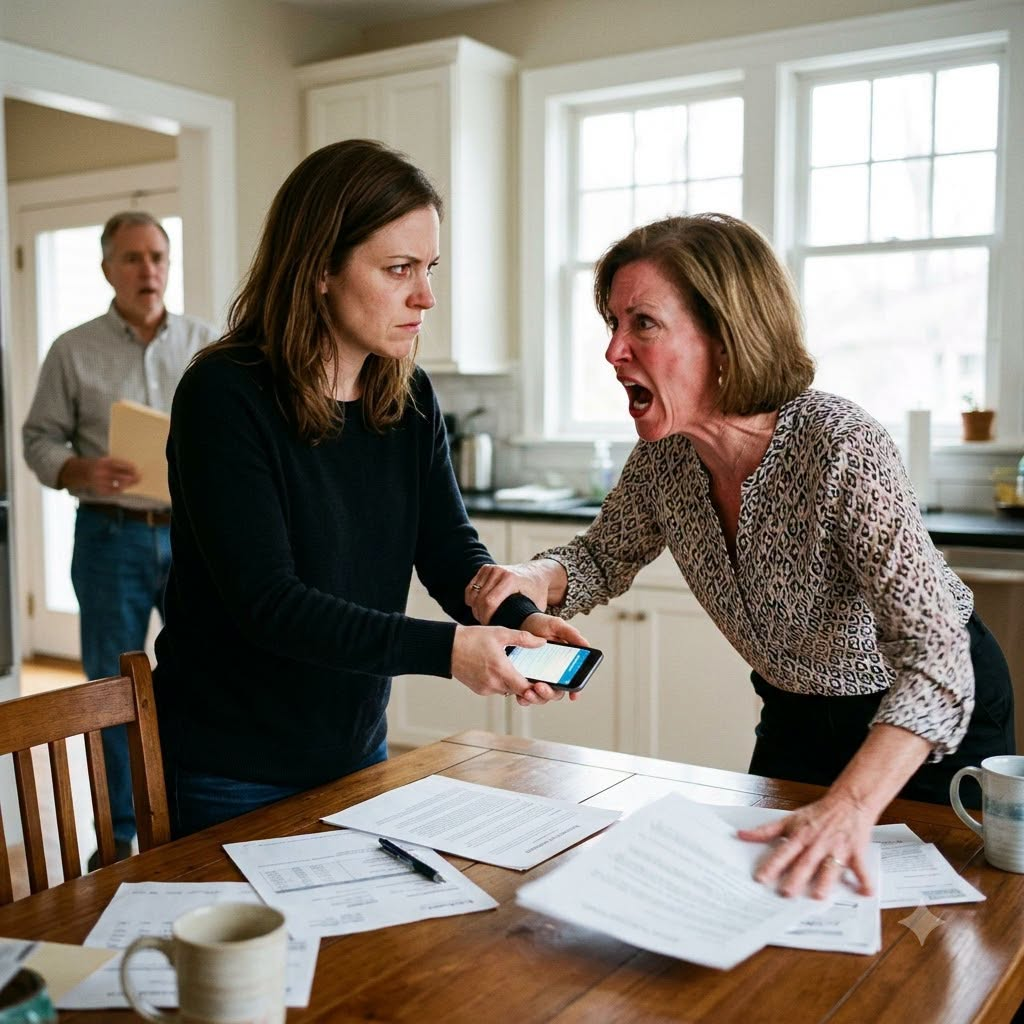
"Emily, don't say another word to your brother until we know exactly what he sent you."
Erin Wallace's voice was sharper than I'd ever heard it.
I sat motionless at my desk, staring at the document on my laptop screen.
My signature was there.
My full name.
Emily Brooks.
Written in the same slightly slanted handwriting I'd used since college.
Except I hadn't signed it.
And underneath the section labeled ADDITIONAL AUTHORIZATION was another name.
Jason Brooks.
My younger brother.
The same brother my mother had demanded I put on the deed of a $720,000 house less than twenty-four hours earlier.
"Erin," I whispered, "what exactly am I looking at?"
"That's what I'm trying to determine. But I need you to listen carefully. Do not accuse anyone. Do not respond to Jason. And do not contact your parents."
I swallowed.
"Why?"
"Because if that signature was used to represent your consent to a financial arrangement you never approved, we may be dealing with something much more serious than a family disagreement."
I looked again at the document.
The signature wasn't perfect.
The capital E had a slightly different loop.
The final s in Brooks curved too far upward.
But someone who didn't know my handwriting would never notice.
My stomach turned.
"Could they have copied it from another document?"
"Possibly."
"Like the paperwork for the new house?"
"That's one possibility. You signed several documents during the purchasing process. We need to establish exactly where this came from and how it was used."
I pressed my fingers against my forehead.
For six years, I'd trusted my family with my money.
I'd given them access to accounts, paid bills without questioning every expense, and signed checks whenever another emergency appeared.
I had never imagined I'd need to protect my own signature from them.
"Erin, tell me something."
"Go ahead."
"Can my parents actually force me to buy that house?"
"No. Not based on anything you've told me. Your purchase was terminated under the review clause. But I won't give you a definitive answer about these other documents until I've examined the originals."
"What about their house sale?"
"That's a separate contract. They may have obligations to their buyers, depending on its terms. But their decision to sell doesn't automatically create an obligation for you."
I closed my eyes.
"Then why is Martin threatening litigation?"
"Because he wants you to call him before you understand your position."
That sentence stayed with me.
My mother had spent my entire childhood teaching me that family problems should never be discussed with outsiders.
When I was twelve, she told me not to mention Dad's financial troubles to my teachers.
When I was seventeen, she instructed me to tell relatives that Jason's expensive summer camp had been a scholarship opportunity.
When I was twenty-six, she asked me to keep quiet about the money I'd lent them to prevent foreclosure.
Every secret had been presented as an act of loyalty.
And every time I kept one, I became responsible for protecting it.
Now I was looking at a document bearing a signature I hadn't written.
And my first instinct was still to protect them.
That realization frightened me more than the document itself.
"Emily?"
Erin's voice brought me back.
"I'm here."
"I want you to send me every page Jason provided. Forward the original email or message attachment if possible. Don't alter anything."
"Okay."
"And Emily?"
"Yes?"
"Whatever happens next, remember that you're allowed to protect yourself."
I didn't answer immediately.
Then I said, "I think I'm finally learning that."
We ended the call.
I forwarded the PDF.
Then I opened my mother's final message again.
"You're no longer our daughter."
I stared at those words.
For years, I'd believed my mother's love came with expectations.
Now I wondered whether it had come with a price tag.
At 12:34 p.m., my phone vibrated.
Dad.
I let it ring.
A voicemail appeared.
I listened.
"Emily, it's Dad. Honey, I know your mother said some things she shouldn't have. She's upset. We're all upset. But this house situation has gotten complicated, and we really need you to talk to us."
He paused.
I heard someone speaking in the background.
My mother.
"Tell her what happens if she doesn't fix it."
Dad sighed.
"Your mother wants you to understand that we could lose everything. Please call us."
The recording ended.
I sat there with the phone against my ear.
Not once had he said he was sorry.
Not once had he asked how I felt.
He hadn't even asked whether I was okay.
He wanted me to fix something.
Again.
I opened my banking application.
The household account I'd funded for my parents still had $8,416.72 in it.
My money.
Money I'd transferred over the previous several weeks to cover utilities, groceries, insurance, and their regular expenses.
I hadn't emptied it.
I hadn't tried to punish them.
I'd simply removed their ability to spend from an account that belonged to me.
Their personal checking and savings accounts remained untouched.
I knew the difference.
And I wanted to make sure everyone else understood it too.
At 12:49 p.m., another message arrived.
This one came from Jason.
"Emily, please answer me. I didn't know Mom was going to send that text."
I read it without replying.
Thirty seconds later, he sent another.
"I swear I didn't know she'd cut you off."
Then:
"There's stuff about the sale you don't understand."
I typed a response.
"Then send everything to my attorney."
I stared at it.
Erin had told me not to respond.
I deleted the message.
Jason called.
I declined.
He called again.
Then a third time.
Finally, he sent a voice message.
I hesitated before playing it.
His voice sounded different from the smug tone he'd used at dinner.
"Em, listen. I know you're mad. I get it. But you need to understand that Mom didn't tell me everything either."
A car horn sounded in the background.
He lowered his voice.
"I thought the paperwork was just supposed to help with the transition. I didn't know your name was going to be on it like that."
My heart started pounding.
He continued.
"Please don't send that document to anyone yet. Just call me. I can explain."
The message ended.
I played it again.
Then I saved it.
My brother had just admitted he knew something about the paperwork.
He hadn't said he forged my signature.
He hadn't explained what he signed.
But he'd made one thing clear.
He was afraid of the document.
I forwarded the recording to Erin.
Her response came four minutes later.
"Preserve the original. Do not engage."
I followed her instructions.
At 1:16 p.m., I received a call from an unfamiliar number.
The caller identified herself as Rachel Bennett, the real estate agent handling my parents' home sale.
"Ms. Brooks, I'm sorry to contact you directly."
"How did you get my number?"
"Your mother provided it as an emergency contact."
Of course she had.
"What can I do for you?"
Rachel hesitated.
"I understand there may be a problem with your parents' relocation."
"That's something you'll need to discuss with them."
"I have. But they told me you were responsible for coordinating the purchase of their replacement property."
I looked at my laptop.
"I was purchasing a house they could live in. That purchase has been canceled."
There was a long silence.
"Canceled?"
"Yes."
"Oh."
Something about her reaction made me straighten in my chair.
"Rachel, what exactly did my parents tell you?"
Another pause.
"They represented that their new residence was already arranged."
"It was under contract. It hadn't closed."
"I understand."
"Did they tell the buyers that?"
"I can't discuss every detail of my clients' transaction without authorization."
"Then why are you calling me?"
Her voice softened.
"Because your mother said you had agreed to guarantee that they would have somewhere to move when the sale closed."
I felt cold.
"I never guaranteed anything."
"I'm sorry. I wasn't aware there was a disagreement."
"There wasn't a disagreement about that. I never made that promise."
Rachel took a breath.
"Ms. Brooks, I think you should speak with your attorney."
"I already have."
"Good."
She sounded relieved.
Then she added something strange.
"And I would recommend asking your attorney to review the seller disclosures and any documents your parents submitted concerning their relocation."
"Why?"
"I don't want to say anything inappropriate."
"Rachel."
Silence.
"Did you see my signature on something?"
She didn't answer immediately.
Then she said, "Please have your attorney contact me."
The call ended.
I sat completely still.
The house purchase had been a gift.
That was how I'd understood it.
My parents would sell their old house whenever they were ready.
They would keep the proceeds.
They would move into a comfortable home I owned.
But now I was beginning to see another arrangement.
One I hadn't agreed to.
One that involved my name, my money, and possibly promises made to people I'd never met.
I looked at the clock.
1:28 p.m.
Less than seven hours had passed since my mother disowned me.
And somehow, my entire understanding of my family was falling apart.
At 1:41, Erin called.
"I've reviewed the PDF."
I grabbed a pen.
"What did you find?"
"First, this appears to be a supplemental document prepared in connection with your parents' sale. It is not the purchase contract for your new property."
"Okay."
"Second, the document references an anticipated replacement residence. It also contains language suggesting that the proceeds from your parents' sale may be distributed according to a separate family arrangement."
I frowned.
"Distributed how?"
"That's not clear from the pages Jason sent. The attachment references another agreement that wasn't included."
"What agreement?"
"Something labeled the Brooks Family Housing Agreement."
I'd never heard of it.
"Erin, I didn't sign any family housing agreement."
"I believe you. But I need to see the document."
"Can Martin send it?"
"I'm requesting it."
I stared at the notepad in front of me.
I'd written three words.
FAMILY HOUSING AGREEMENT.
They looked ridiculous.
Like the title of a document someone had invented to make a bad idea sound respectable.
"There's something else," Erin said.
I tightened my grip on the pen.
"What?"
"The signature beside your name is not a verified electronic signature. It appears to be an image inserted into the document."
I looked up.
"An image?"
"Yes. That doesn't establish who inserted it, but it raises questions about its authenticity."
I remembered signing the initial offer paperwork for the house.
The forms had been sent electronically.
I'd signed them from my laptop.
Could someone have copied that signature?
"Can you prove it isn't mine?"
"We can challenge its authenticity. We can also request the original file and its history. But we shouldn't jump to conclusions before we have the evidence."
I appreciated her caution.
I also hated it.
Because I wanted someone to tell me exactly what had happened.
I wanted a name.
A reason.
An explanation that made sense.
Instead, I had a document, a frightened brother, and parents who suddenly needed me more than ever.
"Emily," Erin said, "there's one more thing I need to ask."
"Okay."
"Have you ever given Jason permission to act on your behalf in a real estate transaction?"
"No."
"Power of attorney?"
"No."
"Written authorization?"
"Absolutely not."
"Have you ever allowed him to use your electronic signature?"
I almost answered immediately.
Then I remembered something.
Three years earlier, Jason had started a small online business.
He'd needed help opening a merchant account.
I'd reviewed his paperwork, explained some financial terms, and helped him complete an application.
He'd asked me to send a sample of my signature because he wanted to compare it with the signature format required by the platform.
At the time, I'd thought it was a strange request.
But I'd sent him a signed letter confirming that I was not an owner of his business.
I could still remember the email.
"Erin," I said slowly, "Jason may have an old document with my signature on it."
She was silent for a moment.
"Find it."
I opened my email.
Searched Jason's name.
Scrolled through years of messages.
There were dozens.
Requests for loans.
Apologies.
Promises.
Screenshots of bills.
Excuses.
Finally, I found the email.
Three years old.
Subject: BUSINESS ACCOUNT PAPERWORK.
I opened the attachment.
There it was.
My signature.
The same slanted E.
The same narrow B.
The same unusual upward curve at the end.
I placed the old document beside the PDF Jason had sent.
My breath caught.
They weren't just similar.
They appeared identical.
Even the tiny break in the ink near the bottom of the capital B was in the same place.
"Erin."
"I'm here."
"I found something."
I sent her both documents.
She examined them while I waited.
Then she said, "Emily, don't delete anything."
I looked at the two signatures.
"Someone copied it."
"It certainly appears possible."
"Jason had this file."
"That makes him someone we need to ask questions about. It doesn't establish who placed the signature on the other document."
I knew she was right.
But my chest hurt.
Because Jason wasn't just my brother.
He was the little boy I'd helped with homework.
The teenager I'd driven to baseball practice.
The college student I'd secretly sent grocery money when he was too embarrassed to ask our parents.
He'd been irresponsible.
Selfish.
Sometimes dishonest about money.
But I'd never believed he'd use my identity.
At 2:07 p.m., my mother sent another message.
"Emily, this has gone far enough. You need to stop punishing your family and call Martin immediately."
I stared at it.
Then another arrived.
"Your father is having chest pains because of what you've done."
My stomach dropped.
I immediately called Dad.
It was the first call I'd made to either parent since receiving the disownment message.
He answered after one ring.
"Emily?"
"Dad, are you having chest pains?"
"What?"
"Mom says you're having chest pains. Do you need an ambulance?"
He hesitated.
"Well, I've been under a lot of stress."
"Are you having chest pain right now?"
"No, honey. Not exactly."
"Then what does that mean?"
"I've been feeling anxious."
I closed my eyes.
"Did you tell Mom you were having chest pains?"
"She was worried about me."
"Dad, if you're having symptoms, call emergency services or get medical care. Don't use it to make me discuss the house."
"Emily, please."
"Are you safe?"
"Yes."
"Then I need to go."
"Wait."
I paused.
His voice dropped.
"Your mother didn't mean what she said this morning."
I looked at the message still glowing on my screen.
"She wrote it very clearly."
"She was angry."
"She told me never to contact her again."
"People say things they don't mean."
"Then why hasn't she apologized?"
Silence.
I could hear him breathing.
Finally, he said, "She thinks you should apologize first."
I almost laughed.
"For what?"
"For canceling the house."
I stared at the wall.
"Dad, she disowned me before I canceled anything."
"I know."
"Then why am I the one who owes her an apology?"
He didn't answer.
I waited.
Nothing.
"Goodbye, Dad."
I ended the call.
My hands were shaking again.
But this time, it wasn't from shock.
It was anger.
Not the explosive kind.
Not the kind that makes you scream or throw things.
The quiet kind.
The kind that arrives when you finally understand how long you've been manipulated.
At 2:36 p.m., Erin emailed me a short summary of the documents we had.
She advised me to preserve all communications, avoid direct discussions about the property, and let her handle contact with Martin Cole.
I read her email carefully.
Then I opened a blank spreadsheet.
For six years, I'd tracked my parents' expenses.
Mortgage payments.
Utilities.
Insurance.
Repairs.
Medical bills.
Groceries.
Jason's emergencies.
Every transfer.
Every receipt.
Every explanation.
I'd always kept those records because I liked being organized.
Now I realized they might become important for an entirely different reason.
I began adding the totals.
The numbers were worse than I'd remembered.
Over six years, I'd transferred more than $170,000 toward my parents' household expenses.
That didn't include the money I'd spent helping Jason.
His failed business.
His car repairs.
His overdue rent.
His credit cards.
His legal fees after a minor driving incident.
Another $46,000.
More than $216,000 altogether.
I stared at the total.
I had spent enough money to change my own life.
I could have paid down my mortgage.
Invested more.
Taken vacations.
Built a larger emergency fund.
Instead, I'd spent years making sure my family never had to face the full consequences of their decisions.
And now they were calling me selfish.
At 3:18 p.m., my brother called again.
I let it go to voicemail.
This time, his message was short.
"Emily, I need to talk to you before Mom does something stupid."
I forwarded it to Erin.
Then I returned to work.
At 4:02 p.m., an email arrived from Martin Cole.
Erin was copied.
The subject line read:
FORMAL REQUEST FOR IMMEDIATE RESOLUTION.
The message was written in careful legal language.
It stated that my parents had relied on my anticipated purchase when entering into their existing home sale.
It claimed my sudden withdrawal had created significant hardship.
It requested a conference to discuss possible remedies.
But one paragraph caught my attention.
"Certain representations concerning the replacement property were communicated to third parties in reliance upon the understanding of all participating family members."
All participating family members.
I read those words three times.
Then I called Erin.
"Does that mean they're claiming I agreed to something?"
"Possibly. But notice how carefully it's worded."
"What do you mean?"
"They're describing an understanding. They aren't identifying a signed agreement or specifying what you supposedly promised."
"Because they don't have one?"
"Maybe. Or because they know there's a problem with what they have."
I leaned back.
"What happens next?"
"I've requested the complete Brooks Family Housing Agreement, along with any documents bearing your name or signature. I've also asked them to preserve the original electronic files."
"And if they refuse?"
"We'll consider our options."
I looked at the clock.
4:17 p.m.
My mother had disowned me nine hours earlier.
Now her attorney was trying to negotiate.
"Erin, can I ask you something?"
"Of course."
"Do you think my parents planned all of this?"
She paused.
"I think there are facts we haven't uncovered yet."
That wasn't the answer I wanted.
But it was the answer I trusted.
At 4:46 p.m., I finally left my office.
I drove home without music.
At every red light, I found myself remembering small moments I'd ignored.
Mom asking for copies of my mortgage statements.
Jason casually asking whether the new house would be placed in a trust.
Dad mentioning that their current house had attracted interest from buyers.
Mom insisting I use her preferred closing attorney.
At the time, none of those things had seemed connected.
Now they formed a pattern I couldn't stop seeing.
When I reached my driveway, my phone vibrated.
A message from Erin.
"Martin has agreed to provide the missing agreement tomorrow morning."
I exhaled.
Then another message appeared.
"But he says your parents are requesting an emergency family meeting tonight."
I didn't respond.
I went inside.
Locked the door.
Set my purse on the kitchen counter.
For the first time all day, I allowed myself to cry.
Not because I regretted canceling the house.
Not because I wanted my mother's approval.
I cried because I was finally admitting something I'd spent years refusing to see.
My family didn't simply depend on me.
They had built their entire financial future around the assumption that I would never say no.
And when I finally did, they treated it like betrayal.
At 6:12 p.m., someone knocked on my front door.
Three sharp knocks.
Then silence.
I checked the security camera.
My father stood on the porch.
Alone.
He was holding the same beige folder I'd seen at my parents' house the night before.
I hesitated.
Then I spoke through the doorbell.
"Dad, why are you here?"
He looked directly into the camera.
"Emily, I need to give you something."
"Send it to Erin."
"I can't."
"Why not?"
He glanced toward the street.
Then lowered his voice.
"Because your mother doesn't know I have it."
My heart started pounding.
"What is it?"
He lifted the folder.
"The original paperwork."
I stared at the screen.
"Original paperwork for what?"
He swallowed.
"The agreement Jason signed."
I reached for the door.
Then stopped.
"Why are you bringing it to me now?"
Dad looked down.
For several seconds, he said nothing.
Then he whispered, "Because I found out what they were planning to do with the money."
I unlocked the door.
He stepped inside.
His hands were trembling.
He placed the beige folder on my kitchen counter.
I opened it.
Inside were several documents, a bank statement, and a handwritten note.
The note was addressed to my mother.
At the top was a dollar amount.
$310,000.
Below it were three words.
"Jason's outstanding obligation."
I looked up at my father.
"Dad, what is this?"
His face crumpled.
"Emily, there's something I should have told you months ago."
He reached into the folder and removed a sealed envelope.
My name was written across the front.
But the handwriting wasn't his.
It was my mother's.
Dad held it out.
"She made me promise you'd never see this."
I took the envelope.
The seal had already been broken.
Inside was a single folded sheet of paper.
I unfolded it.
And the first line contained a date from six months earlier.
A date I remembered perfectly.
Because on that day, my mother had told me Jason was finally debt-free.
I started reading.
Halfway down the page, my father's phone rang.
He looked at the screen.
His face went white.
"Emily," he whispered, "don't answer the door."
I turned toward the hallway.
A car had just pulled into my driveway.
Then came three hard knocks.
And from the other side of the door, I heard my mother's voice.
"Emily, I know your father is in there. Open this door. Right now."






Comments 0