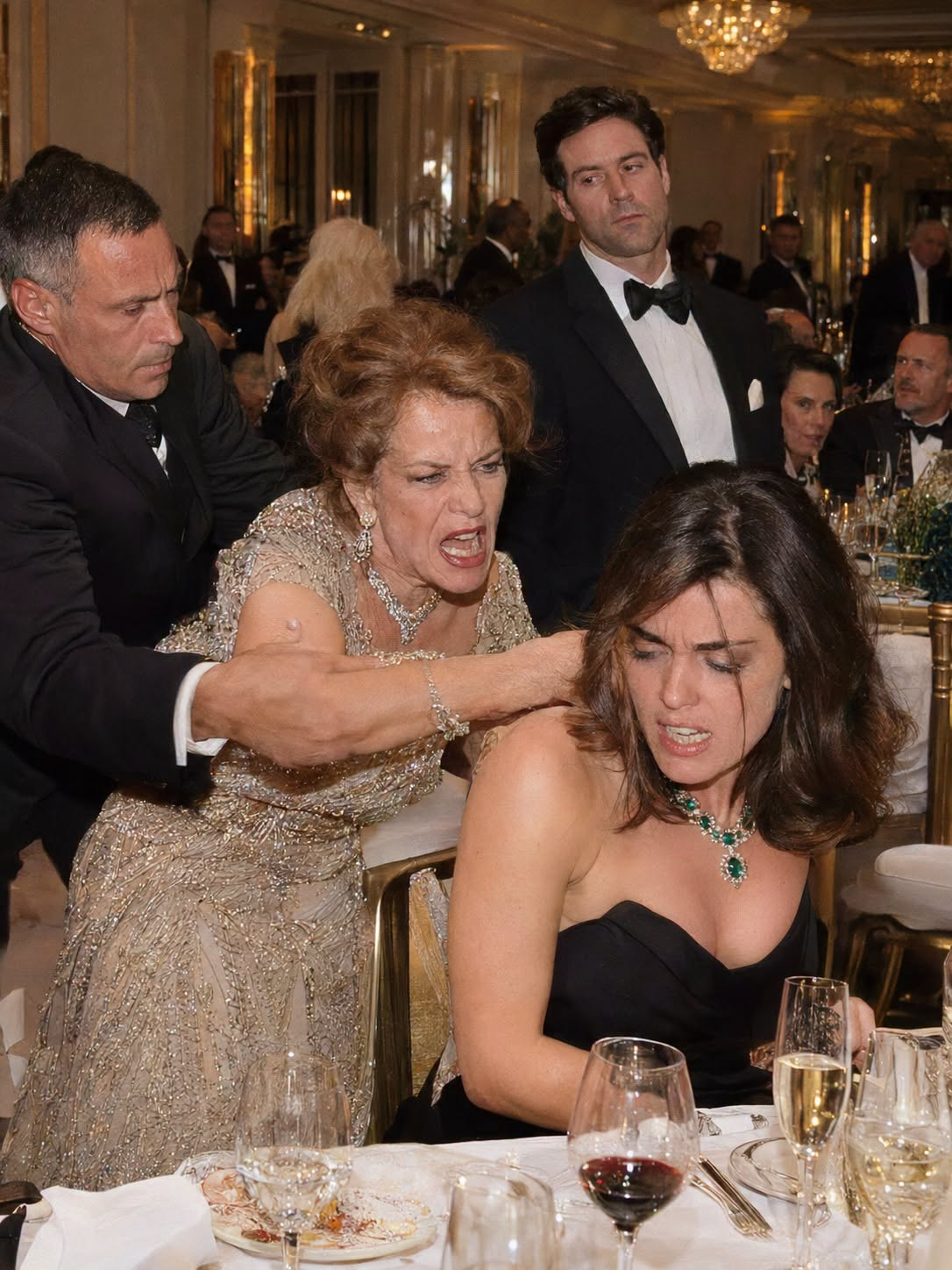
"Turn around, Isabel. You're making this difficult!" Vivian snapped as her fingers closed around the clasp behind my neck.
Marcus, the security escort, stepped forward with the necklace's custody paperwork in his hand.
One line on the document identified the owner: Teresa Navarro Family Trust.
My mother-in-law wasn't trying to borrow something that belonged to our family.
She was trying to take something that had never belonged to hers.
The realization came so quickly that I couldn't immediately find my voice.
I was sitting at a private charity dinner in Fort Lauderdale, surrounded by foundation trustees, wealthy donors, and people who had known my husband's family for decades. The room was filled with crystal chandeliers, polished silverware, and the quiet confidence of people who rarely heard the word no.
Vivian Whitcomb was standing behind my chair.
Her fingers were still touching the clasp of my grandmother's emerald necklace.
And my husband, Grant, was watching.
He didn't move.
He didn't ask his mother to stop.
He simply turned his wineglass by the stem and looked at the table.
"Ma'am, please step back," Marcus said.
His voice was calm. That was part of his job. He and his partner, Lena, were licensed escorts assigned to the necklace whenever it left secure storage. The insurance company required it because the necklace wasn't ordinary jewelry.
It belonged to my grandmother's trust.
Vivian pulled her hand away as though Marcus had insulted her.
"Tell your employees to sit down."
Marcus didn't respond.
I moved my chair several inches away from her.
"Please ask before touching me."
Vivian gave a short laugh.
"I was helping with the clasp."
"I didn't ask you to."
For a moment, neither of us spoke.
I could hear a waiter setting down a glass at the next table. Someone near the ballroom entrance laughed at a joke they hadn't realized was badly timed.
Then my father-in-law, Richard Whitcomb, leaned back in his chair.
"Different customs," he said. "Let's enjoy dinner."
Different customs.
As though taking jewelry off another woman's neck without permission were a charming family tradition.
I looked toward Grant.
He had finally stopped turning his glass.
"Grant?"
He looked up.
"What?"
I waited.
He glanced at his mother, then back at me.
"Can we not do this here?"
The words landed harder than Vivian's fingers had.
I had been married to Grant for two years. I knew how he sounded when he was embarrassed, how he sounded when he was tired, and how he sounded when he wanted me to stop making something inconvenient.
This was the third voice.
He wasn't asking his mother to behave.
He was asking me to accept her behavior quietly.
I looked down at the emerald resting against my chest.
My grandmother, Teresa Navarro, had bought the necklace after her first refrigerated warehouse finally turned a profit.
She had told me the story so many times that I could repeat every detail.
She had walked into a jewelry store wearing work boots because she hadn't planned to buy anything. The salesman had assumed she was delivering something.
When she asked to see the emeralds, he suggested a less expensive display.
Grandma had smiled.
Then she had paid for the necklace in full.
"Never let someone else decide what you're allowed to own, Isabel," she told me years later.
I was fourteen when she first let me try it on.
The necklace was too heavy for my narrow shoulders, and I kept looking at myself in the mirror.
"Do I look rich?"
Grandma laughed.
"You look like a girl wearing expensive rocks."
I had been disappointed.
She took my chin gently between her fingers.
"Money doesn't make you important. What you build with it does."
At the time, I thought she was talking about warehouses.
I understood something different now.
Across the table, Vivian was explaining to a foundation trustee that there had been a misunderstanding.
"Isabel gets terribly protective about sentimental things."
The trustee gave me an uncomfortable smile.
I returned it automatically.
That was something I had learned during two years of marriage.
When Vivian embarrassed me, I smiled.
When Richard made a cutting remark, I smiled.
When Grant explained that his parents didn't mean anything by it, I smiled.
I had become very good at making other people comfortable while they made me miserable.
The waiter returned with our main course.
I ate two bites of fish I couldn't taste.
Marcus remained nearby.
Lena stood at the doorway.
Nobody mentioned the necklace again.
That should have relieved me.
Instead, I felt as though something had shifted beneath the table and everyone else was pretending the floor was still level.
When dinner ended, I excused myself before dessert.
I had nearly reached the hallway when Richard appeared beside me.
He was sixty-eight, silver-haired, and always dressed as though he might be photographed for a financial magazine.
He had built Whitcomb Capital into a respected private investment firm.
People described him as disciplined.
I had once admired that quality.
"Isabel," he said.
I stopped.
"Richard."
He looked toward the ballroom.
"Vivian was only trying to help."
"She tried to remove my necklace."
"Your grandmother's necklace."
"Yes."
He gave a small nod.
"Family support goes both ways."
I knew exactly what he meant.
Sixteen months earlier, Richard had lent Navarro Floral Logistics six million dollars.
My company had suffered a major refrigeration failure. Three systems had been damaged, and we needed money quickly to replace equipment, rent temporary units, and keep our operations running.
Richard had offered a bridge loan through his fund.
Two years.
Nine percent interest.
It had seemed like a generous solution to a frightening problem.
Now he was mentioning it in a hallway because I wouldn't let his wife borrow jewelry.
"I appreciate what you did for the company," I said.
Richard smiled.
"Good. I would hate for you to forget."
He walked away before I could answer.
I stood there for several seconds.
Then I called Marcus and arranged for the necklace to be returned to secure storage that night.
Grant barely spoke during the drive home.
We were halfway along the interstate when he finally broke the silence.
"You could've let her borrow it."
I stared through the windshield.
"She didn't ask."
"That's how Mom asks."
I turned toward him.
"By putting her hands on me?"
He sighed.
"You're making it sound worse than it was."
"She tried to take off my necklace."
"For a portrait, Isabel. Not to sell it."
"She didn't have permission."
Grant tightened his grip on the steering wheel.
"Mom sat with you when your grandmother died. Remember that?"
I looked away.
Of course I remembered.
Five months before our wedding, Grandma had spent her final night in hospice.
Grant couldn't bear the sound of her breathing. He went home.
Vivian stayed.
She brought me coffee. She found an extra blanket. She held my hand when the nurse told me Grandma was gone.
I had never forgotten it.
For two years, I had been trying to repay that kindness.
First with the wedding Vivian wanted.
Then with a key to my house.
Then with permission to rearrange the furniture, invite guests without asking, and make decisions about my life that were none of her business.
I had mistaken gratitude for a debt without an ending.
"I remember," I said.
"Then why are you treating her like a criminal?"
"I'm asking her to respect something that belongs to my grandmother's trust."
Grant shook his head.
"Sometimes I think you care more about that company and those emeralds than you do about this marriage."
I didn't answer.
I was afraid that if I did, I would say something I couldn't take back.
We reached our house in Miami Springs shortly before eleven.
Grandma had raised me there after my mother left.
The house was older than Grant liked. He had suggested selling it several times.
I always refused.
He said I was sentimental.
Maybe I was.
But the walls held memories of someone who had never made me feel small for saying no.
Grant carried the velvet necklace case inside and placed it beside his keys.
"I'll take it over tomorrow," he said. "We can straighten this out."
I looked at the case.
"No."
He turned.
"What?"
"It goes back tonight."
"Isabel."
I took out my phone and called Marcus.
He was waiting outside to complete the return transfer.
When I opened the door, Grant followed me.
Marcus presented the custody sheet.
I checked the necklace, placed it inside the case, and signed.
Grant watched every movement.
"You trust strangers with it more than me?"
I looked at him.
"Marcus is doing the job the trust hired him to do."
Grant laughed without humor.
"Unbelievable."
Marcus accepted the case.
"Good night, Ms. Navarro."
"Good night."
I closed the door.
Grant stood in the hallway.
"Are you seriously going to sleep angry over this?"
I was exhausted.
"Yes."
I went downstairs to my old bedroom.
Grandma's brass warehouse thermometer still stood on the dresser.
Beside it was a photograph of her standing outside the original Navarro warehouse, wearing rubber boots and holding a rose with a broken stem.
Vivian had suggested moving the picture out of the living room.
She said it didn't match the new furniture.
I picked it up.
Grandma looked irritated in the photograph, as though someone had interrupted her work.
I smiled despite myself.
Then I sat on the edge of the bed and cried.
Not because of the necklace.
Because I had spent two years trying to belong to a family that seemed to consider my boundaries a personal insult.
At five the next morning, I was at Navarro Floral Logistics in Hialeah.
The warehouse smelled of cardboard, cold air, and fresh flowers.
I checked the refrigeration gauges before the loading crews arrived.
Thirty-four degrees.
Thirty-three point eight.
Thirty-four again.
The numbers steadied me.
They were honest.
A cold room either maintained its temperature or it didn't.
A shipment either arrived safely or it didn't.
There were no hidden meanings.
No guilt.
No conversations in which someone tried to convince me that what I had witnessed hadn't happened.
I walked past rows of roses waiting for delivery.
Grandma had built this company from a rented storage unit and one refrigerated truck.
By the time I inherited it, Navarro Floral Logistics served distributors throughout South Florida.
We had survived hurricanes, equipment failures, fuel-price spikes, and customers who thought flowers should arrive perfectly fresh regardless of the laws of physics.
I had helped modernize the monitoring systems and saved our largest account during a refrigeration emergency.
I knew this business.
Or at least I believed I did.
Carmen Ruiz was waiting outside my office.
She had been our controller for eleven years.
She was forty-eight, practical, and almost impossible to impress.
That morning, she looked worried.
"I need you to look at something before Grant calls," she said.
I unlocked my office.
"What's wrong?"
She followed me inside and closed the door.
Then she placed a bank statement on my desk.
One transaction had been circled in red.
September 26.
$920,000.
Harbor Mechanical Services.
I stared at the number.
"What did they do?"
"The invoice says overhaul and emergency coverage for rooms three through five."
I frowned.
"We didn't authorize an overhaul."
Carmen pulled out another sheet.
"Grant said you approved it during your Orlando trip."
My stomach tightened.
I had been in Orlando meeting distributors.
I remembered an email from Carmen about a vendor.
I hadn't opened it.
"Did anyone come to the warehouse?" I asked.
"Not that I can verify."
I looked at the statement again.
Nine hundred and twenty thousand dollars.
Nearly a million dollars had left my company.
And I hadn't known.
"You should have stopped it," I said.
Carmen straightened.
"You gave him signing authority."
The words stung.
Because they were true.
During our first Valentine's rush, Grant had offered to handle payments while I worked the loading docks.
I had made him an authorized signer.
Carmen had recommended requiring a second approval for large transactions.
I told her I trusted my husband.
Now I was looking at what that trust had cost.
"You're right," I said quietly. "I'm sorry."
Carmen nodded.
Then she placed a third document on the desk.
"Our September closing cash balance was $1.31 million."
I knew that number mattered.
I just needed a second to remember why.
Then I did.
Richard's loan required us to maintain at least $1.5 million in operating cash at the end of every quarter.
I looked from the statement to Carmen.
"Without that payment..."
"We would have cleared the covenant comfortably."
I sat down.
The office suddenly felt too warm.
Richard's loan agreement was forty pages long.
I remembered the nine percent interest.
I remembered the two-year term.
And I remembered one provision I had tried very hard not to think about.
If Navarro Floral Logistics breached the agreement and failed to cure the default, Richard's fund could demand majority ownership under the conversion clause.
I opened the bottom drawer of my desk.
The loan documents were inside.
I found the relevant page.
Read it once.
Then again.
Fifty-one percent.
I looked at Carmen.
"Who is Harbor Mechanical Services?"
She hesitated.
"That's the other reason I came in."
She opened her folder and removed a printed Florida business registration.
Harbor Mechanical Services had been formed only six weeks earlier.
Its registered agent was listed near the bottom.
I recognized the name.
The same registered agent handled filings for Richard Whitcomb's investment fund.
That didn't prove Richard owned Harbor.
It didn't prove Grant had done anything deliberately wrong.
But it was enough to make my hands go cold.
Carmen reached for another document.
"I requested the vendor information Grant submitted with the payment."
She placed it in front of me.
The invoice carried Harbor Mechanical Services' name.
Under the payment authorization was my husband's electronic approval.
And attached to the invoice was a brief internal note.
I leaned closer.
The note contained only one sentence.
It referred to the September cash requirement.
I read it twice.
Then I looked at Carmen.
"Who else has seen this?"
"Only me."
I turned the page.
There was another attachment.
A short message forwarded from an account associated with Whitcomb Capital.
The subject line was visible.
September Covenant Position.
My heart began pounding.
I clicked to open the message.
And the first name I saw was Richard Whitcomb's.






Comments 0