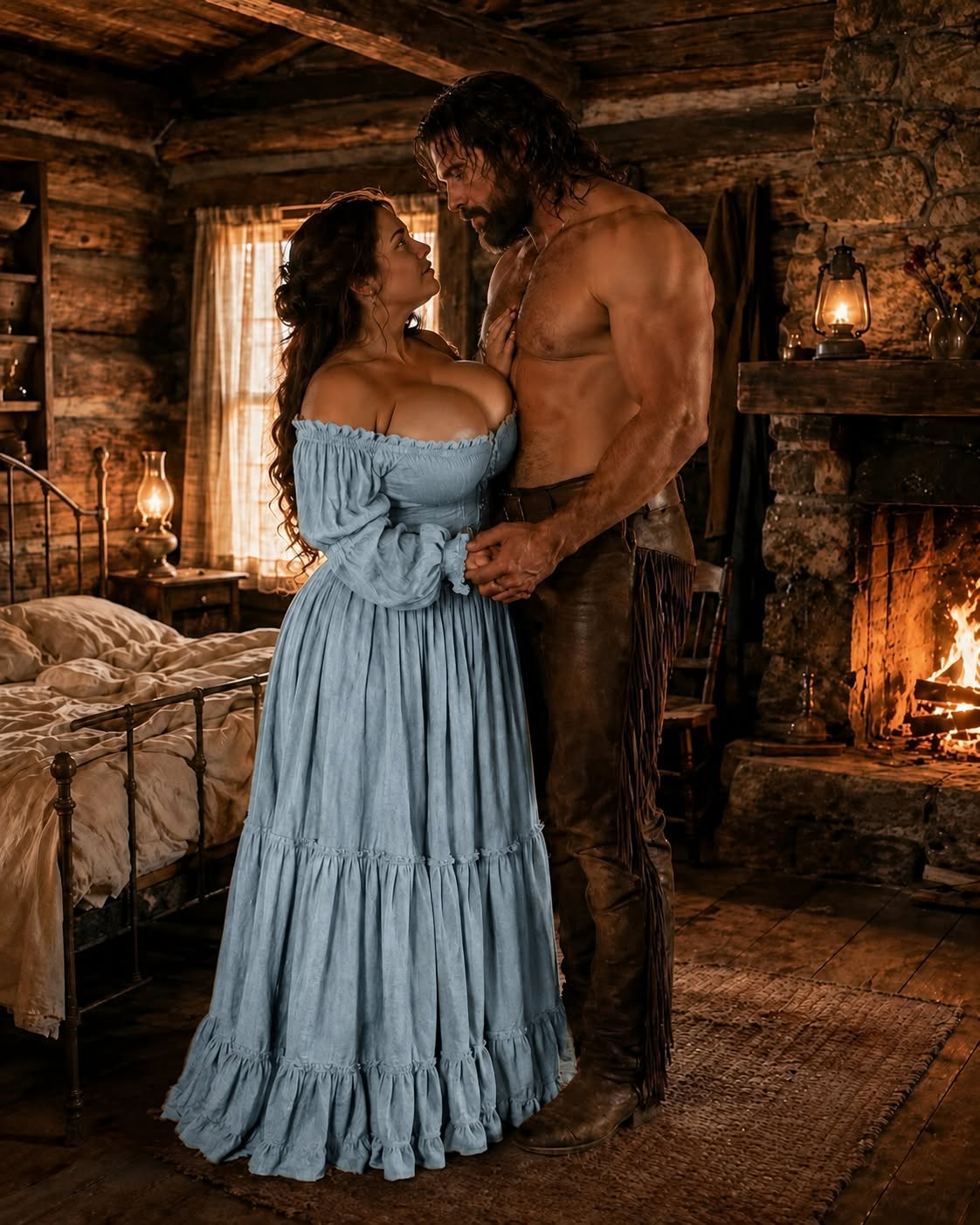
I woke up screaming beneath a stranger's roof.
"Easy. You're safe now."
When Caleb Ward approached the bed, he noticed the torn silver clasp still hanging from my frozen traveling dress.
Four tiny initials were engraved on its back.
He suddenly stopped moving.
And for the first time since rescuing me, the mountain man looked genuinely afraid.
My throat burned when I tried to speak. My entire body felt as though someone had buried me beneath a mountain of stones. I could hear a fire crackling somewhere nearby, and beneath that sound came the faint groaning of wooden walls.
I opened my eyes again.
A man stood beside my bed.
He was enormous.
Broad shoulders stretched beneath a dark green wool shirt, and a reddish-blond beard covered much of his weathered face. His sandy-blond hair was slightly disheveled, as though he had spent the entire night fighting the wilderness. His blue eyes watched me carefully.
I pulled the blanket toward my chin.
"Where am I?"
"My cabin," he answered.
His voice was deep and rough, but there was something unexpectedly gentle beneath it.
"Who are you?"
"Caleb Ward."
I tried to sit up.
Pain immediately shot through my shoulders, and the room began spinning. Caleb moved forward, but I raised one trembling hand.
"Don't."
He stopped immediately.
"All right."
That simple response confused me.
Most men I had known did not stop when a woman told them to. They laughed, argued, or reminded her that she was being unreasonable.
Caleb simply stepped back.
"You're badly exhausted," he said. "You've been unconscious for most of the night. Don't try to stand."
I swallowed.
"What happened?"
He glanced toward the small window.
"Your stagecoach went off the mountain trail during the storm."
My stomach tightened.
The stagecoach.
The passengers.
The driver.
Suddenly, fragments of the previous evening came rushing back.
The wheels had been shaking violently. Someone had shouted from the front. The horses were frightened. I remembered grabbing the seat with both hands as the carriage tilted sharply to one side.
Then came the terrible sound of wood breaking.
And darkness.
I pressed my fingers against my forehead.
"The others?"
Caleb did not answer immediately.
His silence told me enough.
"Please," I whispered. "Were there other passengers?"
He lowered his eyes.
"I found five people in that wreckage. None of them survived."
I stared at him.
Five people.
The driver, two gentlemen, and an older woman who had been traveling toward Helena.
I remembered the older woman's velvet hat. She had complained about the cold throughout the journey, but before the accident, she had offered me a peppermint from her handbag.
Now she was dead.
All of them were dead.
I turned my face toward the pillow.
For several seconds, I couldn't breathe properly.
Caleb remained beside the bed without saying anything.
He didn't tell me to stop crying. He didn't offer empty assurances that everything happened for a reason. He simply allowed the silence to remain.
Eventually, I looked at him again.
"How did you find me?"
"I was checking the northern ridge after the storm. The wreckage was buried under the snow."
"And you carried me here?"
He nodded.
"Two miles."
I looked at his large hands.
They were rough, scarred, and visibly chapped from the cold.
Two miles through a mountain storm.
Carrying a woman he had never met.
"Why?"
His expression changed slightly.
"What?"
"Why did you save me?"
Caleb looked at me as though the question itself was difficult to understand.
"Because you were alive."
I had no answer.
For most of my twenty-nine years, people had made me feel as though my existence required an explanation.
I was too large. Too awkward. Too noticeable.
My body had become the subject of jokes before I was old enough to understand why people laughed.
In the town where I grew up, children had followed me through the streets, calling me names. Women had whispered behind their fans. Men had looked through me as though I were an inconvenience.
My mother used to say that a woman's worth was not measured by the shape of her body.
But she had died when I was seventeen.
After that, I had learned to survive without expecting kindness.
And now this stranger had carried me two miles through a blizzard simply because I was alive.
I looked away before he could notice the tears gathering in my eyes.
"Thank you," I whispered.
Caleb gave a small nod.
"You're welcome."
He reached for a wooden cup sitting on the bedside table.
"Water?"
I nodded.
He helped me hold it, careful not to touch me more than necessary.
The water was cool and tasted faintly of smoke, but I drank it as though it were the finest thing I had ever been offered.
"What's your name?" he asked.
"Elizabeth."
"Elizabeth what?"
"Elizabeth Harper."
He repeated my name quietly.
Then he placed the cup down.
"Do you have family waiting for you?"
The question hurt more than I expected.
"No."
"Friends?"
I shook my head.
He studied my face.
"Nobody?"
"There was someone," I said. "But not anymore."
I did not explain.
I didn't tell him about the man who had promised to marry me before deciding that a woman like me would embarrass him in front of his business associates.
I didn't tell him about the engagement ring I had returned or the laughter I had heard from the other side of his office door.
And I certainly didn't tell him that the stagecoach journey had been my attempt to begin a new life somewhere nobody knew my name.
Caleb seemed to understand that I did not wish to speak further.
He moved toward the fireplace and adjusted a piece of wood with an iron poker.
The flames rose, sending warm light across the cabin.
Only then did I notice how beautiful the place was.
It was small, but everything had a purpose. A narrow iron bed stood near the hearth. A wooden table occupied the opposite wall. Shelves held jars, folded cloth, and several carefully arranged tools.
There was a second chair beside the fire.
An old hunting rifle rested against the wall.
Everything looked worn, but nothing looked neglected.
"How long have you lived here?" I asked.
"Eight years."
"Alone?"
"Yes."
I studied him.
"Don't you get lonely?"
He stopped moving the poker.
For a moment, he looked toward the fire rather than at me.
"Loneliness is easier than disappointment."
I understood that answer more than I wanted to.
Before I could respond, a sharp gust of wind struck the cabin.
The window rattled.
Caleb glanced toward it.
"Storm's moving east," he said. "You'll be staying here until the trail is safe."
I stiffened.
"I don't want to impose."
"You aren't."
"I can manage on my own."
He looked at me.
"You couldn't stand up five minutes ago."
My cheeks warmed.
"I'll manage."
A faint expression crossed his face, almost like amusement, although he didn't smile.
"Stubborn."
"I've been called worse."
"Probably."
For the first time, something close to a smile threatened to appear on my face.
But it disappeared when I remembered the accident.
"Did you find anything else in the wreckage?"
Caleb became still.
"What kind of thing?"
"My luggage. A small brown traveling case. It had a brass lock."
"I found several bags."
"Was mine among them?"
"I brought what I could carry."
He turned toward a corner of the cabin.
A leather satchel sat beside the wooden table. My eyes immediately recognized its brass clasp.
"My case!"
I tried to rise.
Pain shot through my legs, and I fell back against the pillows.
Caleb crossed the room in two steps.
"Don't."
"Please. That's mine."
He retrieved the satchel and placed it carefully on the bed.
My hands trembled as I opened it.
Most of my belongings were ruined. A folded dress was soaked. Several letters had become unreadable. My small purse had disappeared.
But beneath the damaged lining, I found the silver clasp that had once decorated my traveling dress.
I held it in my palm.
It was a small family keepsake, given to me by my mother before she died.
Four initials were engraved on its back.
E.H.
My name.
I turned it over and brushed away a thin layer of dirt.
Caleb was watching me.
"What's that?" he asked.
"Something my mother gave me."
He leaned slightly closer.
"May I?"
I hesitated before placing it in his palm.
His expression changed the moment he saw the engraving.
Not dramatically.
Not enough for another person to notice.
But I noticed.
His thumb stopped moving.
His eyes narrowed.
Then he looked at me.
"Where did your mother get this?"
I frowned.
"She had it before I was born."
"Do you know where she lived before?"
"Why?"
He didn't answer.
Instead, he turned the clasp over again, examining the tiny initials.
Something about his expression made my stomach tighten.
"Mr. Ward?"
"Caleb."
"What is it?"
He closed his fingers around the silver object.
"I need to ask you something."
His voice had changed.
It was no longer the quiet voice of a man comforting an injured stranger.
It sounded like someone who had just discovered an old wound reopening.
"What?"
He looked toward the wooden floor near the fireplace.
Then he walked to the far corner of the cabin and pulled a small leather bag from beneath his chair.
He opened it.
Inside were several old letters, a faded photograph, and a piece of blue ribbon.
I recognized the ribbon immediately.
It was identical to the one my mother had worn in the only photograph I possessed of her as a young woman.
My heart began pounding.
Caleb slowly removed the photograph.
He turned it toward the morning light.
Then he looked at me.
"Elizabeth," he said quietly, "I think you need to see this."
And when he placed the photograph in my trembling hands, I recognized the woman standing beside a much younger Caleb.






Comments 0