I stared at the photograph until the edges began trembling between my fingers.
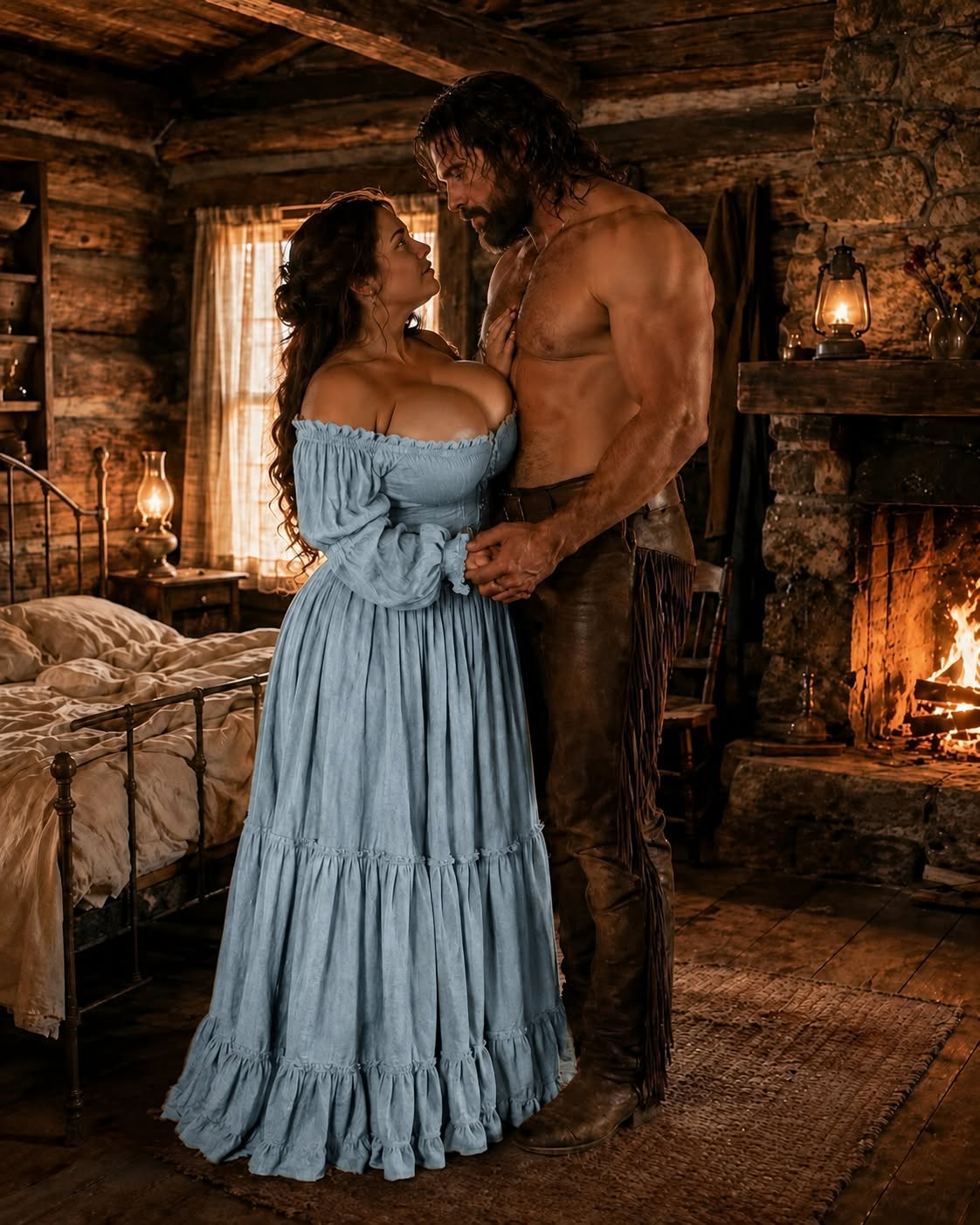
The woman standing beside the younger Caleb had dark auburn hair, bright green eyes, and a familiar expression that made my chest tighten. She wore a simple blue dress, her hands folded neatly in front of her. Even through the faded image, I recognized the delicate curve of her face.
It was my mother.
Not someone who resembled her.
Not a distant relative.
My mother.
The same woman who had raised me in a small rented house, worked herself sick to put food on our table, and died when I was seventeen.
I looked up at Caleb.
"Where did you get this?"
He didn't answer immediately.
His gaze remained fixed on the photograph.
"I found it among my father's belongings after he died."
"Your father?"
He nodded slowly.
"His name was Thomas Ward. He lived in these mountains long before I built this cabin."
I looked down again.
The young man in the photograph was unmistakably Caleb. His face was thinner, his hair shorter, and his beard hadn't yet appeared. But those blue eyes were exactly the same.
My mother stood beside him with one hand resting on his shoulder.
They looked comfortable together.
Almost happy.
"When was this taken?" I asked.
"Twenty-nine years ago."
My stomach tightened.
I was twenty-nine.
I looked at him again.
"That would have been before I was born."
"Yes."
"How did my mother know your family?"
Caleb walked toward the fireplace and placed another piece of wood among the flames.
"I was hoping you could tell me."
I shook my head.
"I don't understand."
"Neither do I."
He returned to the chair, but he didn't sit.
For several seconds, neither of us spoke.
The fire crackled between us, filling the silence with small, familiar sounds.
I studied the photograph again.
My mother had never mentioned a man named Thomas Ward. She had never spoken about Montana, the mountains, or anyone connected to this isolated cabin.
As far as I knew, she had spent most of her life in Ohio.
"Maybe it's a different woman," I whispered.
Caleb shook his head.
"I thought the same thing when I first found it."
"Then why did you keep it?"
He looked toward the photograph.
"Because my father kept it."
There was something painful in his voice.
"Did he know her?"
"I believe he did."
"Did he ever explain?"
"Not before he died."
I turned the photograph over.
The back was yellowed with age. Several handwritten words had almost disappeared, but a date remained visible.
October 14.
Beneath it were three words written in faded ink.
Keep her safe.
My fingers went cold.
"Caleb?"
He stepped closer.
"What?"
I showed him the writing.
He stared at it.
For the first time, I saw genuine uncertainty cross his face.
"I've never noticed those words."
"Who wrote them?"
"I don't know."
I placed the photograph on my lap.
"Could your father have been married to my mother?"
Caleb considered the question.
"Not that I know of."
"Was he?"
"No."
"Then why would he have a photograph of her?"
He looked at the fire.
"That's what I've been trying to understand for years."
I swallowed.
Something about his answer troubled me.
"How long have you had this photograph?"
"Eight years."
"Since you came here?"
He nodded.
I remembered his earlier words.
Eight years alone.
Eight years away from people.
Eight years living in a cabin where he kept a photograph of my mother hidden among old letters.
"Why did you leave town?" I asked.
His jaw tightened.
"That's another story."
"I think I'm entitled to some answers."
He looked at me.
For a moment, I thought he might tell me to rest and stop asking questions.
Instead, he pulled the chair closer.
"My younger brother died in a logging accident," he said. "My father blamed me because I was supposed to be watching him."
I lowered my eyes.
"I'm sorry."
"He was seventeen."
Caleb paused.
"I was twenty-four. I thought I could protect him from anything. I couldn't."
His voice remained steady, but his hands had tightened around the arms of the chair.
"After that, my father and I barely spoke. He died two years later. I sold what I could, brought my belongings here, and stayed."
"Why didn't you return?"
"Nothing was waiting for me."
I understood that feeling.
There were places in the world where a person could lose everything without anyone noticing.
I had spent much of my life in one of them.
"Perhaps," I said carefully, "your father knew my mother before you did."
Caleb studied me.
"Perhaps."
He picked up the photograph and examined it again.
Then he returned it to me.
"You should keep it."
I looked at him in surprise.
"But it's yours."
"It belonged to my father. If the woman in it was your mother, you have more right to understand it than I do."
I held the photograph against my chest.
For a moment, I felt closer to my mother than I had in twelve years.
Then I noticed something else.
The blue ribbon.
It was lying inside the leather bag, beneath the old letters.
I reached for it.
The fabric was faded and frayed at both ends.
My mother had owned a ribbon exactly like that one.
She used to tie it around her hair when she worked in the garden.
I remembered watching her knot it behind her neck while humming an old song.
My throat tightened.
"Where did this come from?"
Caleb looked down.
"It was inside the same box."
I lifted the ribbon carefully.
There was a small piece of paper folded around its center.
I unfolded it.
Only one sentence had been written there.
If the little girl ever comes looking, tell her the truth.
I stopped breathing.
A little girl.
I read the words again.
Then I looked at Caleb.
"What little girl?"
He didn't answer.
I held the paper toward him.
His expression became increasingly troubled.
"I've never seen that note before."
"You're telling me you kept all these things for eight years and never opened the ribbon?"
"I examined the box. Not every piece of fabric."
I stared at him.
"Someone knew I existed."
Caleb nodded slowly.
"That's what it looks like."
"But why would anyone expect me to come looking?"
He rubbed his beard.
"I don't know, Elizabeth."
I wanted to believe him.
But the photograph, the ribbon, and the note were too much to dismiss as coincidence.
My mother had carried secrets.
And someone in these mountains knew them.
A sudden wave of exhaustion swept through me.
I lowered the paper.
Caleb noticed immediately.
"Enough for now."
"I'm fine."
"You look like you're about to fall over."
"I've survived worse."
He raised an eyebrow.
"That doesn't mean you have to prove it."
I looked away.
He stood and walked to the small table.
A pot of broth was warming near the fireplace. He poured some into a wooden bowl and brought it to me.
"Eat."
"I'm not hungry."
"Then take a few spoonfuls."
"I don't need you ordering me around."
He paused.
Then he placed the bowl on the bedside table.
"Fair enough."
I stared at him.
He hadn't argued.
That was becoming a habit I didn't know how to understand.
Most people treated my stubbornness as an invitation to humiliate me.
Caleb seemed to consider it simply another part of who I was.
After a moment, I picked up the spoon.
The broth was warm and rich, made with vegetables and pieces of meat. I ate slowly, feeling some strength return to my body.
Caleb moved toward the window.
He looked outside.
"How far is the nearest town?" I asked.
"About eighteen miles."
"Eighteen?"
"Through the mountain trail."
I looked toward the window.
Snow covered everything.
"How long would it take to get there?"
"Normally, half a day. Right now, longer."
"When can I leave?"
"When the trail is safe."
I tightened my fingers around the spoon.
"I can't stay here indefinitely."
"You won't."
His answer was simple.
But I heard something else beneath it.
He wasn't eager to send me away.
Or perhaps he was simply being polite.
I finished the broth and set the bowl aside.
"Caleb?"
He turned.
"Yes?"
"Did you know my mother?"
He was quiet for a long moment.
"No."
"Are you sure?"
"I would remember her."
I glanced at the photograph.
"Then perhaps your father knew her."
"Perhaps."
He looked toward the leather bag.
"There's something else you should know."
I waited.
"My father wasn't an honest man in every matter."
The words surprised me.
"What do you mean?"
"He worked with several families in the valley. He bought timber, handled property agreements, and sometimes helped people who needed somewhere to stay."
"Was he wealthy?"
"Comfortably."
"Then why did he live here?"
Caleb looked around the cabin.
"Because he preferred the mountains."
I understood that.
Some people escaped to the wilderness because they loved the freedom.
Others escaped because they couldn't face the people they had hurt.
I wondered which kind of man Thomas Ward had been.
Caleb returned to the table and opened another envelope.
Inside were several handwritten pages.
He scanned them, his expression growing darker.
"What is it?" I asked.
"An old letter."
"From whom?"
He turned the paper over.
There was no signature.
He read the first few lines silently.
Then he looked at me.
"Elizabeth, I think your mother may have known my father very well."
My heart began beating faster.
"How well?"
He hesitated.
"Well enough that he wrote about her in his final letter."
"Show me."
He handed me the page.
The handwriting was uneven, but I could make out most of the words.
Thomas,
There are things I should have told you before now. The woman from Ohio came back once, but she refused to speak to anyone. She said the child was growing and that she would never allow the family to take her away.
I stopped reading.
The child.
My fingers began trembling.
I continued.
I promised I would protect them both. If anything happens to me, the truth must reach the girl before someone else finds her.
The bottom of the page was torn away.
There was no signature.
No explanation.
Only a date from nearly three decades earlier.
I lowered the letter.
"Who wanted to take me?"
Caleb took the paper back.
"I don't know."
"My mother never told me about any family trying to take me."
"Maybe she was protecting you."
"From whom?"
He looked at the window.
Outside, a branch cracked beneath the weight of the snow.
Neither of us moved.
Then Caleb walked to the leather bag and removed a small bundle of envelopes tied with string.
He placed them on the table.
"These were in my father's desk."
I stared at the bundle.
"Are they about my mother?"
"I believe so."
He untied the string.
The envelopes were old, their edges yellowed. Most bore no names, only dates.
But one had something written across the front in unmistakable handwriting.
My mother's handwriting.
I recognized the tall letters and the unusual way she crossed the letter T.
My heart stopped.
It was addressed to Thomas Ward.
And beneath his name, in smaller writing, were four words.
Regarding my daughter, Elizabeth.
I reached for it.
Caleb held the envelope for a moment longer.
"There's something you should understand."
"What?"
He looked directly into my eyes.
"My father kept this locked away. He never wanted anyone to find it."
I stared at the envelope.
"Then we should open it."
Caleb slowly broke the brittle seal.
He unfolded the letter.
His eyes moved across the first line.
Then the second.
Suddenly, his expression changed.
He looked at me, then back at the page.
"Elizabeth..."
His voice was barely audible.
"What?"
He turned the letter toward the light.
And when he reached the final paragraph, his hand began to shake.
Because the first sentence contained a name I had spent my entire life believing belonged to a dead man.






Comments 0