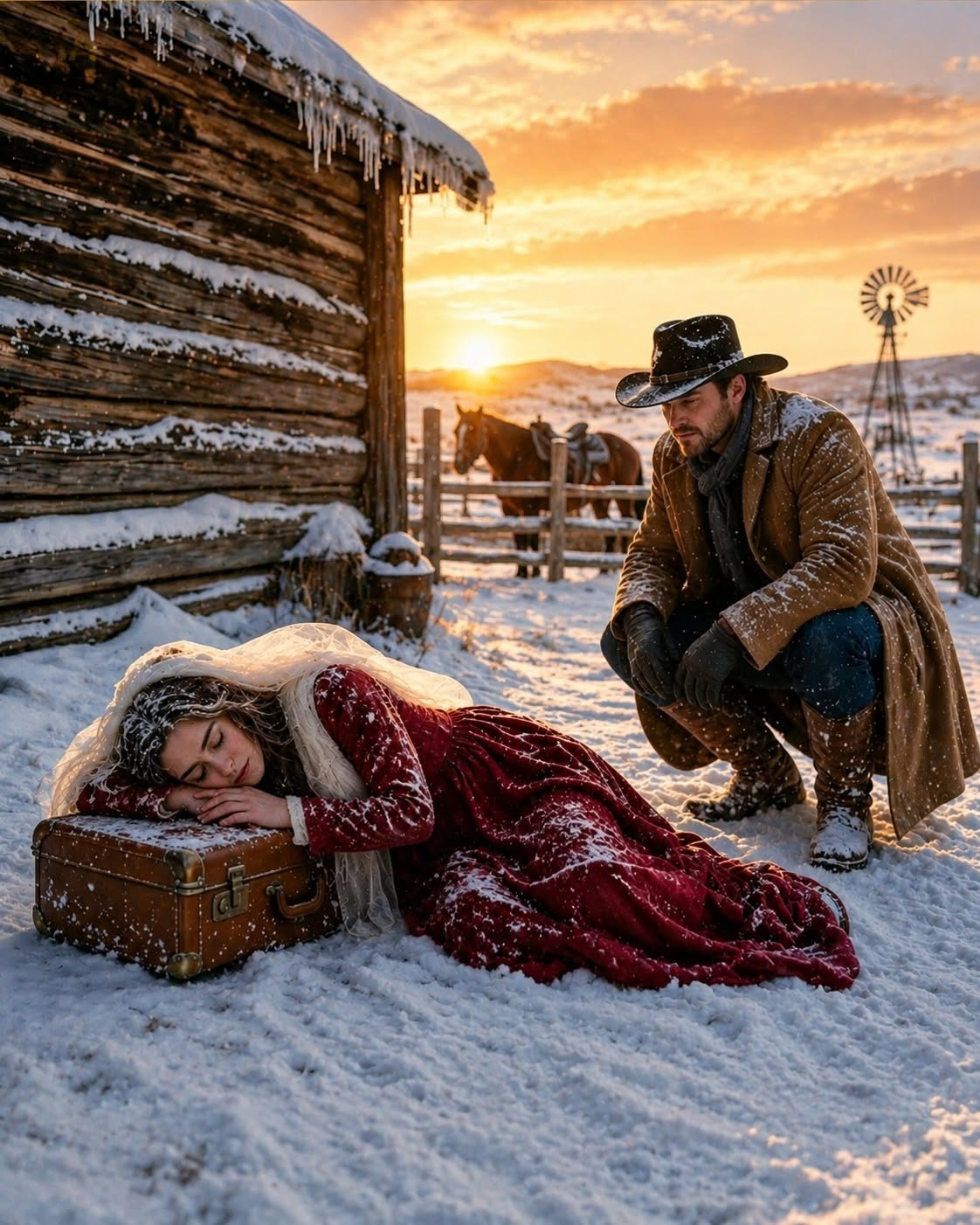
Wyatt Thorne carried me through the front door before I could lose consciousness completely.
I remembered the sound of the door slamming against the wind. I remembered the warmth of the fireplace touching my face. Then I remembered a man's voice telling me not to close my eyes.
"Rosemary. Stay with me."
I tried.
God knew I tried.
But my body seemed to belong to someone else. My legs would not move, my fingers felt like pieces of wood, and every breath seemed to require more strength than I had left.
Wyatt lowered me carefully onto a thick wool blanket beside the fireplace.
"Don't try to stand."
I blinked at him.
He was removing his gloves.
"Can you hear me?"
"Yes," I whispered.
"Good. Keep talking."
He pulled another blanket from a wooden chest and wrapped it around my shoulders. Then he placed a small cushion beneath my head.
The cabin smelled of burning pine, leather, and something warm that reminded me of freshly baked bread.
For the first time in what felt like hours, I was no longer fighting the wind.
I wanted to close my eyes.
Wyatt noticed immediately.
"Not yet."
His voice was firm but not unkind.
"Look at me, Miss Caldwell."
I forced my eyes open.
He crouched beside me and examined my hands.
"Your gloves are soaked."
He carefully removed them.
I winced.
The movement hurt more than I expected.
"Easy," he said. "We need to get you warm gradually."
He placed my hands near the fireplace without allowing them to touch the hot stones. Then he brought a basin of lukewarm water and several clean cloths.
I watched him move around the room.
He did not appear to be a man accustomed to caring for guests.
His movements were awkward in certain ways, as though he was more comfortable repairing fences or handling horses than tending to a half-frozen woman.
Yet he seemed to understand that rushing would make things worse.
"Did you travel all the way from Boston alone?" he asked.
I nodded.
"Since Helena?"
"Yes."
He looked at me.
"How long were you outside?"
"I don't know."
"Twenty minutes? An hour?"
"I don't know."
He stopped working.
"Rosemary, I need you to tell me something. Did the driver leave you at the road, or did he bring you all the way to the ranch entrance?"
"He left me near the north pasture."
Wyatt's expression tightened.
"Near the north pasture?"
I nodded.
"Then you walked the rest?"
"Three miles."
He looked toward the window.
The storm was still raging outside.
For several seconds, he said nothing.
Then he returned his attention to me.
"That man had no business leaving you there."
I wanted to agree.
Instead, I asked the question that had been bothering me since the stagecoach disappeared.
"Why did he call you Mercer?"
Wyatt's hands stopped.
The silence that followed was different from the others.
It was not the silence of a man thinking about what to say.
It was the silence of a man deciding what not to say.
Finally, he pulled a chair closer.
"Mercer was my mother's maiden name."
I stared at him.
"Your mother's?"
"Yes."
"Why would the driver know that?"
Wyatt leaned back.
"That's what I'd like to find out."
I studied his face.
His expression had become unreadable.
He was looking at me, but his thoughts seemed to be somewhere beyond the walls of the cabin.
"Did you know him?" I asked.
"No."
"Are you certain?"
His eyes returned to mine.
"Have I given you a reason to doubt me?"
The question was gentle, but it caught me off guard.
I looked down.
"No."
He exhaled.
"Then let's take this one thing at a time."
He stood and walked toward the stove.
"First, you need something warm to drink."
I watched him fill a kettle.
The cabin was larger than I had imagined from the outside.
A stone fireplace occupied one wall. A heavy wooden table stood near the center of the room. Several shelves held books, folded blankets, and small metal containers.
There was a rifle mounted above the fireplace.
A pair of worn riding boots sat beside the back door.
Everything appeared practical.
Nothing seemed decorative.
Except for a small framed photograph on the mantel.
I turned my head toward it.
A woman stood beside a young boy.
The woman had dark hair and a serious expression. The boy was perhaps twelve years old.
I wondered whether he was Wyatt.
"That's my mother," Wyatt said behind me.
I turned.
He was holding a tin cup.
"And the boy?"
"Me."
I looked again.
"You were very young."
"Long time ago."
He handed me the cup.
I held it carefully between my hands.
The liquid smelled of herbs and honey.
"Drink slowly."
I took a small sip.
It tasted sweet.
For several minutes, neither of us spoke.
The warmth began returning to my fingers, bringing with it a painful tingling sensation.
I looked at the photograph again.
"Your mother was beautiful."
Wyatt glanced toward it.
"She was."
"Is she still alive?"
He shook his head.
"No."
"I'm sorry."
"She died when I was twenty."
I lowered my eyes.
There was something about the way he spoke that made me understand the subject was not easy for him.
I did not ask another question.
Instead, I looked around the room.
"Is this where you live alone?"
"Most of the time."
"Most of the time?"
"I spend plenty of nights out with the cattle. Sometimes I stay in the north bunkhouse during roundup."
He moved another piece of wood into the fireplace.
"Winters are quieter."
I nodded.
Then, remembering why I had come, I placed the cup on the small table.
"Mr. Thorne..."
"Wyatt."
I hesitated.
"Wyatt, I want to apologize."
He turned toward me.
"For what?"
"For arriving like this."
He stared at me as though I had said something completely unreasonable.
"Like what?"
"Half-frozen. Without proper notice. With a ruined dress and a suitcase covered in snow."
He slowly put down the piece of wood.
"Rosemary, you walked three miles through a blizzard."
"I know."
"Because a man abandoned you in the wilderness."
"I know."
"And you're apologizing to me?"
I looked at my hands.
"I didn't want our first meeting to be like this."
For the first time, something softened in his expression.
He pulled the chair closer.
"I had imagined it differently too."
I looked up.
He gave a small, almost embarrassed smile.
"I thought you'd arrive on a clear afternoon. I'd meet you at the gate. We'd have coffee, and I'd show you the house."
He glanced at the fireplace.
"I even repaired the guest room floor because one of the boards made a terrible noise."
Despite my exhaustion, I almost smiled.
"That was thoughtful."
"I wasn't sure whether you'd notice."
"I probably would have."
He nodded.
For a brief moment, the tension in the room seemed to disappear.
Then he looked at me more seriously.
"Can I ask you something?"
"Of course."
"Did you receive all three of my letters?"
I nodded.
"Every one."
"Did you bring them?"
"They're in my suitcase."
He looked toward the door.
"The suitcase outside?"
I nodded.
His expression changed.
"I should have brought it in."
"You were carrying me."
"That doesn't make leaving your belongings in a blizzard any smarter."
He stood.
"I'll get it after I make sure you're settled."
I reached for his sleeve.
"Please don't go outside."
He looked down at my hand.
The gesture surprised me.
I quickly released him.
"Sorry."
"Don't apologize."
He lowered himself into the chair again.
"I wasn't planning to leave you alone for long."
I studied his face.
There was something reassuring about his voice.
Not romantic.
Not yet.
Just steady.
And after the journey I had endured, steadiness felt more precious than anything.
"How long have you been waiting?" I asked.
"Three months."
"Exactly three?"
"Almost."
He leaned forward.
"I received your acceptance letter in September. I started preparing the house the following week."
I looked around.
"You prepared all this for me?"
"Most of it."
He pointed toward the staircase.
"There's a room upstairs with a window overlooking the north pasture. I had new curtains made. Put a proper mattress in the bed. Repaired the fireplace."
I stared at him.
"You did all that?"
"Didn't seem right to invite a woman to share my life and then give her a room that looked like a storage closet."
My throat tightened unexpectedly.
Nobody had prepared a room for me in a very long time.
In Boston, every place I had lived had been temporary.
A rented room.
A boardinghouse.
A corner of someone else's apartment.
I had never imagined that a man I had never met would repair a floorboard because he wanted me to feel comfortable.
"Thank you," I whispered.
Wyatt nodded.
Then he looked toward the windows again.
The wind pushed against the cabin.
A faint cracking sound came from somewhere outside.
I flinched.
"Just the shutters," he said.
I nodded.
He stood and crossed the room.
He checked the wooden latch.
Then he looked through a narrow gap in the curtain.
"What is it?" I asked.
"Nothing."
He closed the curtain.
But I had noticed his expression.
He looked concerned.
"Wyatt?"
He turned.
"Yes?"
"The tracks."
His face became still.
"What tracks?"
"Outside. Near the fence."
I remembered seeing them before I collapsed.
They were clear in my mind.
"Someone had been riding toward the ranch."
He walked back toward the fireplace.
"Yes."
"Was it the stagecoach?"
"No."
"How can you tell?"
"The horses pull differently. The tracks I saw were made by a single riding horse."
He looked at me carefully.
"Did you see anyone following you?"
I tried to remember.
The storm had been so thick that I could barely see the fence.
"No."
"Did the driver stop anywhere?"
"Once. Near Helena."
"Did anyone speak to you?"
"No."
He frowned.
"Did you leave your suitcase unattended?"
I thought about it.
"Only when I went to buy bread at the station."
"Where?"
"Helena."
He nodded slowly.
"How long were you gone?"
"Perhaps ten minutes."
Wyatt said nothing.
I remembered something.
"There was a man near the coach."
He looked at me.
"What man?"
"I don't know. He was wearing a dark coat. He spoke with the driver."
"When?"
"Before we left Helena."
"What did he look like?"
I closed my eyes.
I could almost see him.
"He was tall. I think he had a scar near his chin."
Wyatt's jaw tightened.
"Did you hear what they said?"
"No. I was too far away."
He turned toward the stove.
For a moment, he seemed to be fighting with his own thoughts.
Then he asked, "Rosemary, did anyone in Boston know you were coming here?"
"My landlady knew."
"Anyone else?"
"The woman who arranged the correspondence."
"What woman?"
"Mrs. Eleanor Whitcomb. She handled the marriage advertisement."
Wyatt turned around.
"Whitcomb?"
I nodded.
"She worked with the newspaper office. She helped arrange the letters and passage."
He stared at me.
"Did you meet her in person?"
"Twice."
"Did she know the date of your departure?"
"Yes."
"Did she know the route?"
"Yes."
He rubbed his beard.
"Did she give you the name of the stagecoach company?"
"She arranged the ticket."
A long silence followed.
Then Wyatt asked another question.
"Did she ever mention the Mercer family?"
I shook my head.
"No. Why?"
He did not answer immediately.
Instead, he walked toward the mantel and picked up the photograph.
He studied it.
Then he placed it back.
"My mother was a Mercer before she married my father."
"I remember."
"Her family owned land east of here. A considerable amount of land."
I waited.
"After my father died, my mother sold most of her share. There were disagreements about the property."
"What kind of disagreements?"
"Family disagreements."
He spoke the words carefully.
"Some people believed she had given away more than she was entitled to."
I looked at him.
"Did they threaten her?"
"Not openly."
He glanced at the window.
"At least, not while I was around."
I felt a chill that had nothing to do with the weather.
"Do you think the driver knew about your family?"
"I don't know."
"Then why did he mention the name?"
Wyatt looked at me.
"That's what worries me."
He walked toward the back door.
"I'll get your suitcase when the wind settles."
I looked down at my dress.
The fabric was wet around the hem.
My boots were covered in snow.
I felt embarrassed all over again.
"I must look terrible."
Wyatt turned.
"You look like someone who survived something she shouldn't have had to survive."
I could not think of an answer.
He moved toward the staircase.
"There's a spare room downstairs. I'll bring you some dry clothes."
"Thank you."
He disappeared into a small adjoining room.
I sat quietly beside the fireplace.
For the first time since leaving Boston, I allowed myself to imagine that I might actually be safe.
The thought was almost frightening.
I had spent so much time preparing for disappointment that hope felt unfamiliar.
I looked toward the photograph.
The woman beside the young Wyatt had one hand resting on his shoulder.
She looked strong.
I wondered what kind of mother she had been.
I wondered whether she would have liked me.
Then my eyes moved toward the front door.
Wyatt had mentioned that he had been waiting three months.
Three months.
I had received his last letter just before leaving Boston.
He had written about the ranch, the weather, and the repairs.
But there was something else.
A sentence near the bottom of the page.
He had written:
"If anything changes with your journey, please send word directly to me. Do not rely on anyone else to speak on your behalf."
At the time, I had thought it was simply a practical instruction.
Now I wondered why he had included it.
Wyatt returned carrying a folded bundle of clothing.
"I found something that should fit."
He placed it beside me.
A dark blue wool dress.
A cream-colored blouse.
Thick knitted stockings.
"They belonged to my sister," he explained. "She hasn't lived here for years, but I kept some of her things."
I touched the fabric.
"They're beautiful."
"They're warm."
He glanced toward the fireplace.
"You can change in the room beside the kitchen. I'll wait here."
I nodded.
As I stood, my knees trembled.
Wyatt reached out instinctively, then stopped before touching me.
"Easy."
I held the edge of the chair.
"I can manage."
"I believe you."
He stepped aside.
I walked slowly toward the adjoining room.
The dress was much too large around the waist, but it felt wonderful against my skin.
When I returned, Wyatt had placed a bowl of soup on the table.
"Chicken and barley," he said.
"I made it this morning."
I sat down.
The first spoonful nearly brought tears to my eyes.
It was not the taste.
It was the realization that someone had prepared food without expecting me to pay for it.
Wyatt sat opposite me.
"Eat as much as you can."
I nodded.
For a while, we spoke about ordinary things.
He told me that the ranch raised cattle and horses.
He explained that the nearest town was several miles away.
He described the winter chores and the difficult spring thaw.
I asked about the house.
He told me the original structure had belonged to his father.
I asked whether he had always wanted to be a rancher.
He shrugged.
"Didn't know there was another choice."
I found myself listening to his voice more than his words.
He did not speak like the men I had known in Boston.
He did not seem interested in impressing me.
He simply answered questions.
And when I asked about something he did not want to discuss, he said so.
It was strangely comforting.
When I finished the soup, he collected the bowl.
"You're going to rest now."
"I don't want to be a burden."
He looked at me.
"Rosemary, I have forty acres of land, a barn full of animals, and a roof that needs repairing every spring. I can survive one extra person in the house."
I almost smiled.
He noticed.
For the first time, his own expression softened.
"There's that."
"What's that?"
"Proof you're still alive."
I lowered my eyes.
He walked toward the staircase.
"Your room is ready."
I followed him slowly.
The upstairs hallway was narrow, with polished wooden floors and several framed photographs.
At the end stood a white-painted door.
Wyatt opened it.
The room was simple but lovely.
A large bed stood against the far wall.
There was a small writing desk beneath the window, a wooden wardrobe, and a braided rug beside the bed.
A vase held dried wildflowers.
A folded quilt lay at the foot of the mattress.
I stopped in the doorway.
"You really prepared this for me."
Wyatt nodded.
"I did."
I walked toward the desk.
There was a small envelope resting beside an oil lamp.
My name was written across it.
Rosemary Caldwell.
I turned toward him.
"What's this?"
He looked at the envelope.
His expression changed.
"I don't know."
I picked it up.
The handwriting was not his.
I was certain of that.
The letters were narrow and slightly slanted.
My fingers tightened around the paper.
"Did someone put this here?"
Wyatt stepped closer.
"I haven't seen it before."
I turned the envelope over.
There was no stamp.
No return address.
Only a small mark pressed into the wax seal.
A letter M.
My stomach tightened.
Wyatt stared at it.
For several seconds, he did not speak.
Then he reached for the envelope.
"Don't open that yet."
I looked at him.
"Why?"
He examined the wax.
His face had gone pale.
"Because I recognize this seal."
He turned the envelope toward the light.
And beneath the letter M, I noticed something I had not seen before.
A tiny engraved symbol.
A black horse.
Wyatt took one step backward.
Then he whispered a name.
"Mercer."
Before I could ask what he meant, a sudden pounding shook the front door downstairs.
Three knocks.
A pause.
Then three more.
Wyatt immediately moved toward the staircase.
I remained beside the desk, holding the sealed envelope.
A man's voice came through the door.
"Thorne! Open up!"
Wyatt stopped halfway down the stairs.
His face changed.
He knew that voice.
Then the stranger spoke again.
"Bring the Boston girl downstairs. We need to talk about what happened on the road."
Strengthen my chapter’s physical continuity Bring my chapter closer to 2000 words






Comments 0